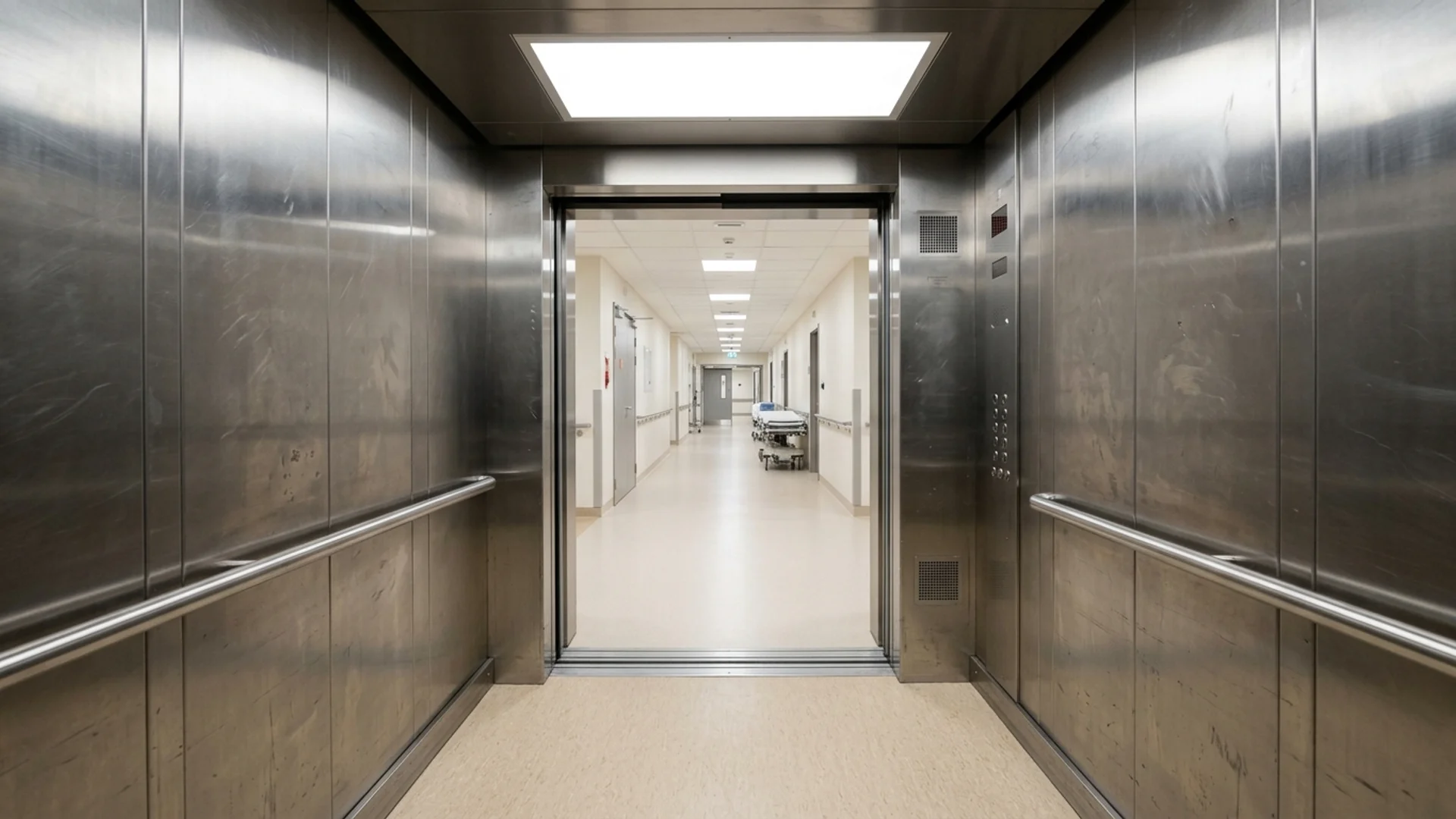
Stretcher Lift Specifications & Compliance in Australia
A stretcher lift is defined by its car: deep enough to take an ambulance stretcher or hospital bed plus the attendants and equipment that travel with it. Here are the internal dimensions, door width, rated capacity, the building classes that trigger one, and the AS 1735 and NCC references that govern it.
The stretcher sets the car size
A car of about 1,600 mm x 2,400 mm with a 1,300 mm clear door takes an ambulance stretcher or occupied bed plus attendants — far larger than the 1,100 mm x 1,400 mm accessible passenger minimum.
Capacity of 1,600–2,500 kg
A stretcher lift is rated well above a passenger car so it can carry the bed, the patient, attendants, and equipment together without approaching its limit.
The NCC decides when one is required
NCC Volume One triggers a stretcher-facility lift in Class 9a health-care buildings and other cases above set effective heights. A certifier confirms the trigger for your building.
Stretcher lift is not a bed lift by accident
The terms overlap, but a bed lift is sized for a hospital bed on a ward, while a stretcher-facility lift is the NCC term for the ambulance-stretcher-capable lift a building must provide.
A stretcher lift — also called a stretcher-facility lift or bed lift — needs an internal car of roughly 1,600 mm wide by 2,400 mm deep, a clear door opening of about 1,300 mm, and a rated capacity in the order of 1,600–2,500 kg. Those numbers exist for one reason: a full-length ambulance stretcher or occupied hospital bed, roughly 600 mm by 2,000 mm on its own, has to enter the car with a paramedic or nurse at the head and equipment alongside. A standard accessible passenger lift — about 1,100 mm by 1,400 mm with a 900 mm door — cannot do that.
The requirements are spread across three documents that never sit in one place: NCC Volume One decides when a stretcher-facility lift is required, the AS 1735 lift series sets the engineering and access rules, and the Australasian Health Facility Guidelines set the clinical sizing for hospitals and aged-care buildings. This page brings the dimensions, capacity, and building triggers together for health and aged-care operators, developers, and facility managers specifying a lift.
Treat every figure here as an indicative minimum, not a substitute for the code. Confirm the required car size and the building class trigger with a building certifier and, for a health facility, against the Australasian Health Facility Guidelines and the clinical brief before the shaft is designed.
What size is a stretcher lift, and why?
The governing object is the stretcher itself. An ambulance stretcher or trolley is roughly 600 mm wide and up to 2,000 mm long, and it almost never travels alone — a paramedic guides the head, a second attendant the foot, and an IV pole, oxygen cylinder, or monitor moves with it. To take that safely a stretcher lift needs an internal car of about 1,600 mm wide by 2,400 mm deep, a clear door opening of around 1,300 mm, and a rated capacity of 1,600–2,500 kg. The car depth is the number that matters most: at roughly 2,400 mm it lets a full-length stretcher sit square in the car with a person at each end, where a 1,400 mm passenger car simply cannot close its doors on an occupied stretcher.
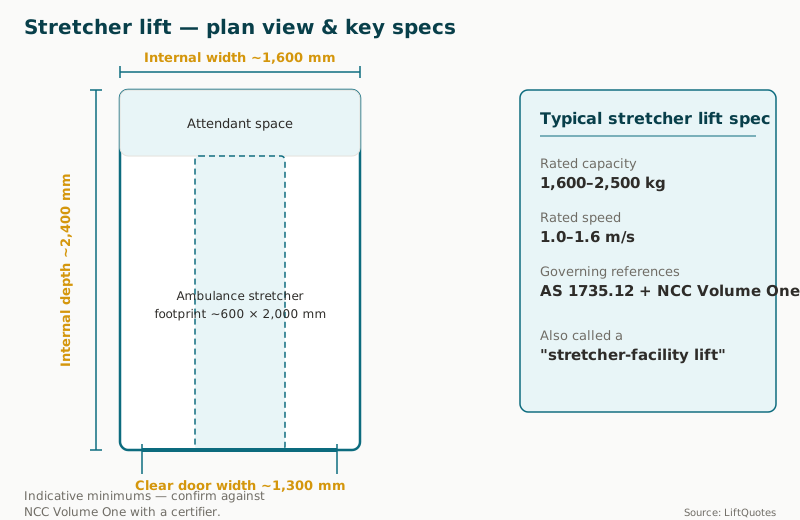
Those dimensions are indicative minimums. The hospital and healthcare lift requirements guide covers the redundancy, standby power, and infection-control finishes that sit on top of the raw sizing in an acute setting, and the Australasian Health Facility Guidelines set the clinical planning dimensions for each facility type. Because the car size drives the shaft, pit, and headroom the structure has to accommodate, fix the target car dimension against the guidelines and your clinical brief before the commercial lift shaft is designed — enlarging a car after the shaft is poured is expensive.
Which buildings are required to have a stretcher lift?
Whether a building must provide a stretcher-facility lift is set by NCC Volume One, and it turns on the building class and, in some cases, the effective height. Class 9a health-care buildings — hospitals, day-procedure and similar clinical settings — are the clearest case: where a lift is provided to connect the patient floors, at least one is generally required to be stretcher-capable so a patient can be moved between levels on a stretcher or bed. Class 3 and Class 9c residential aged-care buildings need at least one lift able to take a resident on a bed or trolley for ambulance transfers, even where the redundancy expectations are lower than an acute hospital.
The NCC also sets when any accessible lift is required at all, largely by effective height and the number of storeys served — the NCC lift requirements guide sets that out in plain English. The precise stretcher-facility trigger for a specific project depends on the building class, the storeys connected, and whether the work is a new build or an alteration, so confirm it with a building certifier at concept stage. LiftQuotes does not provide compliance advice — verify the current requirement against NCC Volume One through the ABCB and your certifier.
Stretcher lift vs bed lift vs passenger lift
The three terms are used loosely, and the distinction is worth getting right in a specification. A passenger lift — including a standard accessible lift to AS 1735.12:2020 — is sized for people standing or a wheelchair with an assisting carer: about 1,100 mm x 1,400 mm, a 900 mm door, and 630–1,000 kg. A bed lift is the everyday term for a car sized to carry an occupied hospital bed on a ward, sharing the deep-car geometry of a stretcher lift. A stretcher-facility lift is the NCC term for the ambulance-stretcher-capable lift a building is required to provide — the compliance object, whether or not the building ever calls it a bed lift day to day.
In practice a single deep car of about 1,600 mm x 2,400 mm satisfies both the clinical bed-lift function and the NCC stretcher-facility requirement, which is why the specifications converge. What separates them is intent: a bed lift is described by what it carries, a stretcher-facility lift by the code obligation it discharges. When writing a lift brief, name the NCC requirement explicitly so the tender is priced against the compliance object, not just a large passenger car.
Which standards and references apply?
A stretcher lift answers to the lift standards and the building code together. The AS 1735 lift series — headed for accessibility by AS 1735.12:2020, lifts for persons with disabilities — sets the engineering, safety, and access requirements for the lift itself, the same series that underpins the Australian lift standards that govern any commercial installation. NCC Volume One determines when a lift, and specifically a stretcher-facility lift, is required, and references the AS 1735 series for how it must perform. For hospitals and aged-care buildings, the Australasian Health Facility Guidelines add the clinical planning layer — lift numbers, which cars must be stretcher-capable, and how they are separated for infection control.
Cite each document by its correct designation in the specification — 'AS 1735.12:2020' and 'NCC Volume One', not 'the lift standard' — and verify the current versions with Standards Australia and the ABCB before the brief is issued. Standards and NCC editions are updated on their own cycles, and a stretcher-facility requirement written against a superseded edition can miss a change in the trigger or the referenced performance clause.
If you are specifying a stretcher or bed lift for a hospital, day-procedure centre, or aged-care facility, confirm the car size and the NCC trigger with your certifier, then price it against the wider hospital and healthcare lift requirements rather than a standard passenger car. Get free quotes from qualified Australian lift installers who work to AS 1735 and the health facility guidelines to compare specifications, lead times, and installed cost.
Lift companies in Australia
Browse profiles, compare service areas, and check reviews.

Lift Shop
★ 5.0 (1551 reviews)
Australia's largest dedicated home lift specialist since 1996. 10,000+ installations. Exclusive Italian-crafted lifts with industry-leading 8-year warranty.
View profile →

Compact Home Lifts
NDIS★ 5.0 (465 reviews)
Melbourne branch of Compact Home Lifts. Compact residential lift specialist providing maintenance and repair services across Victoria.
View profile →

Next Level Elevators
★ 5.0 (454 reviews)
Award-winning provider of premium Italian-designed all-electric home elevators. Certified Eltec Partner. Showrooms in Melbourne, Sydney, and Brisbane.
View profile →

Shotton Lifts
NDIS★ 5.0 (9 reviews)
Family-owned Australian lift manufacturer since 1977. 80+ staff. Design, engineer, manufacture, install and service from Dandenong South VIC. NDIS registered.
View profile →

LiftFit Australia
NDIS★ 5.0 (8 reviews)
Victoria-based NDIS registered lift provider, est. 2011. Partners with Cibes, Savaria, and Kalea. Residential, commercial, and platform lifts.
View profile →

Easy Living Home Elevators
★ 5.0 (7 reviews)
Australia's #1 home elevator supplier since 1998. 100% Australian-owned. 11,000+ elevators in service across 6 states.
View profile →
LiftQuotes is a comparison platform. Companies shown are filtered by relevance to this page. Listing does not imply endorsement. LiftQuotes may receive a referral fee when you request quotes.
Put this into action
When you're ready to move forward, get free quotes from verified Australian lift installers.
What are you looking for today?
I need a lift installed
I have a lift that needs attention
A stretcher lift — also called a stretcher-facility lift or bed lift — needs an internal car of roughly 1,600 mm wide by 2,400 mm deep, a clear door opening of about 1,300 mm, and a rated capacity in the order of 1,600–2,500 kg. Those numbers exist for one reason: a full-length ambulance stretcher or occupied hospital bed, roughly 600 mm by 2,000 mm on its own, has to enter the car with a paramedic or nurse at the head and equipment alongside. A standard accessible passenger lift — about 1,100 mm by 1,400 mm with a 900 mm door — cannot do that.
The requirements are spread across three documents that never sit in one place: NCC Volume One decides when a stretcher-facility lift is required, the AS 1735 lift series sets the engineering and access rules, and the Australasian Health Facility Guidelines set the clinical sizing for hospitals and aged-care buildings. This page brings the dimensions, capacity, and building triggers together for health and aged-care operators, developers, and facility managers specifying a lift.
Treat every figure here as an indicative minimum, not a substitute for the code. Confirm the required car size and the building class trigger with a building certifier and, for a health facility, against the Australasian Health Facility Guidelines and the clinical brief before the shaft is designed.
What size is a stretcher lift, and why?
The governing object is the stretcher itself. An ambulance stretcher or trolley is roughly 600 mm wide and up to 2,000 mm long, and it almost never travels alone — a paramedic guides the head, a second attendant the foot, and an IV pole, oxygen cylinder, or monitor moves with it. To take that safely a stretcher lift needs an internal car of about 1,600 mm wide by 2,400 mm deep, a clear door opening of around 1,300 mm, and a rated capacity of 1,600–2,500 kg. The car depth is the number that matters most: at roughly 2,400 mm it lets a full-length stretcher sit square in the car with a person at each end, where a 1,400 mm passenger car simply cannot close its doors on an occupied stretcher.
Those dimensions are indicative minimums. The hospital and healthcare lift requirements guide covers the redundancy, standby power, and infection-control finishes that sit on top of the raw sizing in an acute setting, and the Australasian Health Facility Guidelines set the clinical planning dimensions for each facility type. Because the car size drives the shaft, pit, and headroom the structure has to accommodate, fix the target car dimension against the guidelines and your clinical brief before the commercial lift shaft is designed — enlarging a car after the shaft is poured is expensive.
Which buildings are required to have a stretcher lift?
Whether a building must provide a stretcher-facility lift is set by NCC Volume One, and it turns on the building class and, in some cases, the effective height. Class 9a health-care buildings — hospitals, day-procedure and similar clinical settings — are the clearest case: where a lift is provided to connect the patient floors, at least one is generally required to be stretcher-capable so a patient can be moved between levels on a stretcher or bed. Class 3 and Class 9c residential aged-care buildings need at least one lift able to take a resident on a bed or trolley for ambulance transfers, even where the redundancy expectations are lower than an acute hospital.
The NCC also sets when any accessible lift is required at all, largely by effective height and the number of storeys served — the NCC lift requirements guide sets that out in plain English. The precise stretcher-facility trigger for a specific project depends on the building class, the storeys connected, and whether the work is a new build or an alteration, so confirm it with a building certifier at concept stage. LiftQuotes does not provide compliance advice — verify the current requirement against NCC Volume One through the ABCB and your certifier.
Stretcher lift vs bed lift vs passenger lift
The three terms are used loosely, and the distinction is worth getting right in a specification. A passenger lift — including a standard accessible lift to AS 1735.12:2020 — is sized for people standing or a wheelchair with an assisting carer: about 1,100 mm x 1,400 mm, a 900 mm door, and 630–1,000 kg. A bed lift is the everyday term for a car sized to carry an occupied hospital bed on a ward, sharing the deep-car geometry of a stretcher lift. A stretcher-facility lift is the NCC term for the ambulance-stretcher-capable lift a building is required to provide — the compliance object, whether or not the building ever calls it a bed lift day to day.
In practice a single deep car of about 1,600 mm x 2,400 mm satisfies both the clinical bed-lift function and the NCC stretcher-facility requirement, which is why the specifications converge. What separates them is intent: a bed lift is described by what it carries, a stretcher-facility lift by the code obligation it discharges. When writing a lift brief, name the NCC requirement explicitly so the tender is priced against the compliance object, not just a large passenger car.
Which standards and references apply?
A stretcher lift answers to the lift standards and the building code together. The AS 1735 lift series — headed for accessibility by AS 1735.12:2020, lifts for persons with disabilities — sets the engineering, safety, and access requirements for the lift itself, the same series that underpins the Australian lift standards that govern any commercial installation. NCC Volume One determines when a lift, and specifically a stretcher-facility lift, is required, and references the AS 1735 series for how it must perform. For hospitals and aged-care buildings, the Australasian Health Facility Guidelines add the clinical planning layer — lift numbers, which cars must be stretcher-capable, and how they are separated for infection control.
Cite each document by its correct designation in the specification — 'AS 1735.12:2020' and 'NCC Volume One', not 'the lift standard' — and verify the current versions with Standards Australia and the ABCB before the brief is issued. Standards and NCC editions are updated on their own cycles, and a stretcher-facility requirement written against a superseded edition can miss a change in the trigger or the referenced performance clause.
If you are specifying a stretcher or bed lift for a hospital, day-procedure centre, or aged-care facility, confirm the car size and the NCC trigger with your certifier, then price it against the wider hospital and healthcare lift requirements rather than a standard passenger car. Get free quotes from qualified Australian lift installers who work to AS 1735 and the health facility guidelines to compare specifications, lead times, and installed cost.
Lift companies in Australia
Browse profiles, compare service areas, and check reviews.
Lift Shop
★ 5.0 (1551 reviews)
Australia's largest dedicated home lift specialist since 1996. 10,000+ installations. Exclusive Italian-crafted lifts with industry-leading 8-year warranty.
View profile →
Compact Home Lifts
NDIS★ 5.0 (465 reviews)
Melbourne branch of Compact Home Lifts. Compact residential lift specialist providing maintenance and repair services across Victoria.
View profile →
Next Level Elevators
★ 5.0 (454 reviews)
Award-winning provider of premium Italian-designed all-electric home elevators. Certified Eltec Partner. Showrooms in Melbourne, Sydney, and Brisbane.
View profile →
Shotton Lifts
NDIS★ 5.0 (9 reviews)
Family-owned Australian lift manufacturer since 1977. 80+ staff. Design, engineer, manufacture, install and service from Dandenong South VIC. NDIS registered.
View profile →
LiftFit Australia
NDIS★ 5.0 (8 reviews)
Victoria-based NDIS registered lift provider, est. 2011. Partners with Cibes, Savaria, and Kalea. Residential, commercial, and platform lifts.
View profile →
Easy Living Home Elevators
★ 5.0 (7 reviews)
Australia's #1 home elevator supplier since 1998. 100% Australian-owned. 11,000+ elevators in service across 6 states.
View profile →
LiftQuotes is a comparison platform. Companies shown are filtered by relevance to this page. Listing does not imply endorsement. LiftQuotes may receive a referral fee when you request quotes.
Put this into action
When you're ready to move forward, get free quotes from verified Australian lift installers.
What are you looking for today?
I need a lift installed
I have a lift that needs attention
Common questions about stretcher lift specifications
A stretcher lift is a lift with a deep car sized to carry an ambulance stretcher or occupied hospital bed together with the attendants and equipment that move with the patient. The defining feature is car depth — around 2,400 mm, against roughly 1,400 mm for a standard accessible passenger lift — so a full-length stretcher fits with a person at each end. In the National Construction Code it is called a stretcher-facility lift, and it is also commonly known as a bed lift. Stretcher lifts also carry higher rated loads and wider doors than passenger lifts, and in healthcare settings are specified with infection-control finishes and standby power.
Related guides
Guide
Our Editorial Methodology: How LiftQuotes Researches Content
How LiftQuotes researches, sources and reviews every lift guide and cost page: the standards we cite, our linked-source rule for cost data, and how often we update.
Guide
Lift Compliance Checklist for Facility Managers (Australia)
A facility manager's lift compliance checklist for Australia: plant registration, inspection, log books, 4G VoLTE emergency phones and DDA access duties.
Comparison
Stairlift vs Platform Lift: Which Access Solution Fits?
A stairlift carries a seated user along the stairs from about $3,000; a platform lift raises a wheelchair vertically from about $15,000. Compare cost, access and fit.
Location
Lift Companies in Melbourne: Compare Local Installers
Compare lift companies in Melbourne for home, platform and commercial lifts. WorkSafe Victoria compliance, local installer coverage and indicative VIC costs.
Specifying a stretcher or bed lift?
Whether you need a stretcher-facility lift for a Class 9a health-care building or a bed-capable lift for an aged-care facility, compare quotes from qualified Australian lift installers who work to AS 1735.12 and the Australasian Health Facility Guidelines.
Join 1,000+ Australians who've requested quotes through LiftQuotes
Get free quotes