Goods & Freight Lifts in Australia: Types, Cost & Compliance
A practical guide to goods lifts, freight hoists, and dumbwaiters — what they move, what they cost, and what the WHS rules require.
Four goods lift categories
Goods-only lifts, goods-passenger lifts, dumbwaiters, and freight hoists each serve different loads, settings, and compliance requirements.
Load capacity: 50 kg to 10,000+ kg
Dumbwaiters handle small items from 50 kg. Heavy freight hoists move palletised loads above 10,000 kg with forklift access.
WHS plant registration required
All goods lifts are registrable plant under the model WHS Regulations (Schedule 5). Design and item registration apply in most states.
Costs from $15,000 to $200,000+
A basic dumbwaiter starts around $15,000 installed. A multi-storey freight hoist for heavy industrial use can exceed $200,000.
A goods lift moves stock, equipment, or materials between floors in a commercial or industrial building. Some carry passengers alongside goods. Others are restricted to goods only. The distinction matters — it determines the standards that apply, the safety features required, and the plant registration obligations under WHS law.
In Australia, goods lifts range from compact dumbwaiters in restaurant kitchens to heavy-duty freight hoists rated for forklift-loaded pallets. Choosing the right type depends on what you are moving, how heavy it is, whether people ride with it, and what your state regulator requires.
This guide covers the four main goods lift categories, their indicative costs, and the compliance framework that applies in each Australian state and territory.
Types of goods lifts
Four categories cover the majority of goods-moving applications in Australian buildings. Each has different load ratings, safety requirements, and compliance obligations.
Goods-only lifts are designed exclusively for transporting materials — no passengers permitted inside the cabin during operation. They are common in warehouses, factories, and logistics centres where palletised stock moves between mezzanine levels or floors. Load capacities range from 500 kg to 5,000 kg. Because no one rides in the cabin, the safety specification differs from passenger lifts, but WHS plant registration still applies.
Goods-passenger lifts carry both people and materials in the same cabin. Think retail stockrooms, hospital supply floors, or commercial kitchens where staff accompany trolleys between levels. Load capacities typically range from 1,000 kg to 2,500 kg. These lifts must meet the full passenger lift standards — AS 1735.1 and AS 1735.2 — in addition to goods-handling requirements. For a broader view of commercial lift types and their specifications, see the category guide.
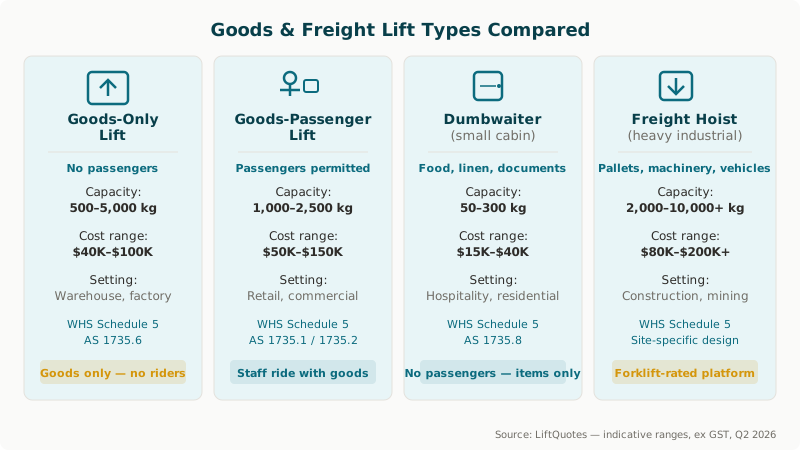
Dumbwaiters are small-cabin lifts designed for food, documents, laundry, or other light items. Cabin sizes are typically 600 mm × 600 mm to 800 mm × 800 mm, with load capacities of 50 kg to 300 kg. They are standard in hospitality (restaurants, hotels, aged care kitchens) and some residential applications. A dumbwaiter is not a passenger lift — no person should enter the cabin, and the openings are too small to permit it.
Freight hoists handle the heaviest loads: palletised goods, machinery, vehicles, and bulk materials. Load capacities start at 2,000 kg and exceed 10,000 kg for mining and construction applications. These are purpose-built installations with reinforced floors, heavy-duty doors, and forklift-rated platforms. Freight hoists are the most expensive goods lift category, with complex structural and compliance requirements.
Choosing the right goods lift
The decision comes down to three questions. What are you moving? Does a person need to travel with it? And what load capacity do you need?
If you are moving light items between floors in a kitchen or office — documents, food trays, linen — a dumbwaiter is the most cost-effective solution. If staff need to accompany goods, you need a goods-passenger lift with full passenger safety features. If you are moving heavy stock in a warehouse and no one rides with it, a goods-only lift or freight hoist is appropriate.
Load capacity determines the structural requirements. A 300 kg dumbwaiter needs minimal floor reinforcement. A 5,000 kg goods-only lift needs engineered pit and floor supports. Get a structural assessment before committing to a specific capacity rating.
Cost factors for goods lifts
As of Q2 2026, goods lift costs in Australia vary widely by type and capacity. The lift equipment itself accounts for roughly 50–60% of the total installed cost. The remainder covers structural work (pit, shaft, floor reinforcement), electrical supply, and installation labour.
The biggest cost variable is load capacity. Every step up in capacity rating requires heavier guide rails, a stronger motor, thicker doors, and more robust structural supports. A 1,000 kg goods-passenger lift costs substantially less than a 5,000 kg freight hoist — not just for the lift itself, but for every structural element that supports it.
For detailed pricing on commercial lift costs across all categories, including goods lifts, see the cost guide.
Compliance and plant registration
Goods lifts are classified as registrable plant under Schedule 5 of the model WHS Regulations. In most Australian states and territories, this means both the lift design and each installed unit must be registered with the state regulator before commissioning.
The applicable standards depend on the lift type. Goods-passenger lifts must comply with AS 1735.1 (general requirements) and AS 1735.2 (passenger lifts). Goods-only lifts fall under AS 1735.6 (builders hoists) or state-specific goods lift requirements depending on the installation context. Dumbwaiters are covered by AS 1735.8.
Victoria operates under the OHS Act, not the model WHS laws — WorkSafe Victoria handles plant registration there. All other states follow the model WHS framework through their respective regulators: SafeWork NSW, WHSQ, WorkSafe WA, SafeWork SA, WorkSafe Tasmania, WorkSafe ACT, and NT WorkSafe.
For the full picture of lift standards and compliance in Australia, including the three-layer compliance model (building, accessibility, workplace safety), see the standards guide.
Ongoing maintenance
Goods lifts — particularly those in high-use commercial and industrial settings — require regular maintenance to remain safe and compliant. A comprehensive maintenance contract covers scheduled servicing, parts replacement, emergency callouts, and annual safety inspections. A non-comprehensive contract covers scheduled visits only, with parts and callouts charged separately.
For goods lifts handling heavy loads or operating at high cycle rates (multiple trips per hour), a comprehensive contract is almost always more cost-effective. Emergency callouts and parts failures add up quickly under a non-comprehensive arrangement when the equipment is working hard.
If you need a goods lift for your warehouse, factory, or commercial premises, get free quotes from Australian lift installers to compare capacity, pricing, and lead times for your specific requirements.
Lift companies in Australia
Browse profiles, compare service areas, and check reviews.

Lift Shop
★ 5.0 (1551 reviews)
Australia's largest dedicated home lift specialist since 1996. 10,000+ installations. Exclusive Italian-crafted lifts with industry-leading 8-year warranty.
View profile →

Compact Home Lifts
NDIS★ 5.0 (465 reviews)
Melbourne branch of Compact Home Lifts. Compact residential lift specialist providing maintenance and repair services across Victoria.
View profile →

Next Level Elevators
★ 5.0 (454 reviews)
Award-winning provider of premium Italian-designed all-electric home elevators. Certified Eltec Partner. Showrooms in Melbourne, Sydney, and Brisbane.
View profile →

Shotton Lifts
NDIS★ 5.0 (9 reviews)
Family-owned Australian lift manufacturer since 1977. 80+ staff. Design, engineer, manufacture, install and service from Dandenong South VIC. NDIS registered.
View profile →

LiftFit Australia
NDIS★ 5.0 (8 reviews)
Victoria-based NDIS registered lift provider, est. 2011. Partners with Cibes, Savaria, and Kalea. Residential, commercial, and platform lifts.
View profile →

Easy Living Home Elevators
★ 5.0 (7 reviews)
Australia's #1 home elevator supplier since 1998. 100% Australian-owned. 11,000+ elevators in service across 6 states.
View profile →
LiftQuotes is a comparison platform. Companies shown are filtered by relevance to this page. Listing does not imply endorsement. LiftQuotes may receive a referral fee when you request quotes.
Goods lift pricing in Australia depends on the lift type, load capacity, number of stops, and the structural work required for installation.
| Scenario | Cost range (AUD, ex GST) | Notes |
|---|---|---|
| Dumbwaiter, 50–300 kg capacity, 2 stops, hospitality or residential | $15,000–$40,000 | Compact cabin (600×600 mm to 800×800 mm). Minimal structural work. Simplest installation of any goods lift type. Stainless steel cabin standard for food service. |
| Goods-only lift, 500–2,000 kg, 2–3 stops, warehouse or factory | $40,000–$100,000 | No passenger safety features required. Heavy-duty platform with forklift-rated floor. Structural pit and shaft required. Cost varies significantly with load rating. |
| Goods-passenger lift, 1,000–2,500 kg, 2–4 stops, retail or commercial | $50,000–$150,000 | Full passenger lift safety specification (AS 1735.1/1735.2). Cabin finishes, lighting, ventilation, and emergency communication required. Higher compliance cost than goods-only. |
| Heavy freight hoist, 2,000–10,000+ kg, industrial or mining | $80,000–$200,000 | Purpose-built for heavy palletised loads or machinery. Reinforced structure, heavy-duty doors, forklift access both levels. Structural engineering and site-specific design add to cost. |
Ranges are indicative, ex GST, based on published supplier pricing and commercial lift installer quotes compiled by LiftQuotes. Actual costs depend on load capacity, site conditions, structural requirements, and location. Regional and remote sites incur additional transport and labour costs.
Last checked: 1 April 2026
Put this into action
When you're ready to move forward, get free quotes from verified Australian lift installers.
What are you looking for today?
I need a lift installed
I have a lift that needs attention
A goods lift moves stock, equipment, or materials between floors in a commercial or industrial building. Some carry passengers alongside goods. Others are restricted to goods only. The distinction matters — it determines the standards that apply, the safety features required, and the plant registration obligations under WHS law.
In Australia, goods lifts range from compact dumbwaiters in restaurant kitchens to heavy-duty freight hoists rated for forklift-loaded pallets. Choosing the right type depends on what you are moving, how heavy it is, whether people ride with it, and what your state regulator requires.
This guide covers the four main goods lift categories, their indicative costs, and the compliance framework that applies in each Australian state and territory.
Types of goods lifts
Four categories cover the majority of goods-moving applications in Australian buildings. Each has different load ratings, safety requirements, and compliance obligations.
Goods-only lifts are designed exclusively for transporting materials — no passengers permitted inside the cabin during operation. They are common in warehouses, factories, and logistics centres where palletised stock moves between mezzanine levels or floors. Load capacities range from 500 kg to 5,000 kg. Because no one rides in the cabin, the safety specification differs from passenger lifts, but WHS plant registration still applies.
Goods-passenger lifts carry both people and materials in the same cabin. Think retail stockrooms, hospital supply floors, or commercial kitchens where staff accompany trolleys between levels. Load capacities typically range from 1,000 kg to 2,500 kg. These lifts must meet the full passenger lift standards — AS 1735.1 and AS 1735.2 — in addition to goods-handling requirements. For a broader view of commercial lift types and their specifications, see the category guide.
Dumbwaiters are small-cabin lifts designed for food, documents, laundry, or other light items. Cabin sizes are typically 600 mm × 600 mm to 800 mm × 800 mm, with load capacities of 50 kg to 300 kg. They are standard in hospitality (restaurants, hotels, aged care kitchens) and some residential applications. A dumbwaiter is not a passenger lift — no person should enter the cabin, and the openings are too small to permit it.
Freight hoists handle the heaviest loads: palletised goods, machinery, vehicles, and bulk materials. Load capacities start at 2,000 kg and exceed 10,000 kg for mining and construction applications. These are purpose-built installations with reinforced floors, heavy-duty doors, and forklift-rated platforms. Freight hoists are the most expensive goods lift category, with complex structural and compliance requirements.
Choosing the right goods lift
The decision comes down to three questions. What are you moving? Does a person need to travel with it? And what load capacity do you need?
If you are moving light items between floors in a kitchen or office — documents, food trays, linen — a dumbwaiter is the most cost-effective solution. If staff need to accompany goods, you need a goods-passenger lift with full passenger safety features. If you are moving heavy stock in a warehouse and no one rides with it, a goods-only lift or freight hoist is appropriate.
Load capacity determines the structural requirements. A 300 kg dumbwaiter needs minimal floor reinforcement. A 5,000 kg goods-only lift needs engineered pit and floor supports. Get a structural assessment before committing to a specific capacity rating.
Cost factors for goods lifts
As of Q2 2026, goods lift costs in Australia vary widely by type and capacity. The lift equipment itself accounts for roughly 50–60% of the total installed cost. The remainder covers structural work (pit, shaft, floor reinforcement), electrical supply, and installation labour.
The biggest cost variable is load capacity. Every step up in capacity rating requires heavier guide rails, a stronger motor, thicker doors, and more robust structural supports. A 1,000 kg goods-passenger lift costs substantially less than a 5,000 kg freight hoist — not just for the lift itself, but for every structural element that supports it.
For detailed pricing on commercial lift costs across all categories, including goods lifts, see the cost guide.
Compliance and plant registration
Goods lifts are classified as registrable plant under Schedule 5 of the model WHS Regulations. In most Australian states and territories, this means both the lift design and each installed unit must be registered with the state regulator before commissioning.
The applicable standards depend on the lift type. Goods-passenger lifts must comply with AS 1735.1 (general requirements) and AS 1735.2 (passenger lifts). Goods-only lifts fall under AS 1735.6 (builders hoists) or state-specific goods lift requirements depending on the installation context. Dumbwaiters are covered by AS 1735.8.
Victoria operates under the OHS Act, not the model WHS laws — WorkSafe Victoria handles plant registration there. All other states follow the model WHS framework through their respective regulators: SafeWork NSW, WHSQ, WorkSafe WA, SafeWork SA, WorkSafe Tasmania, WorkSafe ACT, and NT WorkSafe.
For the full picture of lift standards and compliance in Australia, including the three-layer compliance model (building, accessibility, workplace safety), see the standards guide.
Ongoing maintenance
Goods lifts — particularly those in high-use commercial and industrial settings — require regular maintenance to remain safe and compliant. A comprehensive maintenance contract covers scheduled servicing, parts replacement, emergency callouts, and annual safety inspections. A non-comprehensive contract covers scheduled visits only, with parts and callouts charged separately.
For goods lifts handling heavy loads or operating at high cycle rates (multiple trips per hour), a comprehensive contract is almost always more cost-effective. Emergency callouts and parts failures add up quickly under a non-comprehensive arrangement when the equipment is working hard.
If you need a goods lift for your warehouse, factory, or commercial premises, get free quotes from Australian lift installers to compare capacity, pricing, and lead times for your specific requirements.
Lift companies in Australia
Browse profiles, compare service areas, and check reviews.
Lift Shop
★ 5.0 (1551 reviews)
Australia's largest dedicated home lift specialist since 1996. 10,000+ installations. Exclusive Italian-crafted lifts with industry-leading 8-year warranty.
View profile →
Compact Home Lifts
NDIS★ 5.0 (465 reviews)
Melbourne branch of Compact Home Lifts. Compact residential lift specialist providing maintenance and repair services across Victoria.
View profile →
Next Level Elevators
★ 5.0 (454 reviews)
Award-winning provider of premium Italian-designed all-electric home elevators. Certified Eltec Partner. Showrooms in Melbourne, Sydney, and Brisbane.
View profile →
Shotton Lifts
NDIS★ 5.0 (9 reviews)
Family-owned Australian lift manufacturer since 1977. 80+ staff. Design, engineer, manufacture, install and service from Dandenong South VIC. NDIS registered.
View profile →
LiftFit Australia
NDIS★ 5.0 (8 reviews)
Victoria-based NDIS registered lift provider, est. 2011. Partners with Cibes, Savaria, and Kalea. Residential, commercial, and platform lifts.
View profile →
Easy Living Home Elevators
★ 5.0 (7 reviews)
Australia's #1 home elevator supplier since 1998. 100% Australian-owned. 11,000+ elevators in service across 6 states.
View profile →
LiftQuotes is a comparison platform. Companies shown are filtered by relevance to this page. Listing does not imply endorsement. LiftQuotes may receive a referral fee when you request quotes.
Goods lift pricing in Australia depends on the lift type, load capacity, number of stops, and the structural work required for installation.
| Scenario | Cost range (AUD, ex GST) | Notes |
|---|---|---|
| Dumbwaiter, 50–300 kg capacity, 2 stops, hospitality or residential | $15,000–$40,000 | Compact cabin (600×600 mm to 800×800 mm). Minimal structural work. Simplest installation of any goods lift type. Stainless steel cabin standard for food service. |
| Goods-only lift, 500–2,000 kg, 2–3 stops, warehouse or factory | $40,000–$100,000 | No passenger safety features required. Heavy-duty platform with forklift-rated floor. Structural pit and shaft required. Cost varies significantly with load rating. |
| Goods-passenger lift, 1,000–2,500 kg, 2–4 stops, retail or commercial | $50,000–$150,000 | Full passenger lift safety specification (AS 1735.1/1735.2). Cabin finishes, lighting, ventilation, and emergency communication required. Higher compliance cost than goods-only. |
| Heavy freight hoist, 2,000–10,000+ kg, industrial or mining | $80,000–$200,000 | Purpose-built for heavy palletised loads or machinery. Reinforced structure, heavy-duty doors, forklift access both levels. Structural engineering and site-specific design add to cost. |
Ranges are indicative, ex GST, based on published supplier pricing and commercial lift installer quotes compiled by LiftQuotes. Actual costs depend on load capacity, site conditions, structural requirements, and location. Regional and remote sites incur additional transport and labour costs.
Last checked: 1 April 2026
Put this into action
When you're ready to move forward, get free quotes from verified Australian lift installers.
What are you looking for today?
I need a lift installed
I have a lift that needs attention
Common questions about goods lifts
A goods lift is designed primarily to transport materials, stock, or equipment between floors. A passenger lift is designed to carry people. The key distinction is whether people ride in the cabin. A goods-only lift prohibits passengers entirely — the cabin lacks passenger safety features like emergency communication, ventilation, and full-height doors. A goods-passenger lift carries both people and materials, and must meet the full passenger lift standards (AS 1735.1 and AS 1735.2) in addition to goods-handling requirements.
Related guides
Guide
Our Editorial Methodology: How LiftQuotes Researches Content
How LiftQuotes researches, sources and reviews every lift guide and cost page: the standards we cite, our linked-source rule for cost data, and how often we update.
Guide
Lift Compliance Checklist for Facility Managers (Australia)
A facility manager's lift compliance checklist for Australia: plant registration, inspection, log books, 4G VoLTE emergency phones and DDA access duties.
Comparison
Stairlift vs Platform Lift: Which Access Solution Fits?
A stairlift carries a seated user along the stairs from about $3,000; a platform lift raises a wheelchair vertically from about $15,000. Compare cost, access and fit.
Location
Lift Companies in Melbourne: Compare Local Installers
Compare lift companies in Melbourne for home, platform and commercial lifts. WorkSafe Victoria compliance, local installer coverage and indicative VIC costs.
Need a goods lift for your business?
Compare quotes from commercial lift installers across Australia. Tell us what you need to move, the load capacity, and the number of floors — we will connect you with suppliers who can provide accurate pricing.
Join 1,000+ Australians who've requested quotes through LiftQuotes
Get free quotes