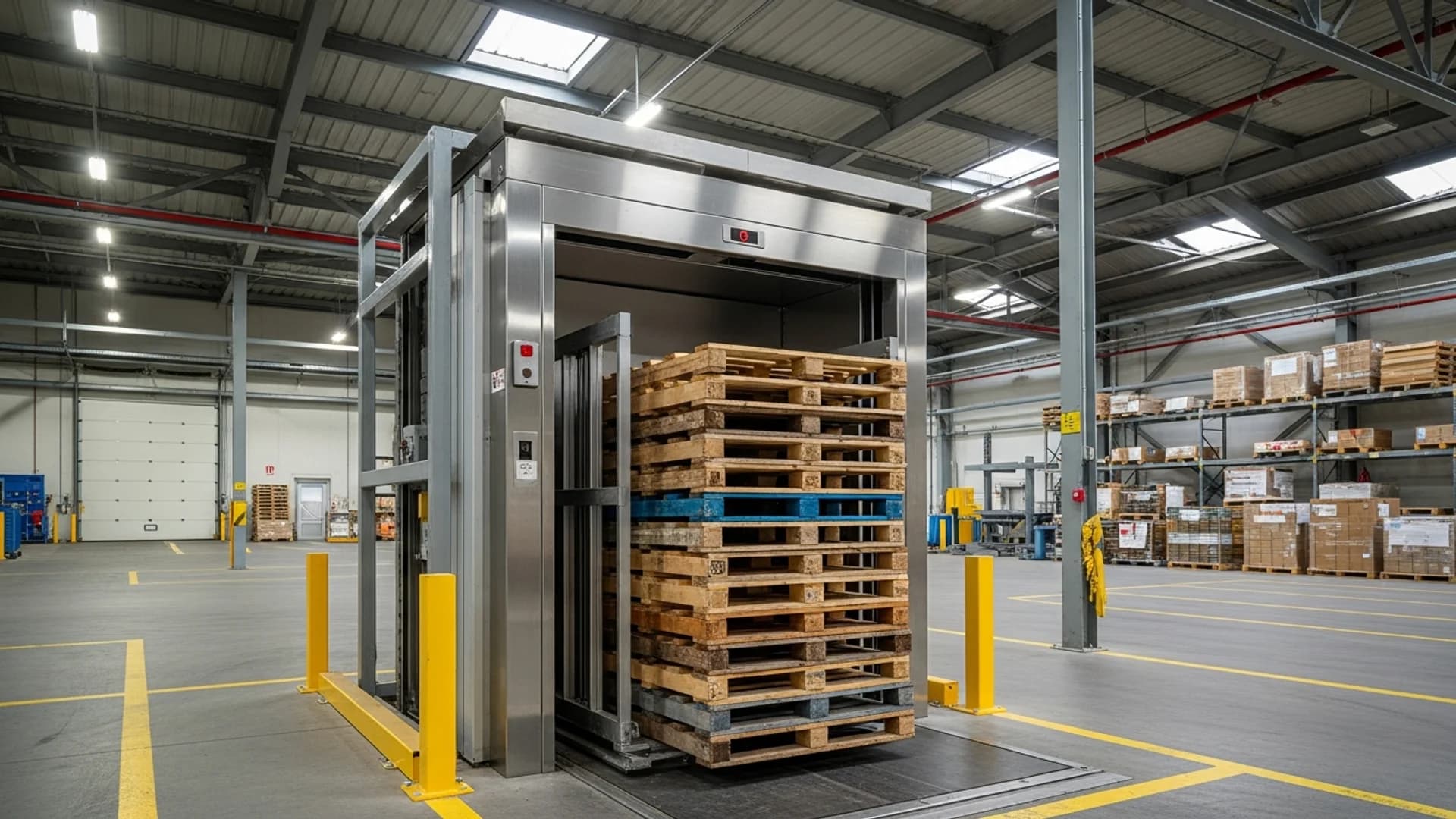
Goods Lift Cost in Australia
A standard goods lift costs roughly $35,000 to $70,000 installed; heavy-duty and industrial freight lifts run higher. Here is the 2026 price guide, banded by load capacity.
A goods lift in Australia costs roughly $35,000 to $70,000 installed for a standard 500–1,000 kg unit as of Q2 2026 — the lift itself, plus the builder's works and electrical connection needed to put it into service. Load capacity is the single biggest price driver, so the honest answer is a band, not a figure.
At the light end, a dumbwaiter moving 50–300 kg between two levels runs $8,000 to $25,000. A heavy-duty goods lift rated to 1,000–2,500 kg sits at $60,000 to $120,000. An industrial freight lift carrying 2,500–5,000 kg or more starts around $90,000 and climbs past $200,000. A goods-and-passenger lift, which is rated to carry people as well as loads, runs $55,000 to $140,000.
This page gives indicative 2026 ranges by capacity class, then splits the installed cost into its three real parts — the lift supply, the structural and builder's works, and plant registration — and covers the lead times that catch out project programmes.
Indicative Australian goods lift costs, ex GST, installed. Ranges are banded by load capacity to match how fabricators and lift companies actually quote. Last checked July 2026.
| Scenario | Cost range (AUD, ex GST) | Notes |
|---|---|---|
| Dumbwaiter (50–300 kg, 2 levels) | $8,000–$25,000 | Small goods-only lift for documents, meals or retail stock between floors. Lower end for a compact bench-height unit; higher end for a floor-to-floor cabinet with fire-rated doors. Supplier-stated pricing collated by LiftQuotes, July 2026. |
| Standard goods lift (500–1,000 kg) | $35,000–$70,000 | General warehouse, retail and hospitality goods lift. Includes the lift and typical installation; structural works vary the figure most. Indicative, ex GST. |
| Heavy-duty goods lift (1,000–2,500 kg) | $60,000–$120,000 | Distribution and manufacturing duty. Heavier structure, larger drive and stronger landing doors push the cost above a standard unit. Indicative, ex GST. |
| Industrial freight lift (2,500–5,000 kg+) | $90,000–$200,000 | Factory, cold-store and bulk-handling duty. Custom engineering and long lead items; $200,000+ for the largest capacities. Indicative floor price, ex GST. |
| Goods & passenger lift (630–2,000 kg) | $55,000–$140,000 | Rated to carry people as well as loads, so it meets passenger-lift safety requirements — dearer than a goods-only lift of the same capacity. Common at loading docks with staff access. Indicative, ex GST. |
Ranges combine supplier-stated and fabricator pricing for goods and freight lifts collated by LiftQuotes, cross-checked against published commercial lift cost data. Figures are installed but exclude major structural works, plant registration fees and site-specific builder's works, which are called out separately. Goods lifts are quoted on enquiry rather than from public price lists, so treat every figure as a planning range and confirm against site-specific quotes.
Last checked: 9 July 2026
Three cost buckets make up the installed price of a goods lift — and for a facility manager budgeting a project, the builder's works are where the number moves most.
The lift supply
The lift itself — car, drive, guide rails, landing and car doors, and controls — is the base cost. Load rating drives it: a 500 kg standard goods lift is far cheaper than a 3,000 kg freight lift with a heavier structure, a larger hydraulic or traction drive and fire-rated doors. Travel (number of levels), door configuration (single or through-car) and finish (galvanised versus stainless) all move the supply figure within a capacity band.
Structural and builder's works
A goods lift needs a shaft, a pit and a load-bearing landing at each level, and in an existing building that means cutting openings, forming the pit and sometimes reinforcing the slab. Builder's works commonly add $15,000 to $60,000 or more depending on how many levels, the structure you are cutting into, and access for delivery. Designing the shaft into a new build is far cheaper than retrofitting one into a working warehouse where downtime has its own cost.
Plant registration and compliance
A goods lift is registrable plant under Schedule 5 of the model Work Health and Safety (WHS) Regulations, so both the design and each installed unit are registered with your state regulator — SafeWork NSW, WorkSafe Queensland and the like. Victoria runs its own OHS scheme through WorkSafe Victoria rather than the model WHS laws. Registration fees are modest against the lift itself, but the design registration, commissioning inspection and ongoing statutory inspections are real line items a home lift never carries.
Lead time and delivery
Standard goods lifts from stock configurations can be installed in a few weeks once works are ready; custom heavy-duty and imported freight lifts commonly run 12 to 20 weeks or more from order. Lead time is a cost when it holds up a fit-out or a warehouse handover, so lock the lift order early in the programme and confirm the delivery window before you commit downstream trades.
Lift companies in Australia
Browse profiles, compare service areas, and check reviews.

Lift Shop
★ 5.0 (1551 reviews)
Australia's largest dedicated home lift specialist since 1996. 10,000+ installations. Exclusive Italian-crafted lifts with industry-leading 8-year warranty.
View profile →

Compact Home Lifts
NDIS★ 5.0 (465 reviews)
Melbourne branch of Compact Home Lifts. Compact residential lift specialist providing maintenance and repair services across Victoria.
View profile →

Next Level Elevators
★ 5.0 (454 reviews)
Award-winning provider of premium Italian-designed all-electric home elevators. Certified Eltec Partner. Showrooms in Melbourne, Sydney, and Brisbane.
View profile →

Shotton Lifts
NDIS★ 5.0 (9 reviews)
Family-owned Australian lift manufacturer since 1977. 80+ staff. Design, engineer, manufacture, install and service from Dandenong South VIC. NDIS registered.
View profile →

LiftFit Australia
NDIS★ 5.0 (8 reviews)
Victoria-based NDIS registered lift provider, est. 2011. Partners with Cibes, Savaria, and Kalea. Residential, commercial, and platform lifts.
View profile →

Easy Living Home Elevators
★ 5.0 (7 reviews)
Australia's #1 home elevator supplier since 1998. 100% Australian-owned. 11,000+ elevators in service across 6 states.
View profile →
LiftQuotes is a comparison platform. Companies shown are filtered by relevance to this page. Listing does not imply endorsement. LiftQuotes may receive a referral fee when you request quotes.
How much does a goods lift cost?
A standard goods lift costs roughly $35,000 to $70,000 installed in Australia as of Q2 2026 for a 500–1,000 kg unit. Load capacity is the main lever: a small dumbwaiter starts around $8,000, while an industrial freight lift rated past 2,500 kg runs from $90,000 to well over $200,000. The figure is a band rather than a price because the structural works around the lift vary far more than the lift itself.
The cleanest way to budget is by load-capacity class, which is exactly how fabricators and lift companies quote. The chart below sets out the five common classes with indicative installed ranges.
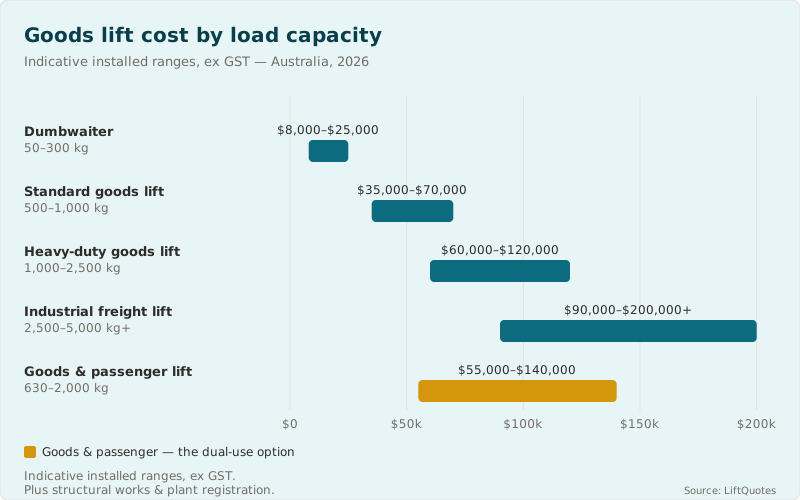
These classes map directly to the freight and industrial lift category, and the type detail — capacities, duty and typical use — sits on the goods lifts in Australia guide. This page is the price companion: if you already know which class you need, read on for what makes up the installed cost.
What makes up the installed cost
An installed goods lift price breaks into three parts: the lift supply, the structural and builder's works, and plant registration. The lift supply is the base cost and tracks load rating, travel and door configuration. For a standard goods lift that is the larger share; for a small dumbwaiter the lift dominates because the building works are minor.
The builder's works are where a facility manager's budget moves. Forming a shaft and pit, cutting landing openings and reinforcing structure in an existing building commonly adds $15,000 to $60,000 or more, and a retrofit into a live warehouse carries downtime on top. A new build that designs the shaft in from the start avoids most of this. The third part — plant registration — is covered next.
Registration and compliance costs
A goods lift is registrable plant under Schedule 5 of the model WHS Regulations, so its design and each installed unit must be registered with the state regulator, and it carries commissioning and periodic statutory inspection. The registration fees are small against the lift, but the compliance obligations are ongoing and are a genuine cost of ownership. Our lift plant registration guide sets out the state-by-state requirements, including the fact that Victoria uses its own OHS scheme rather than the harmonised WHS laws.
Goods lift vs passenger and commercial lifts
A goods-only lift is cheaper than a passenger lift of the same capacity because it does not have to meet the full passenger-lift safety requirements — but the moment people ride with the load, it becomes a goods-and-passenger lift and the price rises to $55,000 to $140,000. If your project also needs to move people between floors, compare this against the commercial lift cost guide and the broader commercial lifts category, because specifying one combined lift is sometimes cheaper than a separate goods lift and passenger lift.
Lead times and imports
Standard goods lifts built from stock configurations can be installed within a few weeks once the builder's works are ready. Custom heavy-duty and imported freight lifts commonly run 12 to 20 weeks or more from order, and that lead time becomes a cost when it holds up a fit-out or a warehouse handover. Order the lift early in the programme and confirm the delivery window in writing before you commit downstream trades.
What this means for your budget
Start from the capacity you actually need and budget the matching band — around $35,000 to $70,000 for a standard goods lift, more for heavy-duty and freight duty — then add the builder's works and registration as separate lines rather than assuming they are in the headline price. Every figure here is indicative, ex GST, and last checked in July 2026.
Goods lifts are quoted on enquiry, so comparing suppliers is the only way to see a real price for your site and capacity. Get free quotes from vetted Australian lift companies and compare the lift supply, the builder's works and the ongoing compliance — not just the headline number.
How we research these costs
Cost figures on this page are indicative ranges, ex GST, last checked in July 2026. They are installed costs — the lift supply plus typical installation — and exclude major structural works, plant registration fees and site-specific builder's works, which are called out separately as their own budget lines. Ranges are banded by load capacity because that is the primary price driver and the way fabricators and lift companies quote. Goods and freight lifts are quoted on enquiry rather than from published price lists, so every figure is a planning range to confirm against site-specific quotes.
Sources: supplier-stated and fabricator pricing for goods and freight lifts collated by LiftQuotes (2026); published commercial lift cost-guide data for cross-checking; Standards Australia AS 1735 series designations for goods and goods-passenger lift context; Safe Work Australia model WHS Regulations Schedule 5 on lifts as registrable plant. Figures exclude major structural works, registration fees and finishes.
Last reviewed
9 July 2026
Next review due
9 January 2027
Get quotes tailored to your project
Tell us about your home and receive personalised pricing from local installers.
What are you looking for today?
I need a lift installed
I have a lift that needs attention
Indicative Australian goods lift costs, ex GST, installed. Ranges are banded by load capacity to match how fabricators and lift companies actually quote. Last checked July 2026.
| Scenario | Cost range (AUD, ex GST) | Notes |
|---|---|---|
| Dumbwaiter (50–300 kg, 2 levels) | $8,000–$25,000 | Small goods-only lift for documents, meals or retail stock between floors. Lower end for a compact bench-height unit; higher end for a floor-to-floor cabinet with fire-rated doors. Supplier-stated pricing collated by LiftQuotes, July 2026. |
| Standard goods lift (500–1,000 kg) | $35,000–$70,000 | General warehouse, retail and hospitality goods lift. Includes the lift and typical installation; structural works vary the figure most. Indicative, ex GST. |
| Heavy-duty goods lift (1,000–2,500 kg) | $60,000–$120,000 | Distribution and manufacturing duty. Heavier structure, larger drive and stronger landing doors push the cost above a standard unit. Indicative, ex GST. |
| Industrial freight lift (2,500–5,000 kg+) | $90,000–$200,000 | Factory, cold-store and bulk-handling duty. Custom engineering and long lead items; $200,000+ for the largest capacities. Indicative floor price, ex GST. |
| Goods & passenger lift (630–2,000 kg) | $55,000–$140,000 | Rated to carry people as well as loads, so it meets passenger-lift safety requirements — dearer than a goods-only lift of the same capacity. Common at loading docks with staff access. Indicative, ex GST. |
Ranges combine supplier-stated and fabricator pricing for goods and freight lifts collated by LiftQuotes, cross-checked against published commercial lift cost data. Figures are installed but exclude major structural works, plant registration fees and site-specific builder's works, which are called out separately. Goods lifts are quoted on enquiry rather than from public price lists, so treat every figure as a planning range and confirm against site-specific quotes.
Last checked: 9 July 2026
Three cost buckets make up the installed price of a goods lift — and for a facility manager budgeting a project, the builder's works are where the number moves most.
The lift supply
The lift itself — car, drive, guide rails, landing and car doors, and controls — is the base cost. Load rating drives it: a 500 kg standard goods lift is far cheaper than a 3,000 kg freight lift with a heavier structure, a larger hydraulic or traction drive and fire-rated doors. Travel (number of levels), door configuration (single or through-car) and finish (galvanised versus stainless) all move the supply figure within a capacity band.
Structural and builder's works
A goods lift needs a shaft, a pit and a load-bearing landing at each level, and in an existing building that means cutting openings, forming the pit and sometimes reinforcing the slab. Builder's works commonly add $15,000 to $60,000 or more depending on how many levels, the structure you are cutting into, and access for delivery. Designing the shaft into a new build is far cheaper than retrofitting one into a working warehouse where downtime has its own cost.
Plant registration and compliance
A goods lift is registrable plant under Schedule 5 of the model Work Health and Safety (WHS) Regulations, so both the design and each installed unit are registered with your state regulator — SafeWork NSW, WorkSafe Queensland and the like. Victoria runs its own OHS scheme through WorkSafe Victoria rather than the model WHS laws. Registration fees are modest against the lift itself, but the design registration, commissioning inspection and ongoing statutory inspections are real line items a home lift never carries.
Lead time and delivery
Standard goods lifts from stock configurations can be installed in a few weeks once works are ready; custom heavy-duty and imported freight lifts commonly run 12 to 20 weeks or more from order. Lead time is a cost when it holds up a fit-out or a warehouse handover, so lock the lift order early in the programme and confirm the delivery window before you commit downstream trades.
Lift companies in Australia
Browse profiles, compare service areas, and check reviews.
Lift Shop
★ 5.0 (1551 reviews)
Australia's largest dedicated home lift specialist since 1996. 10,000+ installations. Exclusive Italian-crafted lifts with industry-leading 8-year warranty.
View profile →
Compact Home Lifts
NDIS★ 5.0 (465 reviews)
Melbourne branch of Compact Home Lifts. Compact residential lift specialist providing maintenance and repair services across Victoria.
View profile →
Next Level Elevators
★ 5.0 (454 reviews)
Award-winning provider of premium Italian-designed all-electric home elevators. Certified Eltec Partner. Showrooms in Melbourne, Sydney, and Brisbane.
View profile →
Shotton Lifts
NDIS★ 5.0 (9 reviews)
Family-owned Australian lift manufacturer since 1977. 80+ staff. Design, engineer, manufacture, install and service from Dandenong South VIC. NDIS registered.
View profile →
LiftFit Australia
NDIS★ 5.0 (8 reviews)
Victoria-based NDIS registered lift provider, est. 2011. Partners with Cibes, Savaria, and Kalea. Residential, commercial, and platform lifts.
View profile →
Easy Living Home Elevators
★ 5.0 (7 reviews)
Australia's #1 home elevator supplier since 1998. 100% Australian-owned. 11,000+ elevators in service across 6 states.
View profile →
LiftQuotes is a comparison platform. Companies shown are filtered by relevance to this page. Listing does not imply endorsement. LiftQuotes may receive a referral fee when you request quotes.
How much does a goods lift cost?
A standard goods lift costs roughly $35,000 to $70,000 installed in Australia as of Q2 2026 for a 500–1,000 kg unit. Load capacity is the main lever: a small dumbwaiter starts around $8,000, while an industrial freight lift rated past 2,500 kg runs from $90,000 to well over $200,000. The figure is a band rather than a price because the structural works around the lift vary far more than the lift itself.
The cleanest way to budget is by load-capacity class, which is exactly how fabricators and lift companies quote. The chart below sets out the five common classes with indicative installed ranges.
These classes map directly to the freight and industrial lift category, and the type detail — capacities, duty and typical use — sits on the goods lifts in Australia guide. This page is the price companion: if you already know which class you need, read on for what makes up the installed cost.
What makes up the installed cost
An installed goods lift price breaks into three parts: the lift supply, the structural and builder's works, and plant registration. The lift supply is the base cost and tracks load rating, travel and door configuration. For a standard goods lift that is the larger share; for a small dumbwaiter the lift dominates because the building works are minor.
The builder's works are where a facility manager's budget moves. Forming a shaft and pit, cutting landing openings and reinforcing structure in an existing building commonly adds $15,000 to $60,000 or more, and a retrofit into a live warehouse carries downtime on top. A new build that designs the shaft in from the start avoids most of this. The third part — plant registration — is covered next.
Registration and compliance costs
A goods lift is registrable plant under Schedule 5 of the model WHS Regulations, so its design and each installed unit must be registered with the state regulator, and it carries commissioning and periodic statutory inspection. The registration fees are small against the lift, but the compliance obligations are ongoing and are a genuine cost of ownership. Our lift plant registration guide sets out the state-by-state requirements, including the fact that Victoria uses its own OHS scheme rather than the harmonised WHS laws.
Goods lift vs passenger and commercial lifts
A goods-only lift is cheaper than a passenger lift of the same capacity because it does not have to meet the full passenger-lift safety requirements — but the moment people ride with the load, it becomes a goods-and-passenger lift and the price rises to $55,000 to $140,000. If your project also needs to move people between floors, compare this against the commercial lift cost guide and the broader commercial lifts category, because specifying one combined lift is sometimes cheaper than a separate goods lift and passenger lift.
Lead times and imports
Standard goods lifts built from stock configurations can be installed within a few weeks once the builder's works are ready. Custom heavy-duty and imported freight lifts commonly run 12 to 20 weeks or more from order, and that lead time becomes a cost when it holds up a fit-out or a warehouse handover. Order the lift early in the programme and confirm the delivery window in writing before you commit downstream trades.
What this means for your budget
Start from the capacity you actually need and budget the matching band — around $35,000 to $70,000 for a standard goods lift, more for heavy-duty and freight duty — then add the builder's works and registration as separate lines rather than assuming they are in the headline price. Every figure here is indicative, ex GST, and last checked in July 2026.
Goods lifts are quoted on enquiry, so comparing suppliers is the only way to see a real price for your site and capacity. Get free quotes from vetted Australian lift companies and compare the lift supply, the builder's works and the ongoing compliance — not just the headline number.
How we research these costs
Cost figures on this page are indicative ranges, ex GST, last checked in July 2026. They are installed costs — the lift supply plus typical installation — and exclude major structural works, plant registration fees and site-specific builder's works, which are called out separately as their own budget lines. Ranges are banded by load capacity because that is the primary price driver and the way fabricators and lift companies quote. Goods and freight lifts are quoted on enquiry rather than from published price lists, so every figure is a planning range to confirm against site-specific quotes.
Sources: supplier-stated and fabricator pricing for goods and freight lifts collated by LiftQuotes (2026); published commercial lift cost-guide data for cross-checking; Standards Australia AS 1735 series designations for goods and goods-passenger lift context; Safe Work Australia model WHS Regulations Schedule 5 on lifts as registrable plant. Figures exclude major structural works, registration fees and finishes.
Last reviewed
9 July 2026
Next review due
9 January 2027
Get quotes tailored to your project
Tell us about your home and receive personalised pricing from local installers.
What are you looking for today?
I need a lift installed
I have a lift that needs attention
Common questions about goods lift costs
A standard goods lift costs roughly $35,000 to $70,000 installed in Australia as of Q2 2026 for a 500–1,000 kg unit. Load capacity is the main price driver: a small dumbwaiter starts around $8,000, a heavy-duty goods lift runs $60,000 to $120,000, and an industrial freight lift starts near $90,000. All figures are indicative and ex GST, and exclude structural works and plant registration.
Related guides
Guide
Our Editorial Methodology: How LiftQuotes Researches Content
How LiftQuotes researches, sources and reviews every lift guide and cost page: the standards we cite, our linked-source rule for cost data, and how often we update.
Guide
Lift Compliance Checklist for Facility Managers (Australia)
A facility manager's lift compliance checklist for Australia: plant registration, inspection, log books, 4G VoLTE emergency phones and DDA access duties.
Comparison
Stairlift vs Platform Lift: Which Access Solution Fits?
A stairlift carries a seated user along the stairs from about $3,000; a platform lift raises a wheelchair vertically from about $15,000. Compare cost, access and fit.
Location
Lift Companies in Melbourne: Compare Local Installers
Compare lift companies in Melbourne for home, platform and commercial lifts. WorkSafe Victoria compliance, local installer coverage and indicative VIC costs.
Compare goods lift quotes
Get free, no-obligation quotes from vetted Australian goods and freight lift specialists — and compare the lift supply, the builder's works and the ongoing compliance, not just the headline price.
Join 1,000+ Australians who've requested quotes through LiftQuotes
Get free quotes