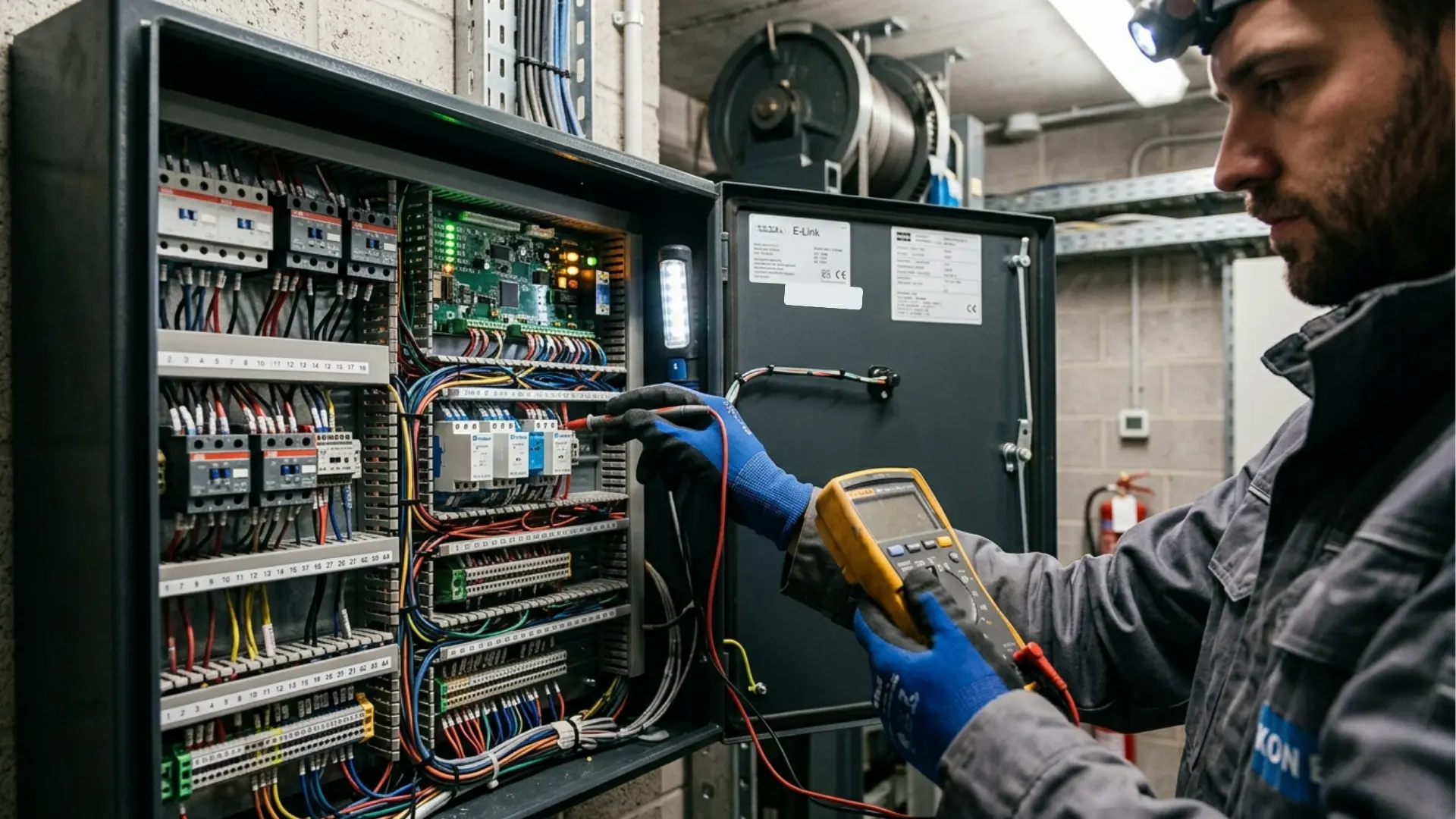
Lift Repair in Australia
Lift repair covers unplanned callouts, component failures, and fault diagnoses. What you pay depends largely on whether your maintenance contract covers the repair or leaves you with a separate invoice. Here is what you need to know before and after a breakdown.
Lift repair covers unplanned work — emergency callouts, component failures, entrapment releases, and fault diagnoses — as distinct from routine maintenance. Repair costs in Australia are highly variable: a minor fault that takes an hour to diagnose and fix carries a very different cost to a failed controller, a worn hydraulic seal, or a door system failure. What you pay depends primarily on whether you hold a comprehensive maintenance contract (in which most repairs are covered within the contract fee) or a non-comprehensive arrangement (in which repairs are invoiced separately at parts and labour cost).
For strata committees and building managers, a lift breakdown involves more than calling a technician. There are WHS obligations when a lift is out of service, communication requirements to occupants, and a decision to make about whether an urgent repair, a scheduled repair, or a modernisation trigger is the appropriate response. Repeated call-outs on an ageing lift are often a signal that the maintenance contract is not delivering value, or that the lift is approaching end of economic life.
Under a comprehensive maintenance contract, most unplanned repairs should be covered within the fixed fee. Under a non-comprehensive arrangement, every call-out generates a separate invoice. For buildings with older lifts generating multiple breakdowns per year, total annual repair spend under a non-comprehensive arrangement often significantly exceeds what a comprehensive contract would have cost. The key unknown is contract exclusions — major electrical components, hydraulic fluid, and proprietary parts are commonly excluded even from 'comprehensive' contracts.
When repair costs on an individual lift begin to approach the cost of a partial modernisation — controller, drive, and door system work starting from around $80,000–$120,000 per car (indicative, last checked March 2026) — the economics of continued repair versus planned modernisation are worth reviewing. An independent lift consultant can model this for your specific building and lift portfolio.
Callouts, WHS obligations and the repair vs modernisation decision
Emergency callouts: what to do when your lift breaks down
When a lift fails, the immediate steps are: confirm no one is trapped, contact the maintenance contractor emergency line, and put up clear out-of-service signage at all landings. If a person is trapped, the emergency phone inside the lift connects directly to the monitoring centre, which dispatches a technician. Do not attempt to open the doors manually or improvise a release — this risks injury to the trapped person and anyone assisting.
Most maintenance contracts specify a response time commitment for entrapment callouts, typically within 2 hours. Verify this commitment is current and documented before a breakdown occurs, not after.
Document every fault: time reported, contractor response time, fault diagnosis, parts used, and resolution. This record supports contract review, WHS obligations, and future decisions about repair vs modernisation.
How maintenance contracts determine who pays for repairs
Under a comprehensive maintenance contract, most unplanned repairs — call-out labour, diagnosis, and standard parts — are covered within the fixed fee. The contractor carries the repair cost risk.
Under a non-comprehensive contract, each call-out generates a separate invoice. Labour, travel, diagnosis, and parts are all billed in addition to the base inspection fee. Emergency callouts outside business hours attract higher rates.
The risk with modern comprehensive contracts is exclusions. Major electrical components, hydraulic fluid replacement, door mechanisms, and proprietary parts are commonly excluded — meaning these repairs appear as separate invoices even under a 'comprehensive' contract. The exclusions list, not the contract title, determines what is actually covered.
Common causes of lift breakdowns
The most frequent causes of commercial lift breakdowns include:
- Door system faults — door sensors, motor wear, and misalignment; doors are the highest-frequency failure point in most commercial lifts
- Controller faults — circuit board failures, software faults, communication errors between lift components
- Drive and motor issues — worn motor bearings, drive unit faults, hydraulic seal failures in hydraulic lifts
- Safety circuit faults — triggered safety switches, floor levelling issues, buffer condition faults
- Emergency phone and comms — 4G VoLTE connection failures that prevent the monitoring arrangement from functioning
Lifts older than 15 years tend to generate increasing call-out frequency as components approach end of life. An increasing breakdown rate is a signal worth discussing with an independent lift consultant before committing to another repair cycle.
WHS obligations when a lift is out of service
When a lift is taken out of service — whether for repair or following a fault — the person with management or control of the plant holds ongoing WHS duties:
- Secure the lift against unauthorised use — all landing doors should be inaccessible
- Post clear out-of-service signage at every landing
- Notify occupants with mobility limitations who depend on the lift for access
- Maintain records of the fault, repair actions taken, and the return-to-service date
An entrapment or incident involving injury may also trigger incident reporting obligations to your state WHS regulator. Victoria operates under the OHS Act 2004; all other jurisdictions follow the model WHS framework. Contact your state regulator if in doubt: SafeWork NSW, WorkSafe Victoria, Workplace Health and Safety Queensland, or your state equivalent.
Repair vs modernisation: the decision framework
The repair-vs-modernisation decision has no fixed threshold, but these indicators suggest the economics of continued repair are poor:
- Annual repair costs (call-outs plus parts) approach 15–20% of a modernisation quote
- The same components are failing repeatedly — indicating systemic ageing rather than isolated faults
- A critical component (controller, drive) is no longer supported by the manufacturer and parts availability is at risk
- Downtime frequency is affecting building accessibility compliance or generating WHS obligations
Modernisation of an existing commercial lift — controller, drive, and door systems as a starting scope — typically runs $80,000–$120,000 per car. Comprehensive modernisation including fixtures and comms typically runs $150,000–$250,000. Full replacement in complex shafts can reach $220,000–$400,000 or more. All figures are indicative based on available market data (last checked March 2026).
An independent lift consultant can model the repair-vs-modernisation economics for your specific lift and building portfolio.
Related pages
For modernisation planning and scope detail, see lift modernisation. For maintenance contract information, see lift maintenance. For commercial lift specifications, see commercial lifts.
Lift Repair companies in Australia
Browse profiles, compare service areas, and check reviews.

Lift Shop
★ 5.0 (1551 reviews)
Australia's largest dedicated home lift specialist since 1996. 10,000+ installations. Exclusive Italian-crafted lifts with industry-leading 8-year warranty.
View profile →

Compact Home Lifts
NDIS★ 5.0 (465 reviews)
Melbourne branch of Compact Home Lifts. Compact residential lift specialist providing maintenance and repair services across Victoria.
View profile →

Next Level Elevators
★ 5.0 (454 reviews)
Award-winning provider of premium Italian-designed all-electric home elevators. Certified Eltec Partner. Showrooms in Melbourne, Sydney, and Brisbane.
View profile →

EMS Elevator Group
★ 5.0 (2 reviews)
Sydney-based bespoke elevator company specialising in installation, modernisation, and maintenance. 24/7 support.
View profile →

Grant Elevators
★ 4.8 (22 reviews)
Perth's premier luxury lift company with 50+ years experience and 3,000+ projects across 6 countries. Four generations of family ownership.
View profile →

Infinity Lifts
★ 4.6 (32 reviews)
Boutique Sydney lift company on the Northern Beaches, est. 2014. European-designed residential traction and hydraulic lifts, plus custom glass shaft structures.
View profile →
LiftQuotes is a comparison platform. Companies shown are filtered by relevance to this page. Listing does not imply endorsement. LiftQuotes may receive a referral fee when you request quotes.
Get quotes from local installers
Your home's layout and access needs will determine the right product. Get quotes to find out.
What are you looking for today?
I need a lift installed
I have a lift that needs attention
Lift repair covers unplanned work — emergency callouts, component failures, entrapment releases, and fault diagnoses — as distinct from routine maintenance. Repair costs in Australia are highly variable: a minor fault that takes an hour to diagnose and fix carries a very different cost to a failed controller, a worn hydraulic seal, or a door system failure. What you pay depends primarily on whether you hold a comprehensive maintenance contract (in which most repairs are covered within the contract fee) or a non-comprehensive arrangement (in which repairs are invoiced separately at parts and labour cost).
For strata committees and building managers, a lift breakdown involves more than calling a technician. There are WHS obligations when a lift is out of service, communication requirements to occupants, and a decision to make about whether an urgent repair, a scheduled repair, or a modernisation trigger is the appropriate response. Repeated call-outs on an ageing lift are often a signal that the maintenance contract is not delivering value, or that the lift is approaching end of economic life.
Under a comprehensive maintenance contract, most unplanned repairs should be covered within the fixed fee. Under a non-comprehensive arrangement, every call-out generates a separate invoice. For buildings with older lifts generating multiple breakdowns per year, total annual repair spend under a non-comprehensive arrangement often significantly exceeds what a comprehensive contract would have cost. The key unknown is contract exclusions — major electrical components, hydraulic fluid, and proprietary parts are commonly excluded even from 'comprehensive' contracts.
When repair costs on an individual lift begin to approach the cost of a partial modernisation — controller, drive, and door system work starting from around $80,000–$120,000 per car (indicative, last checked March 2026) — the economics of continued repair versus planned modernisation are worth reviewing. An independent lift consultant can model this for your specific building and lift portfolio.
Callouts, WHS obligations and the repair vs modernisation decision
Emergency callouts: what to do when your lift breaks down
When a lift fails, the immediate steps are: confirm no one is trapped, contact the maintenance contractor emergency line, and put up clear out-of-service signage at all landings. If a person is trapped, the emergency phone inside the lift connects directly to the monitoring centre, which dispatches a technician. Do not attempt to open the doors manually or improvise a release — this risks injury to the trapped person and anyone assisting.
Most maintenance contracts specify a response time commitment for entrapment callouts, typically within 2 hours. Verify this commitment is current and documented before a breakdown occurs, not after.
Document every fault: time reported, contractor response time, fault diagnosis, parts used, and resolution. This record supports contract review, WHS obligations, and future decisions about repair vs modernisation.
How maintenance contracts determine who pays for repairs
Under a comprehensive maintenance contract, most unplanned repairs — call-out labour, diagnosis, and standard parts — are covered within the fixed fee. The contractor carries the repair cost risk.
Under a non-comprehensive contract, each call-out generates a separate invoice. Labour, travel, diagnosis, and parts are all billed in addition to the base inspection fee. Emergency callouts outside business hours attract higher rates.
The risk with modern comprehensive contracts is exclusions. Major electrical components, hydraulic fluid replacement, door mechanisms, and proprietary parts are commonly excluded — meaning these repairs appear as separate invoices even under a 'comprehensive' contract. The exclusions list, not the contract title, determines what is actually covered.
Common causes of lift breakdowns
The most frequent causes of commercial lift breakdowns include:
- Door system faults — door sensors, motor wear, and misalignment; doors are the highest-frequency failure point in most commercial lifts
- Controller faults — circuit board failures, software faults, communication errors between lift components
- Drive and motor issues — worn motor bearings, drive unit faults, hydraulic seal failures in hydraulic lifts
- Safety circuit faults — triggered safety switches, floor levelling issues, buffer condition faults
- Emergency phone and comms — 4G VoLTE connection failures that prevent the monitoring arrangement from functioning
Lifts older than 15 years tend to generate increasing call-out frequency as components approach end of life. An increasing breakdown rate is a signal worth discussing with an independent lift consultant before committing to another repair cycle.
WHS obligations when a lift is out of service
When a lift is taken out of service — whether for repair or following a fault — the person with management or control of the plant holds ongoing WHS duties:
- Secure the lift against unauthorised use — all landing doors should be inaccessible
- Post clear out-of-service signage at every landing
- Notify occupants with mobility limitations who depend on the lift for access
- Maintain records of the fault, repair actions taken, and the return-to-service date
An entrapment or incident involving injury may also trigger incident reporting obligations to your state WHS regulator. Victoria operates under the OHS Act 2004; all other jurisdictions follow the model WHS framework. Contact your state regulator if in doubt: SafeWork NSW, WorkSafe Victoria, Workplace Health and Safety Queensland, or your state equivalent.
Repair vs modernisation: the decision framework
The repair-vs-modernisation decision has no fixed threshold, but these indicators suggest the economics of continued repair are poor:
- Annual repair costs (call-outs plus parts) approach 15–20% of a modernisation quote
- The same components are failing repeatedly — indicating systemic ageing rather than isolated faults
- A critical component (controller, drive) is no longer supported by the manufacturer and parts availability is at risk
- Downtime frequency is affecting building accessibility compliance or generating WHS obligations
Modernisation of an existing commercial lift — controller, drive, and door systems as a starting scope — typically runs $80,000–$120,000 per car. Comprehensive modernisation including fixtures and comms typically runs $150,000–$250,000. Full replacement in complex shafts can reach $220,000–$400,000 or more. All figures are indicative based on available market data (last checked March 2026).
An independent lift consultant can model the repair-vs-modernisation economics for your specific lift and building portfolio.
Related pages
For modernisation planning and scope detail, see lift modernisation. For maintenance contract information, see lift maintenance. For commercial lift specifications, see commercial lifts.
Lift Repair companies in Australia
Browse profiles, compare service areas, and check reviews.
Lift Shop
★ 5.0 (1551 reviews)
Australia's largest dedicated home lift specialist since 1996. 10,000+ installations. Exclusive Italian-crafted lifts with industry-leading 8-year warranty.
View profile →
Compact Home Lifts
NDIS★ 5.0 (465 reviews)
Melbourne branch of Compact Home Lifts. Compact residential lift specialist providing maintenance and repair services across Victoria.
View profile →
Next Level Elevators
★ 5.0 (454 reviews)
Award-winning provider of premium Italian-designed all-electric home elevators. Certified Eltec Partner. Showrooms in Melbourne, Sydney, and Brisbane.
View profile →
EMS Elevator Group
★ 5.0 (2 reviews)
Sydney-based bespoke elevator company specialising in installation, modernisation, and maintenance. 24/7 support.
View profile →
Grant Elevators
★ 4.8 (22 reviews)
Perth's premier luxury lift company with 50+ years experience and 3,000+ projects across 6 countries. Four generations of family ownership.
View profile →
Infinity Lifts
★ 4.6 (32 reviews)
Boutique Sydney lift company on the Northern Beaches, est. 2014. European-designed residential traction and hydraulic lifts, plus custom glass shaft structures.
View profile →
LiftQuotes is a comparison platform. Companies shown are filtered by relevance to this page. Listing does not imply endorsement. LiftQuotes may receive a referral fee when you request quotes.
Get quotes from local installers
Your home's layout and access needs will determine the right product. Get quotes to find out.
What are you looking for today?
I need a lift installed
I have a lift that needs attention
Callouts, contracts and when to consider modernisation
Emergency callouts: what to do
When a lift fails, confirm no one is trapped, contact the maintenance contractor emergency line, and put up out-of-service signage at all landings. If a person is trapped, the emergency phone in the lift connects directly to the monitoring centre. Do not attempt to manually open the doors. Document the fault: time reported, response time, diagnosis, parts used, and resolution. This record supports future contract reviews and any WHS incident reporting obligations.
How your maintenance contract determines repair costs
Under a comprehensive contract, most unplanned repairs — including call-out labour, diagnosis, and standard parts — should be covered within the fixed fee. Under a non-comprehensive contract, each call-out generates a separate invoice. Even under 'comprehensive' contracts, review the exclusions list: major electrical components, hydraulic fluid, and door mechanisms are frequently excluded, appearing as separate invoices despite the contract name.
Common causes of lift breakdowns
Door system faults are the most frequent failure point in commercial lifts — door sensors, motor wear, and misalignment account for a high proportion of call-outs. Controller faults, drive and motor issues, safety circuit triggers, and emergency phone connectivity failures also generate unplanned callouts. Increasing call-out frequency on a lift older than 15 years typically indicates components approaching end of life rather than isolated faults.
Repair vs modernisation: when the economics shift
When annual repair costs approach 15–20% of a modernisation quote, or when the same components are failing repeatedly, continued repair investment yields diminishing returns. A critical component no longer supported by the manufacturer narrows repair options regardless of cost. Modernisation of an existing commercial lift — controller, drive, and doors as a starting scope — typically runs $80,000–$120,000 per car (indicative, last checked March 2026). An independent lift consultant can assess your specific situation.
Related guides
Location
Commercial Lifts Melbourne: Costs, Compliance & Installers
Commercial lift costs, Victorian OHS compliance and the Melbourne installer market — indicative prices, WorkSafe Victoria rules and NCC requirements for VIC projects.
Location
Commercial Lifts Sydney: Costs, Compliance & Installers
Commercial lift costs, NSW compliance and the Sydney installer market — indicative prices, SafeWork NSW rules and NCC requirements for CBD and metro projects.
Guide
What Size Lift Do I Need for a Wheelchair? (Australia)
A home lift for a wheelchair needs roughly 1,100 x 1,400 mm inside and a 900 mm clear door. See minimum sizes for a wheelchair, a carer, and turning space.
Guide
Support at Home & Lift Funding: The 2026 Guide
Can Support at Home fund a home lift or stairlift? How aged care funding works, the OT assessment, means-tested contributions, and how it differs from the NDIS.
Get lift repair quotes for your building
Whether you need an emergency callout or a planned repair quoted, getting responses from two or three providers gives you a reference point on cost and response time. Your current maintenance contract may already cover some or all of the work.
Join 1,000+ Australians who've requested quotes through LiftQuotes
Get repair quotes