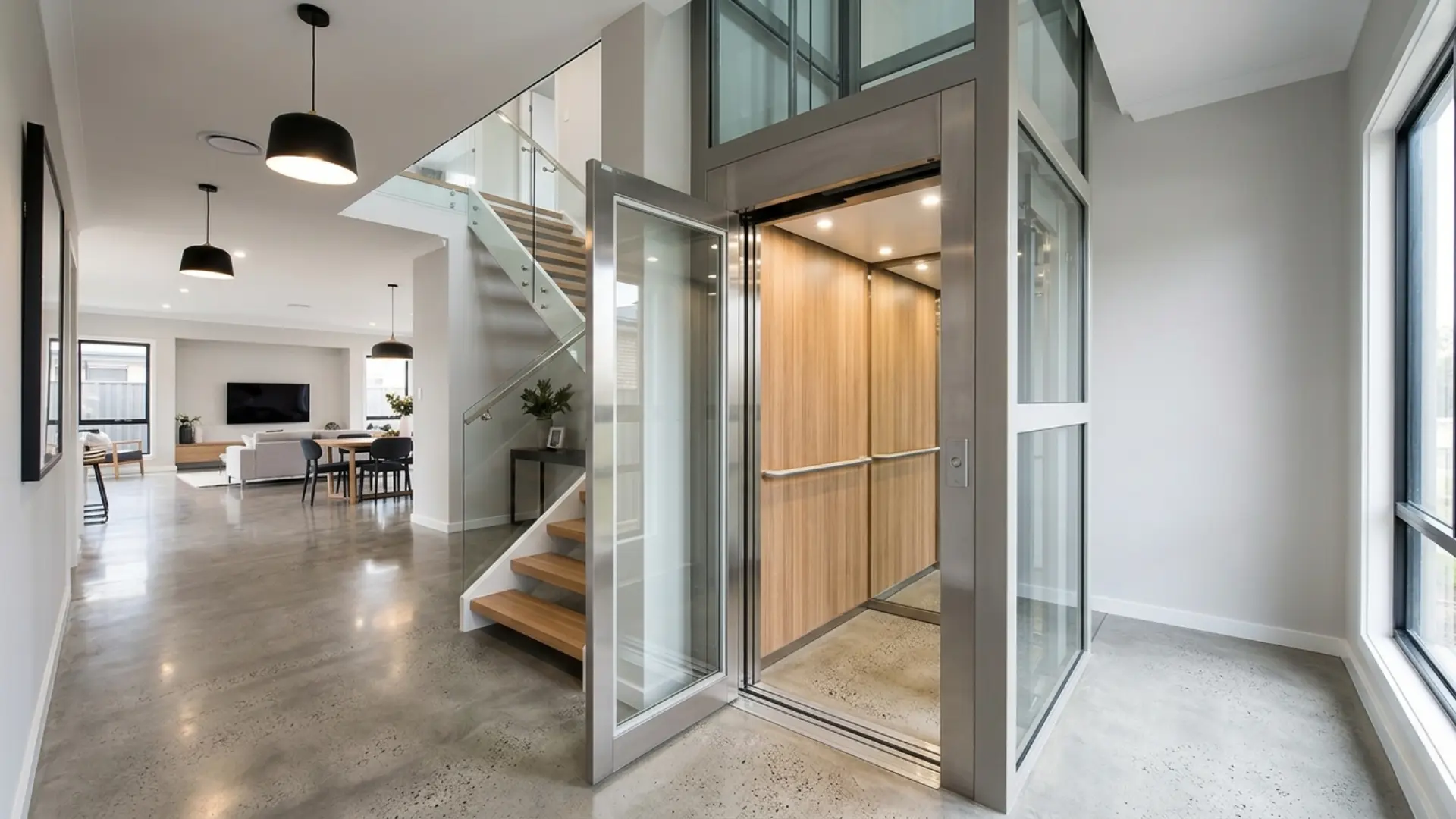
Home Lift Cost in Australia
Home lift installation costs range from $20,000 to $70,000 or more, depending on lift type, building works, and number of stops. This guide breaks down every cost component with sourced data so you can budget accurately.
Budgeting for a home lift in Australia means understanding two separate cost layers: the lift itself and the building works required to install it. These are often quoted separately, and a low headline price can conceal significant civil and structural costs.
According to hipages national cost guide data, most residential lift installations fall between $20,000 and $70,000 all-in. Compact platform lifts start at the lower end of that range; through-floor home lifts with cab finishes and multiple stops sit toward the upper end or beyond.
The figures on this page are sourced from published cost guides, supplier-stated pricing, and Australian Standards documentation. They reflect Australian supply and installation conditions as at March 2026. All prices are in AUD and exclude GST unless stated otherwise.
The following cost ranges reflect installed prices across common residential lift scenarios in Australia. All figures are AUD excluding GST and cover supply, delivery, and standard installation. Building works such as shaft construction, structural modification, and electrical supply upgrades are excluded unless noted.
| Scenario | Cost range (AUD, ex GST) | Notes |
|---|---|---|
| Compact platform lift (2 stops, standard finishes) | $20,000–$40,000 | Entry-level residential platform lift supplied and installed. Assumes existing opening or minor builder works. Source: hipages national cost guide. |
| Through-floor home lift (2–3 stops, standard cab) | $31,000–$55,000 | Hydraulic or screw-drive residential lift with enclosed cab. Compact models from ~$31,000 supplier-stated; mid-range installs typically $40,000–$55,000. Source: supplier-stated pricing, multiple Australian suppliers. |
| Premium or custom home lift (3+ stops, custom finishes) | $55,000–$70,000 | Glass cab, custom joinery, or 3+ stop configuration. Perth metro installs reported at $60,000+ GST for standard 2-stop units in new builds. Source: hipages national cost guide; regional supplier data. |
| Annual service contract | $500–$1,500 | Ongoing maintenance cost per year. AS/NZS 1735.18 requires periodic inspection and maintenance. Cost varies by lift type and service provider. Source: hipages national cost guide. |
Ranges are sourced from hipages national cost guide data and supplier-stated pricing from multiple Australian residential lift suppliers. Regional variation is significant — metro Sydney and Melbourne installations tend to sit at the lower end of ranges; Perth and regional centres can exceed the upper bound. Building works costs are not included and must be obtained separately from a licensed builder.
Last checked: 18 March 2026
Eight factors determine where your home lift installation lands within the cost ranges above. Understanding each one will help you scope your project accurately and avoid budget surprises.
Lift type
Platform lifts, hydraulic lifts, and screw-drive lifts carry different price points. Platform lifts are typically the lowest-cost entry point; hydraulic models with enclosed cabs sit in the mid-to-upper range. The drive mechanism also affects ongoing service costs.
Number of stops
Each additional level adds cost through extended rail, cab travel, and landing door requirements. A 2-stop lift is the base case; 3 or more stops can add $5,000–$15,000 depending on lift type and shaft height.
New build vs retrofit
Installing a lift in a new build is less expensive than retrofitting into an existing home. New builds allow the shaft, pit, and electrical supply to be planned from the start. Retrofits often require structural modifications and floor penetrations that can equal or exceed the lift cost itself.
Shaft and pit construction
Most through-floor lifts require a builder-constructed shaft and a pit dug below the lowest landing. Shaft costs vary widely but commonly range from $5,000 to $20,000+ for masonry or steel-framed construction. This is a separate cost quoted by your builder.
Cab finishes and customisation
Standard laminate finishes are included in base pricing. Glass panels, custom joinery, stainless steel, and bespoke lighting add cost. Premium cab packages can add $5,000–$15,000 over a standard specification.
Electrical supply upgrade
Home lifts typically require a dedicated 15A or 20A circuit. If your switchboard does not have capacity, an electrician upgrade may cost $1,000–$3,000. This is arranged separately from the lift supplier.
Annual service contract
AS/NZS 1735.18 requires regular maintenance and periodic inspection of all residential lifts. Annual service contracts typically cost $500–$1,500 per year. Factor this into total cost of ownership, not just the upfront budget.
WHS plant registration
In most Australian states and territories, residential lifts meeting the definition of ‘plant’ under WHS regulations must be registered with the relevant state regulator. Registration fees are modest ($50–$200 typically), but inspection and documentation adds installer time to the project.
Home Lifts companies in Australia
Browse profiles, compare service areas, and check reviews.

Shotton Lifts
NDIS★ 5.0 (9 reviews)
Family-owned Australian lift manufacturer since 1977. 80+ staff. Design, engineer, manufacture, install and service from Dandenong South VIC. NDIS registered.
View profile →

LiftFit Australia
NDIS★ 5.0 (8 reviews)
Victoria-based NDIS registered lift provider, est. 2011. Partners with Cibes, Savaria, and Kalea. Residential, commercial, and platform lifts.
View profile →

Easy Living Home Elevators
★ 5.0 (7 reviews)
Australia's #1 home elevator supplier since 1998. 100% Australian-owned. 11,000+ elevators in service across 6 states.
View profile →

EcoLift
★ 5.0 (3 reviews)
Family-owned Sydney lift company. European-parts-based installations for reliability and cost-efficient servicing.
View profile →

Sunshine Coast Elevators
★ 5.0 (3 reviews)
Sunshine Coast QLD specialist in bespoke Italian-made residential elevators and disability access lifts. 38+ years industry experience.
View profile →

EMS Elevator Group
★ 5.0 (2 reviews)
Sydney-based bespoke elevator company specialising in installation, modernisation, and maintenance. 24/7 support.
View profile →
LiftQuotes is a comparison platform. Companies shown are filtered by relevance to this page. Listing does not imply endorsement. LiftQuotes may receive a referral fee when you request quotes.
How we research these costs
Cost figures on this page were compiled from three source categories: published national cost guides (hipages), supplier-stated pricing from multiple Australian residential lift suppliers, and Australian Standards documentation for ongoing maintenance requirements. Hipages national cost guide data provides median and range figures drawn from job completion data across the hipages trade platform. These figures reflect actual quoted and invoiced jobs, not manufacturer list prices. Supplier-stated pricing was cross-referenced from publicly available pricing pages and brochures from multiple suppliers operating in Australian states. Where ranges differed materially between sources, the broader range is reported to avoid understating cost exposure. All figures exclude GST. Regional variation is real and significant — particularly for Perth and regional Queensland and Western Australia, where freight and installer availability can push costs above the national upper bound. Building works (shaft, pit, structural) are excluded from all lift supply and installation figures and must be scoped and quoted separately by a licensed builder. This page does not constitute a quote. Get written quotes from at least three suppliers and a separate builder quote for any required building works.
Primary sources: hipages Home Lift Cost Guide; supplier-stated pricing from Australian residential lift suppliers (multiple); AS/NZS 1735.18:2002 Lifts, Escalators and Moving Walks — Maintenance.
Last reviewed
18 March 2026
For a full overview of home lift types, installation requirements, and what to expect from the process, see the home lifts guide. Ready to compare supplier pricing? Get free quotes from multiple Australian home lift installers.
Get quotes tailored to your project
Tell us about your home and receive personalised pricing from local installers.
What are you looking for today?
I need a lift installed
I have a lift that needs attention
Budgeting for a home lift in Australia means understanding two separate cost layers: the lift itself and the building works required to install it. These are often quoted separately, and a low headline price can conceal significant civil and structural costs.
According to hipages national cost guide data, most residential lift installations fall between $20,000 and $70,000 all-in. Compact platform lifts start at the lower end of that range; through-floor home lifts with cab finishes and multiple stops sit toward the upper end or beyond.
The figures on this page are sourced from published cost guides, supplier-stated pricing, and Australian Standards documentation. They reflect Australian supply and installation conditions as at March 2026. All prices are in AUD and exclude GST unless stated otherwise.
The following cost ranges reflect installed prices across common residential lift scenarios in Australia. All figures are AUD excluding GST and cover supply, delivery, and standard installation. Building works such as shaft construction, structural modification, and electrical supply upgrades are excluded unless noted.
| Scenario | Cost range (AUD, ex GST) | Notes |
|---|---|---|
| Compact platform lift (2 stops, standard finishes) | $20,000–$40,000 | Entry-level residential platform lift supplied and installed. Assumes existing opening or minor builder works. Source: hipages national cost guide. |
| Through-floor home lift (2–3 stops, standard cab) | $31,000–$55,000 | Hydraulic or screw-drive residential lift with enclosed cab. Compact models from ~$31,000 supplier-stated; mid-range installs typically $40,000–$55,000. Source: supplier-stated pricing, multiple Australian suppliers. |
| Premium or custom home lift (3+ stops, custom finishes) | $55,000–$70,000 | Glass cab, custom joinery, or 3+ stop configuration. Perth metro installs reported at $60,000+ GST for standard 2-stop units in new builds. Source: hipages national cost guide; regional supplier data. |
| Annual service contract | $500–$1,500 | Ongoing maintenance cost per year. AS/NZS 1735.18 requires periodic inspection and maintenance. Cost varies by lift type and service provider. Source: hipages national cost guide. |
Ranges are sourced from hipages national cost guide data and supplier-stated pricing from multiple Australian residential lift suppliers. Regional variation is significant — metro Sydney and Melbourne installations tend to sit at the lower end of ranges; Perth and regional centres can exceed the upper bound. Building works costs are not included and must be obtained separately from a licensed builder.
Last checked: 18 March 2026
Eight factors determine where your home lift installation lands within the cost ranges above. Understanding each one will help you scope your project accurately and avoid budget surprises.
Lift type
Platform lifts, hydraulic lifts, and screw-drive lifts carry different price points. Platform lifts are typically the lowest-cost entry point; hydraulic models with enclosed cabs sit in the mid-to-upper range. The drive mechanism also affects ongoing service costs.
Number of stops
Each additional level adds cost through extended rail, cab travel, and landing door requirements. A 2-stop lift is the base case; 3 or more stops can add $5,000–$15,000 depending on lift type and shaft height.
New build vs retrofit
Installing a lift in a new build is less expensive than retrofitting into an existing home. New builds allow the shaft, pit, and electrical supply to be planned from the start. Retrofits often require structural modifications and floor penetrations that can equal or exceed the lift cost itself.
Shaft and pit construction
Most through-floor lifts require a builder-constructed shaft and a pit dug below the lowest landing. Shaft costs vary widely but commonly range from $5,000 to $20,000+ for masonry or steel-framed construction. This is a separate cost quoted by your builder.
Cab finishes and customisation
Standard laminate finishes are included in base pricing. Glass panels, custom joinery, stainless steel, and bespoke lighting add cost. Premium cab packages can add $5,000–$15,000 over a standard specification.
Electrical supply upgrade
Home lifts typically require a dedicated 15A or 20A circuit. If your switchboard does not have capacity, an electrician upgrade may cost $1,000–$3,000. This is arranged separately from the lift supplier.
Annual service contract
AS/NZS 1735.18 requires regular maintenance and periodic inspection of all residential lifts. Annual service contracts typically cost $500–$1,500 per year. Factor this into total cost of ownership, not just the upfront budget.
WHS plant registration
In most Australian states and territories, residential lifts meeting the definition of ‘plant’ under WHS regulations must be registered with the relevant state regulator. Registration fees are modest ($50–$200 typically), but inspection and documentation adds installer time to the project.
Home Lifts companies in Australia
Browse profiles, compare service areas, and check reviews.
Shotton Lifts
NDIS★ 5.0 (9 reviews)
Family-owned Australian lift manufacturer since 1977. 80+ staff. Design, engineer, manufacture, install and service from Dandenong South VIC. NDIS registered.
View profile →
LiftFit Australia
NDIS★ 5.0 (8 reviews)
Victoria-based NDIS registered lift provider, est. 2011. Partners with Cibes, Savaria, and Kalea. Residential, commercial, and platform lifts.
View profile →
Easy Living Home Elevators
★ 5.0 (7 reviews)
Australia's #1 home elevator supplier since 1998. 100% Australian-owned. 11,000+ elevators in service across 6 states.
View profile →
EcoLift
★ 5.0 (3 reviews)
Family-owned Sydney lift company. European-parts-based installations for reliability and cost-efficient servicing.
View profile →
Sunshine Coast Elevators
★ 5.0 (3 reviews)
Sunshine Coast QLD specialist in bespoke Italian-made residential elevators and disability access lifts. 38+ years industry experience.
View profile →
EMS Elevator Group
★ 5.0 (2 reviews)
Sydney-based bespoke elevator company specialising in installation, modernisation, and maintenance. 24/7 support.
View profile →
LiftQuotes is a comparison platform. Companies shown are filtered by relevance to this page. Listing does not imply endorsement. LiftQuotes may receive a referral fee when you request quotes.
How we research these costs
Cost figures on this page were compiled from three source categories: published national cost guides (hipages), supplier-stated pricing from multiple Australian residential lift suppliers, and Australian Standards documentation for ongoing maintenance requirements. Hipages national cost guide data provides median and range figures drawn from job completion data across the hipages trade platform. These figures reflect actual quoted and invoiced jobs, not manufacturer list prices. Supplier-stated pricing was cross-referenced from publicly available pricing pages and brochures from multiple suppliers operating in Australian states. Where ranges differed materially between sources, the broader range is reported to avoid understating cost exposure. All figures exclude GST. Regional variation is real and significant — particularly for Perth and regional Queensland and Western Australia, where freight and installer availability can push costs above the national upper bound. Building works (shaft, pit, structural) are excluded from all lift supply and installation figures and must be scoped and quoted separately by a licensed builder. This page does not constitute a quote. Get written quotes from at least three suppliers and a separate builder quote for any required building works.
Primary sources: hipages Home Lift Cost Guide; supplier-stated pricing from Australian residential lift suppliers (multiple); AS/NZS 1735.18:2002 Lifts, Escalators and Moving Walks — Maintenance.
Last reviewed
18 March 2026
For a full overview of home lift types, installation requirements, and what to expect from the process, see the home lifts guide. Ready to compare supplier pricing? Get free quotes from multiple Australian home lift installers.
Get quotes tailored to your project
Tell us about your home and receive personalised pricing from local installers.
What are you looking for today?
I need a lift installed
I have a lift that needs attention
Common questions about home lift costs
Most home lift installations in Australia cost between $20,000 and $70,000, excluding GST. Compact platform lifts start at around $20,000–$40,000 installed. Through-floor home lifts with enclosed cabs typically cost $31,000–$55,000. Premium configurations with glass cabs, custom finishes, or three or more stops can reach $70,000 or more. These figures cover lift supply and standard installation only — shaft construction, pit work, and electrical upgrades are quoted separately by a builder.
Related guides
Location
Commercial Lifts Melbourne: Costs, Compliance & Installers
Commercial lift costs, Victorian OHS compliance and the Melbourne installer market — indicative prices, WorkSafe Victoria rules and NCC requirements for VIC projects.
Location
Commercial Lifts Sydney: Costs, Compliance & Installers
Commercial lift costs, NSW compliance and the Sydney installer market — indicative prices, SafeWork NSW rules and NCC requirements for CBD and metro projects.
Guide
What Size Lift Do I Need for a Wheelchair? (Australia)
A home lift for a wheelchair needs roughly 1,100 x 1,400 mm inside and a 900 mm clear door. See minimum sizes for a wheelchair, a carer, and turning space.
Guide
Support at Home & Lift Funding: The 2026 Guide
Can Support at Home fund a home lift or stairlift? How aged care funding works, the OT assessment, means-tested contributions, and how it differs from the NDIS.
Ready to get home lift quotes?
Compare quotes from multiple Australian lift suppliers. Free, no-obligation, and takes less than two minutes.
Join 1,000+ Australians who've requested quotes through LiftQuotes
Get free quotes