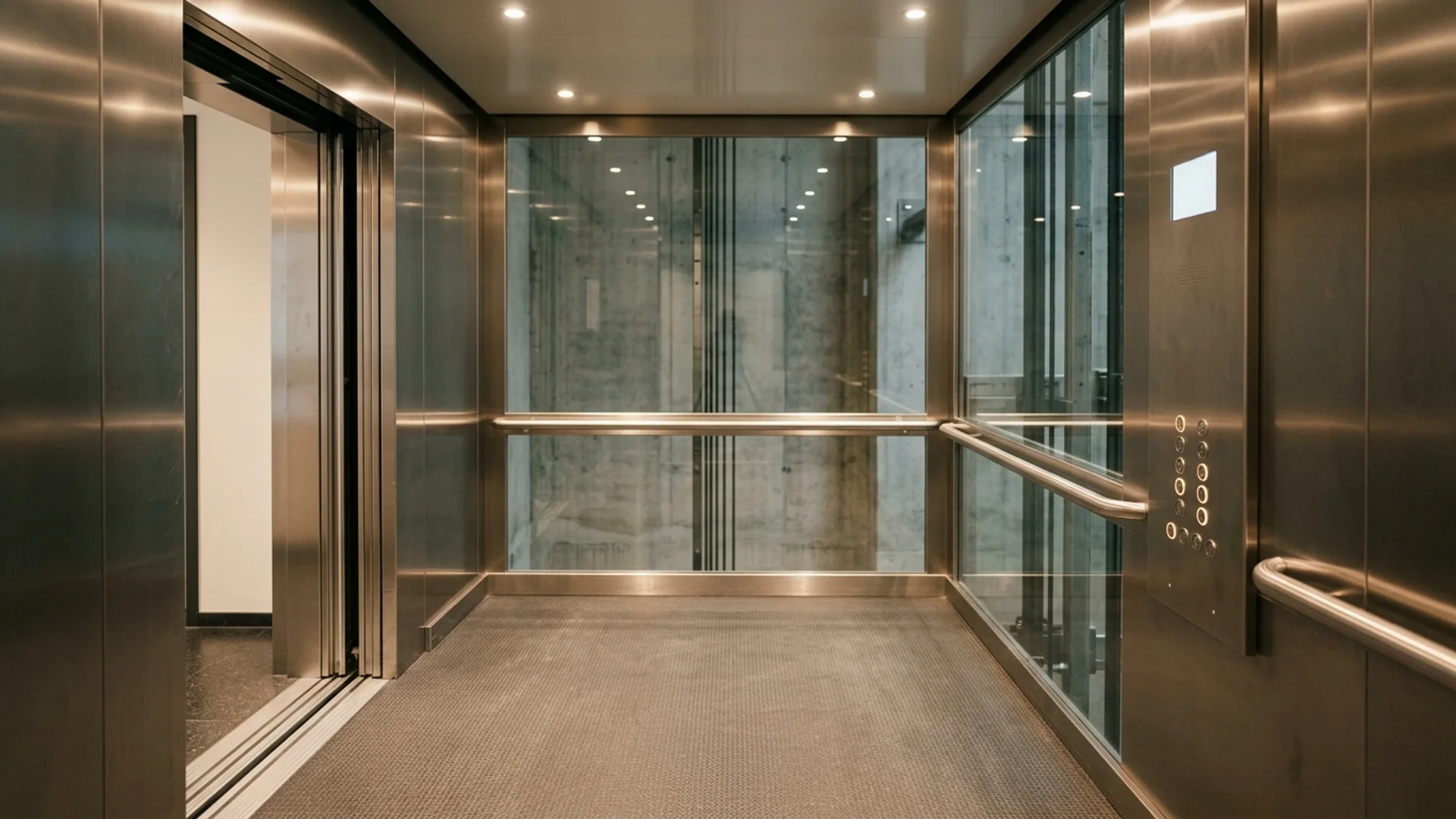
What Size Lift Do I Need for a Wheelchair?
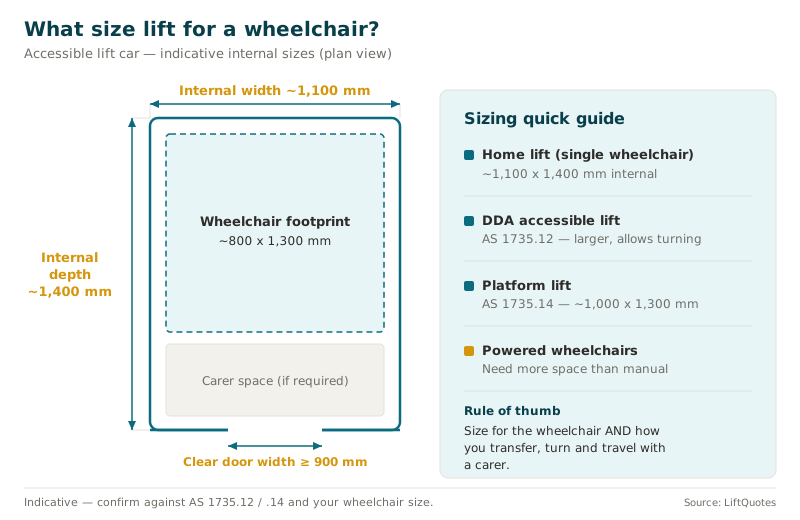
A home lift for one wheelchair user needs roughly 1,100 mm wide by 1,400 mm deep inside, with a clear door of at least 900 mm. Add space for a carer, a powered chair, or turning and the figure grows.
Single wheelchair: ~1,100 x 1,400 mm
A home lift car around 1,100 mm wide by 1,400 mm deep comfortably takes one manual wheelchair, giving clearance around the roughly 800 x 1,300 mm space a wheelchair and user occupy.
Clear door width: 900 mm+
Aim for a clear door opening of at least 900 mm. Some compact platform lifts work to 800 mm, but 900 mm is the comfortable target for a wheelchair to pass without clipping the frame.
Wheelchair plus a carer needs more
If a carer travels in the car, size up: a deeper or wider car, or a DDA-style accessible lift built to AS 1735.12, so both fit and the doors still close safely.
Powered chairs and turning add space
Powered wheelchairs and mobility scooters have a larger footprint than manual chairs, and turning inside the car — rather than reversing out — needs a bigger plan again.
The honest answer is that a wheelchair lift needs to be sized for three things at once: the wheelchair, the person moving in and out of it, and whether anyone travels with them. For a single manual-wheelchair user, a home lift car of about 1,100 mm wide by 1,400 mm deep with a 900 mm clear door works in most homes. That is the figure to plan around before an assessment refines it.
The reason sizing feels confusing is that the useful numbers are buried in Australian Standards written for engineers, not buyers. This guide translates them into plain dimensions you can hold a tape measure against — the minimum internal car size, the door width, platform-lift sizes under AS 1735.14, the extra room a carer or a powered wheelchair needs, and how much turning space a car really requires.
Sizes here are indicative and meant for planning. Your wheelchair model, the way you transfer, and the standard your lift is built to all shift the final figure, so confirm the detail with your supplier and, where accessibility is the goal, an occupational therapist.
The short answer — sizes at a glance
For planning purposes, here are the indicative figures most Australian buyers need. Treat them as a starting point and confirm against the relevant standard and your own wheelchair.
- Single wheelchair, home lift: internal car around 1,100 mm wide x 1,400 mm deep.
- Clear door width: 900 mm is the comfortable target; 800 mm is the practical floor for some compact lifts.
- Platform lift (AS 1735.14): platform commonly 1,000–1,100 mm wide x 1,250–1,400 mm deep.
- Wheelchair footprint: a manual wheelchair and user occupy roughly 800 mm x 1,300 mm.
- Wheelchair plus carer, or turning inside: step up to a larger car, often a DDA-style accessible lift (AS 1735.12).
Those numbers cover the common case: one person, a manual wheelchair, moving between two levels of a home. The rest of this guide explains when the figure needs to grow, and which standard sets the rules for your situation.
Home lift or accessible passenger lift — two different rulebooks
The single biggest thing to get straight is which kind of lift you are actually buying, because the sizing rules differ.
A private residence lift — a home lift inside a house — is built to AS/NZS 1735.18, the standard for automatically controlled passenger lifts in private homes. These cars are sized to suit the household, and a car around 1,100 mm x 1,400 mm is a common, practical size for a wheelchair user. There is more room to tailor the size to the home than many buyers expect. Our guide to wheelchair lifts covers the lift types that suit accessibility at home.
A DDA-compliant accessible passenger lift is a different animal. It is built to AS 1735.12:2020, the Australian Standard covering lifts for persons with disabilities, and it applies where a building has to provide equitable access — public and commercial buildings, and common-property lifts in apartments. AS 1735.12 sets minimum car dimensions, control heights, door widths and handrail requirements so that any wheelchair user, including someone travelling with an attendant, can use the lift independently. Accessible lifts are therefore generally larger than a private home lift, and they allow a wheelchair to turn rather than reverse out. If access compliance is your goal, read our DDA lift compliance guide alongside this one.
The practical takeaway: a home lift can be smaller and still work well for a named wheelchair user, while an accessible lift is sized to a published minimum so it works for everyone. Which one you need depends on the building and who will use it.
Manual versus powered wheelchairs — footprint matters
Sizing starts with the chair. A standard manual wheelchair, with an occupant, occupies a space of roughly 800 mm wide by 1,300 mm long — the figure AS 1428.1 uses as the wheelchair envelope. A car of 1,100 mm x 1,400 mm gives sensible clearance around that envelope.
Powered wheelchairs and mobility scooters change the sum. They are longer, heavier, and harder to manoeuvre in a tight space, so the same 800 x 1,300 mm envelope no longer describes them. If the user drives a powered chair or a scooter, measure the actual chair — length, width, and the turning it needs — and give the supplier those numbers rather than assuming a manual-chair footprint. It is common for a powered chair to push the sensible car size towards, or past, the width and depth of a small accessible lift.
Weight matters too: the car has to carry the chair, the person, and anyone with them, within the lift rated load. A heavy powered chair eats into that allowance quickly, which is another reason to specify the real chair early.
Door width, turning space and getting in and out
Two dimensions decide whether a lift is genuinely usable day to day: the door and the turning space.
Door width. A clear opening of 900 mm lets a wheelchair pass without the user having to line up perfectly. Some compact home and platform lifts come with an 800 mm door, which can work for a narrower manual chair, but 900 mm is the target that removes the daily friction. Note that the clear opening — the actual gap you pass through — is what counts, not the nominal door size, because the frame and any door hardware reduce it.
Turning space. AS 1428.1 sets a wheelchair turning space of about 1,540 mm for a 180-degree turn. Very few home lift cars are that large, and they do not need to be — most are designed so the user drives in forwards and reverses out at the other level, or the landing gives the turning room instead of the car. An accessible lift built to AS 1735.12 is sized so a wheelchair can enter, and in larger configurations turn, inside the car. Decide early whether you want to turn inside the lift or reverse out, because it changes the car you need. Our guide to home lift space requirements covers the shaft, pit and landing space around the car, which matters as much as the internal figure.
What this means for your project
Start with the person and the chair, not the lift. Measure the wheelchair the user actually has, decide whether a carer travels with them, and note whether turning inside the car matters. Those three answers set the minimum car size, and everything else — the shaft, the door, the drive system — follows from it.
If you are buying for a home and one named wheelchair user, a car around 1,100 mm x 1,400 mm with a 900 mm door is a sound plan to quote against. If the lift serves a building, common property, or anyone who turns up in a wheelchair, you are into AS 1735.12 accessible-lift territory and a larger, standard-sized car. When money is the next question, our wheelchair lift cost guide sets out indicative ranges so you can budget alongside the sizing.
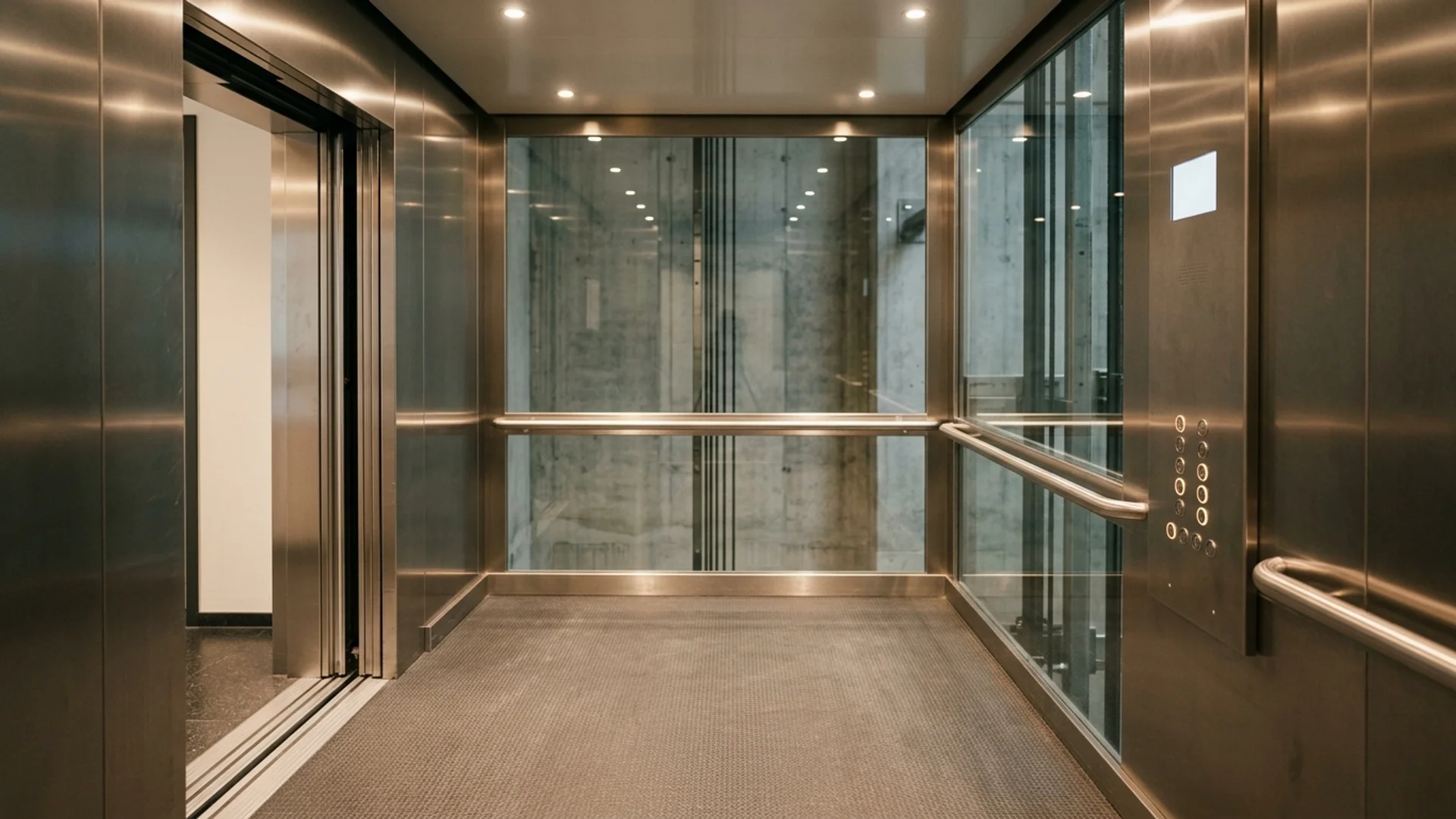
The surest way to get the size right is to have an occupational therapist or a lift supplier measure against the real wheelchair and the real space. When you are ready, get free quotes from Australian lift installers who can confirm the car size for your wheelchair and your home.
Lift companies in Australia
Browse profiles, compare service areas, and check reviews.

Lift Shop
★ 5.0 (1551 reviews)
Australia's largest dedicated home lift specialist since 1996. 10,000+ installations. Exclusive Italian-crafted lifts with industry-leading 8-year warranty.
View profile →

Compact Home Lifts
NDIS★ 5.0 (465 reviews)
Melbourne branch of Compact Home Lifts. Compact residential lift specialist providing maintenance and repair services across Victoria.
View profile →

Next Level Elevators
★ 5.0 (454 reviews)
Award-winning provider of premium Italian-designed all-electric home elevators. Certified Eltec Partner. Showrooms in Melbourne, Sydney, and Brisbane.
View profile →

Shotton Lifts
NDIS★ 5.0 (9 reviews)
Family-owned Australian lift manufacturer since 1977. 80+ staff. Design, engineer, manufacture, install and service from Dandenong South VIC. NDIS registered.
View profile →

LiftFit Australia
NDIS★ 5.0 (8 reviews)
Victoria-based NDIS registered lift provider, est. 2011. Partners with Cibes, Savaria, and Kalea. Residential, commercial, and platform lifts.
View profile →

Easy Living Home Elevators
★ 5.0 (7 reviews)
Australia's #1 home elevator supplier since 1998. 100% Australian-owned. 11,000+ elevators in service across 6 states.
View profile →
LiftQuotes is a comparison platform. Companies shown are filtered by relevance to this page. Listing does not imply endorsement. LiftQuotes may receive a referral fee when you request quotes.
Put this into action
When you're ready to move forward, get free quotes from verified Australian lift installers.
What are you looking for today?
I need a lift installed
I have a lift that needs attention
The honest answer is that a wheelchair lift needs to be sized for three things at once: the wheelchair, the person moving in and out of it, and whether anyone travels with them. For a single manual-wheelchair user, a home lift car of about 1,100 mm wide by 1,400 mm deep with a 900 mm clear door works in most homes. That is the figure to plan around before an assessment refines it.
The reason sizing feels confusing is that the useful numbers are buried in Australian Standards written for engineers, not buyers. This guide translates them into plain dimensions you can hold a tape measure against — the minimum internal car size, the door width, platform-lift sizes under AS 1735.14, the extra room a carer or a powered wheelchair needs, and how much turning space a car really requires.
Sizes here are indicative and meant for planning. Your wheelchair model, the way you transfer, and the standard your lift is built to all shift the final figure, so confirm the detail with your supplier and, where accessibility is the goal, an occupational therapist.
The short answer — sizes at a glance
For planning purposes, here are the indicative figures most Australian buyers need. Treat them as a starting point and confirm against the relevant standard and your own wheelchair.
- Single wheelchair, home lift: internal car around 1,100 mm wide x 1,400 mm deep.
- Clear door width: 900 mm is the comfortable target; 800 mm is the practical floor for some compact lifts.
- Platform lift (AS 1735.14): platform commonly 1,000–1,100 mm wide x 1,250–1,400 mm deep.
- Wheelchair footprint: a manual wheelchair and user occupy roughly 800 mm x 1,300 mm.
- Wheelchair plus carer, or turning inside: step up to a larger car, often a DDA-style accessible lift (AS 1735.12).
Those numbers cover the common case: one person, a manual wheelchair, moving between two levels of a home. The rest of this guide explains when the figure needs to grow, and which standard sets the rules for your situation.
Home lift or accessible passenger lift — two different rulebooks
The single biggest thing to get straight is which kind of lift you are actually buying, because the sizing rules differ.
A private residence lift — a home lift inside a house — is built to AS/NZS 1735.18, the standard for automatically controlled passenger lifts in private homes. These cars are sized to suit the household, and a car around 1,100 mm x 1,400 mm is a common, practical size for a wheelchair user. There is more room to tailor the size to the home than many buyers expect. Our guide to wheelchair lifts covers the lift types that suit accessibility at home.
A DDA-compliant accessible passenger lift is a different animal. It is built to AS 1735.12:2020, the Australian Standard covering lifts for persons with disabilities, and it applies where a building has to provide equitable access — public and commercial buildings, and common-property lifts in apartments. AS 1735.12 sets minimum car dimensions, control heights, door widths and handrail requirements so that any wheelchair user, including someone travelling with an attendant, can use the lift independently. Accessible lifts are therefore generally larger than a private home lift, and they allow a wheelchair to turn rather than reverse out. If access compliance is your goal, read our DDA lift compliance guide alongside this one.
The practical takeaway: a home lift can be smaller and still work well for a named wheelchair user, while an accessible lift is sized to a published minimum so it works for everyone. Which one you need depends on the building and who will use it.
Manual versus powered wheelchairs — footprint matters
Sizing starts with the chair. A standard manual wheelchair, with an occupant, occupies a space of roughly 800 mm wide by 1,300 mm long — the figure AS 1428.1 uses as the wheelchair envelope. A car of 1,100 mm x 1,400 mm gives sensible clearance around that envelope.
Powered wheelchairs and mobility scooters change the sum. They are longer, heavier, and harder to manoeuvre in a tight space, so the same 800 x 1,300 mm envelope no longer describes them. If the user drives a powered chair or a scooter, measure the actual chair — length, width, and the turning it needs — and give the supplier those numbers rather than assuming a manual-chair footprint. It is common for a powered chair to push the sensible car size towards, or past, the width and depth of a small accessible lift.
Weight matters too: the car has to carry the chair, the person, and anyone with them, within the lift rated load. A heavy powered chair eats into that allowance quickly, which is another reason to specify the real chair early.
Door width, turning space and getting in and out
Two dimensions decide whether a lift is genuinely usable day to day: the door and the turning space.
Door width. A clear opening of 900 mm lets a wheelchair pass without the user having to line up perfectly. Some compact home and platform lifts come with an 800 mm door, which can work for a narrower manual chair, but 900 mm is the target that removes the daily friction. Note that the clear opening — the actual gap you pass through — is what counts, not the nominal door size, because the frame and any door hardware reduce it.
Turning space. AS 1428.1 sets a wheelchair turning space of about 1,540 mm for a 180-degree turn. Very few home lift cars are that large, and they do not need to be — most are designed so the user drives in forwards and reverses out at the other level, or the landing gives the turning room instead of the car. An accessible lift built to AS 1735.12 is sized so a wheelchair can enter, and in larger configurations turn, inside the car. Decide early whether you want to turn inside the lift or reverse out, because it changes the car you need. Our guide to home lift space requirements covers the shaft, pit and landing space around the car, which matters as much as the internal figure.
What this means for your project
Start with the person and the chair, not the lift. Measure the wheelchair the user actually has, decide whether a carer travels with them, and note whether turning inside the car matters. Those three answers set the minimum car size, and everything else — the shaft, the door, the drive system — follows from it.
If you are buying for a home and one named wheelchair user, a car around 1,100 mm x 1,400 mm with a 900 mm door is a sound plan to quote against. If the lift serves a building, common property, or anyone who turns up in a wheelchair, you are into AS 1735.12 accessible-lift territory and a larger, standard-sized car. When money is the next question, our wheelchair lift cost guide sets out indicative ranges so you can budget alongside the sizing.
The surest way to get the size right is to have an occupational therapist or a lift supplier measure against the real wheelchair and the real space. When you are ready, get free quotes from Australian lift installers who can confirm the car size for your wheelchair and your home.
Lift companies in Australia
Browse profiles, compare service areas, and check reviews.
Lift Shop
★ 5.0 (1551 reviews)
Australia's largest dedicated home lift specialist since 1996. 10,000+ installations. Exclusive Italian-crafted lifts with industry-leading 8-year warranty.
View profile →
Compact Home Lifts
NDIS★ 5.0 (465 reviews)
Melbourne branch of Compact Home Lifts. Compact residential lift specialist providing maintenance and repair services across Victoria.
View profile →
Next Level Elevators
★ 5.0 (454 reviews)
Award-winning provider of premium Italian-designed all-electric home elevators. Certified Eltec Partner. Showrooms in Melbourne, Sydney, and Brisbane.
View profile →
Shotton Lifts
NDIS★ 5.0 (9 reviews)
Family-owned Australian lift manufacturer since 1977. 80+ staff. Design, engineer, manufacture, install and service from Dandenong South VIC. NDIS registered.
View profile →
LiftFit Australia
NDIS★ 5.0 (8 reviews)
Victoria-based NDIS registered lift provider, est. 2011. Partners with Cibes, Savaria, and Kalea. Residential, commercial, and platform lifts.
View profile →
Easy Living Home Elevators
★ 5.0 (7 reviews)
Australia's #1 home elevator supplier since 1998. 100% Australian-owned. 11,000+ elevators in service across 6 states.
View profile →
LiftQuotes is a comparison platform. Companies shown are filtered by relevance to this page. Listing does not imply endorsement. LiftQuotes may receive a referral fee when you request quotes.
Put this into action
When you're ready to move forward, get free quotes from verified Australian lift installers.
What are you looking for today?
I need a lift installed
I have a lift that needs attention
Common questions about wheelchair lift sizes
For one manual-wheelchair user, a home lift car of about 1,100 mm wide by 1,400 mm deep, with a clear door of at least 900 mm, works in most homes. That gives clearance around the roughly 800 x 1,300 mm space a wheelchair and user occupy. Size up if a carer travels in the car, if the user has a powered wheelchair, or if you need to turn inside the car rather than reverse out. These figures are indicative — confirm against your wheelchair and the relevant standard.
Related guides
Location
Commercial Lifts Sydney: Costs, Compliance & Installers
Commercial lift costs, NSW compliance and the Sydney installer market — indicative prices, SafeWork NSW rules and NCC requirements for CBD and metro projects.
Guide
Support at Home & Lift Funding: The 2026 Guide
Can Support at Home fund a home lift or stairlift? How aged care funding works, the OT assessment, means-tested contributions, and how it differs from the NDIS.
Guide
Our Editorial Methodology: How LiftQuotes Researches Content
How LiftQuotes researches, sources and reviews every lift guide and cost page: the standards we cite, our linked-source rule for cost data, and how often we update.
Comparison
Stairlift vs Platform Lift: Which Access Solution Fits?
A stairlift carries a seated user along the stairs from about $3,000; a platform lift raises a wheelchair vertically from about $15,000. Compare cost, access and fit.
Get the size right for your wheelchair
Compare free, no-obligation quotes from Australian lift suppliers. They can measure against your wheelchair and your home, and confirm the car and door size you need.
Join 1,000+ Australians who've requested quotes through LiftQuotes
Get free quotes