Strata Lift Modernisation: A Guide for Owners Corporations
When to modernise an ageing apartment lift, how to fund it through a special levy or capital works fund, and how to get the owners corporation to yes.
An ageing strata lift rarely fails all at once. It gives warning — more frequent callouts, longer waits for parts, off-level stops, and a service bill that creeps up every year. At some point the owners corporation has to decide whether to keep repairing the lift or modernise it: reuse the shaft and structure, and replace the drive, controller, doors and car with current equipment.
This guide is written for strata committees and owners corporation managers. It covers the trigger signals that mean modernisation, the difference between modernising and replacing, realistic budgets, how to fund the work through the capital works fund or a special levy, the general-meeting approval you will need, and how to manage downtime in a building that depends on a single lift.
When should an owners corporation modernise a lift?
Modernise a strata lift when repairs are becoming frequent and expensive, spare parts are getting hard to source, and the lift is 15 to 20 years past its last major upgrade — but the shaft and structure are still sound. If the structure is compromised or the lift is beyond economic repair, full replacement is the better path. The decision tree below sets out the sequence most strata committees work through.
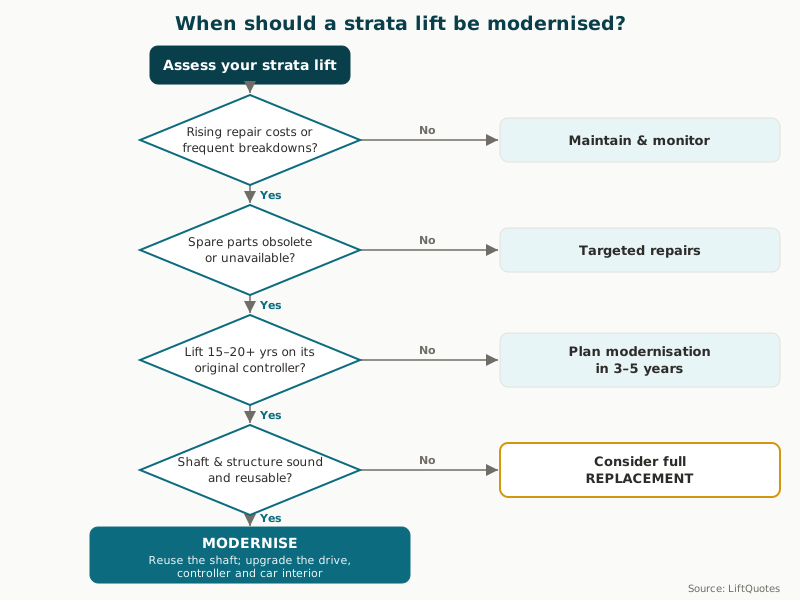
The trigger signals are practical, not theoretical. Rising callout frequency is usually the first sign a committee notices — a lift that needed two or three service visits a year now needs one a month. The second is parts obsolescence: once a manufacturer stops supporting a controller or drive, every fault means a longer wait and a scavenged or fabricated part. Slow, unreliable, or off-level service and a failed statutory inspection round out the list. When two or more of these appear together, the building has moved from a strata lift maintenance problem to a modernisation decision.
Modernisation or replacement?
Modernisation reuses the existing shaft, guide rails, and often the car frame, while upgrading the components that wear out or go obsolete — the drive, the controller, the doors, and the car interior. Replacement strips the installation back and installs a new lift system end to end. Modernisation is typically 30 to 50 per cent cheaper than replacement and keeps the lift out of service for weeks rather than months, which is why it is the default for most mid-life strata lifts.
Replacement wins when the shaft no longer meets current dimensions, when structural defects make reuse unsafe, or when the lift is so old that a piecemeal upgrade would still leave obsolete parts in service. Our guide to modernising versus replacing a lift works through the trade-off in detail. For a committee, the honest test is whether the money buys another 20 years of reliable service — if it does not, replacement is usually the sounder capital decision.
What a modernisation covers
Modernisation is scalable. A committee can upgrade one subsystem or the whole lift, depending on condition and budget. As of Q3 2026, indicative installed ranges (ex GST) are:
- Controls and controller upgrade: $15,000 to $30,000 — new controller, call buttons and floor indicators.
- Door replacement: $10,000 to $25,000 — new car and landing doors, the most common breakdown point.
- Car interior refurbishment: $8,000 to $20,000 — wall panels, lighting, flooring and handrails.
- Full modernisation: $60,000 to $150,000 — drive, controller, doors, car and safety gear together.
These are indicative ranges drawn from LiftQuotes market research and vary with the lift's age, the number of floors served, and site access. The cost of lift modernisation page breaks the figures down further, and what lift modernisation involves sits alongside the broader lift modernisation category.
Funding a strata lift modernisation
Routine servicing is an administrative-fund expense, but modernisation is capital expenditure — it is funded from the capital works fund (called the sinking fund or maintenance fund in some states). A well-run scheme has been contributing to that fund against the lift's known service life, so the money is at least partly there when the work falls due.
When the capital works fund cannot cover the cost, the owners corporation raises a special levy — a one-off contribution apportioned across lots by unit entitlement. A $120,000 modernisation across a 30-lot building averages a $4,000 levy per lot, though each lot's actual share depends on its entitlement, not a flat split. Committees that plan the work a year or two ahead can stage contributions and soften the levy. Leaving it until the lift fails forces an emergency levy and a building with no working lift.
Getting owners corporation approval
A modernisation of this scale is not usually a decision the committee can make alone — it typically needs a general-meeting resolution, and raising a special levy almost always does. The threshold is set by your state's strata legislation and your scheme's by-laws: some resolutions pass on a simple majority, others require a special resolution. Do not assume a single national rule — confirm the required majority for both the works and the levy under your own state's Act before you call the meeting.
Give owners the evidence to vote yes: the service and breakdown history, an independent condition report, at least two or three comparable quotes, and a clear funding plan. The strata lift tender guide sets out how to scope the works and compare quotes like-for-like, so the meeting decides on real numbers rather than a single supplier's pitch.
Managing downtime in a single-lift building
Downtime is the hardest part of modernising a strata lift, especially in a building with one lift and residents who depend on it. A controls-only upgrade may take one to two weeks; a full modernisation commonly runs four to eight weeks with the lift out of service for much of that time. Plan for it: notify residents early, arrange assistance for anyone with mobility needs, and ask tenderers to guarantee a staged programme and a firm return-to-service date.
Staging can shorten the continuous outage. A committee can split the work — controller and doors in one phase, car interior in another — so the lift returns to service between stages. Staging costs a little more in mobilisation but is often worth it in a building where an eight-week outage is not tolerable.
Accessibility and energy upgrades
A modernisation is the natural moment to close accessibility and efficiency gaps. Older lifts often predate current access expectations; upgrading the car controls, adding audible floor announcements and tactile buttons, and improving door timing brings the lift closer to AS 1735.12:2020 — the Australian Standard for lifts used by persons with disabilities — even where a full retrofit is not strictly mandated. Confirm what applies to your building with an access consultant.
Energy is the quieter win. Swapping an old hydraulic or geared drive for a modern gearless traction machine with regenerative capability, and replacing the car lighting with LED, can cut a lift's running cost noticeably and reduce the load it places on the building's electrical supply. Emergency phone compliance should be confirmed within the scope too — all lift phones in Australia now run on 4G VoLTE after the copper and 3G networks were retired.
One WHS note for Victorian schemes: the owners corporation's plant duties there sit under the Occupational Health and Safety Act 2004 and WorkSafe Victoria, not the model WHS laws that apply in the other states. The obligation to keep the lift safe and maintained is the same in substance; the legislation and regulator differ.
Modernisation is a capital decision, not a repair. Committees that treat it that way — with a condition report, competitive quotes, a funded plan and a resident communications strategy — get 20 more years of reliable service without the shock of an emergency replacement. Get free quotes from lift companies to scope a modernisation for your building.
Lift companies in Australia
Browse profiles, compare service areas, and check reviews.

Lift Shop
★ 5.0 (1551 reviews)
Australia's largest dedicated home lift specialist since 1996. 10,000+ installations. Exclusive Italian-crafted lifts with industry-leading 8-year warranty.
View profile →

Compact Home Lifts
NDIS★ 5.0 (465 reviews)
Melbourne branch of Compact Home Lifts. Compact residential lift specialist providing maintenance and repair services across Victoria.
View profile →

Next Level Elevators
★ 5.0 (454 reviews)
Award-winning provider of premium Italian-designed all-electric home elevators. Certified Eltec Partner. Showrooms in Melbourne, Sydney, and Brisbane.
View profile →

Shotton Lifts
NDIS★ 5.0 (9 reviews)
Family-owned Australian lift manufacturer since 1977. 80+ staff. Design, engineer, manufacture, install and service from Dandenong South VIC. NDIS registered.
View profile →

LiftFit Australia
NDIS★ 5.0 (8 reviews)
Victoria-based NDIS registered lift provider, est. 2011. Partners with Cibes, Savaria, and Kalea. Residential, commercial, and platform lifts.
View profile →

Easy Living Home Elevators
★ 5.0 (7 reviews)
Australia's #1 home elevator supplier since 1998. 100% Australian-owned. 11,000+ elevators in service across 6 states.
View profile →
LiftQuotes is a comparison platform. Companies shown are filtered by relevance to this page. Listing does not imply endorsement. LiftQuotes may receive a referral fee when you request quotes.
Put this into action
When you're ready to move forward, get free quotes from verified Australian lift installers.
What are you looking for today?
I need a lift installed
I have a lift that needs attention
When should an owners corporation modernise a lift?
Modernise a strata lift when repairs are becoming frequent and expensive, spare parts are getting hard to source, and the lift is 15 to 20 years past its last major upgrade — but the shaft and structure are still sound. If the structure is compromised or the lift is beyond economic repair, full replacement is the better path. The decision tree below sets out the sequence most strata committees work through.
The trigger signals are practical, not theoretical. Rising callout frequency is usually the first sign a committee notices — a lift that needed two or three service visits a year now needs one a month. The second is parts obsolescence: once a manufacturer stops supporting a controller or drive, every fault means a longer wait and a scavenged or fabricated part. Slow, unreliable, or off-level service and a failed statutory inspection round out the list. When two or more of these appear together, the building has moved from a strata lift maintenance problem to a modernisation decision.
Modernisation or replacement?
Modernisation reuses the existing shaft, guide rails, and often the car frame, while upgrading the components that wear out or go obsolete — the drive, the controller, the doors, and the car interior. Replacement strips the installation back and installs a new lift system end to end. Modernisation is typically 30 to 50 per cent cheaper than replacement and keeps the lift out of service for weeks rather than months, which is why it is the default for most mid-life strata lifts.
Replacement wins when the shaft no longer meets current dimensions, when structural defects make reuse unsafe, or when the lift is so old that a piecemeal upgrade would still leave obsolete parts in service. Our guide to modernising versus replacing a lift works through the trade-off in detail. For a committee, the honest test is whether the money buys another 20 years of reliable service — if it does not, replacement is usually the sounder capital decision.
What a modernisation covers
Modernisation is scalable. A committee can upgrade one subsystem or the whole lift, depending on condition and budget. As of Q3 2026, indicative installed ranges (ex GST) are:
- Controls and controller upgrade: $15,000 to $30,000 — new controller, call buttons and floor indicators.
- Door replacement: $10,000 to $25,000 — new car and landing doors, the most common breakdown point.
- Car interior refurbishment: $8,000 to $20,000 — wall panels, lighting, flooring and handrails.
- Full modernisation: $60,000 to $150,000 — drive, controller, doors, car and safety gear together.
These are indicative ranges drawn from LiftQuotes market research and vary with the lift's age, the number of floors served, and site access. The cost of lift modernisation page breaks the figures down further, and what lift modernisation involves sits alongside the broader lift modernisation category.
Funding a strata lift modernisation
Routine servicing is an administrative-fund expense, but modernisation is capital expenditure — it is funded from the capital works fund (called the sinking fund or maintenance fund in some states). A well-run scheme has been contributing to that fund against the lift's known service life, so the money is at least partly there when the work falls due.
When the capital works fund cannot cover the cost, the owners corporation raises a special levy — a one-off contribution apportioned across lots by unit entitlement. A $120,000 modernisation across a 30-lot building averages a $4,000 levy per lot, though each lot's actual share depends on its entitlement, not a flat split. Committees that plan the work a year or two ahead can stage contributions and soften the levy. Leaving it until the lift fails forces an emergency levy and a building with no working lift.
Getting owners corporation approval
A modernisation of this scale is not usually a decision the committee can make alone — it typically needs a general-meeting resolution, and raising a special levy almost always does. The threshold is set by your state's strata legislation and your scheme's by-laws: some resolutions pass on a simple majority, others require a special resolution. Do not assume a single national rule — confirm the required majority for both the works and the levy under your own state's Act before you call the meeting.
Give owners the evidence to vote yes: the service and breakdown history, an independent condition report, at least two or three comparable quotes, and a clear funding plan. The strata lift tender guide sets out how to scope the works and compare quotes like-for-like, so the meeting decides on real numbers rather than a single supplier's pitch.
Managing downtime in a single-lift building
Downtime is the hardest part of modernising a strata lift, especially in a building with one lift and residents who depend on it. A controls-only upgrade may take one to two weeks; a full modernisation commonly runs four to eight weeks with the lift out of service for much of that time. Plan for it: notify residents early, arrange assistance for anyone with mobility needs, and ask tenderers to guarantee a staged programme and a firm return-to-service date.
Staging can shorten the continuous outage. A committee can split the work — controller and doors in one phase, car interior in another — so the lift returns to service between stages. Staging costs a little more in mobilisation but is often worth it in a building where an eight-week outage is not tolerable.
Accessibility and energy upgrades
A modernisation is the natural moment to close accessibility and efficiency gaps. Older lifts often predate current access expectations; upgrading the car controls, adding audible floor announcements and tactile buttons, and improving door timing brings the lift closer to AS 1735.12:2020 — the Australian Standard for lifts used by persons with disabilities — even where a full retrofit is not strictly mandated. Confirm what applies to your building with an access consultant.
Energy is the quieter win. Swapping an old hydraulic or geared drive for a modern gearless traction machine with regenerative capability, and replacing the car lighting with LED, can cut a lift's running cost noticeably and reduce the load it places on the building's electrical supply. Emergency phone compliance should be confirmed within the scope too — all lift phones in Australia now run on 4G VoLTE after the copper and 3G networks were retired.
One WHS note for Victorian schemes: the owners corporation's plant duties there sit under the Occupational Health and Safety Act 2004 and WorkSafe Victoria, not the model WHS laws that apply in the other states. The obligation to keep the lift safe and maintained is the same in substance; the legislation and regulator differ.
Modernisation is a capital decision, not a repair. Committees that treat it that way — with a condition report, competitive quotes, a funded plan and a resident communications strategy — get 20 more years of reliable service without the shock of an emergency replacement. Get free quotes from lift companies to scope a modernisation for your building.
Lift companies in Australia
Browse profiles, compare service areas, and check reviews.
Lift Shop
★ 5.0 (1551 reviews)
Australia's largest dedicated home lift specialist since 1996. 10,000+ installations. Exclusive Italian-crafted lifts with industry-leading 8-year warranty.
View profile →
Compact Home Lifts
NDIS★ 5.0 (465 reviews)
Melbourne branch of Compact Home Lifts. Compact residential lift specialist providing maintenance and repair services across Victoria.
View profile →
Next Level Elevators
★ 5.0 (454 reviews)
Award-winning provider of premium Italian-designed all-electric home elevators. Certified Eltec Partner. Showrooms in Melbourne, Sydney, and Brisbane.
View profile →
Shotton Lifts
NDIS★ 5.0 (9 reviews)
Family-owned Australian lift manufacturer since 1977. 80+ staff. Design, engineer, manufacture, install and service from Dandenong South VIC. NDIS registered.
View profile →
LiftFit Australia
NDIS★ 5.0 (8 reviews)
Victoria-based NDIS registered lift provider, est. 2011. Partners with Cibes, Savaria, and Kalea. Residential, commercial, and platform lifts.
View profile →
Easy Living Home Elevators
★ 5.0 (7 reviews)
Australia's #1 home elevator supplier since 1998. 100% Australian-owned. 11,000+ elevators in service across 6 states.
View profile →
LiftQuotes is a comparison platform. Companies shown are filtered by relevance to this page. Listing does not imply endorsement. LiftQuotes may receive a referral fee when you request quotes.
Put this into action
When you're ready to move forward, get free quotes from verified Australian lift installers.
What are you looking for today?
I need a lift installed
I have a lift that needs attention
Modernise when the signals converge
Frequent breakdowns, obsolete spare parts and a lift 15 to 20+ years past its last upgrade — with a sound shaft — point to modernisation rather than ongoing repair.
Modernisation is cheaper and faster than replacement
Reusing the shaft and structure is typically 30 to 50 per cent cheaper than a full replacement and returns the lift to service in weeks rather than months.
Fund it as capital, not maintenance
Modernisation is a capital works fund expense. Where the fund falls short, the owners corporation raises a special levy apportioned by unit entitlement.
Approval usually needs a general-meeting vote
A modernisation of this scale — and the levy to fund it — generally requires an owners corporation resolution. The required majority is set by your state and by-laws, not a national rule.
Common questions about strata lift modernisation
Watch for four signals: rising callout frequency (a lift that needed two or three visits a year now needs monthly attention), spare parts becoming obsolete or slow to source, slow or unreliable service and off-level stops, and a failed or borderline statutory inspection. When two or more appear together and the lift is 15 to 20+ years past its last major upgrade, it has moved from a repair problem to a modernisation decision — provided the shaft and structure are still sound.
Related guides
Guide
Our Editorial Methodology: How LiftQuotes Researches Content
How LiftQuotes researches, sources and reviews every lift guide and cost page: the standards we cite, our linked-source rule for cost data, and how often we update.
Guide
Lift Compliance Checklist for Facility Managers (Australia)
A facility manager's lift compliance checklist for Australia: plant registration, inspection, log books, 4G VoLTE emergency phones and DDA access duties.
Comparison
Stairlift vs Platform Lift: Which Access Solution Fits?
A stairlift carries a seated user along the stairs from about $3,000; a platform lift raises a wheelchair vertically from about $15,000. Compare cost, access and fit.
Location
Lift Companies in Melbourne: Compare Local Installers
Compare lift companies in Melbourne for home, platform and commercial lifts. WorkSafe Victoria compliance, local installer coverage and indicative VIC costs.
Planning a strata lift modernisation?
Compare scope and pricing from vetted Australian lift companies. Free, no-obligation quotes to put real numbers in front of your owners corporation.
Join 1,000+ Australians who've requested quotes through LiftQuotes
Get free quotes