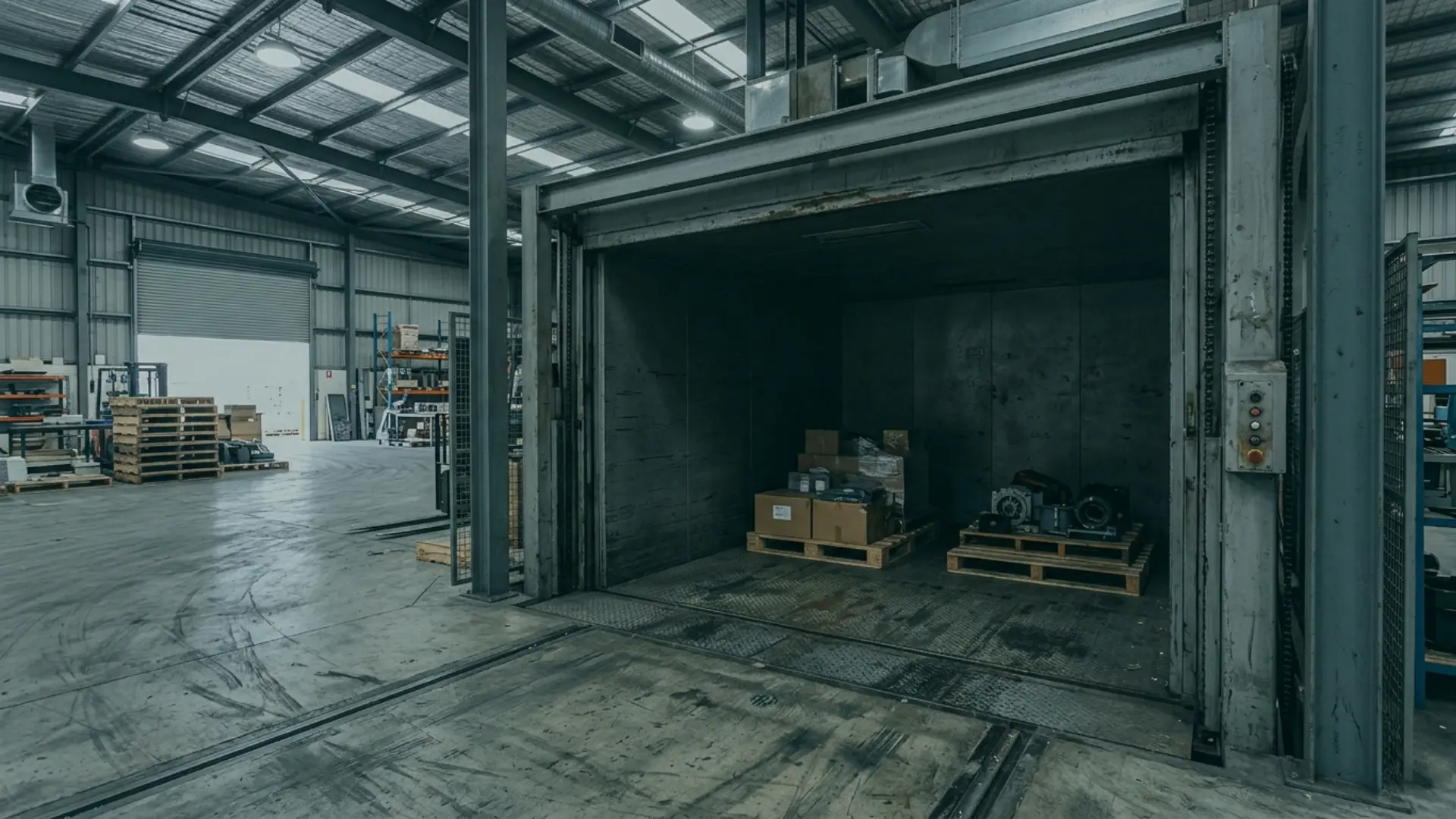
Freight & Industrial Lifts in Australia
Goods-only lifts, passenger-goods lifts, dumbwaiters, and car lifts each serve different load, compliance, and access requirements. Choosing the wrong type costs more than choosing the right one.
Freight and industrial lifts move goods, vehicles, and equipment between levels in warehouses, factories, retail buildings, hospitals, and commercial premises. The category covers a wide range of equipment — from a 50 kg dumbwaiter in a restaurant kitchen to a 10,000 kg car lift in a service centre.
The critical distinction is between goods-only lifts (which must never carry passengers) and passenger-goods lifts (rated to carry people alongside freight). This distinction drives the NCC requirements, the WHS plant registration obligations, and the cost. Getting it wrong creates compliance exposure that is expensive to fix after installation.
This page covers the main freight and industrial lift types available in Australia, the compliance framework governing each, and the key factors that determine which type suits your application.
Goods-only vs passenger-goods: the fundamental distinction
Every freight lift installation begins with one question: will people ride in the lift alongside the goods?
If yes, the lift must meet passenger lift requirements under the NCC and the relevant AS 1735 series standards. Car size, door configuration, emergency communication, ventilation, and control systems must all comply with passenger lift specifications. DDA access provisions under the Premises Standards 2010 may also apply, depending on the building class and the nature of the work.
If no — if the lift moves goods only and passengers are excluded — the compliance requirements are simpler but still significant. Goods-only lifts must have physical barriers (interlocked doors or gates) preventing human entry. They must still be registered as plant under WHS regulations, and they still require routine inspection and maintenance.
The cost difference is substantial. A goods-only lift for the same load capacity and travel can cost 30–50% less than a passenger-goods lift, primarily because of the reduced compliance and safety system requirements. But retrofitting passenger compliance into a goods-only installation is far more expensive than specifying correctly from the start.
Freight lift types in detail
Goods-only freight lifts
Goods-only lifts range from compact units moving palletised stock between mezzanine levels to heavy-duty platform lifts handling multi-tonne industrial loads. Key specifications include:
- Load capacity: 500 kg to 5,000 kg+ depending on application
- Car size: Determined by the largest item to be transported — allow clearance for pallet jacks, trolleys, or forklifts where relevant
- Door type: Vertical bi-parting doors, roller shutters, or swing gates depending on the load profile and available headroom
- Drive type: Hydraulic for low-rise heavy loads; traction for higher travel distances
Goods-only lifts must be clearly marked as not suitable for passenger use. Interlocked doors must prevent the lift from operating unless all landing and car doors are fully closed and locked.
Passenger-goods lifts
Passenger-goods lifts are the standard choice for commercial buildings where staff accompany goods — hospitals moving beds between floors, retail stores with stockroom access, and warehouses where personnel ride with palletised goods.
These lifts must comply with the full suite of passenger lift standards, including:
- AS 1735.1 or AS 1735.2 (depending on configuration)
- Emergency communication requirements (4G VoLTE emergency phone)
- DDA provisions where applicable under the Premises Standards 2010
- Car ventilation and lighting to passenger standards
Capacity ratings typically range from 1,000 kg to 5,000 kg.
Dumbwaiters
Dumbwaiters are small goods-only lifts with car sizes too small for human occupancy. Typical applications include:
- Restaurants and cafes — moving food and dishes between kitchen and service levels
- Hospitals — transporting medical supplies, pharmacy items, or meal trays
- Libraries and archives — moving books and records between floors
- Retail — stock transfer between sales floor and storage
Capacity ranges from 50 kg to 300 kg. Installation is relatively simple compared to full freight lifts, and costs are significantly lower — indicative range of $15,000–$50,000.
Dumbwaiters still require WHS plant registration in most jurisdictions. Do not assume the smaller scale exempts them from compliance obligations.
Car lifts
Car lifts (vehicle lifts) are heavy-duty platforms designed to move cars, trucks, or other vehicles between levels. Load ratings start at approximately 2,500 kg for passenger vehicles and extend to 10,000 kg+ for commercial vehicles.
Car lifts require substantial structural engineering — the pit, shaft, and supporting structure must handle dynamic loads significantly greater than the rated static capacity. Hydraulic drive is common for car lifts due to the high load and low speed requirements.
NCC compliance requirements
The National Construction Code (NCC) sets the building compliance framework for lift installations. For new commercial buildings (NCC classes 2–9), the NCC Volume One specifies where lifts are required, the performance requirements they must meet, and the referenced Australian Standards that provide the deemed-to-satisfy solutions.
Goods-only lifts that do not carry passengers have a different compliance pathway under the NCC compared to passenger-goods lifts.
WHS plant registration
Under Schedule 5 of the model WHS regulations, lifts are classified as registrable plant. Both the design and each installed unit require registration with the relevant state regulator.
Victoria operates under the OHS Act 2004 rather than the model WHS framework. Plant registration in Victoria is administered by WorkSafe Victoria, and the requirements differ from other states.
Choosing the right freight lift
The selection process starts with three questions:
- What are you moving? Define the heaviest single load, the largest physical item, and the daily throughput.
- Will people ride in the lift? This single question determines whether you need goods-only or passenger-goods compliance — and has the largest impact on cost.
- What is the travel distance? Low-rise applications (1–2 levels) suit hydraulic drive. Higher travel favours traction systems.
For maintenance obligations after installation, see our lift maintenance guide. For cost data, see commercial lift costs. For modernising ageing freight equipment, see lift modernisation.
Lift companies in Australia
Browse profiles, compare service areas, and check reviews.

Lift Shop
★ 5.0 (1551 reviews)
Australia's largest dedicated home lift specialist since 1996. 10,000+ installations. Exclusive Italian-crafted lifts with industry-leading 8-year warranty.
View profile →

Compact Home Lifts
NDIS★ 5.0 (465 reviews)
Melbourne branch of Compact Home Lifts. Compact residential lift specialist providing maintenance and repair services across Victoria.
View profile →

Next Level Elevators
★ 5.0 (454 reviews)
Award-winning provider of premium Italian-designed all-electric home elevators. Certified Eltec Partner. Showrooms in Melbourne, Sydney, and Brisbane.
View profile →

Shotton Lifts
NDIS★ 5.0 (9 reviews)
Family-owned Australian lift manufacturer since 1977. 80+ staff. Design, engineer, manufacture, install and service from Dandenong South VIC. NDIS registered.
View profile →

LiftFit Australia
NDIS★ 5.0 (8 reviews)
Victoria-based NDIS registered lift provider, est. 2011. Partners with Cibes, Savaria, and Kalea. Residential, commercial, and platform lifts.
View profile →

Easy Living Home Elevators
★ 5.0 (7 reviews)
Australia's #1 home elevator supplier since 1998. 100% Australian-owned. 11,000+ elevators in service across 6 states.
View profile →
LiftQuotes is a comparison platform. Companies shown are filtered by relevance to this page. Listing does not imply endorsement. LiftQuotes may receive a referral fee when you request quotes.
Get quotes from local installers
Your home's layout and access needs will determine the right product. Get quotes to find out.
What are you looking for today?
I need a lift installed
I have a lift that needs attention
Goods-only vs passenger-goods: the fundamental distinction
Every freight lift installation begins with one question: will people ride in the lift alongside the goods?
If yes, the lift must meet passenger lift requirements under the NCC and the relevant AS 1735 series standards. Car size, door configuration, emergency communication, ventilation, and control systems must all comply with passenger lift specifications. DDA access provisions under the Premises Standards 2010 may also apply, depending on the building class and the nature of the work.
If no — if the lift moves goods only and passengers are excluded — the compliance requirements are simpler but still significant. Goods-only lifts must have physical barriers (interlocked doors or gates) preventing human entry. They must still be registered as plant under WHS regulations, and they still require routine inspection and maintenance.
The cost difference is substantial. A goods-only lift for the same load capacity and travel can cost 30–50% less than a passenger-goods lift, primarily because of the reduced compliance and safety system requirements. But retrofitting passenger compliance into a goods-only installation is far more expensive than specifying correctly from the start.
Freight lift types in detail
Goods-only freight lifts
Goods-only lifts range from compact units moving palletised stock between mezzanine levels to heavy-duty platform lifts handling multi-tonne industrial loads. Key specifications include:
- Load capacity: 500 kg to 5,000 kg+ depending on application
- Car size: Determined by the largest item to be transported — allow clearance for pallet jacks, trolleys, or forklifts where relevant
- Door type: Vertical bi-parting doors, roller shutters, or swing gates depending on the load profile and available headroom
- Drive type: Hydraulic for low-rise heavy loads; traction for higher travel distances
Goods-only lifts must be clearly marked as not suitable for passenger use. Interlocked doors must prevent the lift from operating unless all landing and car doors are fully closed and locked.
Passenger-goods lifts
Passenger-goods lifts are the standard choice for commercial buildings where staff accompany goods — hospitals moving beds between floors, retail stores with stockroom access, and warehouses where personnel ride with palletised goods.
These lifts must comply with the full suite of passenger lift standards, including:
- AS 1735.1 or AS 1735.2 (depending on configuration)
- Emergency communication requirements (4G VoLTE emergency phone)
- DDA provisions where applicable under the Premises Standards 2010
- Car ventilation and lighting to passenger standards
Capacity ratings typically range from 1,000 kg to 5,000 kg.
Dumbwaiters
Dumbwaiters are small goods-only lifts with car sizes too small for human occupancy. Typical applications include:
- Restaurants and cafes — moving food and dishes between kitchen and service levels
- Hospitals — transporting medical supplies, pharmacy items, or meal trays
- Libraries and archives — moving books and records between floors
- Retail — stock transfer between sales floor and storage
Capacity ranges from 50 kg to 300 kg. Installation is relatively simple compared to full freight lifts, and costs are significantly lower — indicative range of $15,000–$50,000.
Dumbwaiters still require WHS plant registration in most jurisdictions. Do not assume the smaller scale exempts them from compliance obligations.
Car lifts
Car lifts (vehicle lifts) are heavy-duty platforms designed to move cars, trucks, or other vehicles between levels. Load ratings start at approximately 2,500 kg for passenger vehicles and extend to 10,000 kg+ for commercial vehicles.
Car lifts require substantial structural engineering — the pit, shaft, and supporting structure must handle dynamic loads significantly greater than the rated static capacity. Hydraulic drive is common for car lifts due to the high load and low speed requirements.
NCC compliance requirements
The National Construction Code (NCC) sets the building compliance framework for lift installations. For new commercial buildings (NCC classes 2–9), the NCC Volume One specifies where lifts are required, the performance requirements they must meet, and the referenced Australian Standards that provide the deemed-to-satisfy solutions.
Goods-only lifts that do not carry passengers have a different compliance pathway under the NCC compared to passenger-goods lifts.
WHS plant registration
Under Schedule 5 of the model WHS regulations, lifts are classified as registrable plant. Both the design and each installed unit require registration with the relevant state regulator.
Victoria operates under the OHS Act 2004 rather than the model WHS framework. Plant registration in Victoria is administered by WorkSafe Victoria, and the requirements differ from other states.
Choosing the right freight lift
The selection process starts with three questions:
- What are you moving? Define the heaviest single load, the largest physical item, and the daily throughput.
- Will people ride in the lift? This single question determines whether you need goods-only or passenger-goods compliance — and has the largest impact on cost.
- What is the travel distance? Low-rise applications (1–2 levels) suit hydraulic drive. Higher travel favours traction systems.
For maintenance obligations after installation, see our lift maintenance guide. For cost data, see commercial lift costs. For modernising ageing freight equipment, see lift modernisation.
Lift companies in Australia
Browse profiles, compare service areas, and check reviews.
Lift Shop
★ 5.0 (1551 reviews)
Australia's largest dedicated home lift specialist since 1996. 10,000+ installations. Exclusive Italian-crafted lifts with industry-leading 8-year warranty.
View profile →
Compact Home Lifts
NDIS★ 5.0 (465 reviews)
Melbourne branch of Compact Home Lifts. Compact residential lift specialist providing maintenance and repair services across Victoria.
View profile →
Next Level Elevators
★ 5.0 (454 reviews)
Award-winning provider of premium Italian-designed all-electric home elevators. Certified Eltec Partner. Showrooms in Melbourne, Sydney, and Brisbane.
View profile →
Shotton Lifts
NDIS★ 5.0 (9 reviews)
Family-owned Australian lift manufacturer since 1977. 80+ staff. Design, engineer, manufacture, install and service from Dandenong South VIC. NDIS registered.
View profile →
LiftFit Australia
NDIS★ 5.0 (8 reviews)
Victoria-based NDIS registered lift provider, est. 2011. Partners with Cibes, Savaria, and Kalea. Residential, commercial, and platform lifts.
View profile →
Easy Living Home Elevators
★ 5.0 (7 reviews)
Australia's #1 home elevator supplier since 1998. 100% Australian-owned. 11,000+ elevators in service across 6 states.
View profile →
LiftQuotes is a comparison platform. Companies shown are filtered by relevance to this page. Listing does not imply endorsement. LiftQuotes may receive a referral fee when you request quotes.
Get quotes from local installers
Your home's layout and access needs will determine the right product. Get quotes to find out.
What are you looking for today?
I need a lift installed
I have a lift that needs attention
Goods-only lifts
Designed exclusively for transporting goods with no passenger access. Simpler compliance requirements than passenger-rated equipment, but must have interlocked gates or doors that prevent people from entering the car or shaft. Capacity ranges from 500 kg to 5,000 kg+ depending on the application.
Passenger-goods lifts
Rated to carry both people and freight. Subject to full passenger lift compliance under the NCC and AS 1735 series, including DDA requirements where the lift serves an accessible building. The default choice when staff need to accompany goods between floors.
Dumbwaiters
Small-capacity goods-only lifts (typically 50–300 kg) used in restaurants, hospitals, libraries, and retail. Not designed for human occupancy. Lower cost and simpler installation than full goods lifts, but capacity and car size are limited.
Car lifts and heavy-duty platforms
Purpose-built for moving vehicles between levels in car parks, showrooms, and service centres. Load ratings of 2,500–10,000 kg+. Require specialist engineering, significant structural provisions, and specific WHS plant registration.
Frequently asked questions about freight and industrial lifts
A goods-only lift is designed exclusively to transport goods — passengers must never ride in it. A passenger-goods lift is rated to carry both people and freight, and must comply with full passenger lift standards under the NCC and AS 1735 series.
Related guides
Location
Commercial Lifts Melbourne: Costs, Compliance & Installers
Commercial lift costs, Victorian OHS compliance and the Melbourne installer market — indicative prices, WorkSafe Victoria rules and NCC requirements for VIC projects.
Location
Commercial Lifts Sydney: Costs, Compliance & Installers
Commercial lift costs, NSW compliance and the Sydney installer market — indicative prices, SafeWork NSW rules and NCC requirements for CBD and metro projects.
Guide
What Size Lift Do I Need for a Wheelchair? (Australia)
A home lift for a wheelchair needs roughly 1,100 x 1,400 mm inside and a 900 mm clear door. See minimum sizes for a wheelchair, a carer, and turning space.
Guide
Support at Home & Lift Funding: The 2026 Guide
Can Support at Home fund a home lift or stairlift? How aged care funding works, the OT assessment, means-tested contributions, and how it differs from the NDIS.
Ready to compare freight lift quotes?
Get obligation-free quotes from freight and industrial lift suppliers serving your area.
Join 1,000+ Australians who've requested quotes through LiftQuotes
Get free quotes