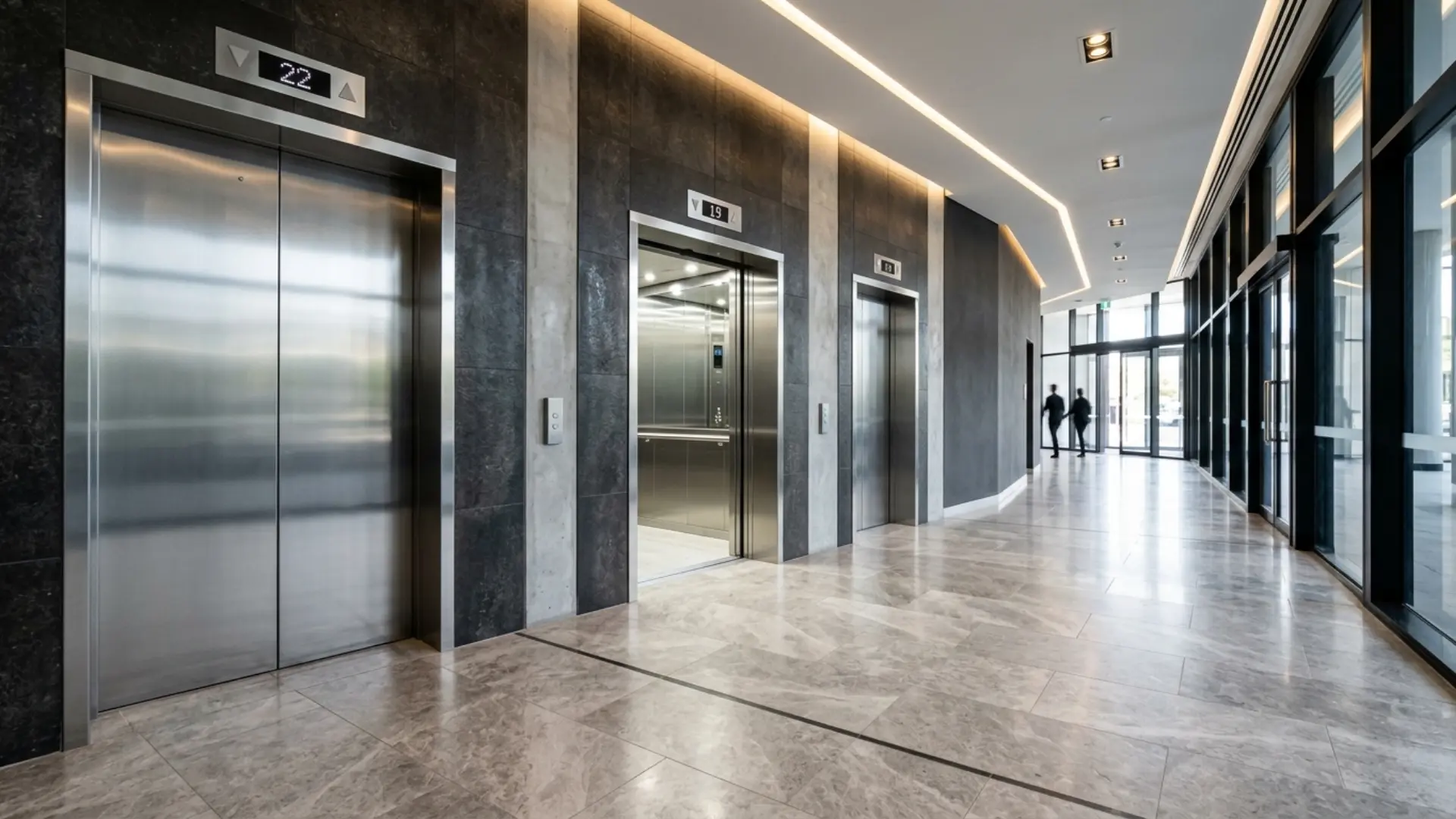
Commercial Lifts in Australia
A basic 2-stop DDA-compliant passenger lift starts from $50,000–$55,000 ex GST. Complex installations exceed $200,000 per lift. Here is what drives that range — and what compliance, maintenance, and registration obligations apply to your building.
Compliance, contracts and obligations at a glance
NCC and DDA compliance for new builds
Commercial buildings must comply with the NCC and, where public access is required, the Disability (Access to Premises — Buildings) Standards 2010. AS 1735.12:2020 specifies requirements for lift facilities for persons with disabilities. Whether a DDA-compliant lift is required, and what specifications it must meet, depends on building class, whether the building is new or undergoing work, the nature of that work, and travel height thresholds. An access consultant or building certifier confirms which requirements apply to a specific project.
Maintenance contracts: comprehensive vs non-comprehensive
A comprehensive contract covers labour, parts, adjustments, and call-outs within a fixed fee — the contractor carries the repair cost risk. A non-comprehensive contract covers scheduled inspections only; repairs and call-outs are invoiced separately — the owner carries the risk. Industry commentary in Australia notes that modern 'comprehensive' contracts often exclude major components and may restrict future competitive tendering. Confirm exclusions, response time commitments, and remedies before signing.
Plant registration and WHS obligations
Lifts are registrable plant under Schedule 5 of the Model WHS Regulations, requiring both design registration and item registration in WHS jurisdictions. Victoria uses the OHS Regulations 2017, not the model WHS framework, but equivalent obligations apply. The person with management or control of the plant — typically the building owner, owners corporation, or facility manager — holds ongoing WHS duties including safe maintenance, plant records, and current registration.
Emergency phone compliance
All lift emergency phones in Australia now operate on 4G VoLTE cellular — the PSTN copper network has been fully decommissioned. Emergency phone compliance is an ongoing maintenance obligation. Building managers should confirm the monitoring arrangement is active and documented at each routine maintenance visit. This is a standard scope item in modernisation projects and should be a line item in any maintenance contract review.
A commercial lift covers the range of passenger, goods, and DDA-accessible lifts installed in workplaces, commercial premises, strata buildings, and public facilities. A basic 2-stop DDA-compliant passenger lift starts from approximately $50,000–$55,000 ex GST, based on multiple supplier starting price examples (last checked March 2026). Complex installations — higher speeds, larger car sizes, stretcher capability, or difficult shaft configurations — can exceed $200,000 per lift. These figures exclude building works and ongoing maintenance costs.
This page primarily serves building managers and facility managers, strata committees and owners corporations (body corporate in Queensland), and commercial developers. A developer specifying a lift at DA stage has different priorities to a building manager managing a 20-year-old lift generating repeated call-outs. Both groups need to understand three compliance layers — building, disability access, and workplace safety — that apply simultaneously.
Building compliance is governed by the NCC and its referenced standards, including AS 1735.12:2020, which covers facilities for persons with disabilities in passenger lifts. Disability access compliance is governed by the Disability (Access to Premises — Buildings) Standards 2010 and AS 1428.1:2021. Workplace safety and plant registration obligations are governed by the model WHS Regulations in most jurisdictions — Victoria operates under the OHS Act 2004 and OHS Regulations 2017 — with lifts listed as registrable plant under Schedule 5.
For owners and managers of existing buildings, maintenance contract scope is often the highest-stakes commercial decision. The distinction between comprehensive and non-comprehensive contracts determines who carries the risk for unplanned repairs and parts costs. Modern 'comprehensive' contracts can be narrower in scope than their name suggests. Reviewing contract terms before signing or renewing, ideally with an independent lift consultant, is standard practice for well-managed strata and commercial portfolios.
NCC compliance, maintenance contracts and WHS obligations in detail
Commercial lift types
Passenger lifts serve people in commercial, retail, strata, and public buildings. Subject to AS 1735.12:2020 for DDA compliance where public access is required. Speed, car size, and door configuration are the primary specification variables.
Goods lifts are higher-capacity, typically with reinforced flooring and wider doors. Configurations range from goods-only to accompanied goods (operator rides with the load).
Stretcher and bed lifts are required in health and aged care facilities. Car size and door clearance requirements exceed standard passenger lifts; uptime and redundancy expectations are more demanding.
Car lifts are heavy-duty platforms for vehicle transport between parking levels. Rated to 2,500–5,000 kg, low speed, governed by WHS plant registration.
What a commercial lift costs
Indicative ranges (ex GST; last checked March 2026): standard passenger lift for 2–4 storeys $50,000–$100,000; mid-rise 5–10 storeys $100,000–$200,000; goods lifts $80,000–$150,000+. These cover equipment and installation — shaft construction, builder's works, and compliance costs are additional.
For a detailed breakdown, see commercial lift costs. For cost comparisons across all lift types, see lift costs in Australia.
NCC and DDA compliance
The NCC references AS 1735.12:2020 in its access provisions. Whether a DDA-compliant lift is required depends on building class, whether the building is new or existing, the nature of the work, and travel height thresholds. The Premises Standards 2010 provide the primary compliance pathway for access obligations. AS 1428.1:2021 sets minimum access design requirements.
An access consultant or building certifier is the appropriate professional to confirm requirements for a specific project.
Maintenance contracts and WHS
The distinction between comprehensive and non-comprehensive maintenance contracts determines who carries the risk for unplanned repairs. For contract comparison details and tendering guidance, see lift maintenance.
Lifts are registrable plant under Schedule 5 of the Model WHS Regulations. Victoria operates under the OHS Regulations 2017. State regulators: SafeWork NSW, WorkSafe Victoria, WHSQ, WorkSafe WA, SafeWork SA.
Emergency phone compliance
All lift emergency phones now operate on 4G VoLTE cellular. Compliance is an ongoing obligation — verify the monitoring arrangement at each maintenance visit. This is a standard scope item in modernisation projects.
Related pages
For upgrade planning, see lift modernisation. For maintenance contract guidance, see lift maintenance.
Commercial Lifts companies in Australia
Browse profiles, compare service areas, and check reviews.

Shotton Lifts
NDIS★ 5.0 (9 reviews)
Family-owned Australian lift manufacturer since 1977. 80+ staff. Design, engineer, manufacture, install and service from Dandenong South VIC. NDIS registered.
View profile →

LiftFit Australia
NDIS★ 5.0 (8 reviews)
Victoria-based NDIS registered lift provider, est. 2011. Partners with Cibes, Savaria, and Kalea. Residential, commercial, and platform lifts.
View profile →

Easy Living Home Elevators
★ 5.0 (7 reviews)
Australia's #1 home elevator supplier since 1998. 100% Australian-owned. 11,000+ elevators in service across 6 states.
View profile →

EcoLift
★ 5.0 (3 reviews)
Family-owned Sydney lift company. European-parts-based installations for reliability and cost-efficient servicing.
View profile →
EMS Elevator Group
★ 5.0 (2 reviews)
Sydney-based bespoke elevator company specialising in installation, modernisation, and maintenance. 24/7 support.
View profile →
Austand Elevator
★ 5.0 (1 reviews)
Adelaide-based global MRL elevator specialist. 30+ years experience, 2,000+ clients, lifts installed in 32 countries. Inventor of the Pre-Assembled Lift.
View profile →
LiftQuotes is a comparison platform. Companies shown are filtered by relevance to this page. Listing does not imply endorsement. LiftQuotes may receive a referral fee when you request quotes.
Get quotes from local installers
Your home's layout and access needs will determine the right product. Get quotes to find out.
What are you looking for today?
I need a lift installed
I have a lift that needs attention
A commercial lift covers the range of passenger, goods, and DDA-accessible lifts installed in workplaces, commercial premises, strata buildings, and public facilities. A basic 2-stop DDA-compliant passenger lift starts from approximately $50,000–$55,000 ex GST, based on multiple supplier starting price examples (last checked March 2026). Complex installations — higher speeds, larger car sizes, stretcher capability, or difficult shaft configurations — can exceed $200,000 per lift. These figures exclude building works and ongoing maintenance costs.
This page primarily serves building managers and facility managers, strata committees and owners corporations (body corporate in Queensland), and commercial developers. A developer specifying a lift at DA stage has different priorities to a building manager managing a 20-year-old lift generating repeated call-outs. Both groups need to understand three compliance layers — building, disability access, and workplace safety — that apply simultaneously.
Building compliance is governed by the NCC and its referenced standards, including AS 1735.12:2020, which covers facilities for persons with disabilities in passenger lifts. Disability access compliance is governed by the Disability (Access to Premises — Buildings) Standards 2010 and AS 1428.1:2021. Workplace safety and plant registration obligations are governed by the model WHS Regulations in most jurisdictions — Victoria operates under the OHS Act 2004 and OHS Regulations 2017 — with lifts listed as registrable plant under Schedule 5.
For owners and managers of existing buildings, maintenance contract scope is often the highest-stakes commercial decision. The distinction between comprehensive and non-comprehensive contracts determines who carries the risk for unplanned repairs and parts costs. Modern 'comprehensive' contracts can be narrower in scope than their name suggests. Reviewing contract terms before signing or renewing, ideally with an independent lift consultant, is standard practice for well-managed strata and commercial portfolios.
NCC compliance, maintenance contracts and WHS obligations in detail
Commercial lift types
Passenger lifts serve people in commercial, retail, strata, and public buildings. Subject to AS 1735.12:2020 for DDA compliance where public access is required. Speed, car size, and door configuration are the primary specification variables.
Goods lifts are higher-capacity, typically with reinforced flooring and wider doors. Configurations range from goods-only to accompanied goods (operator rides with the load).
Stretcher and bed lifts are required in health and aged care facilities. Car size and door clearance requirements exceed standard passenger lifts; uptime and redundancy expectations are more demanding.
Car lifts are heavy-duty platforms for vehicle transport between parking levels. Rated to 2,500–5,000 kg, low speed, governed by WHS plant registration.
What a commercial lift costs
Indicative ranges (ex GST; last checked March 2026): standard passenger lift for 2–4 storeys $50,000–$100,000; mid-rise 5–10 storeys $100,000–$200,000; goods lifts $80,000–$150,000+. These cover equipment and installation — shaft construction, builder's works, and compliance costs are additional.
For a detailed breakdown, see commercial lift costs. For cost comparisons across all lift types, see lift costs in Australia.
NCC and DDA compliance
The NCC references AS 1735.12:2020 in its access provisions. Whether a DDA-compliant lift is required depends on building class, whether the building is new or existing, the nature of the work, and travel height thresholds. The Premises Standards 2010 provide the primary compliance pathway for access obligations. AS 1428.1:2021 sets minimum access design requirements.
An access consultant or building certifier is the appropriate professional to confirm requirements for a specific project.
Maintenance contracts and WHS
The distinction between comprehensive and non-comprehensive maintenance contracts determines who carries the risk for unplanned repairs. For contract comparison details and tendering guidance, see lift maintenance.
Lifts are registrable plant under Schedule 5 of the Model WHS Regulations. Victoria operates under the OHS Regulations 2017. State regulators: SafeWork NSW, WorkSafe Victoria, WHSQ, WorkSafe WA, SafeWork SA.
Emergency phone compliance
All lift emergency phones now operate on 4G VoLTE cellular. Compliance is an ongoing obligation — verify the monitoring arrangement at each maintenance visit. This is a standard scope item in modernisation projects.
Related pages
For upgrade planning, see lift modernisation. For maintenance contract guidance, see lift maintenance.
Commercial Lifts companies in Australia
Browse profiles, compare service areas, and check reviews.
Shotton Lifts
NDIS★ 5.0 (9 reviews)
Family-owned Australian lift manufacturer since 1977. 80+ staff. Design, engineer, manufacture, install and service from Dandenong South VIC. NDIS registered.
View profile →
LiftFit Australia
NDIS★ 5.0 (8 reviews)
Victoria-based NDIS registered lift provider, est. 2011. Partners with Cibes, Savaria, and Kalea. Residential, commercial, and platform lifts.
View profile →
Easy Living Home Elevators
★ 5.0 (7 reviews)
Australia's #1 home elevator supplier since 1998. 100% Australian-owned. 11,000+ elevators in service across 6 states.
View profile →
EcoLift
★ 5.0 (3 reviews)
Family-owned Sydney lift company. European-parts-based installations for reliability and cost-efficient servicing.
View profile →
EMS Elevator Group
★ 5.0 (2 reviews)
Sydney-based bespoke elevator company specialising in installation, modernisation, and maintenance. 24/7 support.
View profile →
Austand Elevator
★ 5.0 (1 reviews)
Adelaide-based global MRL elevator specialist. 30+ years experience, 2,000+ clients, lifts installed in 32 countries. Inventor of the Pre-Assembled Lift.
View profile →
LiftQuotes is a comparison platform. Companies shown are filtered by relevance to this page. Listing does not imply endorsement. LiftQuotes may receive a referral fee when you request quotes.
Get quotes from local installers
Your home's layout and access needs will determine the right product. Get quotes to find out.
What are you looking for today?
I need a lift installed
I have a lift that needs attention
Frequently asked questions about commercial lifts
A basic 2-stop DDA-compliant passenger lift starts from approximately $50,000–$55,000 ex GST, based on multiple supplier starting price examples (last checked March 2026). As building height, speed class, car size, and shaft complexity increase, costs can reach $200,000 or more per lift. Goods lifts start from around $45,000 for basic configurations. Modernisation of an existing commercial lift — controller, drive, and doors as a starting scope — typically runs $80,000–$120,000 per car. Full modernisation or replacement in complex shafts can reach $220,000–$400,000 or more per lift. All figures exclude building works, which are typically quoted separately.
Related guides
Location
Commercial Lifts Melbourne: Costs, Compliance & Installers
Commercial lift costs, Victorian OHS compliance and the Melbourne installer market — indicative prices, WorkSafe Victoria rules and NCC requirements for VIC projects.
Location
Commercial Lifts Sydney: Costs, Compliance & Installers
Commercial lift costs, NSW compliance and the Sydney installer market — indicative prices, SafeWork NSW rules and NCC requirements for CBD and metro projects.
Guide
What Size Lift Do I Need for a Wheelchair? (Australia)
A home lift for a wheelchair needs roughly 1,100 x 1,400 mm inside and a 900 mm clear door. See minimum sizes for a wheelchair, a carer, and turning space.
Guide
Support at Home & Lift Funding: The 2026 Guide
Can Support at Home fund a home lift or stairlift? How aged care funding works, the OT assessment, means-tested contributions, and how it differs from the NDIS.
Get commercial lift quotes for your building
Commercial lift costs vary significantly based on building type, floors served, car size, access requirements, and shaft configuration. Whether you are specifying a new build, reviewing a maintenance contract, or planning a modernisation, getting independent quotes is the starting point.
Join 1,000+ Australians who've requested quotes through LiftQuotes
Get free quotes