Strata Lift Maintenance: A Guide for Owners Corporations
A practical framework for managing lift maintenance obligations, contracts, budgets and record-keeping in strata buildings.
The owners corporation or body corporate is legally responsible for maintaining lifts on common property. Under WHS legislation in most states — and the OHS Act in Victoria — it holds duties as a Person Conducting a Business or Undertaking (PCBU) over that plant. A maintenance failure that injures a resident or visitor exposes the owners corporation to regulatory action, not just the service provider.
This guide covers the practical decisions a strata committee needs to make: choosing between comprehensive and non-comprehensive maintenance contracts, setting service frequency, budgeting from the right fund, keeping compliant records, and switching providers when the current arrangement no longer serves the building.
Who is responsible for strata lift maintenance?
The owners corporation (NSW, VIC, ACT, WA, SA, TAS) or body corporate (QLD) holds the maintenance obligation for lifts on common property. Under the Work Health and Safety Act — and the Occupational Health and Safety Act in Victoria — the owners corporation is classified as a PCBU. That classification creates a positive duty to ensure common-property plant, including lifts, is maintained in a safe condition and does not pose a risk to health.
In practice, the strata committee cannot treat lift maintenance as optional or defer it indefinitely. A breakdown that injures a resident or visitor can trigger regulatory action against the owners corporation, not just the maintenance provider. The committee must ensure a current maintenance contract is in place, statutory inspections are completed, and the lift log book is kept up to date.
Victoria is the exception to the national WHS framework. WorkSafe Victoria administers the OHS Act 2004 and OHS Regulations 2017 — the duties are substantively similar, but the legislation, regulator, and registration processes differ. If your building is in Victoria, verify your obligations through WorkSafe Victoria rather than Safe Work Australia.
Comprehensive vs non-comprehensive contracts
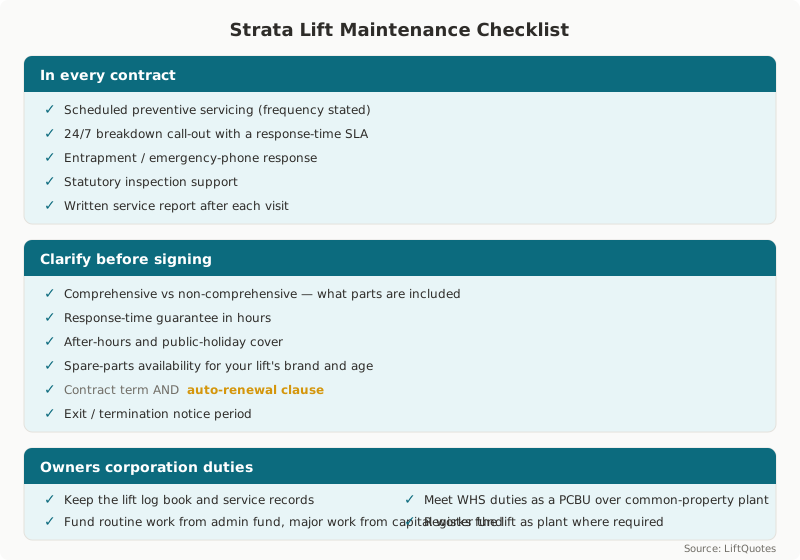
The distinction between comprehensive and non-comprehensive maintenance contracts is the single most consequential decision a strata committee makes when procuring lift servicing.
A comprehensive contract bundles all scheduled servicing, parts, labour, and emergency callouts into one fixed annual fee. The provider covers the cost of component failures — motors, door operators, controllers, ropes — as they arise. Budgeting is predictable, and the provider has a financial incentive to maintain the lift well, because every breakdown they prevent saves them money.
A non-comprehensive contract covers scheduled service visits and basic inspections only. Parts, emergency callouts, and major repairs are billed separately at market rates. The annual fee is lower — often 40–60% less than a comprehensive equivalent — but the total cost of ownership can be higher if the lift is older or unreliable. Strata committees choosing non-comprehensive contracts should budget a contingency in the administrative fund for unplanned call-outs, which typically range from $150 to $300 per visit plus parts at full price. For a detailed cost breakdown, see the guide to lift maintenance costs.
Neither contract type is universally better. A newer lift under five years old may suit a non-comprehensive contract because component failures are rare. An ageing lift over 15 years old — particularly one with obsolete parts — is usually better served by a comprehensive arrangement. Match the contract type to the lift's age, condition, and parts availability.
Service frequency and statutory inspections
Most strata lift maintenance contracts specify monthly or quarterly scheduled visits, depending on the lift's age, traffic volume, and the contract tier. Monthly servicing is standard for high-traffic residential buildings with more than 10 floors. Quarterly visits are common for low-rise buildings with a single lift.
Statutory inspections are separate from routine maintenance. Every state and territory requires a periodic inspection by a competent person — typically annual, though frequency varies by jurisdiction. The inspection verifies that the lift complies with the relevant Australian lift standards, that safety systems are functional, and that the lift is registered as plant where required. Your maintenance provider should coordinate statutory inspections, but the owners corporation remains responsible for ensuring they happen.
Emergency phone compliance is another ongoing obligation. All lift emergency phones in Australia now operate on 4G VoLTE following the decommissioning of the 3G and PSTN copper networks. The committee should verify that the monitoring arrangement is active and that the 4G connection functions correctly — this is typically checked during routine service visits.
Budgeting for lift maintenance
Routine maintenance is funded from the owners corporation's administrative (operating) fund. As of Q3 2026, indicative annual costs for a comprehensive strata lift maintenance contract range from $2,500 to $6,000 per lift, depending on the lift's age, number of floors served, and the contract scope. Non-comprehensive contracts typically sit between $1,200 and $3,000 per lift per year, but unbudgeted call-outs and parts can push the true cost higher.
Major repairs, modernisation, and lift replacement are capital expenditure items funded from the capital works (sinking) fund. A full lift modernisation — new controller, doors, motor, and car interior — typically costs between $60,000 and $150,000 per lift. The capital works fund plan should include a provision for modernisation based on the lift's age and condition, reviewed every five years.
Statutory inspections (typically $400 to $1,200 per lift per year) and emergency phone monitoring ($300 to $700 per year) are recurrent costs that sit in the administrative fund. Include them as separate line items in the annual budget rather than burying them in general maintenance.
Record-keeping obligations
The owners corporation must maintain a lift log book for each lift on common property. This log records every service visit, inspection, breakdown, entrapment, and modification. It is the primary audit trail if a regulator, insurer, or workplace safety inspector examines the building's compliance history.
Records to retain include service reports from every maintenance visit (the provider should supply these after each attendance), statutory and periodic inspection reports, incident and entrapment logs with dates and actions taken, plant registration and design registration certificates, and modernisation or major repair documentation. Retain records for the service life of the lift — not just the current maintenance contract term. Auditors, insurers, and state regulators can request access at any time.
Switching your maintenance provider
Strata committees can and do change maintenance providers — the contract is not permanent. Start by reviewing the current contract's exit clause: most specify a notice period of 60 to 90 days, and some include an auto-renewal clause that extends the term unless notice is given by a specific date. Missing the notice window can lock the building in for another 12 months.
Once notice is served, run a structured tender. Shortlist three to four providers — mixing OEM service arms and independent contractors — and score their proposals on response-time SLA, parts access for your lift's brand and age, scope (comprehensive or non-comprehensive), and references from comparable buildings. The handover must include transfer of keys, access codes, the lift log book, and all service records.
Lift maintenance is a compliance obligation and a budget line — not a set-and-forget item. Strata committees that treat it as a procurement decision consistently achieve better uptime, lower total cost, and fewer compliance surprises. Get free quotes from maintenance providers serving your building to compare scope and pricing.
Lift companies in Australia
Browse profiles, compare service areas, and check reviews.

Lift Shop
★ 5.0 (1551 reviews)
Australia's largest dedicated home lift specialist since 1996. 10,000+ installations. Exclusive Italian-crafted lifts with industry-leading 8-year warranty.
View profile →

Compact Home Lifts
NDIS★ 5.0 (465 reviews)
Melbourne branch of Compact Home Lifts. Compact residential lift specialist providing maintenance and repair services across Victoria.
View profile →

Next Level Elevators
★ 5.0 (454 reviews)
Award-winning provider of premium Italian-designed all-electric home elevators. Certified Eltec Partner. Showrooms in Melbourne, Sydney, and Brisbane.
View profile →

Shotton Lifts
NDIS★ 5.0 (9 reviews)
Family-owned Australian lift manufacturer since 1977. 80+ staff. Design, engineer, manufacture, install and service from Dandenong South VIC. NDIS registered.
View profile →

LiftFit Australia
NDIS★ 5.0 (8 reviews)
Victoria-based NDIS registered lift provider, est. 2011. Partners with Cibes, Savaria, and Kalea. Residential, commercial, and platform lifts.
View profile →

Easy Living Home Elevators
★ 5.0 (7 reviews)
Australia's #1 home elevator supplier since 1998. 100% Australian-owned. 11,000+ elevators in service across 6 states.
View profile →
LiftQuotes is a comparison platform. Companies shown are filtered by relevance to this page. Listing does not imply endorsement. LiftQuotes may receive a referral fee when you request quotes.
Put this into action
When you're ready to move forward, get free quotes from verified Australian lift installers.
What are you looking for today?
I need a lift installed
I have a lift that needs attention
The owners corporation or body corporate is legally responsible for maintaining lifts on common property. Under WHS legislation in most states — and the OHS Act in Victoria — it holds duties as a Person Conducting a Business or Undertaking (PCBU) over that plant. A maintenance failure that injures a resident or visitor exposes the owners corporation to regulatory action, not just the service provider.
This guide covers the practical decisions a strata committee needs to make: choosing between comprehensive and non-comprehensive maintenance contracts, setting service frequency, budgeting from the right fund, keeping compliant records, and switching providers when the current arrangement no longer serves the building.
Who is responsible for strata lift maintenance?
The owners corporation (NSW, VIC, ACT, WA, SA, TAS) or body corporate (QLD) holds the maintenance obligation for lifts on common property. Under the Work Health and Safety Act — and the Occupational Health and Safety Act in Victoria — the owners corporation is classified as a PCBU. That classification creates a positive duty to ensure common-property plant, including lifts, is maintained in a safe condition and does not pose a risk to health.
In practice, the strata committee cannot treat lift maintenance as optional or defer it indefinitely. A breakdown that injures a resident or visitor can trigger regulatory action against the owners corporation, not just the maintenance provider. The committee must ensure a current maintenance contract is in place, statutory inspections are completed, and the lift log book is kept up to date.
Victoria is the exception to the national WHS framework. WorkSafe Victoria administers the OHS Act 2004 and OHS Regulations 2017 — the duties are substantively similar, but the legislation, regulator, and registration processes differ. If your building is in Victoria, verify your obligations through WorkSafe Victoria rather than Safe Work Australia.
Comprehensive vs non-comprehensive contracts
The distinction between comprehensive and non-comprehensive maintenance contracts is the single most consequential decision a strata committee makes when procuring lift servicing.
A comprehensive contract bundles all scheduled servicing, parts, labour, and emergency callouts into one fixed annual fee. The provider covers the cost of component failures — motors, door operators, controllers, ropes — as they arise. Budgeting is predictable, and the provider has a financial incentive to maintain the lift well, because every breakdown they prevent saves them money.
A non-comprehensive contract covers scheduled service visits and basic inspections only. Parts, emergency callouts, and major repairs are billed separately at market rates. The annual fee is lower — often 40–60% less than a comprehensive equivalent — but the total cost of ownership can be higher if the lift is older or unreliable. Strata committees choosing non-comprehensive contracts should budget a contingency in the administrative fund for unplanned call-outs, which typically range from $150 to $300 per visit plus parts at full price. For a detailed cost breakdown, see the guide to lift maintenance costs.
Neither contract type is universally better. A newer lift under five years old may suit a non-comprehensive contract because component failures are rare. An ageing lift over 15 years old — particularly one with obsolete parts — is usually better served by a comprehensive arrangement. Match the contract type to the lift's age, condition, and parts availability.
Service frequency and statutory inspections
Most strata lift maintenance contracts specify monthly or quarterly scheduled visits, depending on the lift's age, traffic volume, and the contract tier. Monthly servicing is standard for high-traffic residential buildings with more than 10 floors. Quarterly visits are common for low-rise buildings with a single lift.
Statutory inspections are separate from routine maintenance. Every state and territory requires a periodic inspection by a competent person — typically annual, though frequency varies by jurisdiction. The inspection verifies that the lift complies with the relevant Australian lift standards, that safety systems are functional, and that the lift is registered as plant where required. Your maintenance provider should coordinate statutory inspections, but the owners corporation remains responsible for ensuring they happen.
Emergency phone compliance is another ongoing obligation. All lift emergency phones in Australia now operate on 4G VoLTE following the decommissioning of the 3G and PSTN copper networks. The committee should verify that the monitoring arrangement is active and that the 4G connection functions correctly — this is typically checked during routine service visits.
Budgeting for lift maintenance
Routine maintenance is funded from the owners corporation's administrative (operating) fund. As of Q3 2026, indicative annual costs for a comprehensive strata lift maintenance contract range from $2,500 to $6,000 per lift, depending on the lift's age, number of floors served, and the contract scope. Non-comprehensive contracts typically sit between $1,200 and $3,000 per lift per year, but unbudgeted call-outs and parts can push the true cost higher.
Major repairs, modernisation, and lift replacement are capital expenditure items funded from the capital works (sinking) fund. A full lift modernisation — new controller, doors, motor, and car interior — typically costs between $60,000 and $150,000 per lift. The capital works fund plan should include a provision for modernisation based on the lift's age and condition, reviewed every five years.
Statutory inspections (typically $400 to $1,200 per lift per year) and emergency phone monitoring ($300 to $700 per year) are recurrent costs that sit in the administrative fund. Include them as separate line items in the annual budget rather than burying them in general maintenance.
Record-keeping obligations
The owners corporation must maintain a lift log book for each lift on common property. This log records every service visit, inspection, breakdown, entrapment, and modification. It is the primary audit trail if a regulator, insurer, or workplace safety inspector examines the building's compliance history.
Records to retain include service reports from every maintenance visit (the provider should supply these after each attendance), statutory and periodic inspection reports, incident and entrapment logs with dates and actions taken, plant registration and design registration certificates, and modernisation or major repair documentation. Retain records for the service life of the lift — not just the current maintenance contract term. Auditors, insurers, and state regulators can request access at any time.
Switching your maintenance provider
Strata committees can and do change maintenance providers — the contract is not permanent. Start by reviewing the current contract's exit clause: most specify a notice period of 60 to 90 days, and some include an auto-renewal clause that extends the term unless notice is given by a specific date. Missing the notice window can lock the building in for another 12 months.
Once notice is served, run a structured tender. Shortlist three to four providers — mixing OEM service arms and independent contractors — and score their proposals on response-time SLA, parts access for your lift's brand and age, scope (comprehensive or non-comprehensive), and references from comparable buildings. The handover must include transfer of keys, access codes, the lift log book, and all service records.
Lift maintenance is a compliance obligation and a budget line — not a set-and-forget item. Strata committees that treat it as a procurement decision consistently achieve better uptime, lower total cost, and fewer compliance surprises. Get free quotes from maintenance providers serving your building to compare scope and pricing.
Lift companies in Australia
Browse profiles, compare service areas, and check reviews.
Lift Shop
★ 5.0 (1551 reviews)
Australia's largest dedicated home lift specialist since 1996. 10,000+ installations. Exclusive Italian-crafted lifts with industry-leading 8-year warranty.
View profile →
Compact Home Lifts
NDIS★ 5.0 (465 reviews)
Melbourne branch of Compact Home Lifts. Compact residential lift specialist providing maintenance and repair services across Victoria.
View profile →
Next Level Elevators
★ 5.0 (454 reviews)
Award-winning provider of premium Italian-designed all-electric home elevators. Certified Eltec Partner. Showrooms in Melbourne, Sydney, and Brisbane.
View profile →
Shotton Lifts
NDIS★ 5.0 (9 reviews)
Family-owned Australian lift manufacturer since 1977. 80+ staff. Design, engineer, manufacture, install and service from Dandenong South VIC. NDIS registered.
View profile →
LiftFit Australia
NDIS★ 5.0 (8 reviews)
Victoria-based NDIS registered lift provider, est. 2011. Partners with Cibes, Savaria, and Kalea. Residential, commercial, and platform lifts.
View profile →
Easy Living Home Elevators
★ 5.0 (7 reviews)
Australia's #1 home elevator supplier since 1998. 100% Australian-owned. 11,000+ elevators in service across 6 states.
View profile →
LiftQuotes is a comparison platform. Companies shown are filtered by relevance to this page. Listing does not imply endorsement. LiftQuotes may receive a referral fee when you request quotes.
Put this into action
When you're ready to move forward, get free quotes from verified Australian lift installers.
What are you looking for today?
I need a lift installed
I have a lift that needs attention
Responsibility sits with the owners corporation
Under WHS legislation (OHS in Victoria), the owners corporation is a PCBU with a positive duty to maintain common-property lifts in safe working order.
Contract type is the key decision
Choose between comprehensive (all parts, labour and callouts included) and non-comprehensive (scheduled visits only) based on your lift's age, condition and parts availability.
Budget from the right fund
Routine maintenance comes from the administrative fund. Major repairs and modernisation are capital works fund items. Annual comprehensive contracts typically cost $2,500 to $6,000 per lift.
Records are a compliance obligation
Maintain a lift log book, retain service reports and inspection certificates, and keep incident records for the service life of the lift. Regulators and insurers can request access at any time.
Common questions about strata lift maintenance
The owners corporation (NSW, VIC, WA, SA, TAS, ACT) or body corporate (QLD) is responsible. Under WHS legislation — or the OHS Act in Victoria — the owners corporation is a Person Conducting a Business or Undertaking (PCBU) with a duty to maintain common-property plant, including lifts, in a safe condition. The committee must ensure a current maintenance contract is in place and statutory inspections are completed.
Related guides
Guide
Our Editorial Methodology: How LiftQuotes Researches Content
How LiftQuotes researches, sources and reviews every lift guide and cost page: the standards we cite, our linked-source rule for cost data, and how often we update.
Guide
Lift Compliance Checklist for Facility Managers (Australia)
A facility manager's lift compliance checklist for Australia: plant registration, inspection, log books, 4G VoLTE emergency phones and DDA access duties.
Comparison
Stairlift vs Platform Lift: Which Access Solution Fits?
A stairlift carries a seated user along the stairs from about $3,000; a platform lift raises a wheelchair vertically from about $15,000. Compare cost, access and fit.
Location
Lift Companies in Melbourne: Compare Local Installers
Compare lift companies in Melbourne for home, platform and commercial lifts. WorkSafe Victoria compliance, local installer coverage and indicative VIC costs.
Need strata lift maintenance quotes?
Compare maintenance providers serving your building. Free, no-obligation quotes from vetted Australian lift companies.
Join 1,000+ Australians who've requested quotes through LiftQuotes
Get free quotes