Stairlift Cost in Australia
Straight stairlifts start from around $3,000 installed. Curved models run $8,000–$15,000+. Here is what drives the price and where to save.
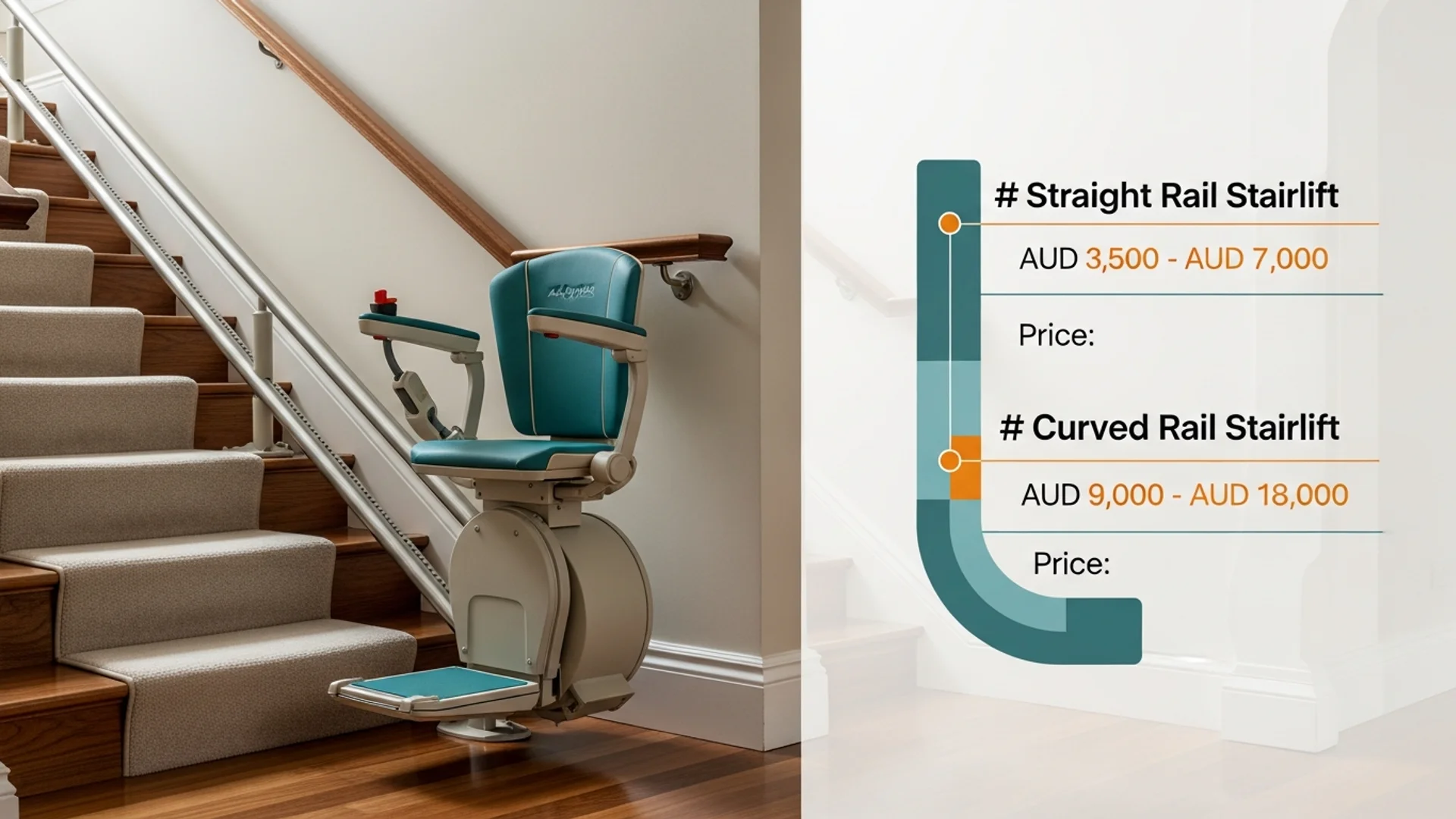
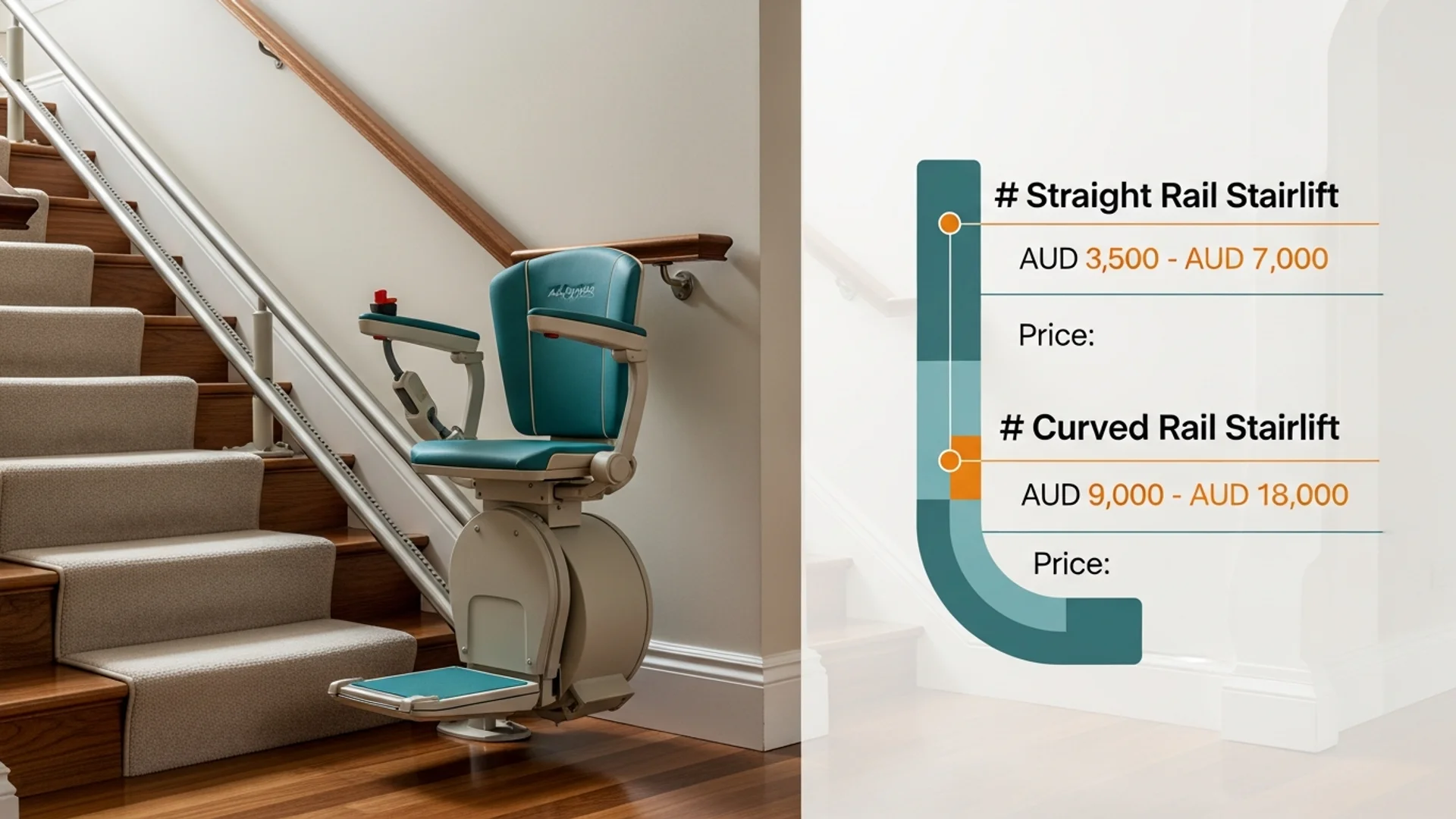
A stairlift in Australia costs between $3,000 and $15,000+ installed, depending almost entirely on one variable: whether your staircase is straight or curved. A straight stairlift — one continuous rail from bottom to top — is a standardised product that installs in a few hours. A curved stairlift requires a custom-manufactured rail that follows every turn, landing, and angle of your staircase, and that bespoke rail is where the cost sits.
As of Q2 2026, expect to pay $3,000–$6,000 for a new straight stairlift and $8,000–$15,000+ for a curved model. Reconditioned units can reduce these figures by 30–40%. Rental is also available from around $80–$150 per month for straight models — a practical option after surgery or during short-term recovery.
The table below shows indicative stairlift prices for the Australian market as of April 2026. All figures are ex GST and include standard installation on a timber or concrete staircase.
| Scenario | Cost range (AUD, ex GST) | Notes |
|---|---|---|
| Straight stairlift — new, single flight, indoor | $3,000–$6,000 | Standard rail up to 5m. Includes seat, rail, installation, and basic warranty. Based on supplier-stated pricing from major Australian distributors (Direct Lifts, P.R. King & Sons; checked April 2026). |
| Curved stairlift — new, single curve or 90° turn | $8,000–$12,000 | Custom-manufactured rail to suit staircase geometry. Price varies with number of turns and rail length. Supplier-stated pricing and hipages data; checked April 2026. |
| Curved stairlift — new, multi-turn or complex layout | $12,000–$18,000 | Staircases with multiple landings, 180° turns, or spiral sections. Custom survey and engineering required. Indicative based on supplier quotes; checked April 2026. |
| Straight stairlift — reconditioned | $2,000–$4,000 | Factory-refurbished unit with new upholstery and electrics. Shorter warranty than new (typically 12 months vs 2–5 years). hipages and supplier data; checked April 2026. |
| Curved stairlift — reconditioned | $5,000–$10,000 | Reconditioned curved units are rarer because the rail is custom to the original staircase. Only available if a matching rail profile is in stock. Supplier-stated; checked April 2026. |
| Outdoor stairlift — straight, weather-rated | $5,000–$8,000 | Marine-grade components, waterproof covers, UV-resistant seat. Suits external steps and decks. Supplier-stated; checked April 2026. |
| Stairlift rental — straight, per month | $80–$150 | Monthly rental including installation, removal, and maintenance. Minimum rental periods typically 3–6 months. Supplier-stated pricing; checked April 2026. |
Prices are compiled from publicly available supplier-stated pricing (P.R. King & Sons, Direct Lifts), consumer cost aggregators (hipages), and verified distributor quotes. Figures represent indicative installed costs ex GST for standard residential installations. Complex staircases, heritage homes, or non-standard access may incur additional charges.
Last checked: 3 April 2026
Seven factors determine where your stairlift falls within these ranges.
Staircase shape — the biggest variable
Straight staircases use off-the-shelf rail cut to length. Curved staircases need a rail custom-manufactured from a laser survey of your staircase. This single factor accounts for the $5,000+ gap between straight and curved pricing. Every turn, landing, and angle adds to the rail manufacturing cost.
Rail length
A standard straight rail covers up to about 5 metres. Longer runs or staircases spanning multiple floors cost more — each additional metre of straight rail adds $200–$400, while each additional metre of curved rail adds $500–$1,000.
New vs reconditioned
A reconditioned stairlift uses a factory-refurbished drive unit and new wearing parts on an existing chassis. Cost savings are typically 30–40% off the new price. The trade-off is a shorter warranty (usually 12 months instead of 2–5 years) and limited availability for curved models.
Indoor vs outdoor installation
Outdoor stairlifts cost $1,500–$3,000 more than equivalent indoor models. They use marine-grade components, sealed electronics, waterproof covers, and UV-resistant upholstery — all necessary in the Australian climate.
Weight capacity
Standard stairlifts carry 115–130 kg. Heavy-duty models rated to 160 kg or above cost 10–20% more and require reinforced rail brackets.
Power supply and battery
Most modern stairlifts run on rechargeable batteries charged via the mains at the top and bottom stations. This means they operate during power outages. Older or budget models may require a direct mains connection with no battery backup.
Additional features
Powered swivel seats ($300–$600 extra), powered footrests ($200–$400), remote controls, and upgraded upholstery all add to the price. For users with limited mobility, a powered swivel seat is often worth the extra — it turns the seat at the top landing so you can dismount safely without twisting.
Home Lifts companies in Australia
Browse profiles, compare service areas, and check reviews.

Shotton Lifts
NDIS★ 5.0 (9 reviews)
Family-owned Australian lift manufacturer since 1977. 80+ staff. Design, engineer, manufacture, install and service from Dandenong South VIC. NDIS registered.
View profile →

LiftFit Australia
NDIS★ 5.0 (8 reviews)
Victoria-based NDIS registered lift provider, est. 2011. Partners with Cibes, Savaria, and Kalea. Residential, commercial, and platform lifts.
View profile →
Easy Living Home Elevators
★ 5.0 (7 reviews)
Australia's #1 home elevator supplier since 1998. 100% Australian-owned. 11,000+ elevators in service across 6 states.
View profile →
EcoLift
★ 5.0 (3 reviews)
Family-owned Sydney lift company. European-parts-based installations for reliability and cost-efficient servicing.
View profile →

Sunshine Coast Elevators
★ 5.0 (3 reviews)
Sunshine Coast QLD specialist in bespoke Italian-made residential elevators and disability access lifts. 38+ years industry experience.
View profile →
EMS Elevator Group
★ 5.0 (2 reviews)
Sydney-based bespoke elevator company specialising in installation, modernisation, and maintenance. 24/7 support.
View profile →
LiftQuotes is a comparison platform. Companies shown are filtered by relevance to this page. Listing does not imply endorsement. LiftQuotes may receive a referral fee when you request quotes.
Straight vs curved: which do you need?
The distinction is simple. If your staircase goes from bottom to top in a single straight run with no turns, landings, or curves, you need a straight stairlift. Anything else — a 90° turn, an intermediate landing, an L-shape, a spiral — requires a curved model.
The cost gap is substantial because straight rails are a commodity product. Manufacturers produce them in standard lengths and cut to fit on site. Curved rails are individually manufactured from a 3D laser survey of your specific staircase. No two curved rails are identical.
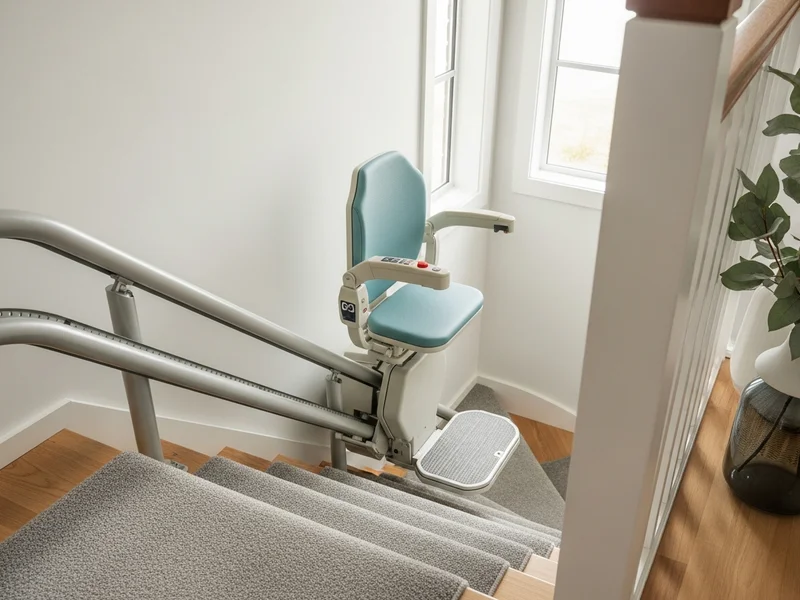
If your home has a straight staircase, you are in the more affordable bracket. If your staircase turns, get a survey done early — the quote depends on the exact geometry and cannot be estimated without measurement.
New, reconditioned, or rental?
New stairlifts come with a full manufacturer warranty (typically 2–5 years parts and labour), the latest safety features, and your choice of upholstery and finishes. For a straight model, expect $3,000–$6,000 installed.
Reconditioned stairlifts are a genuine alternative for straight staircases. Major suppliers refurbish traded-in units with new seats, electronics, and safety sensors. The rail is recut to fit your staircase. Cost savings sit around 30–40%, bringing a straight unit to $2,000–$4,000. Reconditioned curved units are much harder to source because each rail is unique to the original staircase.
Rental suits temporary needs — post-surgery recovery, a visiting parent, or a trial period before committing to purchase. Monthly rates run $80–$150 for a straight stairlift including installation and removal. Minimum rental periods are typically 3–6 months. Rental is rarely available for curved models.
For a broader comparison between stairlifts and other residential options, see our home lift vs stairlift comparison. If your needs extend beyond staircase access, home lifts offer floor-to-floor travel between any levels.
Outdoor stairlifts
Outdoor stairlifts suit external steps, deck access, and split-level garden paths. They cost more than indoor models because every component must handle Australian conditions — UV exposure, rain, heat, and coastal salt air in some regions.
Expect to pay $5,000–$8,000 for a straight outdoor model. Key features to look for: a weather cover that protects the seat when not in use, marine-grade rail and brackets, and sealed drive electronics. The rail is mounted to the steps or a supporting wall, not to the banister.
Stairlifts vs platform lifts vs home lifts
A stairlift is not a lift — it is a motorised chair that travels along your staircase rail. It does not replace a lift, and it is not suitable for wheelchair users who cannot transfer to a seat.
If the person using the stairlift is a wheelchair user, a platform lift or a wheelchair-accessible home lift is likely a better fit. Platform lifts start from around $22,000 installed and can carry a wheelchair directly between levels. The full cost picture is covered in our lift costs overview.
Stairlifts fill a specific gap: they are the most affordable powered option for ambulant users who can sit but struggle with stairs. For that use case, they are hard to beat on cost.
NDIS and Support at Home funding
Stairlifts may be funded under the NDIS as assistive technology or home modifications, depending on the participant's plan and goals. The NDIS typically funds the most cost-effective option that meets the participant's needs — so a stairlift may be preferred over a home lift where the person can transfer to a seat.
Support at Home (the successor to the Home Care Packages Programme, from July 2025) also covers home modifications including stairlifts for eligible older Australians. An occupational therapist assessment is usually required to support the funding application.
Funding does not cover luxury upgrades or features beyond functional need. If you are pursuing funding, get the OT assessment done before requesting quotes — suppliers can then quote to the assessed specification.
Installation: what to expect
A straight stairlift installs in 2–4 hours. The rail mounts to the stair treads (not the wall), and the only preparation needed is a power point within 1 metre of the top or bottom station.
Curved installations take 4–8 hours because the custom rail must be precisely aligned to the staircase geometry. The rail is delivered pre-manufactured and installed in sections.
Most suppliers include installation in the quoted price. Confirm this before signing — some quotes separate the supply and install costs.
Once installed, a stairlift needs an annual service — typically $150–$250 per visit. Most suppliers offer a service contract. Budget for this as an ongoing cost alongside electricity (negligible — stairlifts draw very little power).
How we research these costs
Cost figures in this guide are compiled from three source types: supplier-stated pricing published by major Australian stairlift distributors (P.R. King & Sons, Direct Lifts), consumer cost aggregators (hipages national stairlift cost guide), and indicative quotes gathered from verified installers. All prices are ex GST and represent standard residential installations — complex staircases, heritage properties, or difficult access conditions may incur additional charges. Reconditioned and rental pricing is based on publicly listed rates from national suppliers.
4 sources referenced. Primary data from Australian stairlift suppliers and cost aggregators. Regulatory references from Standards Australia.
Last reviewed
3 April 2026
Next review due
3 October 2026
Get quotes tailored to your project
Tell us about your home and receive personalised pricing from local installers.
What are you looking for today?
I need a lift installed
I have a lift that needs attention
A stairlift in Australia costs between $3,000 and $15,000+ installed, depending almost entirely on one variable: whether your staircase is straight or curved. A straight stairlift — one continuous rail from bottom to top — is a standardised product that installs in a few hours. A curved stairlift requires a custom-manufactured rail that follows every turn, landing, and angle of your staircase, and that bespoke rail is where the cost sits.
As of Q2 2026, expect to pay $3,000–$6,000 for a new straight stairlift and $8,000–$15,000+ for a curved model. Reconditioned units can reduce these figures by 30–40%. Rental is also available from around $80–$150 per month for straight models — a practical option after surgery or during short-term recovery.
The table below shows indicative stairlift prices for the Australian market as of April 2026. All figures are ex GST and include standard installation on a timber or concrete staircase.
| Scenario | Cost range (AUD, ex GST) | Notes |
|---|---|---|
| Straight stairlift — new, single flight, indoor | $3,000–$6,000 | Standard rail up to 5m. Includes seat, rail, installation, and basic warranty. Based on supplier-stated pricing from major Australian distributors (Direct Lifts, P.R. King & Sons; checked April 2026). |
| Curved stairlift — new, single curve or 90° turn | $8,000–$12,000 | Custom-manufactured rail to suit staircase geometry. Price varies with number of turns and rail length. Supplier-stated pricing and hipages data; checked April 2026. |
| Curved stairlift — new, multi-turn or complex layout | $12,000–$18,000 | Staircases with multiple landings, 180° turns, or spiral sections. Custom survey and engineering required. Indicative based on supplier quotes; checked April 2026. |
| Straight stairlift — reconditioned | $2,000–$4,000 | Factory-refurbished unit with new upholstery and electrics. Shorter warranty than new (typically 12 months vs 2–5 years). hipages and supplier data; checked April 2026. |
| Curved stairlift — reconditioned | $5,000–$10,000 | Reconditioned curved units are rarer because the rail is custom to the original staircase. Only available if a matching rail profile is in stock. Supplier-stated; checked April 2026. |
| Outdoor stairlift — straight, weather-rated | $5,000–$8,000 | Marine-grade components, waterproof covers, UV-resistant seat. Suits external steps and decks. Supplier-stated; checked April 2026. |
| Stairlift rental — straight, per month | $80–$150 | Monthly rental including installation, removal, and maintenance. Minimum rental periods typically 3–6 months. Supplier-stated pricing; checked April 2026. |
Prices are compiled from publicly available supplier-stated pricing (P.R. King & Sons, Direct Lifts), consumer cost aggregators (hipages), and verified distributor quotes. Figures represent indicative installed costs ex GST for standard residential installations. Complex staircases, heritage homes, or non-standard access may incur additional charges.
Last checked: 3 April 2026
Seven factors determine where your stairlift falls within these ranges.
Staircase shape — the biggest variable
Straight staircases use off-the-shelf rail cut to length. Curved staircases need a rail custom-manufactured from a laser survey of your staircase. This single factor accounts for the $5,000+ gap between straight and curved pricing. Every turn, landing, and angle adds to the rail manufacturing cost.
Rail length
A standard straight rail covers up to about 5 metres. Longer runs or staircases spanning multiple floors cost more — each additional metre of straight rail adds $200–$400, while each additional metre of curved rail adds $500–$1,000.
New vs reconditioned
A reconditioned stairlift uses a factory-refurbished drive unit and new wearing parts on an existing chassis. Cost savings are typically 30–40% off the new price. The trade-off is a shorter warranty (usually 12 months instead of 2–5 years) and limited availability for curved models.
Indoor vs outdoor installation
Outdoor stairlifts cost $1,500–$3,000 more than equivalent indoor models. They use marine-grade components, sealed electronics, waterproof covers, and UV-resistant upholstery — all necessary in the Australian climate.
Weight capacity
Standard stairlifts carry 115–130 kg. Heavy-duty models rated to 160 kg or above cost 10–20% more and require reinforced rail brackets.
Power supply and battery
Most modern stairlifts run on rechargeable batteries charged via the mains at the top and bottom stations. This means they operate during power outages. Older or budget models may require a direct mains connection with no battery backup.
Additional features
Powered swivel seats ($300–$600 extra), powered footrests ($200–$400), remote controls, and upgraded upholstery all add to the price. For users with limited mobility, a powered swivel seat is often worth the extra — it turns the seat at the top landing so you can dismount safely without twisting.
Home Lifts companies in Australia
Browse profiles, compare service areas, and check reviews.
Shotton Lifts
NDIS★ 5.0 (9 reviews)
Family-owned Australian lift manufacturer since 1977. 80+ staff. Design, engineer, manufacture, install and service from Dandenong South VIC. NDIS registered.
View profile →
LiftFit Australia
NDIS★ 5.0 (8 reviews)
Victoria-based NDIS registered lift provider, est. 2011. Partners with Cibes, Savaria, and Kalea. Residential, commercial, and platform lifts.
View profile →
Easy Living Home Elevators
★ 5.0 (7 reviews)
Australia's #1 home elevator supplier since 1998. 100% Australian-owned. 11,000+ elevators in service across 6 states.
View profile →
EcoLift
★ 5.0 (3 reviews)
Family-owned Sydney lift company. European-parts-based installations for reliability and cost-efficient servicing.
View profile →
Sunshine Coast Elevators
★ 5.0 (3 reviews)
Sunshine Coast QLD specialist in bespoke Italian-made residential elevators and disability access lifts. 38+ years industry experience.
View profile →
EMS Elevator Group
★ 5.0 (2 reviews)
Sydney-based bespoke elevator company specialising in installation, modernisation, and maintenance. 24/7 support.
View profile →
LiftQuotes is a comparison platform. Companies shown are filtered by relevance to this page. Listing does not imply endorsement. LiftQuotes may receive a referral fee when you request quotes.
Straight vs curved: which do you need?
The distinction is simple. If your staircase goes from bottom to top in a single straight run with no turns, landings, or curves, you need a straight stairlift. Anything else — a 90° turn, an intermediate landing, an L-shape, a spiral — requires a curved model.
The cost gap is substantial because straight rails are a commodity product. Manufacturers produce them in standard lengths and cut to fit on site. Curved rails are individually manufactured from a 3D laser survey of your specific staircase. No two curved rails are identical.
If your home has a straight staircase, you are in the more affordable bracket. If your staircase turns, get a survey done early — the quote depends on the exact geometry and cannot be estimated without measurement.
New, reconditioned, or rental?
New stairlifts come with a full manufacturer warranty (typically 2–5 years parts and labour), the latest safety features, and your choice of upholstery and finishes. For a straight model, expect $3,000–$6,000 installed.
Reconditioned stairlifts are a genuine alternative for straight staircases. Major suppliers refurbish traded-in units with new seats, electronics, and safety sensors. The rail is recut to fit your staircase. Cost savings sit around 30–40%, bringing a straight unit to $2,000–$4,000. Reconditioned curved units are much harder to source because each rail is unique to the original staircase.
Rental suits temporary needs — post-surgery recovery, a visiting parent, or a trial period before committing to purchase. Monthly rates run $80–$150 for a straight stairlift including installation and removal. Minimum rental periods are typically 3–6 months. Rental is rarely available for curved models.
For a broader comparison between stairlifts and other residential options, see our home lift vs stairlift comparison. If your needs extend beyond staircase access, home lifts offer floor-to-floor travel between any levels.
Outdoor stairlifts
Outdoor stairlifts suit external steps, deck access, and split-level garden paths. They cost more than indoor models because every component must handle Australian conditions — UV exposure, rain, heat, and coastal salt air in some regions.
Expect to pay $5,000–$8,000 for a straight outdoor model. Key features to look for: a weather cover that protects the seat when not in use, marine-grade rail and brackets, and sealed drive electronics. The rail is mounted to the steps or a supporting wall, not to the banister.
Stairlifts vs platform lifts vs home lifts
A stairlift is not a lift — it is a motorised chair that travels along your staircase rail. It does not replace a lift, and it is not suitable for wheelchair users who cannot transfer to a seat.
If the person using the stairlift is a wheelchair user, a platform lift or a wheelchair-accessible home lift is likely a better fit. Platform lifts start from around $22,000 installed and can carry a wheelchair directly between levels. The full cost picture is covered in our lift costs overview.
Stairlifts fill a specific gap: they are the most affordable powered option for ambulant users who can sit but struggle with stairs. For that use case, they are hard to beat on cost.
NDIS and Support at Home funding
Stairlifts may be funded under the NDIS as assistive technology or home modifications, depending on the participant's plan and goals. The NDIS typically funds the most cost-effective option that meets the participant's needs — so a stairlift may be preferred over a home lift where the person can transfer to a seat.
Support at Home (the successor to the Home Care Packages Programme, from July 2025) also covers home modifications including stairlifts for eligible older Australians. An occupational therapist assessment is usually required to support the funding application.
Funding does not cover luxury upgrades or features beyond functional need. If you are pursuing funding, get the OT assessment done before requesting quotes — suppliers can then quote to the assessed specification.
Installation: what to expect
A straight stairlift installs in 2–4 hours. The rail mounts to the stair treads (not the wall), and the only preparation needed is a power point within 1 metre of the top or bottom station.
Curved installations take 4–8 hours because the custom rail must be precisely aligned to the staircase geometry. The rail is delivered pre-manufactured and installed in sections.
Most suppliers include installation in the quoted price. Confirm this before signing — some quotes separate the supply and install costs.
Once installed, a stairlift needs an annual service — typically $150–$250 per visit. Most suppliers offer a service contract. Budget for this as an ongoing cost alongside electricity (negligible — stairlifts draw very little power).
How we research these costs
Cost figures in this guide are compiled from three source types: supplier-stated pricing published by major Australian stairlift distributors (P.R. King & Sons, Direct Lifts), consumer cost aggregators (hipages national stairlift cost guide), and indicative quotes gathered from verified installers. All prices are ex GST and represent standard residential installations — complex staircases, heritage properties, or difficult access conditions may incur additional charges. Reconditioned and rental pricing is based on publicly listed rates from national suppliers.
4 sources referenced. Primary data from Australian stairlift suppliers and cost aggregators. Regulatory references from Standards Australia.
Last reviewed
3 April 2026
Next review due
3 October 2026
Get quotes tailored to your project
Tell us about your home and receive personalised pricing from local installers.
What are you looking for today?
I need a lift installed
I have a lift that needs attention
Stairlift cost FAQs
A new straight stairlift costs between $3,000 and $6,000 installed (ex GST) as of Q2 2026. This covers a single-flight indoor staircase up to about 5 metres. Reconditioned straight models start from around $2,000. Prices include the rail, seat unit, installation, and a standard warranty.
Related guides
Guide
Our Editorial Methodology: How LiftQuotes Researches Content
How LiftQuotes researches, sources and reviews every lift guide and cost page: the standards we cite, our linked-source rule for cost data, and how often we update.
Guide
Lift Compliance Checklist for Facility Managers (Australia)
A facility manager's lift compliance checklist for Australia: plant registration, inspection, log books, 4G VoLTE emergency phones and DDA access duties.
Comparison
Stairlift vs Platform Lift: Which Access Solution Fits?
A stairlift carries a seated user along the stairs from about $3,000; a platform lift raises a wheelchair vertically from about $15,000. Compare cost, access and fit.
Location
Lift Companies in Melbourne: Compare Local Installers
Compare lift companies in Melbourne for home, platform and commercial lifts. WorkSafe Victoria compliance, local installer coverage and indicative VIC costs.
Ready to get stairlift quotes?
Tell us about your staircase and we will connect you with up to 3 stairlift suppliers in your area. Free, no obligation.
Join 1,000+ Australians who've requested quotes through LiftQuotes
Get free stairlift quotes