Home Lift vs Stairlift: Which Is Right for Your Home?
A stairlift costs a fraction of a home lift — but it solves a different problem. Here is how the two compare on cost, space, wheelchair access, and long-term value.
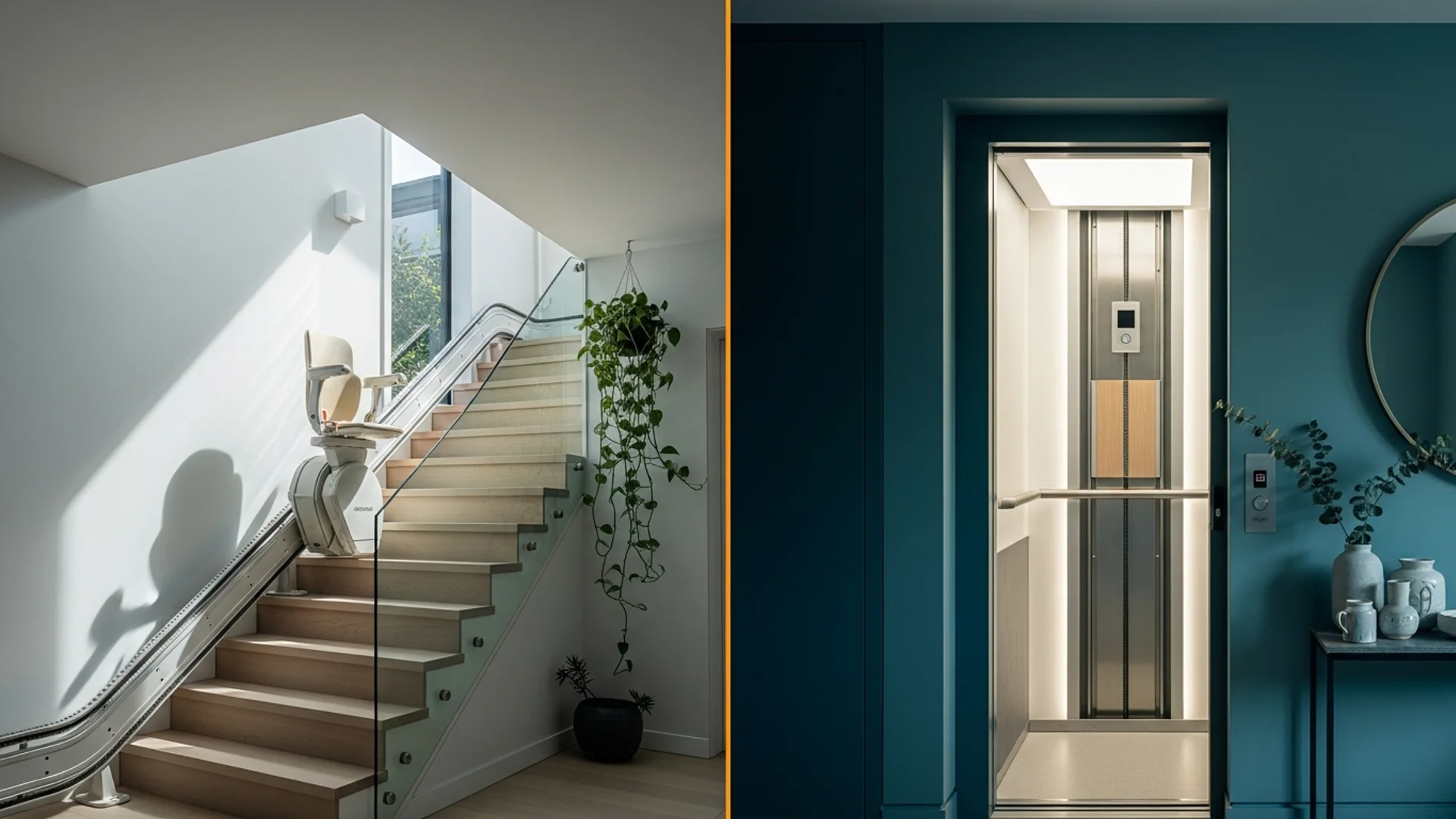
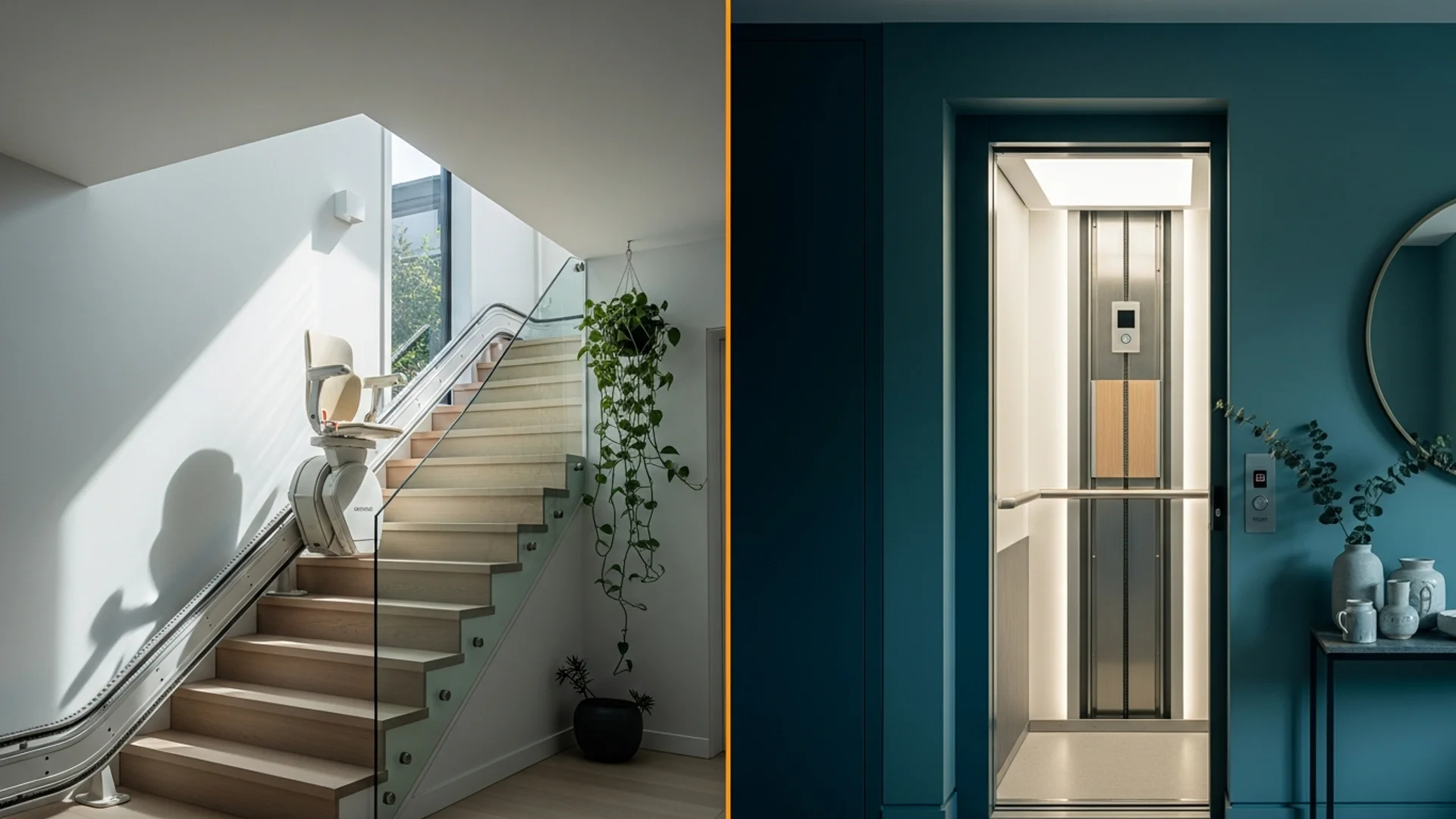
A stairlift and a home lift both move people between floors, but they are fundamentally different products. A stairlift is a motorised chair that rides a rail fixed to your staircase. A home lift is a cabin that travels vertically inside a shaft or self-supporting structure — it is a small passenger lift built for residential use.
The price gap is significant. As of Q2 2026, a straight stairlift starts at around $5,000 installed, while a home lift starts at $20,000 and commonly reaches $50,000–$70,000 with building works included (hipages national cost guides; checked April 2026). That gap reflects a real difference in capability: a stairlift carries one seated person along existing stairs, while a home lift can carry a wheelchair user, multiple passengers, or heavy items between any number of floors.
This page compares the two on the factors that actually drive the decision: upfront cost, ongoing costs, space requirements, wheelchair suitability, installation disruption, and the effect on your home's resale value.
The table below summarises the key decision factors. Scroll down for a detailed breakdown of each.
Swipe to compare →
| Factor | Stairlift | Home lift |
|---|---|---|
| Best for | Single user with reduced mobility on a budget | Long-term accessibility, wheelchair users, multi-generational homes |
| Indicative cost (installed, ex GST) | $5,000–$15,000 (straight) · $10,000–$20,000 (curved) | $20,000–$70,000+ including building works |
| Carries a wheelchair | No — rider must transfer to the seat | Yes — cabin fits a standard wheelchair (≥1,100mm x 1,400mm) |
| Space required | Rail mounts to staircase — no structural changes | Shaft or self-supporting structure: ~1m² to 2.5m² of floor space per level |
| Installation time | 1–2 days (straight) · 3–5 days (curved) | 2–6 weeks including building works |
| Number of floors | Follows the staircase — typically 1 flight, up to 3 with curved rails | Any number of stops — 2 to 5+ floors |
| Weight capacity | 120–160 kg (single person) | 250–400 kg (2–3 passengers or wheelchair + attendant) |
| Annual maintenance cost | $300–$600 | $500–$1,500 |
| Effect on resale value | Minimal — often removed before sale | Positive — adds accessibility and perceived home value |
| Relevant standard | Stairlifts are not separately regulated under AS 1735 — installer warranties apply | AS/NZS 1735.18:2002 (private residential lifts) |
Costs are indicative ranges for the Australian market, ex GST. Building works, structural modifications, and site-specific factors can push home lift costs above the upper range. Stairlift costs assume a standard domestic staircase. Sources: hipages national cost guides, supplier-stated pricing; checked April 2026.
Lift companies in Australia
Browse profiles, compare service areas, and check reviews.

Shotton Lifts
NDIS★ 5.0 (9 reviews)
Family-owned Australian lift manufacturer since 1977. 80+ staff. Design, engineer, manufacture, install and service from Dandenong South VIC. NDIS registered.
View profile →

LiftFit Australia
NDIS★ 5.0 (8 reviews)
Victoria-based NDIS registered lift provider, est. 2011. Partners with Cibes, Savaria, and Kalea. Residential, commercial, and platform lifts.
View profile →

Easy Living Home Elevators
★ 5.0 (7 reviews)
Australia's #1 home elevator supplier since 1998. 100% Australian-owned. 11,000+ elevators in service across 6 states.
View profile →

EcoLift
★ 5.0 (3 reviews)
Family-owned Sydney lift company. European-parts-based installations for reliability and cost-efficient servicing.
View profile →

Sunshine Coast Elevators
★ 5.0 (3 reviews)
Sunshine Coast QLD specialist in bespoke Italian-made residential elevators and disability access lifts. 38+ years industry experience.
View profile →

EMS Elevator Group
★ 5.0 (2 reviews)
Sydney-based bespoke elevator company specialising in installation, modernisation, and maintenance. 24/7 support.
View profile →
LiftQuotes is a comparison platform. Companies shown are filtered by relevance to this page. Listing does not imply endorsement. LiftQuotes may receive a referral fee when you request quotes.
Cost comparison in detail
The upfront cost difference is the first thing most buyers notice — and it is real. A straight stairlift for a standard single-flight staircase costs between $5,000 and $15,000 installed. A curved stairlift, which follows bends or landings, runs $10,000 to $20,000 because the rail must be custom-manufactured to match your staircase geometry.
A home lift starts at around $20,000 for a basic 2-stop model in a new build where the shaft is already designed in. In a retrofit — where structural work, a new shaft, and building approvals are needed — the all-in cost commonly sits between $35,000 and $70,000. For a detailed breakdown of what drives that range, see our home lift cost guide.
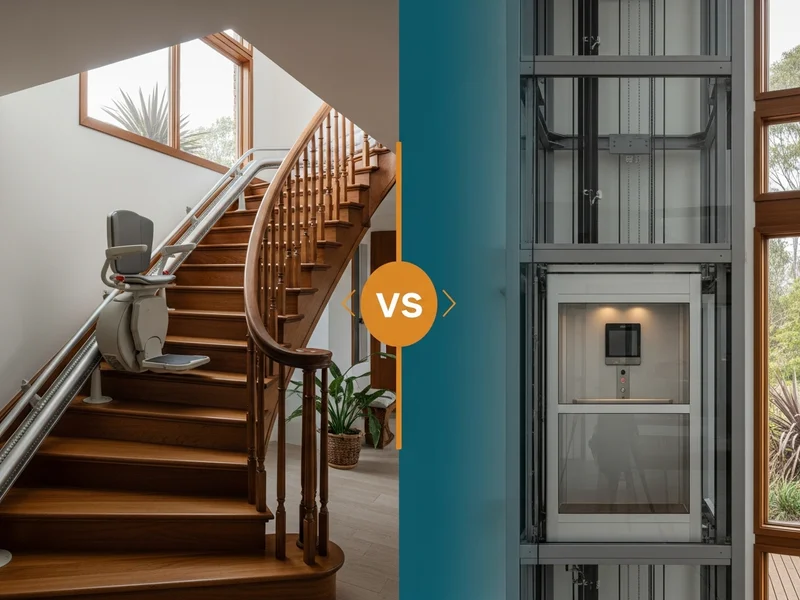
Ongoing costs also differ. A stairlift service visit costs $300–$600 per year. A home lift maintenance contract runs $500–$1,500 annually depending on the contract type — comprehensive contracts (parts and labour included) sit at the higher end. For more on what maintenance contracts cover, see our stairlift cost guide.
Wheelchair and mobility access
This is where the two products diverge most sharply. A stairlift requires the rider to transfer from a wheelchair onto the stairlift seat at the bottom of the stairs, ride up, and transfer back into a wheelchair at the top. For someone with limited upper-body strength or a progressive condition, that transfer becomes harder over time — and may eventually become impossible without assistance.
A home lift eliminates the transfer entirely. The user wheels into the cabin at one level and wheels out at the next. To comply with AS 1735.12:2020, a wheelchair-accessible home lift cabin must be at least 1,100mm wide by 1,400mm deep. Powered wheelchairs and scooters need a larger cabin — at least 1,100mm x 1,600mm.
If wheelchair access is the primary reason for the installation — now or in the foreseeable future — a home lift is the right choice. A stairlift does not solve the wheelchair access problem.
Space and structural impact
A stairlift is non-structural. The rail bolts to the stair treads, not the wall, and the chair folds flat against the rail when not in use. The staircase remains usable for other household members. No building works, no shaft, no pit.
A home lift requires dedicated floor space on every level it serves — typically between 1m² and 2.5m² per floor for the shaft or self-supporting structure. In a new build, this is straightforward to design in. In a retrofit, it means finding or creating that space: converting a cupboard stack, building beside the stairwell, or adding an external lift tower. Our guide to home lift space requirements covers dimensions for every lift type.
For homeowners who need a solution with zero structural changes and minimal disruption, a stairlift is hard to beat.
Installation timeline
A straight stairlift installs in a single day. A curved stairlift takes 3–5 days, mainly because the custom rail has a 2–4 week manufacturing lead time after the survey.
A home lift installation takes 2–6 weeks from the start of building works, depending on whether a shaft needs to be constructed and how much structural modification is required. In a new build where the shaft is formed during construction, the lift itself is typically installed in 2–3 days once the building is at lock-up stage.
Resale value and future-proofing
Stairlifts have a limited effect on resale value. Many sellers remove them before listing because buyers associate them with elderly or disabled occupants. A used stairlift has some resale value — typically 30–50% of the original price if it is a straight model in good condition.
A home lift, by contrast, adds genuine value to a property. It signals that the home is accessible and future-proofed for ageing in place — an increasingly important factor in the Australian market as the population ages. Multi-storey homes with a lift appeal to a broader buyer pool, including older buyers looking for accessible homes and families with members who have mobility needs.
The resale benefit does not recoup the full installation cost, but it narrows the gap — particularly for well-finished lifts that are integrated into the home design rather than bolted on as an afterthought.
The verdict
Choose a stairlift if you need a budget-friendly solution for one person with reduced mobility, the staircase is the only barrier, and wheelchair access is not required now or in the near future. A stairlift installs in a day, costs under $15,000, and solves the immediate problem.
Choose a home lift if you need wheelchair access, want to move items between floors, are planning for long-term ageing in place, or have a multi-storey home where accessibility matters for more than one person. The cost is higher, but the capability gap is significant.
For many families, the decision comes down to timeline. A stairlift is the right answer today; a home lift may be the right answer for the next twenty years.
Ready to compare options for your home? Get free quotes from lift suppliers and stairlift installers in your area.
Still deciding? Get quotes for both options
Installers will assess your site and recommend the right specification.
What are you looking for today?
I need a lift installed
I have a lift that needs attention
A stairlift and a home lift both move people between floors, but they are fundamentally different products. A stairlift is a motorised chair that rides a rail fixed to your staircase. A home lift is a cabin that travels vertically inside a shaft or self-supporting structure — it is a small passenger lift built for residential use.
The price gap is significant. As of Q2 2026, a straight stairlift starts at around $5,000 installed, while a home lift starts at $20,000 and commonly reaches $50,000–$70,000 with building works included (hipages national cost guides; checked April 2026). That gap reflects a real difference in capability: a stairlift carries one seated person along existing stairs, while a home lift can carry a wheelchair user, multiple passengers, or heavy items between any number of floors.
This page compares the two on the factors that actually drive the decision: upfront cost, ongoing costs, space requirements, wheelchair suitability, installation disruption, and the effect on your home's resale value.
The table below summarises the key decision factors. Scroll down for a detailed breakdown of each.
Swipe to compare →
| Factor | Stairlift | Home lift |
|---|---|---|
| Best for | Single user with reduced mobility on a budget | Long-term accessibility, wheelchair users, multi-generational homes |
| Indicative cost (installed, ex GST) | $5,000–$15,000 (straight) · $10,000–$20,000 (curved) | $20,000–$70,000+ including building works |
| Carries a wheelchair | No — rider must transfer to the seat | Yes — cabin fits a standard wheelchair (≥1,100mm x 1,400mm) |
| Space required | Rail mounts to staircase — no structural changes | Shaft or self-supporting structure: ~1m² to 2.5m² of floor space per level |
| Installation time | 1–2 days (straight) · 3–5 days (curved) | 2–6 weeks including building works |
| Number of floors | Follows the staircase — typically 1 flight, up to 3 with curved rails | Any number of stops — 2 to 5+ floors |
| Weight capacity | 120–160 kg (single person) | 250–400 kg (2–3 passengers or wheelchair + attendant) |
| Annual maintenance cost | $300–$600 | $500–$1,500 |
| Effect on resale value | Minimal — often removed before sale | Positive — adds accessibility and perceived home value |
| Relevant standard | Stairlifts are not separately regulated under AS 1735 — installer warranties apply | AS/NZS 1735.18:2002 (private residential lifts) |
Costs are indicative ranges for the Australian market, ex GST. Building works, structural modifications, and site-specific factors can push home lift costs above the upper range. Stairlift costs assume a standard domestic staircase. Sources: hipages national cost guides, supplier-stated pricing; checked April 2026.
Lift companies in Australia
Browse profiles, compare service areas, and check reviews.
Shotton Lifts
NDIS★ 5.0 (9 reviews)
Family-owned Australian lift manufacturer since 1977. 80+ staff. Design, engineer, manufacture, install and service from Dandenong South VIC. NDIS registered.
View profile →
LiftFit Australia
NDIS★ 5.0 (8 reviews)
Victoria-based NDIS registered lift provider, est. 2011. Partners with Cibes, Savaria, and Kalea. Residential, commercial, and platform lifts.
View profile →
Easy Living Home Elevators
★ 5.0 (7 reviews)
Australia's #1 home elevator supplier since 1998. 100% Australian-owned. 11,000+ elevators in service across 6 states.
View profile →
EcoLift
★ 5.0 (3 reviews)
Family-owned Sydney lift company. European-parts-based installations for reliability and cost-efficient servicing.
View profile →
Sunshine Coast Elevators
★ 5.0 (3 reviews)
Sunshine Coast QLD specialist in bespoke Italian-made residential elevators and disability access lifts. 38+ years industry experience.
View profile →
EMS Elevator Group
★ 5.0 (2 reviews)
Sydney-based bespoke elevator company specialising in installation, modernisation, and maintenance. 24/7 support.
View profile →
LiftQuotes is a comparison platform. Companies shown are filtered by relevance to this page. Listing does not imply endorsement. LiftQuotes may receive a referral fee when you request quotes.
Cost comparison in detail
The upfront cost difference is the first thing most buyers notice — and it is real. A straight stairlift for a standard single-flight staircase costs between $5,000 and $15,000 installed. A curved stairlift, which follows bends or landings, runs $10,000 to $20,000 because the rail must be custom-manufactured to match your staircase geometry.
A home lift starts at around $20,000 for a basic 2-stop model in a new build where the shaft is already designed in. In a retrofit — where structural work, a new shaft, and building approvals are needed — the all-in cost commonly sits between $35,000 and $70,000. For a detailed breakdown of what drives that range, see our home lift cost guide.
Ongoing costs also differ. A stairlift service visit costs $300–$600 per year. A home lift maintenance contract runs $500–$1,500 annually depending on the contract type — comprehensive contracts (parts and labour included) sit at the higher end. For more on what maintenance contracts cover, see our stairlift cost guide.
Wheelchair and mobility access
This is where the two products diverge most sharply. A stairlift requires the rider to transfer from a wheelchair onto the stairlift seat at the bottom of the stairs, ride up, and transfer back into a wheelchair at the top. For someone with limited upper-body strength or a progressive condition, that transfer becomes harder over time — and may eventually become impossible without assistance.
A home lift eliminates the transfer entirely. The user wheels into the cabin at one level and wheels out at the next. To comply with AS 1735.12:2020, a wheelchair-accessible home lift cabin must be at least 1,100mm wide by 1,400mm deep. Powered wheelchairs and scooters need a larger cabin — at least 1,100mm x 1,600mm.
If wheelchair access is the primary reason for the installation — now or in the foreseeable future — a home lift is the right choice. A stairlift does not solve the wheelchair access problem.
Space and structural impact
A stairlift is non-structural. The rail bolts to the stair treads, not the wall, and the chair folds flat against the rail when not in use. The staircase remains usable for other household members. No building works, no shaft, no pit.
A home lift requires dedicated floor space on every level it serves — typically between 1m² and 2.5m² per floor for the shaft or self-supporting structure. In a new build, this is straightforward to design in. In a retrofit, it means finding or creating that space: converting a cupboard stack, building beside the stairwell, or adding an external lift tower. Our guide to home lift space requirements covers dimensions for every lift type.
For homeowners who need a solution with zero structural changes and minimal disruption, a stairlift is hard to beat.
Installation timeline
A straight stairlift installs in a single day. A curved stairlift takes 3–5 days, mainly because the custom rail has a 2–4 week manufacturing lead time after the survey.
A home lift installation takes 2–6 weeks from the start of building works, depending on whether a shaft needs to be constructed and how much structural modification is required. In a new build where the shaft is formed during construction, the lift itself is typically installed in 2–3 days once the building is at lock-up stage.
Resale value and future-proofing
Stairlifts have a limited effect on resale value. Many sellers remove them before listing because buyers associate them with elderly or disabled occupants. A used stairlift has some resale value — typically 30–50% of the original price if it is a straight model in good condition.
A home lift, by contrast, adds genuine value to a property. It signals that the home is accessible and future-proofed for ageing in place — an increasingly important factor in the Australian market as the population ages. Multi-storey homes with a lift appeal to a broader buyer pool, including older buyers looking for accessible homes and families with members who have mobility needs.
The resale benefit does not recoup the full installation cost, but it narrows the gap — particularly for well-finished lifts that are integrated into the home design rather than bolted on as an afterthought.
The verdict
Choose a stairlift if you need a budget-friendly solution for one person with reduced mobility, the staircase is the only barrier, and wheelchair access is not required now or in the near future. A stairlift installs in a day, costs under $15,000, and solves the immediate problem.
Choose a home lift if you need wheelchair access, want to move items between floors, are planning for long-term ageing in place, or have a multi-storey home where accessibility matters for more than one person. The cost is higher, but the capability gap is significant.
For many families, the decision comes down to timeline. A stairlift is the right answer today; a home lift may be the right answer for the next twenty years.
Ready to compare options for your home? Get free quotes from lift suppliers and stairlift installers in your area.
Still deciding? Get quotes for both options
Installers will assess your site and recommend the right specification.
What are you looking for today?
I need a lift installed
I have a lift that needs attention
Stairlift: $5K–$15K installed
A motorised chair on a rail fixed to your staircase. Installs in 1–2 days with no structural changes. Best for single users with limited mobility on a budget.
Home lift: $20K–$70K+ installed
A residential passenger lift in a shaft or self-supporting structure. Carries wheelchairs, multiple passengers, and heavy items. Requires building works and 2–6 weeks to install.
Wheelchair access: home lift wins
Stairlifts require a transfer from wheelchair to seat and back. Home lifts eliminate the transfer — wheel in, wheel out. For wheelchair users, a home lift is the only viable option.
Resale value: home lift adds more
Stairlifts are often removed before sale. Home lifts add genuine accessibility value to a property, appealing to a broader buyer pool as Australia's population ages.
Common questions about home lifts and stairlifts
It depends on the mobility need. A stairlift suits a single person who can sit and transfer independently. A platform lift — which is a type of home lift — suits wheelchair users because the rider stays in their chair. Platform lifts cost more ($22,000–$45,000) but solve the wheelchair access problem that a stairlift cannot.
Related guides
Guide
Our Editorial Methodology: How LiftQuotes Researches Content
How LiftQuotes researches, sources and reviews every lift guide and cost page: the standards we cite, our linked-source rule for cost data, and how often we update.
Guide
Lift Compliance Checklist for Facility Managers (Australia)
A facility manager's lift compliance checklist for Australia: plant registration, inspection, log books, 4G VoLTE emergency phones and DDA access duties.
Comparison
Stairlift vs Platform Lift: Which Access Solution Fits?
A stairlift carries a seated user along the stairs from about $3,000; a platform lift raises a wheelchair vertically from about $15,000. Compare cost, access and fit.
Location
Lift Companies in Melbourne: Compare Local Installers
Compare lift companies in Melbourne for home, platform and commercial lifts. WorkSafe Victoria compliance, local installer coverage and indicative VIC costs.
Not sure which option suits your home?
Get free, no-obligation quotes from stairlift and home lift suppliers in your area. Compare prices, installation timelines, and specifications side by side.
Join 1,000+ Australians who've requested quotes through LiftQuotes
Get free quotes