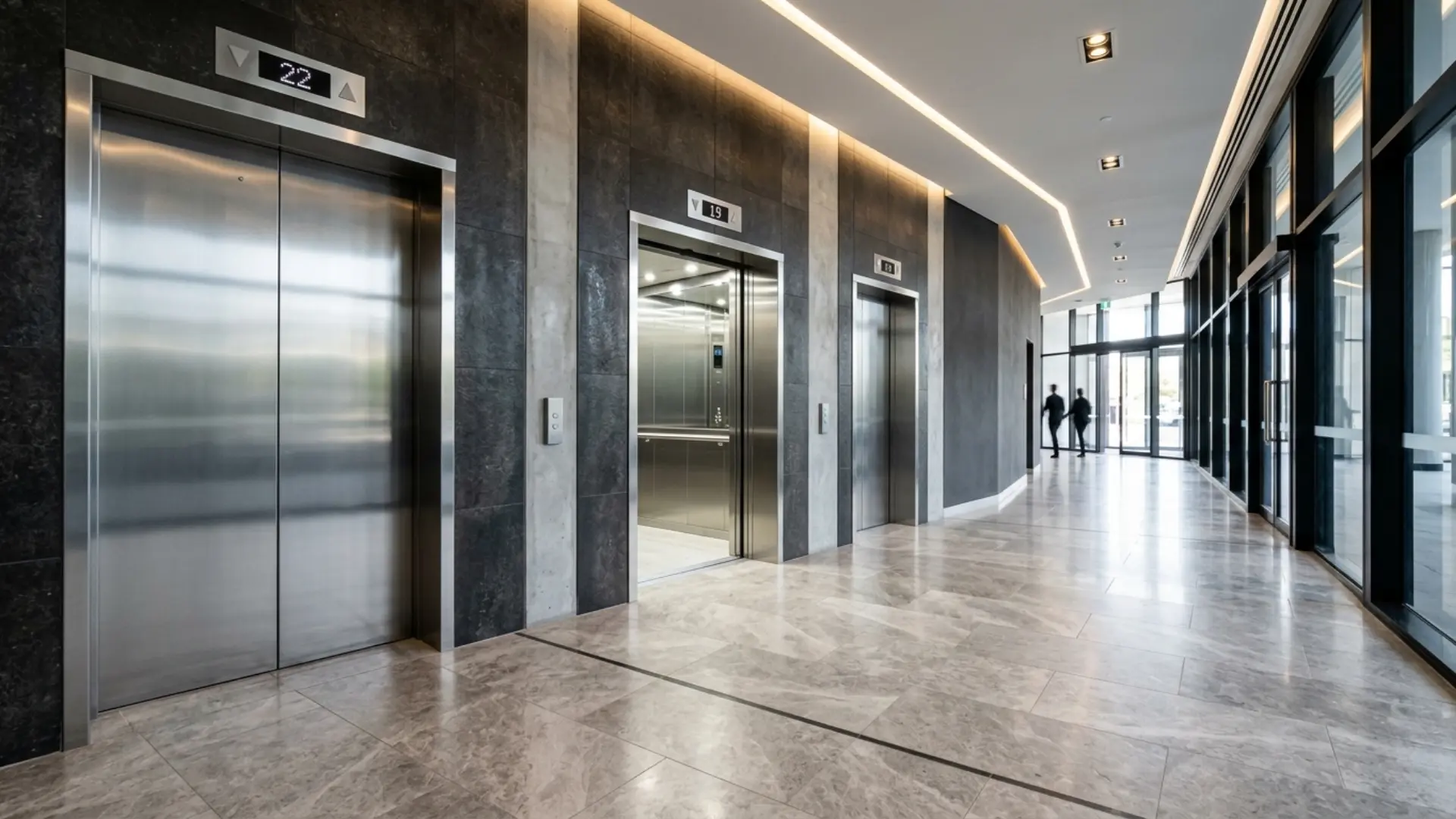
Commercial Lift Cost in Australia
Commercial lift costs in Australia range from $50,000 for a DDA-compliant platform lift to $300,000 or more for a multi-storey traction lift in an office or retail building. This guide breaks down costs by lift type and building application with sourced data.
Commercial lift costs vary enormously depending on what type of lift you need and what building it is going into. A DDA-compliant platform lift for a small retail premises sits at a very different price point to a full traction passenger lift for a six-storey office building.
The three primary cost drivers are: lift type (platform vs traction), number of stops and travel height, and compliance specification (DDA, BCA, AS 1735 series). Understanding these before seeking quotes will help you scope your project and compare suppliers fairly.
All figures on this page are AUD excluding GST. They cover supply and standard installation and reflect Australian market conditions as at March 2026. Building works — shaft construction, structural modification, machine room fitout, and electrical supply upgrades — are excluded from lift supply quotes and must be scoped separately.
The following cost ranges reflect installed prices for common commercial lift types in Australia. All figures are AUD excluding GST and cover lift supply, delivery, and standard installation. Building works and compliance fit-out items are excluded unless stated.
| Scenario | Cost range (AUD, ex GST) | Notes |
|---|---|---|
| Commercial DDA platform lift (2–3 stops) | $50,000–$55,000 | DDA and Premises Standards-compliant enclosed platform lift for commercial or public buildings. Includes compliance features (accessible controls, tactile indicators, emergency systems). Source: industry cost guide data. |
| Small commercial traction lift (3–4 stops, low-rise) | $80,000–$150,000 | Hydraulic or MRL traction passenger lift for low-rise commercial buildings such as offices, retail, or aged care. Compliant with AS 1735.12:2020 and BCA. Source: supplier-stated pricing, Australian commercial lift suppliers. |
| Mid-rise commercial traction lift (5–10 stops) | $150,000–$300,000 | Full-capacity commercial passenger lift for mid-rise office or mixed-use buildings. Machine room or MRL (machine room less) configuration. Cost varies significantly with speed, capacity, and finish specification. Source: supplier-stated pricing, Australian commercial lift suppliers. |
| Annual service contract | $2,000–$8,000 | Commercial lift service contracts are higher than residential due to usage frequency and compliance obligations. AS/NZS 1735.18 and WHS plant registration requirements apply. Cost varies by lift type, number of units, and service provider. |
Commercial DDA platform lift figures are sourced from industry cost guide data. Traction lift ranges are sourced from supplier-stated pricing from multiple Australian commercial lift suppliers. Mid-rise figures are broad due to the wide variation in speed, capacity, and finish specification — always obtain project-specific quotes. Building works are excluded from all figures.
Last checked: 18 March 2026
Seven factors determine the final cost of a commercial lift installation. Lift type and number of stops are the largest variables, but compliance specification and building works can each add material cost to any project.
Lift type: platform vs traction
Platform lifts are lower-cost accessibility solutions suited to short travel heights and lower traffic. Traction lifts (hydraulic or electric MRL) are required for multi-storey buildings with higher passenger loads. The step from a platform lift to a traction lift typically doubles or triples the supply cost. Your building classification and expected usage dictate which type is appropriate.
Number of stops and travel height
Each additional stop adds supply cost through additional landing doors, extended travel components, and installation time. Travel speed requirements also increase with building height. A 4-stop lift in a low-rise office costs materially less than a 10-stop lift with higher speed and capacity, even from the same supplier.
Lift capacity and speed
Commercial lifts are rated by load capacity (typically 630 kg to 1,600 kg or more) and travel speed (0.63 m/s to 2.5 m/s+). Higher capacity and speed requirements increase cost. For most low-to-mid-rise commercial buildings, 630–800 kg at 1.0 m/s is a standard specification.
DDA and BCA compliance specification
Commercial lifts in public buildings must meet the Premises Standards 2010 and AS 1428.1:2021. The BCA (Building Code of Australia) specifies lift requirements under Section D. These compliance requirements affect cab dimensions, door timing, control heights, tactile indicators, and emergency systems. Non-compliance creates liability — confirm compliance certification is included in any commercial lift quote.
Machine room vs machine room less (MRL)
Traditional hydraulic and traction lifts require a dedicated machine room, which adds building cost. Machine room less (MRL) traction lifts relocate the drive to the top of the shaft, eliminating this requirement. MRL units typically cost more to supply but save on building construction — the net difference varies by project.
Shaft, pit, and building works
Commercial lift installation requires a compliant shaft, pit, and overhead clearance. In new builds these are designed in from the start. Retrofitting into an existing building can require structural engineers, core drilling, fire-rated shaft construction, and significant builder cost. Building works for a commercial installation commonly range from $30,000 to $100,000+ and are quoted separately.
Ongoing service and WHS obligations
Commercial lifts are plant under WHS regulations and must be registered with the relevant state regulator. Annual service contracts are higher than residential, typically $2,000–$8,000 per year, reflecting higher usage frequency and compliance obligations under AS/NZS 1735.18. Factor service costs into total cost of ownership when evaluating lift suppliers.
Commercial Lifts companies in Australia
Browse profiles, compare service areas, and check reviews.

Shotton Lifts
NDIS★ 5.0 (9 reviews)
Family-owned Australian lift manufacturer since 1977. 80+ staff. Design, engineer, manufacture, install and service from Dandenong South VIC. NDIS registered.
View profile →

LiftFit Australia
NDIS★ 5.0 (8 reviews)
Victoria-based NDIS registered lift provider, est. 2011. Partners with Cibes, Savaria, and Kalea. Residential, commercial, and platform lifts.
View profile →

Easy Living Home Elevators
★ 5.0 (7 reviews)
Australia's #1 home elevator supplier since 1998. 100% Australian-owned. 11,000+ elevators in service across 6 states.
View profile →

EcoLift
★ 5.0 (3 reviews)
Family-owned Sydney lift company. European-parts-based installations for reliability and cost-efficient servicing.
View profile →
EMS Elevator Group
★ 5.0 (2 reviews)
Sydney-based bespoke elevator company specialising in installation, modernisation, and maintenance. 24/7 support.
View profile →
Austand Elevator
★ 5.0 (1 reviews)
Adelaide-based global MRL elevator specialist. 30+ years experience, 2,000+ clients, lifts installed in 32 countries. Inventor of the Pre-Assembled Lift.
View profile →
LiftQuotes is a comparison platform. Companies shown are filtered by relevance to this page. Listing does not imply endorsement. LiftQuotes may receive a referral fee when you request quotes.
How we research these costs
Cost figures on this page were compiled from three source categories: industry cost guide data for the commercial DDA platform lift range, supplier-stated pricing from multiple Australian commercial lift suppliers for traction lift ranges, and Australian Standards and legislative documentation for compliance cost drivers. The commercial traction lift ranges ($80,000–$300,000) are deliberately broad because commercial lift pricing varies significantly with speed, capacity, cab finish, machine room configuration, and building-specific requirements. A supplier quote for a project-specific configuration is the only reliable figure. The ranges here are intended to inform budgeting and feasibility, not final project pricing. All figures exclude GST and building works. Building works for commercial installations can be substantial — always obtain a combined builder and lift supplier scope before finalising a budget. This page does not constitute a quote.
Primary sources: Industry cost guide data (commercial DDA platform lift range); supplier-stated pricing from Australian commercial lift suppliers (traction lift ranges); AS 1735.12:2020 Lifts, Escalators and Moving Walks — Electric Passenger and Goods Lifts; AS 1428.1:2021 Design for Access and Mobility; Premises Standards 2010.
Last reviewed
18 March 2026
For a full overview of commercial lift types, DDA compliance requirements, and maintenance contract considerations, see the commercial lifts guide. Ready to compare supplier pricing? Get free quotes from multiple Australian commercial lift suppliers.
Get quotes tailored to your project
Tell us about your home and receive personalised pricing from local installers.
What are you looking for today?
I need a lift installed
I have a lift that needs attention
The following cost ranges reflect installed prices for common commercial lift types in Australia. All figures are AUD excluding GST and cover lift supply, delivery, and standard installation. Building works and compliance fit-out items are excluded unless stated.
| Scenario | Cost range (AUD, ex GST) | Notes |
|---|---|---|
| Commercial DDA platform lift (2–3 stops) | $50,000–$55,000 | DDA and Premises Standards-compliant enclosed platform lift for commercial or public buildings. Includes compliance features (accessible controls, tactile indicators, emergency systems). Source: industry cost guide data. |
| Small commercial traction lift (3–4 stops, low-rise) | $80,000–$150,000 | Hydraulic or MRL traction passenger lift for low-rise commercial buildings such as offices, retail, or aged care. Compliant with AS 1735.12:2020 and BCA. Source: supplier-stated pricing, Australian commercial lift suppliers. |
| Mid-rise commercial traction lift (5–10 stops) | $150,000–$300,000 | Full-capacity commercial passenger lift for mid-rise office or mixed-use buildings. Machine room or MRL (machine room less) configuration. Cost varies significantly with speed, capacity, and finish specification. Source: supplier-stated pricing, Australian commercial lift suppliers. |
| Annual service contract | $2,000–$8,000 | Commercial lift service contracts are higher than residential due to usage frequency and compliance obligations. AS/NZS 1735.18 and WHS plant registration requirements apply. Cost varies by lift type, number of units, and service provider. |
Commercial DDA platform lift figures are sourced from industry cost guide data. Traction lift ranges are sourced from supplier-stated pricing from multiple Australian commercial lift suppliers. Mid-rise figures are broad due to the wide variation in speed, capacity, and finish specification — always obtain project-specific quotes. Building works are excluded from all figures.
Last checked: 18 March 2026
Seven factors determine the final cost of a commercial lift installation. Lift type and number of stops are the largest variables, but compliance specification and building works can each add material cost to any project.
Lift type: platform vs traction
Platform lifts are lower-cost accessibility solutions suited to short travel heights and lower traffic. Traction lifts (hydraulic or electric MRL) are required for multi-storey buildings with higher passenger loads. The step from a platform lift to a traction lift typically doubles or triples the supply cost. Your building classification and expected usage dictate which type is appropriate.
Number of stops and travel height
Each additional stop adds supply cost through additional landing doors, extended travel components, and installation time. Travel speed requirements also increase with building height. A 4-stop lift in a low-rise office costs materially less than a 10-stop lift with higher speed and capacity, even from the same supplier.
Lift capacity and speed
Commercial lifts are rated by load capacity (typically 630 kg to 1,600 kg or more) and travel speed (0.63 m/s to 2.5 m/s+). Higher capacity and speed requirements increase cost. For most low-to-mid-rise commercial buildings, 630–800 kg at 1.0 m/s is a standard specification.
DDA and BCA compliance specification
Commercial lifts in public buildings must meet the Premises Standards 2010 and AS 1428.1:2021. The BCA (Building Code of Australia) specifies lift requirements under Section D. These compliance requirements affect cab dimensions, door timing, control heights, tactile indicators, and emergency systems. Non-compliance creates liability — confirm compliance certification is included in any commercial lift quote.
Machine room vs machine room less (MRL)
Traditional hydraulic and traction lifts require a dedicated machine room, which adds building cost. Machine room less (MRL) traction lifts relocate the drive to the top of the shaft, eliminating this requirement. MRL units typically cost more to supply but save on building construction — the net difference varies by project.
Shaft, pit, and building works
Commercial lift installation requires a compliant shaft, pit, and overhead clearance. In new builds these are designed in from the start. Retrofitting into an existing building can require structural engineers, core drilling, fire-rated shaft construction, and significant builder cost. Building works for a commercial installation commonly range from $30,000 to $100,000+ and are quoted separately.
Ongoing service and WHS obligations
Commercial lifts are plant under WHS regulations and must be registered with the relevant state regulator. Annual service contracts are higher than residential, typically $2,000–$8,000 per year, reflecting higher usage frequency and compliance obligations under AS/NZS 1735.18. Factor service costs into total cost of ownership when evaluating lift suppliers.
Commercial Lifts companies in Australia
Browse profiles, compare service areas, and check reviews.
Shotton Lifts
NDIS★ 5.0 (9 reviews)
Family-owned Australian lift manufacturer since 1977. 80+ staff. Design, engineer, manufacture, install and service from Dandenong South VIC. NDIS registered.
View profile →
LiftFit Australia
NDIS★ 5.0 (8 reviews)
Victoria-based NDIS registered lift provider, est. 2011. Partners with Cibes, Savaria, and Kalea. Residential, commercial, and platform lifts.
View profile →
Easy Living Home Elevators
★ 5.0 (7 reviews)
Australia's #1 home elevator supplier since 1998. 100% Australian-owned. 11,000+ elevators in service across 6 states.
View profile →
EcoLift
★ 5.0 (3 reviews)
Family-owned Sydney lift company. European-parts-based installations for reliability and cost-efficient servicing.
View profile →
EMS Elevator Group
★ 5.0 (2 reviews)
Sydney-based bespoke elevator company specialising in installation, modernisation, and maintenance. 24/7 support.
View profile →
Austand Elevator
★ 5.0 (1 reviews)
Adelaide-based global MRL elevator specialist. 30+ years experience, 2,000+ clients, lifts installed in 32 countries. Inventor of the Pre-Assembled Lift.
View profile →
LiftQuotes is a comparison platform. Companies shown are filtered by relevance to this page. Listing does not imply endorsement. LiftQuotes may receive a referral fee when you request quotes.
How we research these costs
Cost figures on this page were compiled from three source categories: industry cost guide data for the commercial DDA platform lift range, supplier-stated pricing from multiple Australian commercial lift suppliers for traction lift ranges, and Australian Standards and legislative documentation for compliance cost drivers. The commercial traction lift ranges ($80,000–$300,000) are deliberately broad because commercial lift pricing varies significantly with speed, capacity, cab finish, machine room configuration, and building-specific requirements. A supplier quote for a project-specific configuration is the only reliable figure. The ranges here are intended to inform budgeting and feasibility, not final project pricing. All figures exclude GST and building works. Building works for commercial installations can be substantial — always obtain a combined builder and lift supplier scope before finalising a budget. This page does not constitute a quote.
Primary sources: Industry cost guide data (commercial DDA platform lift range); supplier-stated pricing from Australian commercial lift suppliers (traction lift ranges); AS 1735.12:2020 Lifts, Escalators and Moving Walks — Electric Passenger and Goods Lifts; AS 1428.1:2021 Design for Access and Mobility; Premises Standards 2010.
Last reviewed
18 March 2026
For a full overview of commercial lift types, DDA compliance requirements, and maintenance contract considerations, see the commercial lifts guide. Ready to compare supplier pricing? Get free quotes from multiple Australian commercial lift suppliers.
Get quotes tailored to your project
Tell us about your home and receive personalised pricing from local installers.
What are you looking for today?
I need a lift installed
I have a lift that needs attention
Common questions about commercial lift costs
Commercial lift costs in Australia range from $50,000–$55,000 for a DDA-compliant platform lift in a small commercial building to $300,000 or more for a mid-rise traction passenger lift. Small commercial traction lifts (3–4 stops) typically cost $80,000–$150,000 installed. Mid-rise lifts (5–10 stops) range from $150,000–$300,000. All figures exclude GST and building works, which must be scoped and quoted separately.
Related guides
Location
Commercial Lifts Melbourne: Costs, Compliance & Installers
Commercial lift costs, Victorian OHS compliance and the Melbourne installer market — indicative prices, WorkSafe Victoria rules and NCC requirements for VIC projects.
Location
Commercial Lifts Sydney: Costs, Compliance & Installers
Commercial lift costs, NSW compliance and the Sydney installer market — indicative prices, SafeWork NSW rules and NCC requirements for CBD and metro projects.
Guide
What Size Lift Do I Need for a Wheelchair? (Australia)
A home lift for a wheelchair needs roughly 1,100 x 1,400 mm inside and a 900 mm clear door. See minimum sizes for a wheelchair, a carer, and turning space.
Guide
Support at Home & Lift Funding: The 2026 Guide
Can Support at Home fund a home lift or stairlift? How aged care funding works, the OT assessment, means-tested contributions, and how it differs from the NDIS.
Ready to get commercial lift quotes?
Compare quotes from multiple Australian commercial lift suppliers. Free, no-obligation, and takes less than two minutes.
Join 1,000+ Australians who've requested quotes through LiftQuotes
Get free quotes