Home Lifts Brisbane: Installation, Costs, and Local Suppliers
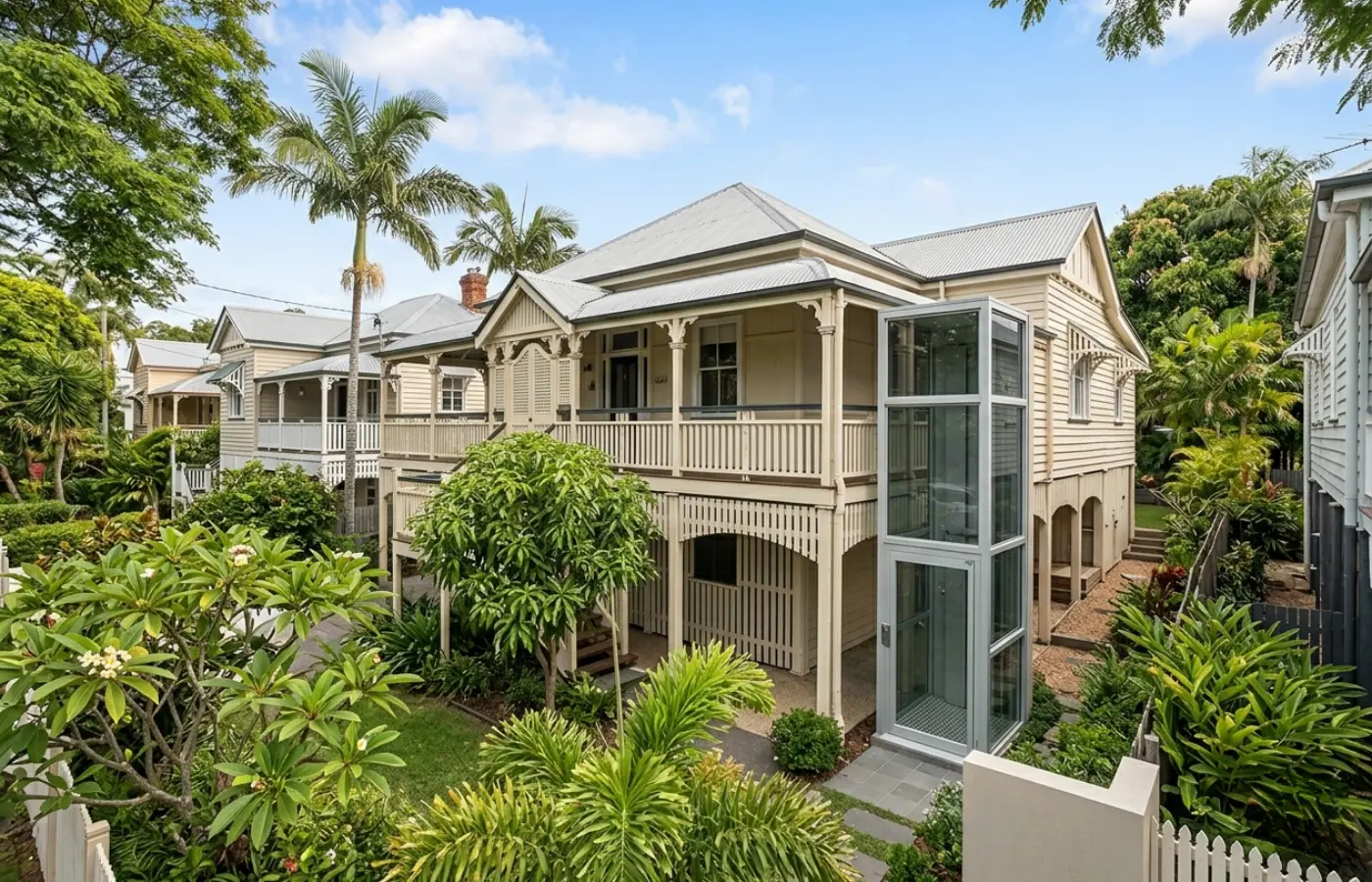
Brisbane Queenslander homes present a unique lift installation context — elevated timber construction with open-plan ground levels. Here is what applies in Queensland.
Brisbane home lift installations split into two distinct groups: elevated Queenslander retrofits and double-storey suburban new builds. The Queenslander — a timber home elevated on stumps or poles — is the defining housing type of inner Brisbane and represents a genuinely different lift installation context from anything found in Sydney or Melbourne.
Queenslander homes in Paddington, Bardon, Red Hill, Ascot, New Farm, and Woolloongabba sit 600 mm to over 1,200 mm above ground level. The open or semi-enclosed ground level beneath the main living area creates an opportunity for a vertical platform lift from ground to verandah level — a practical and cost-effective solution compared to a full internal shaft installation. Compact platform lifts or short-rise hydraulic systems are the most common product choice in this context.
For newer suburban builds across Springfield, North Lakes, Ipswich, and Logan, standard shaft installations are more straightforward. The subtropical climate is a consideration for any outdoor or semi-outdoor installation — UV-stable materials, weather-resistant enclosures, and finishes rated for high humidity are important in the Brisbane climate.
All home lifts in Queensland must be registered with Workplace Health and Safety Queensland (WHSQ) as plant before use. See our home lifts overview and home lift cost guide for product and cost context.
Brisbane, Queensland
Queensland operates under the Work Health and Safety Act 2011 (Qld) and WHS Regulations 2011 (Qld). Home lifts are registrable plant under Schedule 5 of the WHS Regulations — both the design and each installed unit must be registered with Workplace Health and Safety Queensland (WHSQ) before the lift is used. Registration is typically managed by the lift supplier as part of the installation handover.
For strata-titled properties in Brisbane — apartments, townhouses, and unit complexes — the body corporate (not owners corporation, which is the NSW/VIC term) is responsible for common property lift compliance under the Body Corporate and Community Management Act 1997 (Qld). The body corporate committee should hold the current plant registration certificate and maintenance records.
Brisbane has a subtropical climate with high summer humidity and intense UV exposure. Any outdoor or semi-outdoor platform lift installation — including Queenslander ground-to-verandah applications — should specify UV-stable finishes, weather-resistant enclosures, and materials rated for sustained humidity exposure. Confirm these specifications with your supplier at the design stage.
Local compliance at a glance
- Regulator
- WHSQ
- Framework
- WHS Act 2011
- Building approval
- Building approval (certifier or BAO)
- Plant registration
- Required before first use
Queensland installations can exceed national upper bounds in regional areas due to freight costs. Brisbane metro pricing is generally in line with the national range.
Queenslander retrofits — the Brisbane home lift opportunity
The Queenslander is the defining residential housing type of inner Brisbane. These elevated timber homes sit on stumps or poles, typically 600 mm to 1,200 mm or more above ground level, with an open or semi-enclosed ground-level space beneath the main living area. This structural profile creates a natural opportunity for a short-rise vertical platform lift from ground to verandah level — one of the most cost-effective and structurally straightforward home lift applications in the country.
For a standard Queenslander ground-to-verandah installation, a compact platform lift or short-rise hydraulic system is the typical product choice. These installations often require less structural work than a full internal shaft lift, and the outdoor or semi-outdoor position makes the installation less disruptive to the living areas above.
Indicative costs for a Queenslander platform lift installation: $22,000–$40,000 installed, depending on the rise height, platform dimensions, and weatherproofing specification. For a full internal shaft home lift in a renovated Queenslander, budget $30,000–$60,000+ depending on structural complexity.
Subtropical climate considerations
Brisbane receives high UV exposure, high summer humidity, and periodic heavy rainfall. Any outdoor or semi-outdoor lift installation must specify:
- UV-stable finishes and powder-coated or stainless steel structural components
- Weather-resistant enclosures rated for the installation position (IP54 or higher for partially exposed positions)
- Drive system components rated for sustained humidity exposure
Confirm the weatherproofing specification with your supplier before signing off on a product selection.
Body corporate obligations
Brisbane has a large proportion of strata-titled properties governed by body corporates under the Body Corporate and Community Management Act 1997 (Qld). Note the terminology: Queensland uses body corporate — not owners corporation, which is the NSW and VIC term. The body corporate is responsible for common property lift compliance, including plant registration and maintenance records.
If you are installing a home lift within your own lot, confirm whether body corporate approval is required before work begins.
WHSQ plant registration
All home lifts in Queensland must be registered with Workplace Health and Safety Queensland (WHSQ) as plant before use, under Schedule 5 of the WHS Regulations 2011 (Qld). Your supplier will typically manage this as part of the installation handover.
Verify current requirements at WHSQ: https://www.worksafe.qld.gov.au/licensing-and-registrations/plant-design-registration/what-plant-needs-design-registration
Coverage area
This page covers home lift installations across greater Brisbane — including the Inner North, Inner South, Eastern Suburbs, Bayside, Northside, Southside, Ipswich, Logan, and the Moreton Bay region. Suburb-level pages will link back to this page as the Brisbane metro hub.
For national cost context, see our home lift cost guide. For product options including platform lifts suited to Queenslander applications, see our home lifts overview. Ready to compare Brisbane suppliers? Get free quotes through LiftQuotes.
Lift companies in Brisbane
Browse profiles, compare service areas, and check reviews.

Shotton Lifts
NDIS★ 5.0 (9 reviews)
Family-owned Australian lift manufacturer since 1977. 80+ staff. Design, engineer, manufacture, install and service from Dandenong South VIC. NDIS registered.
View profile →
Easy Living Home Elevators
★ 5.0 (7 reviews)
Australia's #1 home elevator supplier since 1998. 100% Australian-owned. 11,000+ elevators in service across 6 states.
View profile →

Sunshine Coast Elevators
★ 5.0 (3 reviews)
Sunshine Coast QLD specialist in bespoke Italian-made residential elevators and disability access lifts. 38+ years industry experience.
View profile →

Direct Lifts Australia
NDIS★ 4.9
Queensland-based home and commercial lift supplier and installer. NDIS registered provider.
View profile →

Savaria Australia
★ 4.6 (19 reviews)
Australian subsidiary of Savaria Corporation (TSX: SIS), a global accessibility industry leader. Offices in Brisbane, Melbourne, Sydney, Adelaide, and Cairns.
View profile →
Harwel Lifts & Hoists
★ 4.6
Australian-owned designer, manufacturer, and installer of lifts, hoists, and access solutions based in Gloucester, NSW.
View profile →
LiftQuotes is a comparison platform. Companies shown are filtered by relevance to this page. Listing does not imply endorsement. LiftQuotes may receive a referral fee when you request quotes.
Compare lift installers in Brisbane
Get free, no-obligation quotes from lift companies serving Brisbane and surrounding areas.
What are you looking for today?
I need a lift installed
I have a lift that needs attention
Brisbane, Queensland
Queensland operates under the Work Health and Safety Act 2011 (Qld) and WHS Regulations 2011 (Qld). Home lifts are registrable plant under Schedule 5 of the WHS Regulations — both the design and each installed unit must be registered with Workplace Health and Safety Queensland (WHSQ) before the lift is used. Registration is typically managed by the lift supplier as part of the installation handover.
For strata-titled properties in Brisbane — apartments, townhouses, and unit complexes — the body corporate (not owners corporation, which is the NSW/VIC term) is responsible for common property lift compliance under the Body Corporate and Community Management Act 1997 (Qld). The body corporate committee should hold the current plant registration certificate and maintenance records.
Brisbane has a subtropical climate with high summer humidity and intense UV exposure. Any outdoor or semi-outdoor platform lift installation — including Queenslander ground-to-verandah applications — should specify UV-stable finishes, weather-resistant enclosures, and materials rated for sustained humidity exposure. Confirm these specifications with your supplier at the design stage.
Local compliance at a glance
- Regulator
- WHSQ
- Framework
- WHS Act 2011
- Building approval
- Building approval (certifier or BAO)
- Plant registration
- Required before first use
Queensland installations can exceed national upper bounds in regional areas due to freight costs. Brisbane metro pricing is generally in line with the national range.
Queenslander retrofits — the Brisbane home lift opportunity
The Queenslander is the defining residential housing type of inner Brisbane. These elevated timber homes sit on stumps or poles, typically 600 mm to 1,200 mm or more above ground level, with an open or semi-enclosed ground-level space beneath the main living area. This structural profile creates a natural opportunity for a short-rise vertical platform lift from ground to verandah level — one of the most cost-effective and structurally straightforward home lift applications in the country.
For a standard Queenslander ground-to-verandah installation, a compact platform lift or short-rise hydraulic system is the typical product choice. These installations often require less structural work than a full internal shaft lift, and the outdoor or semi-outdoor position makes the installation less disruptive to the living areas above.
Indicative costs for a Queenslander platform lift installation: $22,000–$40,000 installed, depending on the rise height, platform dimensions, and weatherproofing specification. For a full internal shaft home lift in a renovated Queenslander, budget $30,000–$60,000+ depending on structural complexity.
Subtropical climate considerations
Brisbane receives high UV exposure, high summer humidity, and periodic heavy rainfall. Any outdoor or semi-outdoor lift installation must specify:
- UV-stable finishes and powder-coated or stainless steel structural components
- Weather-resistant enclosures rated for the installation position (IP54 or higher for partially exposed positions)
- Drive system components rated for sustained humidity exposure
Confirm the weatherproofing specification with your supplier before signing off on a product selection.
Body corporate obligations
Brisbane has a large proportion of strata-titled properties governed by body corporates under the Body Corporate and Community Management Act 1997 (Qld). Note the terminology: Queensland uses body corporate — not owners corporation, which is the NSW and VIC term. The body corporate is responsible for common property lift compliance, including plant registration and maintenance records.
If you are installing a home lift within your own lot, confirm whether body corporate approval is required before work begins.
WHSQ plant registration
All home lifts in Queensland must be registered with Workplace Health and Safety Queensland (WHSQ) as plant before use, under Schedule 5 of the WHS Regulations 2011 (Qld). Your supplier will typically manage this as part of the installation handover.
Verify current requirements at WHSQ: https://www.worksafe.qld.gov.au/licensing-and-registrations/plant-design-registration/what-plant-needs-design-registration
Coverage area
This page covers home lift installations across greater Brisbane — including the Inner North, Inner South, Eastern Suburbs, Bayside, Northside, Southside, Ipswich, Logan, and the Moreton Bay region. Suburb-level pages will link back to this page as the Brisbane metro hub.
For national cost context, see our home lift cost guide. For product options including platform lifts suited to Queenslander applications, see our home lifts overview. Ready to compare Brisbane suppliers? Get free quotes through LiftQuotes.
Lift companies in Brisbane
Browse profiles, compare service areas, and check reviews.
Shotton Lifts
NDIS★ 5.0 (9 reviews)
Family-owned Australian lift manufacturer since 1977. 80+ staff. Design, engineer, manufacture, install and service from Dandenong South VIC. NDIS registered.
View profile →
Easy Living Home Elevators
★ 5.0 (7 reviews)
Australia's #1 home elevator supplier since 1998. 100% Australian-owned. 11,000+ elevators in service across 6 states.
View profile →
Sunshine Coast Elevators
★ 5.0 (3 reviews)
Sunshine Coast QLD specialist in bespoke Italian-made residential elevators and disability access lifts. 38+ years industry experience.
View profile →
Direct Lifts Australia
NDIS★ 4.9
Queensland-based home and commercial lift supplier and installer. NDIS registered provider.
View profile →
Savaria Australia
★ 4.6 (19 reviews)
Australian subsidiary of Savaria Corporation (TSX: SIS), a global accessibility industry leader. Offices in Brisbane, Melbourne, Sydney, Adelaide, and Cairns.
View profile →
Harwel Lifts & Hoists
★ 4.6
Australian-owned designer, manufacturer, and installer of lifts, hoists, and access solutions based in Gloucester, NSW.
View profile →
LiftQuotes is a comparison platform. Companies shown are filtered by relevance to this page. Listing does not imply endorsement. LiftQuotes may receive a referral fee when you request quotes.
Compare lift installers in Brisbane
Get free, no-obligation quotes from lift companies serving Brisbane and surrounding areas.
What are you looking for today?
I need a lift installed
I have a lift that needs attention
You might also need
Location
Commercial Lifts Melbourne: Costs, Compliance & Installers
Commercial lift costs, Victorian OHS compliance and the Melbourne installer market — indicative prices, WorkSafe Victoria rules and NCC requirements for VIC projects.
Location
Commercial Lifts Sydney: Costs, Compliance & Installers
Commercial lift costs, NSW compliance and the Sydney installer market — indicative prices, SafeWork NSW rules and NCC requirements for CBD and metro projects.
Guide
What Size Lift Do I Need for a Wheelchair? (Australia)
A home lift for a wheelchair needs roughly 1,100 x 1,400 mm inside and a 900 mm clear door. See minimum sizes for a wheelchair, a carer, and turning space.
Guide
Support at Home & Lift Funding: The 2026 Guide
Can Support at Home fund a home lift or stairlift? How aged care funding works, the OT assessment, means-tested contributions, and how it differs from the NDIS.
Get quotes from Brisbane home lift suppliers
Tell us about your Brisbane home. Local lift suppliers will assess your site and send competing quotes. Free, no obligation.
Join 1,000+ Australians who've requested quotes through LiftQuotes
Get free Brisbane quotes