
Lift Emergency Phone Compliance: 4G VoLTE Requirements
Every lift emergency phone in Australia now runs on 4G VoLTE. The copper network is gone. Here is what building owners and facility managers need to verify — and keep verifying.
Every passenger lift in Australia must have an emergency communication system. This is not new — AS 1735 has required emergency phones in lifts for decades. What changed is the technology underneath: the copper PSTN network that most lift phones relied on has been fully decommissioned, and every lift emergency phone now operates on 4G VoLTE cellular or, less commonly, landline SIP.
This page is not a migration guide. The migration is done. If your lift phone was converted to 4G VoLTE during the network transition, the question now is whether it remains compliant — whether the connection is active, the monitoring arrangement is current, and the system is being tested. These are ongoing obligations under workplace safety law, and they sit with the building owner or managing body, not the lift installer.
For facility managers and building owners, emergency phone compliance is a standing maintenance item — on the same level as door interlock testing and safety gear inspection. This guide covers what the system looks like as of mid-2026, who is responsible, and exactly what to verify.
What lift emergency phones must do
Every passenger lift in Australia requires an emergency communication system under the AS 1735 series. The phone must auto-dial a 24/7 monitoring centre when a passenger presses the emergency button — no number to dial, no mobile phone needed, no action beyond pressing the button.
The core requirements have not changed. Two-way voice communication between the trapped passenger and a staffed monitoring centre. Auto-dial on activation. Battery backup so the system works during a power failure. What changed is the network: the copper PSTN lines that most lift phones relied on no longer exist, and 3G cellular — used as an early replacement in some buildings — has also been decommissioned. As of mid-2026, every lift emergency phone operates on 4G VoLTE cellular or landline SIP.
This is an ongoing compliance obligation. The PSTN transition is finished. The question for building owners and facility managers is whether the system remains compliant — connection active, monitoring current, testing documented.
How the system works
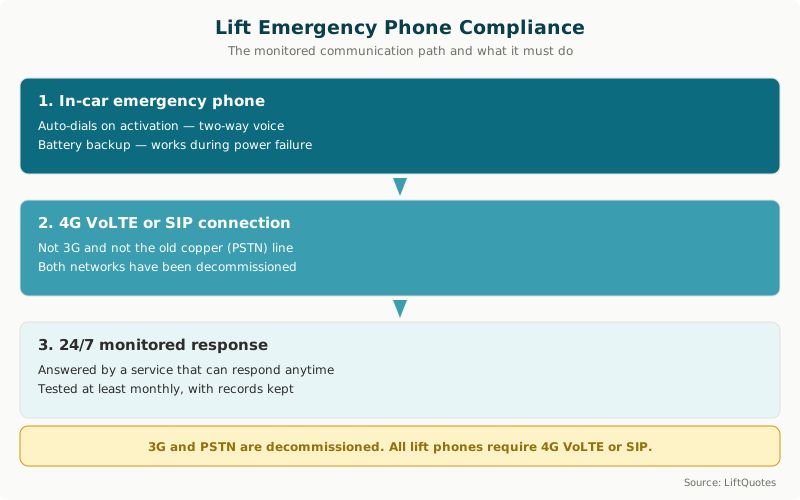
A compliant lift emergency phone system has three components working in sequence.
The in-car emergency phone sits inside the lift car, typically behind the operating panel or in a dedicated recess. Pressing the emergency call button triggers an auto-dial — the passenger does not need to do anything else.
The 4G VoLTE cellular module connects the phone to the mobile network. The module is usually installed in the lift controller cabinet at the top of the shaft or in the machine room, with a SIM card providing the cellular connection. Signal strength inside the shaft must be adequate — external antennas are sometimes required in buildings with poor reception.
The 24/7 monitoring centre receives the call. The centre must be staffed around the clock and able to identify the specific building and lift, communicate with the trapped passenger, and dispatch emergency services if needed. The monitoring arrangement is contractual — if the contract lapses, the phone is non-compliant even though the hardware still works.
For a broader view of how emergency phones fit within the Australian lift standards framework, including building compliance and disability access layers, see the full standards guide.
Who is responsible
The compliance obligation sits with the person conducting a business or undertaking (PCBU) — in practice, the building owner, strata managing body (owners corporation in NSW and Victoria; body corporate in Queensland), or facility manager acting on behalf of the owner.
The PCBU must ensure three things: the emergency phone hardware is installed and functional, the 4G VoLTE connection is active, and the monitoring contract is current. This obligation does not automatically transfer to the lift maintenance contractor. Unless the lift maintenance contract explicitly includes emergency phone monitoring as a scope item, the building owner retains responsibility.
Each lift in a building requires its own independent emergency phone and connection. A single monitoring contract can cover multiple lifts, but each phone must function independently.
What to verify — a practical checklist
Facility managers should verify these items monthly and document the results.
Press the emergency button in each lift. Confirm it connects to the monitoring centre. Verify two-way voice — speak and listen. Ask the operator to confirm your building address and lift number.
Check the 4G module. Locate the VoLTE unit in the controller cabinet. Confirm it is powered and showing a connected status. If it displays signal strength, note the reading. Report any fault indicators to your monitoring provider or lift service company.
Test the battery backup. During scheduled maintenance, simulate a power interruption and verify the emergency phone still connects. Battery backup must sustain the phone for at least one to three hours depending on the installation.
Verify your monitoring contract. Confirm it is current, paid, and the centre is staffed 24/7. A lapsed contract means the phone calls nothing — this is a common compliance gap in buildings where the monitoring provider changed and the new contract was never activated.
Keep records. Record each test — date, time, result, tester name. Under Australian lift standards, inspection records should be retained for at least five years.
Common compliance gaps
Three issues come up repeatedly during inspections and audits.
Lapsed monitoring contract. The most common gap. The original provider changed, a new contract was set up, but activation was never completed. The phone hardware works fine — it just has nowhere to call. Verify the monitoring centre actually answers when you press the button.
3G module still installed. Some buildings had their lift phones converted from PSTN to 3G during the early stages of the network transition. With 3G networks now decommissioned alongside the copper network, these modules no longer function. If your lift phone does not connect when tested, a 3G-to-4G module swap may be needed — a relatively straightforward job for a lift service technician.
No battery backup testing. The phone connects fine during normal operation, but has never been tested during a power failure. Battery backup is a compliance requirement, and batteries degrade over time. If the backup battery has not been tested or replaced within its rated lifecycle, the system may fail precisely when it is most needed — during a power outage that also traps passengers.
How this fits into routine maintenance
Emergency phone compliance is a standing item in any well-structured lift maintenance programme. Under a comprehensive maintenance contract, the service provider typically tests the emergency phone during each routine visit.
The testing obligation remains with the PCBU regardless. Even if the maintenance contractor tests the phone, the building owner must verify tests are happening and results are recorded. Review maintenance reports for emergency phone test entries.
During a lift modernisation project — replacing controllers, doors, or drive systems — the emergency phone system is usually upgraded as part of the scope. Modern controllers integrate the 4G VoLTE module directly. The monitoring arrangement must be confirmed before the modernised lift returns to service.
For buildings on non-comprehensive contracts (parts and callouts billed separately), emergency phone testing may not be included. The PCBU must arrange testing independently — through the monitoring provider or a separate service agreement.

If you need to verify your lift emergency phone system or upgrade to a compliant 4G VoLTE setup, get free quotes from qualified lift service providers who can assess your current installation.
Lift companies in Australia
Browse profiles, compare service areas, and check reviews.

Lift Shop
★ 5.0 (1551 reviews)
Australia's largest dedicated home lift specialist since 1996. 10,000+ installations. Exclusive Italian-crafted lifts with industry-leading 8-year warranty.
View profile →

Compact Home Lifts
NDIS★ 5.0 (465 reviews)
Melbourne branch of Compact Home Lifts. Compact residential lift specialist providing maintenance and repair services across Victoria.
View profile →

Next Level Elevators
★ 5.0 (454 reviews)
Award-winning provider of premium Italian-designed all-electric home elevators. Certified Eltec Partner. Showrooms in Melbourne, Sydney, and Brisbane.
View profile →

Shotton Lifts
NDIS★ 5.0 (9 reviews)
Family-owned Australian lift manufacturer since 1977. 80+ staff. Design, engineer, manufacture, install and service from Dandenong South VIC. NDIS registered.
View profile →

LiftFit Australia
NDIS★ 5.0 (8 reviews)
Victoria-based NDIS registered lift provider, est. 2011. Partners with Cibes, Savaria, and Kalea. Residential, commercial, and platform lifts.
View profile →

Easy Living Home Elevators
★ 5.0 (7 reviews)
Australia's #1 home elevator supplier since 1998. 100% Australian-owned. 11,000+ elevators in service across 6 states.
View profile →
LiftQuotes is a comparison platform. Companies shown are filtered by relevance to this page. Listing does not imply endorsement. LiftQuotes may receive a referral fee when you request quotes.
Put this into action
When you're ready to move forward, get free quotes from verified Australian lift installers.
What are you looking for today?
I need a lift installed
I have a lift that needs attention
What lift emergency phones must do
Every passenger lift in Australia requires an emergency communication system under the AS 1735 series. The phone must auto-dial a 24/7 monitoring centre when a passenger presses the emergency button — no number to dial, no mobile phone needed, no action beyond pressing the button.
The core requirements have not changed. Two-way voice communication between the trapped passenger and a staffed monitoring centre. Auto-dial on activation. Battery backup so the system works during a power failure. What changed is the network: the copper PSTN lines that most lift phones relied on no longer exist, and 3G cellular — used as an early replacement in some buildings — has also been decommissioned. As of mid-2026, every lift emergency phone operates on 4G VoLTE cellular or landline SIP.
This is an ongoing compliance obligation. The PSTN transition is finished. The question for building owners and facility managers is whether the system remains compliant — connection active, monitoring current, testing documented.
How the system works
A compliant lift emergency phone system has three components working in sequence.
The in-car emergency phone sits inside the lift car, typically behind the operating panel or in a dedicated recess. Pressing the emergency call button triggers an auto-dial — the passenger does not need to do anything else.
The 4G VoLTE cellular module connects the phone to the mobile network. The module is usually installed in the lift controller cabinet at the top of the shaft or in the machine room, with a SIM card providing the cellular connection. Signal strength inside the shaft must be adequate — external antennas are sometimes required in buildings with poor reception.
The 24/7 monitoring centre receives the call. The centre must be staffed around the clock and able to identify the specific building and lift, communicate with the trapped passenger, and dispatch emergency services if needed. The monitoring arrangement is contractual — if the contract lapses, the phone is non-compliant even though the hardware still works.
For a broader view of how emergency phones fit within the Australian lift standards framework, including building compliance and disability access layers, see the full standards guide.
Who is responsible
The compliance obligation sits with the person conducting a business or undertaking (PCBU) — in practice, the building owner, strata managing body (owners corporation in NSW and Victoria; body corporate in Queensland), or facility manager acting on behalf of the owner.
The PCBU must ensure three things: the emergency phone hardware is installed and functional, the 4G VoLTE connection is active, and the monitoring contract is current. This obligation does not automatically transfer to the lift maintenance contractor. Unless the lift maintenance contract explicitly includes emergency phone monitoring as a scope item, the building owner retains responsibility.
Each lift in a building requires its own independent emergency phone and connection. A single monitoring contract can cover multiple lifts, but each phone must function independently.
What to verify — a practical checklist
Facility managers should verify these items monthly and document the results.
Press the emergency button in each lift. Confirm it connects to the monitoring centre. Verify two-way voice — speak and listen. Ask the operator to confirm your building address and lift number.
Check the 4G module. Locate the VoLTE unit in the controller cabinet. Confirm it is powered and showing a connected status. If it displays signal strength, note the reading. Report any fault indicators to your monitoring provider or lift service company.
Test the battery backup. During scheduled maintenance, simulate a power interruption and verify the emergency phone still connects. Battery backup must sustain the phone for at least one to three hours depending on the installation.
Verify your monitoring contract. Confirm it is current, paid, and the centre is staffed 24/7. A lapsed contract means the phone calls nothing — this is a common compliance gap in buildings where the monitoring provider changed and the new contract was never activated.
Keep records. Record each test — date, time, result, tester name. Under Australian lift standards, inspection records should be retained for at least five years.
Common compliance gaps
Three issues come up repeatedly during inspections and audits.
Lapsed monitoring contract. The most common gap. The original provider changed, a new contract was set up, but activation was never completed. The phone hardware works fine — it just has nowhere to call. Verify the monitoring centre actually answers when you press the button.
3G module still installed. Some buildings had their lift phones converted from PSTN to 3G during the early stages of the network transition. With 3G networks now decommissioned alongside the copper network, these modules no longer function. If your lift phone does not connect when tested, a 3G-to-4G module swap may be needed — a relatively straightforward job for a lift service technician.
No battery backup testing. The phone connects fine during normal operation, but has never been tested during a power failure. Battery backup is a compliance requirement, and batteries degrade over time. If the backup battery has not been tested or replaced within its rated lifecycle, the system may fail precisely when it is most needed — during a power outage that also traps passengers.
How this fits into routine maintenance
Emergency phone compliance is a standing item in any well-structured lift maintenance programme. Under a comprehensive maintenance contract, the service provider typically tests the emergency phone during each routine visit.
The testing obligation remains with the PCBU regardless. Even if the maintenance contractor tests the phone, the building owner must verify tests are happening and results are recorded. Review maintenance reports for emergency phone test entries.
During a lift modernisation project — replacing controllers, doors, or drive systems — the emergency phone system is usually upgraded as part of the scope. Modern controllers integrate the 4G VoLTE module directly. The monitoring arrangement must be confirmed before the modernised lift returns to service.
For buildings on non-comprehensive contracts (parts and callouts billed separately), emergency phone testing may not be included. The PCBU must arrange testing independently — through the monitoring provider or a separate service agreement.
If you need to verify your lift emergency phone system or upgrade to a compliant 4G VoLTE setup, get free quotes from qualified lift service providers who can assess your current installation.
Lift companies in Australia
Browse profiles, compare service areas, and check reviews.
Lift Shop
★ 5.0 (1551 reviews)
Australia's largest dedicated home lift specialist since 1996. 10,000+ installations. Exclusive Italian-crafted lifts with industry-leading 8-year warranty.
View profile →
Compact Home Lifts
NDIS★ 5.0 (465 reviews)
Melbourne branch of Compact Home Lifts. Compact residential lift specialist providing maintenance and repair services across Victoria.
View profile →
Next Level Elevators
★ 5.0 (454 reviews)
Award-winning provider of premium Italian-designed all-electric home elevators. Certified Eltec Partner. Showrooms in Melbourne, Sydney, and Brisbane.
View profile →
Shotton Lifts
NDIS★ 5.0 (9 reviews)
Family-owned Australian lift manufacturer since 1977. 80+ staff. Design, engineer, manufacture, install and service from Dandenong South VIC. NDIS registered.
View profile →
LiftFit Australia
NDIS★ 5.0 (8 reviews)
Victoria-based NDIS registered lift provider, est. 2011. Partners with Cibes, Savaria, and Kalea. Residential, commercial, and platform lifts.
View profile →
Easy Living Home Elevators
★ 5.0 (7 reviews)
Australia's #1 home elevator supplier since 1998. 100% Australian-owned. 11,000+ elevators in service across 6 states.
View profile →
LiftQuotes is a comparison platform. Companies shown are filtered by relevance to this page. Listing does not imply endorsement. LiftQuotes may receive a referral fee when you request quotes.
Put this into action
When you're ready to move forward, get free quotes from verified Australian lift installers.
What are you looking for today?
I need a lift installed
I have a lift that needs attention
Common questions about lift emergency phones
All passenger lifts and most platform lifts installed in commercial, strata, and public buildings require an emergency communication system under the AS 1735 series. The system must provide two-way voice communication between a trapped passenger and a 24/7 monitored response point — auto-dialling on activation, with no action required from the passenger beyond pressing the emergency button. Residential home lifts covered by AS/NZS 1735.18:2002 also require an emergency communication device, though the monitoring requirements may differ depending on whether the lift is in a private home or a building with WHS/OHS obligations. Since the decommissioning of the copper PSTN network, all lift emergency phones operate on 4G VoLTE cellular or landline SIP connections.
Related guides
Guide
Our Editorial Methodology: How LiftQuotes Researches Content
How LiftQuotes researches, sources and reviews every lift guide and cost page: the standards we cite, our linked-source rule for cost data, and how often we update.
Guide
Lift Compliance Checklist for Facility Managers (Australia)
A facility manager's lift compliance checklist for Australia: plant registration, inspection, log books, 4G VoLTE emergency phones and DDA access duties.
Comparison
Stairlift vs Platform Lift: Which Access Solution Fits?
A stairlift carries a seated user along the stairs from about $3,000; a platform lift raises a wheelchair vertically from about $15,000. Compare cost, access and fit.
Location
Lift Companies in Melbourne: Compare Local Installers
Compare lift companies in Melbourne for home, platform and commercial lifts. WorkSafe Victoria compliance, local installer coverage and indicative VIC costs.
Need help with lift emergency phone compliance?
Whether you need to verify your existing system, upgrade a 3G module to 4G VoLTE, or set up a new monitoring arrangement, compare quotes from qualified Australian lift service providers.
Join 1,000+ Australians who've requested quotes through LiftQuotes
Get free quotes