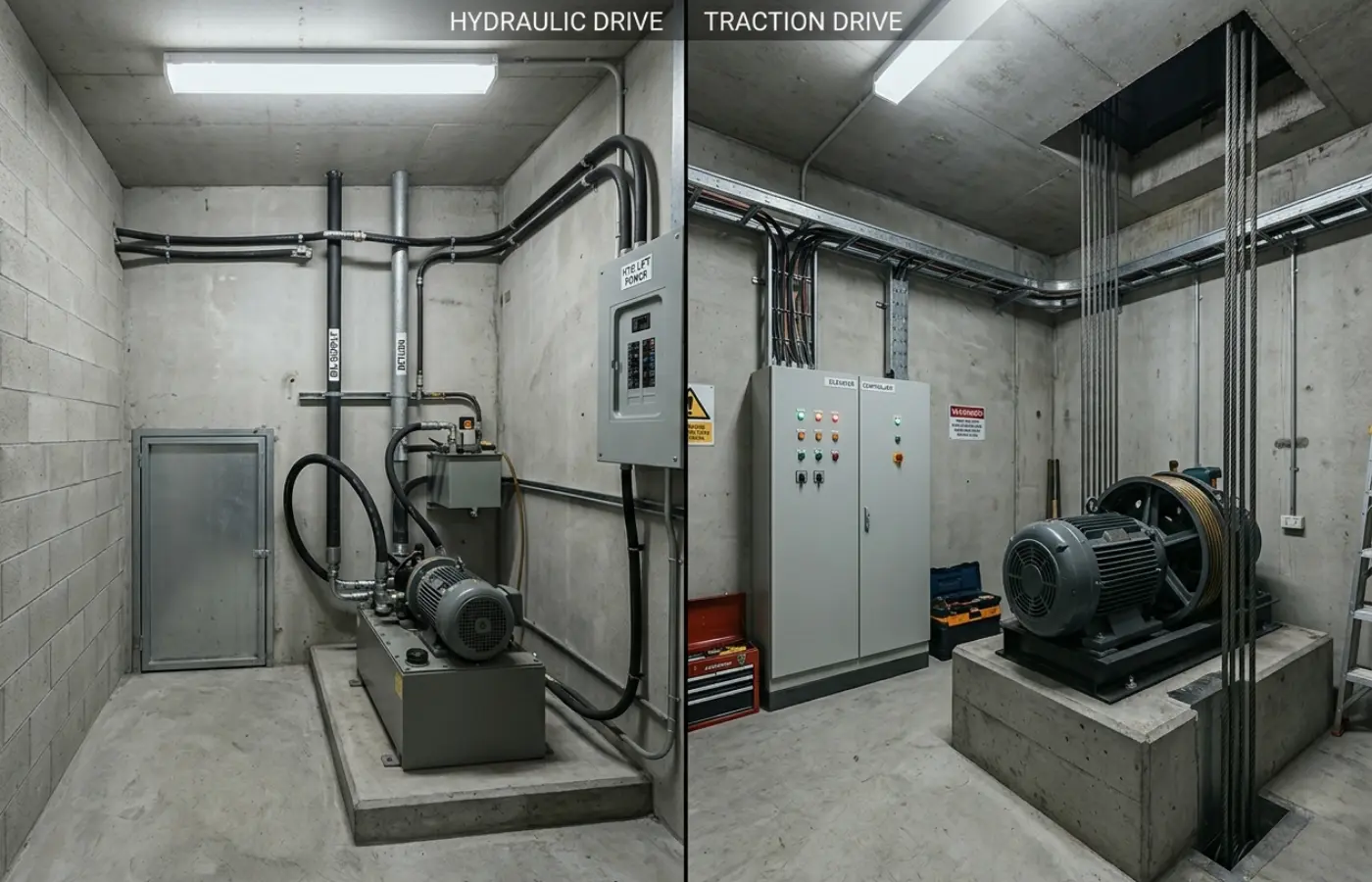
Hydraulic vs Traction Lift: Which Should You Choose?
The right drive system depends on your building height, available space, and energy budget — not brand preference. Here is how the two systems compare.
Hydraulic and traction are the two primary drive systems used in passenger lifts across Australia. Both are reliable, both are widely serviced, and both meet Australian Standards — but they suit fundamentally different buildings.
Hydraulic lifts use a fluid-driven piston to raise and lower the car. They are well-suited to low-rise buildings of two to five floors, have a long service history, and typically cost less to install in that range. The trade-off is energy efficiency: the hydraulic pump runs continuously during travel, which adds up in high-use buildings.
Traction lifts use steel ropes, a counterweight, and an electric motor. They are the standard for buildings of four floors and above, deliver faster speeds and smoother rides, and are significantly more energy efficient — particularly with regenerative drive systems. Machine-room-less (MRL) configurations also remove the need for a separate pump room.
For maintenance cost context on either system, see our lift maintenance cost guide. If you are looking at lifts for a home specifically, also see our home lifts overview.
The table below compares hydraulic and traction lifts across the six factors that matter most when specifying a drive system. These are decision factors — use them to identify which system suits your building before requesting quotes.
Swipe to compare →
| Factor | Hydraulic lift | Traction lift |
|---|---|---|
| Suitable building height | 2–5 floors — most cost-effective in this range | 4+ floors — no practical upper limit |
| Machine room requirement | Yes — adjacent pump room required | Traditional: overhead machine room. MRL: equipment housed in shaft — no separate room needed |
| Typical travel speed | Up to 0.63 m/s — suitable for low-rise | Up to 2.5 m/s and above — standard for commercial use |
| Energy efficiency | Lower — pump runs continuously during travel | Higher — regenerative drive options available on modern systems |
| Maintenance focus | Hydraulic fluid checks, seal and valve inspection | Rope and sheave inspection; fewer fluid components |
| Relevant Australian Standard | AS 1735.7 (hydraulic lifts) | AS 1735.12 (electric passenger and goods lifts) |
Installed cost varies significantly by manufacturer, cab finish, floors served, and site conditions. Both systems require maintenance by a licensed lift contractor under AS 1735.18. Get quotes from multiple suppliers before specifying either system.
Lift companies in Australia
Browse profiles, compare service areas, and check reviews.

Lift Shop
★ 5.0 (1551 reviews)
Australia's largest dedicated home lift specialist since 1996. 10,000+ installations. Exclusive Italian-crafted lifts with industry-leading 8-year warranty.
View profile →

Compact Home Lifts
NDIS★ 5.0 (465 reviews)
Melbourne branch of Compact Home Lifts. Compact residential lift specialist providing maintenance and repair services across Victoria.
View profile →

Next Level Elevators
★ 5.0 (454 reviews)
Award-winning provider of premium Italian-designed all-electric home elevators. Certified Eltec Partner. Showrooms in Melbourne, Sydney, and Brisbane.
View profile →

Shotton Lifts
NDIS★ 5.0 (9 reviews)
Family-owned Australian lift manufacturer since 1977. 80+ staff. Design, engineer, manufacture, install and service from Dandenong South VIC. NDIS registered.
View profile →

LiftFit Australia
NDIS★ 5.0 (8 reviews)
Victoria-based NDIS registered lift provider, est. 2011. Partners with Cibes, Savaria, and Kalea. Residential, commercial, and platform lifts.
View profile →

Easy Living Home Elevators
★ 5.0 (7 reviews)
Australia's #1 home elevator supplier since 1998. 100% Australian-owned. 11,000+ elevators in service across 6 states.
View profile →
LiftQuotes is a comparison platform. Companies shown are filtered by relevance to this page. Listing does not imply endorsement. LiftQuotes may receive a referral fee when you request quotes.
Choose hydraulic lift if
- ✓Your building is two to five floors and will not grow taller
- ✓Budget constraints favour lower upfront installation cost
- ✓Speed is not a priority — a two or three floor rise at 0.63 m/s is acceptable
- ✓Your machine room space is adjacent rather than overhead
- ✓You want a proven drive system with a long domestic service history in Australia
Choose traction lift if
- ✓Your building is four floors or more, or may be extended in future
- ✓Energy efficiency and running costs are a priority — traction systems consume significantly less power per journey at height
- ✓You want a faster, smoother ride for passengers
- ✓A machine-room-less (MRL) configuration is preferable to avoid a separate pump room
- ✓The building is high-traffic commercial where duty cycle and reliability under load matter most
If you are fitting a lift in a commercial building, traction is the default specification at four floors and above. For low-rise strata, small offices, or residential settings, hydraulic remains a cost-competitive option.
Our recommendation
For low-rise residential or small commercial buildings up to four floors, a hydraulic lift is a practical and cost-effective choice. For anything above four floors — or where energy efficiency, speed, and ride quality are priorities — traction is the right specification.
Not sure which system suits your building? Request quotes for both — installers will assess your site and recommend the right specification.
If you are unsure which suits your project, request quotes from qualified lift suppliers. A site visit and building assessment will confirm the appropriate drive system and specification.
Still deciding? Get quotes for both options
Installers will assess your site and recommend the right specification.
What are you looking for today?
I need a lift installed
I have a lift that needs attention
Hydraulic and traction are the two primary drive systems used in passenger lifts across Australia. Both are reliable, both are widely serviced, and both meet Australian Standards — but they suit fundamentally different buildings.
Hydraulic lifts use a fluid-driven piston to raise and lower the car. They are well-suited to low-rise buildings of two to five floors, have a long service history, and typically cost less to install in that range. The trade-off is energy efficiency: the hydraulic pump runs continuously during travel, which adds up in high-use buildings.
Traction lifts use steel ropes, a counterweight, and an electric motor. They are the standard for buildings of four floors and above, deliver faster speeds and smoother rides, and are significantly more energy efficient — particularly with regenerative drive systems. Machine-room-less (MRL) configurations also remove the need for a separate pump room.
For maintenance cost context on either system, see our lift maintenance cost guide. If you are looking at lifts for a home specifically, also see our home lifts overview.
The table below compares hydraulic and traction lifts across the six factors that matter most when specifying a drive system. These are decision factors — use them to identify which system suits your building before requesting quotes.
Swipe to compare →
| Factor | Hydraulic lift | Traction lift |
|---|---|---|
| Suitable building height | 2–5 floors — most cost-effective in this range | 4+ floors — no practical upper limit |
| Machine room requirement | Yes — adjacent pump room required | Traditional: overhead machine room. MRL: equipment housed in shaft — no separate room needed |
| Typical travel speed | Up to 0.63 m/s — suitable for low-rise | Up to 2.5 m/s and above — standard for commercial use |
| Energy efficiency | Lower — pump runs continuously during travel | Higher — regenerative drive options available on modern systems |
| Maintenance focus | Hydraulic fluid checks, seal and valve inspection | Rope and sheave inspection; fewer fluid components |
| Relevant Australian Standard | AS 1735.7 (hydraulic lifts) | AS 1735.12 (electric passenger and goods lifts) |
Installed cost varies significantly by manufacturer, cab finish, floors served, and site conditions. Both systems require maintenance by a licensed lift contractor under AS 1735.18. Get quotes from multiple suppliers before specifying either system.
Lift companies in Australia
Browse profiles, compare service areas, and check reviews.
Lift Shop
★ 5.0 (1551 reviews)
Australia's largest dedicated home lift specialist since 1996. 10,000+ installations. Exclusive Italian-crafted lifts with industry-leading 8-year warranty.
View profile →
Compact Home Lifts
NDIS★ 5.0 (465 reviews)
Melbourne branch of Compact Home Lifts. Compact residential lift specialist providing maintenance and repair services across Victoria.
View profile →
Next Level Elevators
★ 5.0 (454 reviews)
Award-winning provider of premium Italian-designed all-electric home elevators. Certified Eltec Partner. Showrooms in Melbourne, Sydney, and Brisbane.
View profile →
Shotton Lifts
NDIS★ 5.0 (9 reviews)
Family-owned Australian lift manufacturer since 1977. 80+ staff. Design, engineer, manufacture, install and service from Dandenong South VIC. NDIS registered.
View profile →
LiftFit Australia
NDIS★ 5.0 (8 reviews)
Victoria-based NDIS registered lift provider, est. 2011. Partners with Cibes, Savaria, and Kalea. Residential, commercial, and platform lifts.
View profile →
Easy Living Home Elevators
★ 5.0 (7 reviews)
Australia's #1 home elevator supplier since 1998. 100% Australian-owned. 11,000+ elevators in service across 6 states.
View profile →
LiftQuotes is a comparison platform. Companies shown are filtered by relevance to this page. Listing does not imply endorsement. LiftQuotes may receive a referral fee when you request quotes.
Choose hydraulic lift if
- ✓Your building is two to five floors and will not grow taller
- ✓Budget constraints favour lower upfront installation cost
- ✓Speed is not a priority — a two or three floor rise at 0.63 m/s is acceptable
- ✓Your machine room space is adjacent rather than overhead
- ✓You want a proven drive system with a long domestic service history in Australia
Choose traction lift if
- ✓Your building is four floors or more, or may be extended in future
- ✓Energy efficiency and running costs are a priority — traction systems consume significantly less power per journey at height
- ✓You want a faster, smoother ride for passengers
- ✓A machine-room-less (MRL) configuration is preferable to avoid a separate pump room
- ✓The building is high-traffic commercial where duty cycle and reliability under load matter most
If you are fitting a lift in a commercial building, traction is the default specification at four floors and above. For low-rise strata, small offices, or residential settings, hydraulic remains a cost-competitive option.
Our recommendation
For low-rise residential or small commercial buildings up to four floors, a hydraulic lift is a practical and cost-effective choice. For anything above four floors — or where energy efficiency, speed, and ride quality are priorities — traction is the right specification.
Not sure which system suits your building? Request quotes for both — installers will assess your site and recommend the right specification.
If you are unsure which suits your project, request quotes from qualified lift suppliers. A site visit and building assessment will confirm the appropriate drive system and specification.
Still deciding? Get quotes for both options
Installers will assess your site and recommend the right specification.
What are you looking for today?
I need a lift installed
I have a lift that needs attention
Related guides
Location
Commercial Lifts Melbourne: Costs, Compliance & Installers
Commercial lift costs, Victorian OHS compliance and the Melbourne installer market — indicative prices, WorkSafe Victoria rules and NCC requirements for VIC projects.
Location
Commercial Lifts Sydney: Costs, Compliance & Installers
Commercial lift costs, NSW compliance and the Sydney installer market — indicative prices, SafeWork NSW rules and NCC requirements for CBD and metro projects.
Guide
What Size Lift Do I Need for a Wheelchair? (Australia)
A home lift for a wheelchair needs roughly 1,100 x 1,400 mm inside and a 900 mm clear door. See minimum sizes for a wheelchair, a carer, and turning space.
Guide
Support at Home & Lift Funding: The 2026 Guide
Can Support at Home fund a home lift or stairlift? How aged care funding works, the OT assessment, means-tested contributions, and how it differs from the NDIS.
Get quotes for hydraulic and traction lifts
Describe your building and our network of lift suppliers will assess your site and send competing quotes. Free, no obligation.
Join 1,000+ Australians who've requested quotes through LiftQuotes
Get free quotes