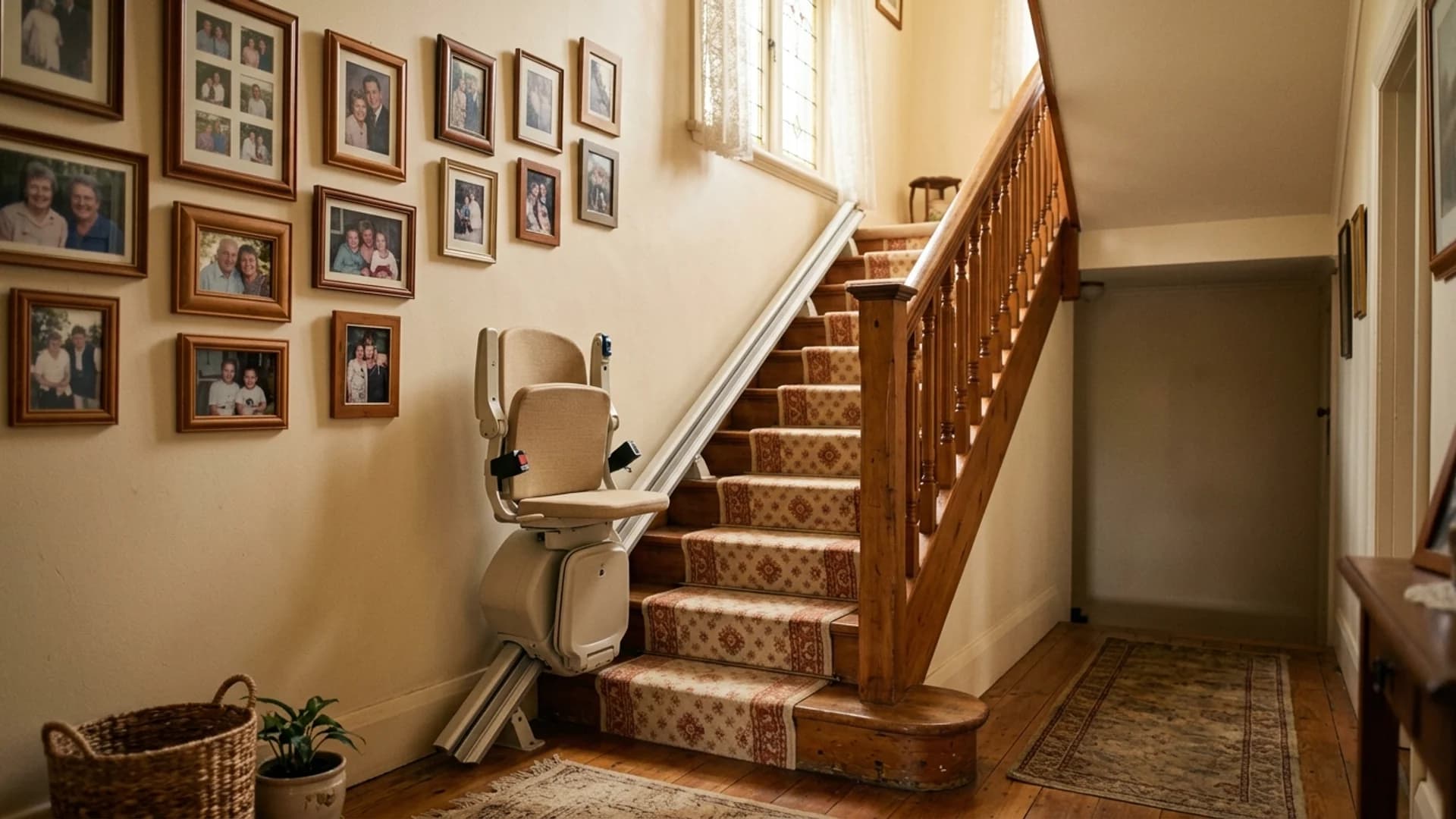
Support at Home and Lift Funding
Support at Home can help fund a stairlift or platform lift for older Australians — after an assessment, an OT recommendation, and a means-tested contribution. Here is how it works.
Lifts can be funded — with an assessment
Stairlifts and platform lifts fall within Support at Home's home-modification and assistive-technology support. They are funded when an assessment shows the change is needed for you to move safely between levels — not on request alone.
The OT assessment is the key step
An occupational therapist assesses your mobility and your home, then recommends the most suitable option. Their report is what the funding decision rests on, so involve an OT early.
You contribute based on your means
Support at Home is a co-contribution programme. What you pay depends on your assessed means and the type of support. Choosing a higher specification than the OT recommends is generally an out-of-pocket cost.
Under 65? The NDIS is your route
Support at Home is for older Australians. People under 65 with a permanent disability are generally funded through the NDIS instead, which has its own assessment and approval process.
Support at Home is the Australian Government programme that helps older people keep living safely in their own home, and it can contribute towards a stairlift or platform lift when an assessment shows you need one. It is not an automatic payment and it seldom covers the full cost of a home lift — funding follows a needs assessment, an occupational therapist's recommendation, and a contribution from you based on your means.
If you are under 65 and living with a permanent disability, the NDIS is usually your funding route instead. This guide covers the aged care side: what Support at Home is, whether a lift or stairlift can be funded, the assessment pathway, and what you can expect to pay yourself.
Funding rules and amounts are still changing as the programme beds in, so treat everything here as general guidance and confirm the current position with My Aged Care and your assessor before you commit.
Can Support at Home fund a lift or stairlift?
Yes — in many cases. Support at Home, the Australian Government's in-home aged care programme, can contribute towards home modifications and assistive technology, and a stairlift or platform lift can sit within that scope when an assessment shows you need it to move safely around your home.
Two things are worth being clear about from the start. It is rarely a full subsidy — aged care funding for a lift is a contribution, not a blank cheque, and a full through-floor home lift often costs more than the funded amount. And it is needs-based — the funding follows an assessment and an occupational therapist's recommendation, not simply a request for a particular product.
If you are under 65 and living with a permanent disability, aged care is not your pathway. Look at NDIS-funded lifts instead, which works to a different set of rules.
What Support at Home is — and what it replaced
Support at Home is the aged care programme for older Australians who want to keep living in their own home rather than move into residential care. It began replacing Home Care Packages in 2025 and is progressively taking over from the Commonwealth Home Support Programme (CHSP). If you or a family member previously held a Home Care Package, that support now sits within the Support at Home framework.
The programme funds a spectrum of help — from personal care and domestic assistance through to assistive technology and home modifications. Lifts and stairlifts belong in that last group: changes to the home, and equipment, that help someone stay mobile and safe across levels. This is the same category that funds grab rails, ramps and bathroom modifications, scaled up to a larger install.
Because the programme is still bedding in, the exact contribution rates, caps and assessment steps are changing. Treat every figure you read — here or anywhere else — as general guidance, and confirm the current position with My Aged Care and your assessor. LiftQuotes does not provide funding or financial advice; the programme rules are set by the Department of Health and Aged Care.
How lift and stairlift funding works — the OT pathway
Funding a lift through aged care follows a fairly consistent sequence, even as the detail shifts:
- Register and get assessed through My Aged Care. An assessment establishes your eligibility and the level of support you can access.
- Occupational therapist assessment. An OT reviews your mobility, the layout of your home, and the risks you face on stairs, then recommends the most appropriate option.
- Recommendation and quotes. The OT specifies the type of equipment or modification. You obtain quotes from suppliers against that specification.
- Approval and your contribution. The funded amount is confirmed, along with the co-contribution you are expected to make.
- Installation. Once approved, the supplier and any builder proceed with the work.
The occupational therapist assessment is the pivot point of the whole process. The OT's report is what the funding decision rests on, so it pays to involve one early and to be candid about the difficulties you have at home. Depending on what they find, the recommended option might be a stairlift, a platform or wheelchair lift, or a through-floor home lift for a two-storey house.
A lift is treated as a home modification, which means approval comes before the work — you cannot install first and claim it back later. If your home needs structural changes to take a lift, factor that into both the timeline and the budget.
Support at Home vs the NDIS — which one applies to you
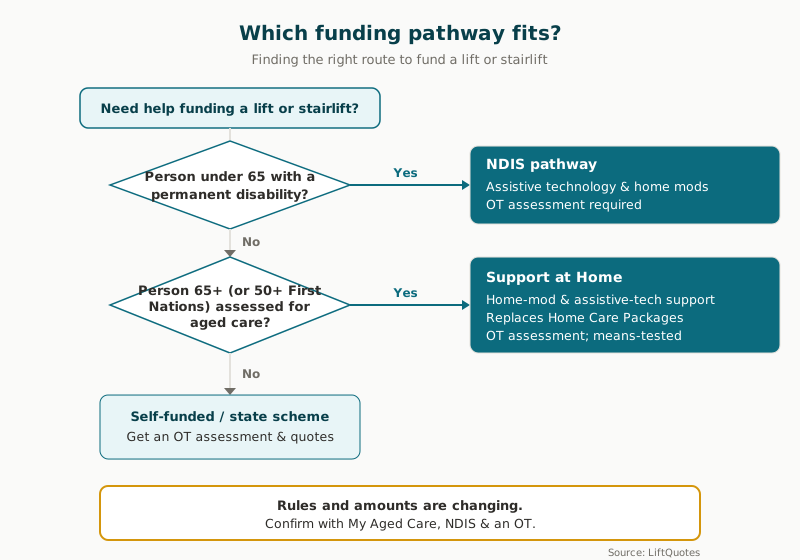
The dividing line is age and disability, and it matters because the two systems do not overlap for the same need.
- Under 65 with a permanent, significant disability — the NDIS is generally your route. It funds assistive technology and home modifications, including lifts, where they are reasonable and necessary. The detail is on our NDIS-funded lifts guide.
- 65 or over (or 50 or over for First Nations people) and assessed for aged care — Support at Home is your route.
If you were already an NDIS participant before turning 65, you can usually stay with the NDIS rather than move across to aged care. Where your situation is genuinely unclear, My Aged Care and an occupational therapist can point you to the right system before you spend money on quotes.
What you will likely pay yourself
Support at Home is a co-contribution programme, so plan for an out-of-pocket component. As of 2026, there is no single published figure that applies to everyone — what you contribute depends on your assessed means and the type of support, and the funded portion is set against the OT's recommended option rather than the most expensive one on the market.
The common places extra cost appears are worth knowing in advance:
- Specification upgrades. If the OT recommends a straightforward stairlift but you prefer a premium platform lift with a full enclosure, funding generally covers up to the recommended option and you pay the difference.
- Building works. Structural changes — a pit, reinforced flooring, or a shaft for a through-floor lift — are where budgets move most, and they may not be fully covered.
- Ongoing costs. Servicing and maintenance beyond any warranty period are usually your responsibility.
Because the numbers vary so much by home and by product, the only reliable figure is a quote for your situation. Our guides to stairlift costs in Australia and wheelchair and platform lifts give indicative ranges to plan around while your assessment is underway.
What to do next
If you think a stairlift or lift could help you or a family member stay at home safely, start with My Aged Care to register for an assessment, and ask specifically about home modifications and assistive technology. Line up an occupational therapist early — their recommendation shapes everything that follows.
While the assessment runs its course, it helps to understand the options. See our guide to home lifts for elderly Australians for the residential choices, or the aged care facility lift guide if you are planning for a care setting rather than a private home. When you are ready to compare real prices, request free quotes from Australian suppliers who work with funded clients — they can advise on the process from the supplier side.
Get the assessment moving first. The funding, the quotes, and the install all follow from there.
Lift companies in Australia
Browse profiles, compare service areas, and check reviews.

Lift Shop
★ 5.0 (1551 reviews)
Australia's largest dedicated home lift specialist since 1996. 10,000+ installations. Exclusive Italian-crafted lifts with industry-leading 8-year warranty.
View profile →

Compact Home Lifts
NDIS★ 5.0 (465 reviews)
Melbourne branch of Compact Home Lifts. Compact residential lift specialist providing maintenance and repair services across Victoria.
View profile →

Next Level Elevators
★ 5.0 (454 reviews)
Award-winning provider of premium Italian-designed all-electric home elevators. Certified Eltec Partner. Showrooms in Melbourne, Sydney, and Brisbane.
View profile →

Shotton Lifts
NDIS★ 5.0 (9 reviews)
Family-owned Australian lift manufacturer since 1977. 80+ staff. Design, engineer, manufacture, install and service from Dandenong South VIC. NDIS registered.
View profile →

LiftFit Australia
NDIS★ 5.0 (8 reviews)
Victoria-based NDIS registered lift provider, est. 2011. Partners with Cibes, Savaria, and Kalea. Residential, commercial, and platform lifts.
View profile →

Easy Living Home Elevators
★ 5.0 (7 reviews)
Australia's #1 home elevator supplier since 1998. 100% Australian-owned. 11,000+ elevators in service across 6 states.
View profile →
LiftQuotes is a comparison platform. Companies shown are filtered by relevance to this page. Listing does not imply endorsement. LiftQuotes may receive a referral fee when you request quotes.
Put this into action
When you're ready to move forward, get free quotes from verified Australian lift installers.
What are you looking for today?
I need a lift installed
I have a lift that needs attention
Support at Home is the Australian Government programme that helps older people keep living safely in their own home, and it can contribute towards a stairlift or platform lift when an assessment shows you need one. It is not an automatic payment and it seldom covers the full cost of a home lift — funding follows a needs assessment, an occupational therapist's recommendation, and a contribution from you based on your means.
If you are under 65 and living with a permanent disability, the NDIS is usually your funding route instead. This guide covers the aged care side: what Support at Home is, whether a lift or stairlift can be funded, the assessment pathway, and what you can expect to pay yourself.
Funding rules and amounts are still changing as the programme beds in, so treat everything here as general guidance and confirm the current position with My Aged Care and your assessor before you commit.
Can Support at Home fund a lift or stairlift?
Yes — in many cases. Support at Home, the Australian Government's in-home aged care programme, can contribute towards home modifications and assistive technology, and a stairlift or platform lift can sit within that scope when an assessment shows you need it to move safely around your home.
Two things are worth being clear about from the start. It is rarely a full subsidy — aged care funding for a lift is a contribution, not a blank cheque, and a full through-floor home lift often costs more than the funded amount. And it is needs-based — the funding follows an assessment and an occupational therapist's recommendation, not simply a request for a particular product.
If you are under 65 and living with a permanent disability, aged care is not your pathway. Look at NDIS-funded lifts instead, which works to a different set of rules.
What Support at Home is — and what it replaced
Support at Home is the aged care programme for older Australians who want to keep living in their own home rather than move into residential care. It began replacing Home Care Packages in 2025 and is progressively taking over from the Commonwealth Home Support Programme (CHSP). If you or a family member previously held a Home Care Package, that support now sits within the Support at Home framework.
The programme funds a spectrum of help — from personal care and domestic assistance through to assistive technology and home modifications. Lifts and stairlifts belong in that last group: changes to the home, and equipment, that help someone stay mobile and safe across levels. This is the same category that funds grab rails, ramps and bathroom modifications, scaled up to a larger install.
Because the programme is still bedding in, the exact contribution rates, caps and assessment steps are changing. Treat every figure you read — here or anywhere else — as general guidance, and confirm the current position with My Aged Care and your assessor. LiftQuotes does not provide funding or financial advice; the programme rules are set by the Department of Health and Aged Care.
How lift and stairlift funding works — the OT pathway
Funding a lift through aged care follows a fairly consistent sequence, even as the detail shifts:
- Register and get assessed through My Aged Care. An assessment establishes your eligibility and the level of support you can access.
- Occupational therapist assessment. An OT reviews your mobility, the layout of your home, and the risks you face on stairs, then recommends the most appropriate option.
- Recommendation and quotes. The OT specifies the type of equipment or modification. You obtain quotes from suppliers against that specification.
- Approval and your contribution. The funded amount is confirmed, along with the co-contribution you are expected to make.
- Installation. Once approved, the supplier and any builder proceed with the work.
The occupational therapist assessment is the pivot point of the whole process. The OT's report is what the funding decision rests on, so it pays to involve one early and to be candid about the difficulties you have at home. Depending on what they find, the recommended option might be a stairlift, a platform or wheelchair lift, or a through-floor home lift for a two-storey house.
A lift is treated as a home modification, which means approval comes before the work — you cannot install first and claim it back later. If your home needs structural changes to take a lift, factor that into both the timeline and the budget.
Support at Home vs the NDIS — which one applies to you
The dividing line is age and disability, and it matters because the two systems do not overlap for the same need.
- Under 65 with a permanent, significant disability — the NDIS is generally your route. It funds assistive technology and home modifications, including lifts, where they are reasonable and necessary. The detail is on our NDIS-funded lifts guide.
- 65 or over (or 50 or over for First Nations people) and assessed for aged care — Support at Home is your route.
If you were already an NDIS participant before turning 65, you can usually stay with the NDIS rather than move across to aged care. Where your situation is genuinely unclear, My Aged Care and an occupational therapist can point you to the right system before you spend money on quotes.
What you will likely pay yourself
Support at Home is a co-contribution programme, so plan for an out-of-pocket component. As of 2026, there is no single published figure that applies to everyone — what you contribute depends on your assessed means and the type of support, and the funded portion is set against the OT's recommended option rather than the most expensive one on the market.
The common places extra cost appears are worth knowing in advance:
- Specification upgrades. If the OT recommends a straightforward stairlift but you prefer a premium platform lift with a full enclosure, funding generally covers up to the recommended option and you pay the difference.
- Building works. Structural changes — a pit, reinforced flooring, or a shaft for a through-floor lift — are where budgets move most, and they may not be fully covered.
- Ongoing costs. Servicing and maintenance beyond any warranty period are usually your responsibility.
Because the numbers vary so much by home and by product, the only reliable figure is a quote for your situation. Our guides to stairlift costs in Australia and wheelchair and platform lifts give indicative ranges to plan around while your assessment is underway.
What to do next
If you think a stairlift or lift could help you or a family member stay at home safely, start with My Aged Care to register for an assessment, and ask specifically about home modifications and assistive technology. Line up an occupational therapist early — their recommendation shapes everything that follows.
While the assessment runs its course, it helps to understand the options. See our guide to home lifts for elderly Australians for the residential choices, or the aged care facility lift guide if you are planning for a care setting rather than a private home. When you are ready to compare real prices, request free quotes from Australian suppliers who work with funded clients — they can advise on the process from the supplier side.
Get the assessment moving first. The funding, the quotes, and the install all follow from there.
Lift companies in Australia
Browse profiles, compare service areas, and check reviews.
Lift Shop
★ 5.0 (1551 reviews)
Australia's largest dedicated home lift specialist since 1996. 10,000+ installations. Exclusive Italian-crafted lifts with industry-leading 8-year warranty.
View profile →
Compact Home Lifts
NDIS★ 5.0 (465 reviews)
Melbourne branch of Compact Home Lifts. Compact residential lift specialist providing maintenance and repair services across Victoria.
View profile →
Next Level Elevators
★ 5.0 (454 reviews)
Award-winning provider of premium Italian-designed all-electric home elevators. Certified Eltec Partner. Showrooms in Melbourne, Sydney, and Brisbane.
View profile →
Shotton Lifts
NDIS★ 5.0 (9 reviews)
Family-owned Australian lift manufacturer since 1977. 80+ staff. Design, engineer, manufacture, install and service from Dandenong South VIC. NDIS registered.
View profile →
LiftFit Australia
NDIS★ 5.0 (8 reviews)
Victoria-based NDIS registered lift provider, est. 2011. Partners with Cibes, Savaria, and Kalea. Residential, commercial, and platform lifts.
View profile →
Easy Living Home Elevators
★ 5.0 (7 reviews)
Australia's #1 home elevator supplier since 1998. 100% Australian-owned. 11,000+ elevators in service across 6 states.
View profile →
LiftQuotes is a comparison platform. Companies shown are filtered by relevance to this page. Listing does not imply endorsement. LiftQuotes may receive a referral fee when you request quotes.
Put this into action
When you're ready to move forward, get free quotes from verified Australian lift installers.
What are you looking for today?
I need a lift installed
I have a lift that needs attention
Common questions about Support at Home lift funding
It can. Stairlifts and platform lifts fall within Support at Home's home-modification and assistive-technology support, and are funded when an assessment shows the change is needed for you to move safely around your home. It is usually a contribution rather than the full cost, and a full through-floor home lift often costs more than the funded amount. An occupational therapist's recommendation drives the decision.
Related guides
Guide
Our Editorial Methodology: How LiftQuotes Researches Content
How LiftQuotes researches, sources and reviews every lift guide and cost page: the standards we cite, our linked-source rule for cost data, and how often we update.
Guide
Lift Compliance Checklist for Facility Managers (Australia)
A facility manager's lift compliance checklist for Australia: plant registration, inspection, log books, 4G VoLTE emergency phones and DDA access duties.
Comparison
Stairlift vs Platform Lift: Which Access Solution Fits?
A stairlift carries a seated user along the stairs from about $3,000; a platform lift raises a wheelchair vertically from about $15,000. Compare cost, access and fit.
Location
Lift Companies in Melbourne: Compare Local Installers
Compare lift companies in Melbourne for home, platform and commercial lifts. WorkSafe Victoria compliance, local installer coverage and indicative VIC costs.
Ready to explore your lift options?
Get free, no-obligation quotes from Australian lift and stairlift suppliers experienced with aged care funding. They can help you understand what is available and work alongside your OT and assessor.
Join 1,000+ Australians who've requested quotes through LiftQuotes
Get free quotes