Home Lift Space Requirements in Australia
Cabin dimensions, shaft sizes, pit depths, and headroom clearances — the numbers you need before talking to a builder or lift supplier.
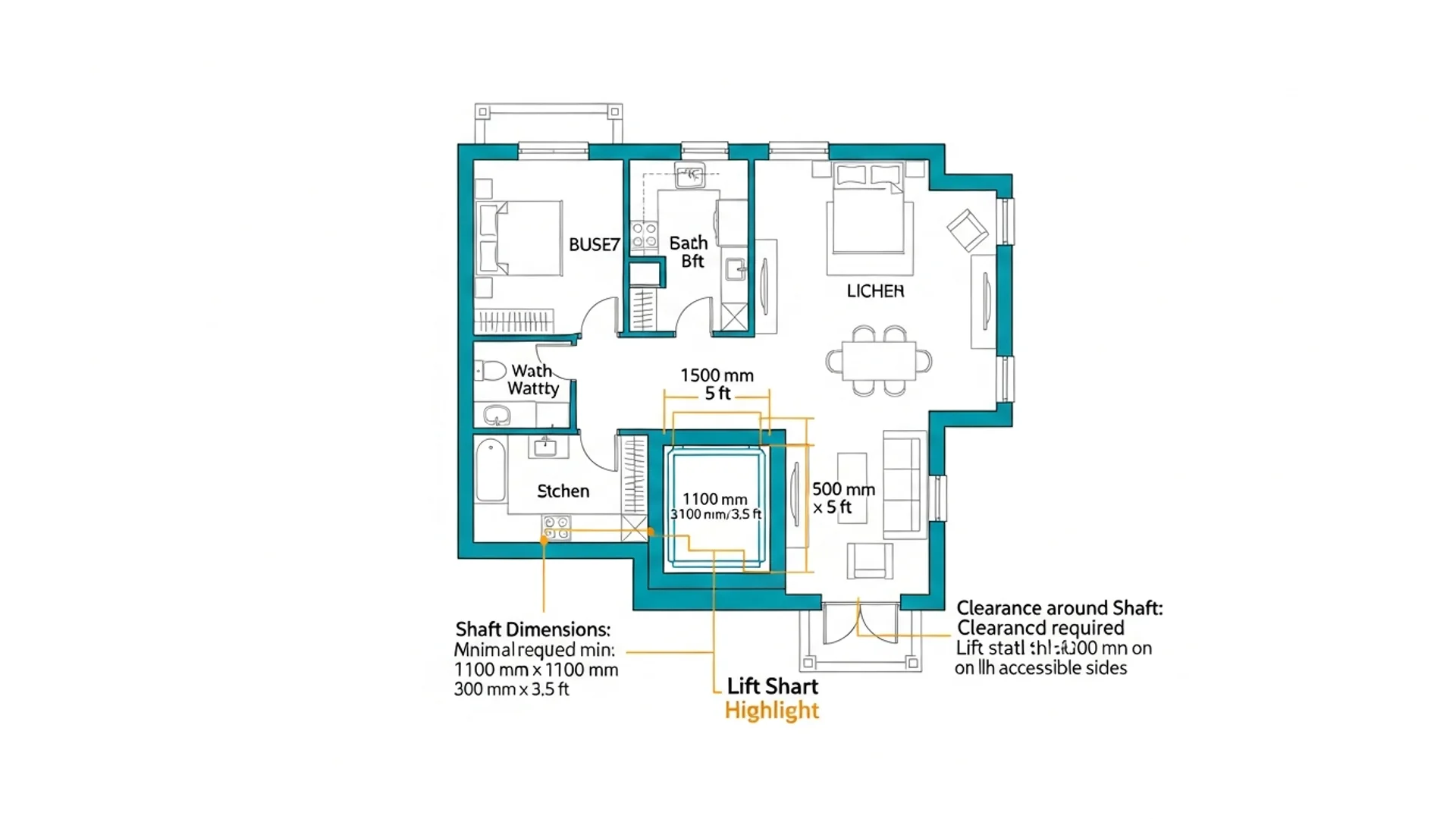
Most home lifts need a footprint between 1,000mm x 1,000mm and 1,500mm x 1,500mm for the shaft — roughly the size of a small wardrobe. The cabin inside is smaller, typically starting at 900mm x 650mm for compact models and reaching 1,100mm x 1,400mm for wheelchair-accessible units.
The real question is not whether a lift will fit in your home — almost every two-storey house has a workable location. The question is how much structural work is involved. A new build with a lift shaft designed into the plans costs far less to fit out than a retrofit into an existing stairwell or cupboard space. This guide covers the actual dimensions, shaft requirements, and pit depths for every common home lift type so you can brief your builder with real numbers.
Dimensions by lift type
The space a home lift needs depends on the drive system. Here are the typical dimensions for each type installed in Australian homes.
Hydraulic home lifts
Hydraulic lifts are the most common type in Australian residential installations. They require a shaft, a pit (typically 150–250mm deep), and a separate machine room or compact hydraulic power unit that can sit adjacent to the shaft or in a nearby cupboard.
Typical cabin size: 1,000mm x 1,000mm to 1,100mm x 1,400mm Shaft footprint: 1,300mm x 1,300mm to 1,500mm x 1,600mm Pit depth: 150–250mm Headroom required: 2,500mm minimum at top landing
Electric traction (MRL) lifts
Machine-room-less traction lifts mount the motor at the top of the shaft, eliminating the need for a separate plant room. They are quieter than hydraulic models and suit homes where space is tight.
Typical cabin size: 900mm x 700mm to 1,100mm x 1,400mm Shaft footprint: 1,100mm x 1,100mm to 1,500mm x 1,500mm Pit depth: 100–200mm Headroom required: 2,500–2,700mm at top landing
Pneumatic vacuum lifts
Vacuum lifts use air pressure rather than cables or pistons. They are self-supporting — no shaft construction required — and install directly onto a flat floor.
Cabin diameter: 750mm (single passenger) to 1,300mm (wheelchair-capable) External cylinder diameter: 900mm to 1,500mm Pit depth: None — sits on the finished floor (50mm ramp threshold) Headroom required: 2,400mm minimum
Screw-drive lifts
Screw-drive lifts (sometimes called platform lifts with a screw mechanism) are compact and suit retrofits. Models like the Compact series are popular in Australian homes.
Typical cabin size: 900mm x 650mm to 1,100mm x 1,400mm Shaft footprint: 1,000mm x 1,000mm to 1,400mm x 1,600mm (self-supporting structure, no built shaft required) Pit depth: 50–70mm (ramp entry) Headroom required: 2,400mm minimum
Shaft requirements
If your chosen lift requires a built shaft, the shaft needs to meet structural and fire-separation requirements. For residential lifts covered by AS/NZS 1735.18:2002, the key requirements are:
- Structural loading: The shaft walls and base must carry the weight of the lift car, counterweight, and occupants. Your structural engineer specifies this based on the lift supplier’s load data.
- Fire separation: In a two-storey home, fire separation between floors is managed by the lift landing doors. A dedicated fire-rated shaft is not typically required for a private residence under the NCC residential provisions, but check with your building certifier.
- Ventilation: Enclosed shafts need ventilation at the top — typically a 100mm duct to the roof space or external wall.
- Waterproofing: The pit must be waterproofed if below the water table or in areas prone to groundwater.
Pit depth explained
The pit is a shallow recess in the floor at the lowest landing. It houses the car buffer and provides undercar clearance when the lift is at its lowest position.
- New builds: The pit is formed during the slab pour. Cost impact is minimal — a few hundred dollars in formwork.
- Retrofits: Cutting a pit into an existing slab is possible but adds $2,000–$5,000 depending on slab thickness, reinforcement, and access (indicative; hipages, checked April 2026). Some homeowners choose a pit-less lift to avoid this cost entirely.
- Upper floors: Timber-framed upper floors usually need a structural platform rather than a pit. The lift supplier specifies the framing requirements.
Wheelchair accessibility dimensions
If the lift needs to accommodate a wheelchair, the minimum internal cabin dimensions are set by AS 1735.12:2020 at 1,100mm wide x 1,400mm deep. This fits a standard manual wheelchair with an attendant.
For powered wheelchairs or scooters, you need a larger cabin — at least 1,100mm x 1,600mm. The landing area outside the lift door must provide a clear 1,540mm turning circle (per AS 1428.1:2021).
A wheelchair-accessible lift typically requires a shaft footprint of at least 1,400mm x 1,600mm — plan for about 2.2m² of floor space.
New build vs retrofit
Designing a lift into a new home is straightforward and cost-effective. The shaft is formed during construction, the pit is poured with the slab, and the builder coordinates penetrations and structural support. For a detailed breakdown of what this costs, see home lift costs.
Retrofitting a lift into an existing home is more complex but almost always feasible. Common retrofit locations include:
- Existing cupboard or wardrobe stack — if a cupboard sits in the same position on two floors, it may already have the right footprint
- Adjacent to the stairwell — the structure around a stairwell is often strong enough to support a shaft
- External addition — a lift tower built against an external wall, connected through new openings at each floor
The structural assessment is the critical first step in any retrofit. A structural engineer inspects the floor framing, foundation capacity, and wall positions before the lift supplier can confirm dimensions.
Planning your space
Before contacting a lift supplier, measure and record:
- Floor-to-floor height at the proposed location (measure between finished floor levels)
- Available footprint — the width and depth of the space where the shaft would sit
- Ceiling height at the top landing — this determines whether you need structural changes for headroom
- Floor construction — concrete slab, timber frame, or a mix (common in split-level homes)
- Access path — how will the lift equipment reach the installation location? Narrow hallways or tight staircases can affect logistics and cost
With these five measurements, a lift supplier can tell you which models fit and provide an accurate quote. If you are considering a compact option for a tight space, see our guide to small lifts for homes.
Lift companies in Australia
Browse profiles, compare service areas, and check reviews.

Shotton Lifts
NDIS★ 5.0 (9 reviews)
Family-owned Australian lift manufacturer since 1977. 80+ staff. Design, engineer, manufacture, install and service from Dandenong South VIC. NDIS registered.
View profile →

LiftFit Australia
NDIS★ 5.0 (8 reviews)
Victoria-based NDIS registered lift provider, est. 2011. Partners with Cibes, Savaria, and Kalea. Residential, commercial, and platform lifts.
View profile →

Easy Living Home Elevators
★ 5.0 (7 reviews)
Australia's #1 home elevator supplier since 1998. 100% Australian-owned. 11,000+ elevators in service across 6 states.
View profile →

EcoLift
★ 5.0 (3 reviews)
Family-owned Sydney lift company. European-parts-based installations for reliability and cost-efficient servicing.
View profile →

Sunshine Coast Elevators
★ 5.0 (3 reviews)
Sunshine Coast QLD specialist in bespoke Italian-made residential elevators and disability access lifts. 38+ years industry experience.
View profile →

EMS Elevator Group
★ 5.0 (2 reviews)
Sydney-based bespoke elevator company specialising in installation, modernisation, and maintenance. 24/7 support.
View profile →
LiftQuotes is a comparison platform. Companies shown are filtered by relevance to this page. Listing does not imply endorsement. LiftQuotes may receive a referral fee when you request quotes.
Put this into action
When you're ready to move forward, get free quotes from verified Australian lift installers.
What are you looking for today?
I need a lift installed
I have a lift that needs attention
Most home lifts need a footprint between 1,000mm x 1,000mm and 1,500mm x 1,500mm for the shaft — roughly the size of a small wardrobe. The cabin inside is smaller, typically starting at 900mm x 650mm for compact models and reaching 1,100mm x 1,400mm for wheelchair-accessible units.
The real question is not whether a lift will fit in your home — almost every two-storey house has a workable location. The question is how much structural work is involved. A new build with a lift shaft designed into the plans costs far less to fit out than a retrofit into an existing stairwell or cupboard space. This guide covers the actual dimensions, shaft requirements, and pit depths for every common home lift type so you can brief your builder with real numbers.
Dimensions by lift type
The space a home lift needs depends on the drive system. Here are the typical dimensions for each type installed in Australian homes.
Hydraulic home lifts
Hydraulic lifts are the most common type in Australian residential installations. They require a shaft, a pit (typically 150–250mm deep), and a separate machine room or compact hydraulic power unit that can sit adjacent to the shaft or in a nearby cupboard.
Typical cabin size: 1,000mm x 1,000mm to 1,100mm x 1,400mm Shaft footprint: 1,300mm x 1,300mm to 1,500mm x 1,600mm Pit depth: 150–250mm Headroom required: 2,500mm minimum at top landing
Electric traction (MRL) lifts
Machine-room-less traction lifts mount the motor at the top of the shaft, eliminating the need for a separate plant room. They are quieter than hydraulic models and suit homes where space is tight.
Typical cabin size: 900mm x 700mm to 1,100mm x 1,400mm Shaft footprint: 1,100mm x 1,100mm to 1,500mm x 1,500mm Pit depth: 100–200mm Headroom required: 2,500–2,700mm at top landing
Pneumatic vacuum lifts
Vacuum lifts use air pressure rather than cables or pistons. They are self-supporting — no shaft construction required — and install directly onto a flat floor.
Cabin diameter: 750mm (single passenger) to 1,300mm (wheelchair-capable) External cylinder diameter: 900mm to 1,500mm Pit depth: None — sits on the finished floor (50mm ramp threshold) Headroom required: 2,400mm minimum
Screw-drive lifts
Screw-drive lifts (sometimes called platform lifts with a screw mechanism) are compact and suit retrofits. Models like the Compact series are popular in Australian homes.
Typical cabin size: 900mm x 650mm to 1,100mm x 1,400mm Shaft footprint: 1,000mm x 1,000mm to 1,400mm x 1,600mm (self-supporting structure, no built shaft required) Pit depth: 50–70mm (ramp entry) Headroom required: 2,400mm minimum
Shaft requirements
If your chosen lift requires a built shaft, the shaft needs to meet structural and fire-separation requirements. For residential lifts covered by AS/NZS 1735.18:2002, the key requirements are:
- Structural loading: The shaft walls and base must carry the weight of the lift car, counterweight, and occupants. Your structural engineer specifies this based on the lift supplier’s load data.
- Fire separation: In a two-storey home, fire separation between floors is managed by the lift landing doors. A dedicated fire-rated shaft is not typically required for a private residence under the NCC residential provisions, but check with your building certifier.
- Ventilation: Enclosed shafts need ventilation at the top — typically a 100mm duct to the roof space or external wall.
- Waterproofing: The pit must be waterproofed if below the water table or in areas prone to groundwater.
Pit depth explained
The pit is a shallow recess in the floor at the lowest landing. It houses the car buffer and provides undercar clearance when the lift is at its lowest position.
- New builds: The pit is formed during the slab pour. Cost impact is minimal — a few hundred dollars in formwork.
- Retrofits: Cutting a pit into an existing slab is possible but adds $2,000–$5,000 depending on slab thickness, reinforcement, and access (indicative; hipages, checked April 2026). Some homeowners choose a pit-less lift to avoid this cost entirely.
- Upper floors: Timber-framed upper floors usually need a structural platform rather than a pit. The lift supplier specifies the framing requirements.
Wheelchair accessibility dimensions
If the lift needs to accommodate a wheelchair, the minimum internal cabin dimensions are set by AS 1735.12:2020 at 1,100mm wide x 1,400mm deep. This fits a standard manual wheelchair with an attendant.
For powered wheelchairs or scooters, you need a larger cabin — at least 1,100mm x 1,600mm. The landing area outside the lift door must provide a clear 1,540mm turning circle (per AS 1428.1:2021).
A wheelchair-accessible lift typically requires a shaft footprint of at least 1,400mm x 1,600mm — plan for about 2.2m² of floor space.
New build vs retrofit
Designing a lift into a new home is straightforward and cost-effective. The shaft is formed during construction, the pit is poured with the slab, and the builder coordinates penetrations and structural support. For a detailed breakdown of what this costs, see home lift costs.
Retrofitting a lift into an existing home is more complex but almost always feasible. Common retrofit locations include:
- Existing cupboard or wardrobe stack — if a cupboard sits in the same position on two floors, it may already have the right footprint
- Adjacent to the stairwell — the structure around a stairwell is often strong enough to support a shaft
- External addition — a lift tower built against an external wall, connected through new openings at each floor
The structural assessment is the critical first step in any retrofit. A structural engineer inspects the floor framing, foundation capacity, and wall positions before the lift supplier can confirm dimensions.
Planning your space
Before contacting a lift supplier, measure and record:
- Floor-to-floor height at the proposed location (measure between finished floor levels)
- Available footprint — the width and depth of the space where the shaft would sit
- Ceiling height at the top landing — this determines whether you need structural changes for headroom
- Floor construction — concrete slab, timber frame, or a mix (common in split-level homes)
- Access path — how will the lift equipment reach the installation location? Narrow hallways or tight staircases can affect logistics and cost
With these five measurements, a lift supplier can tell you which models fit and provide an accurate quote. If you are considering a compact option for a tight space, see our guide to small lifts for homes.
Lift companies in Australia
Browse profiles, compare service areas, and check reviews.
Shotton Lifts
NDIS★ 5.0 (9 reviews)
Family-owned Australian lift manufacturer since 1977. 80+ staff. Design, engineer, manufacture, install and service from Dandenong South VIC. NDIS registered.
View profile →
LiftFit Australia
NDIS★ 5.0 (8 reviews)
Victoria-based NDIS registered lift provider, est. 2011. Partners with Cibes, Savaria, and Kalea. Residential, commercial, and platform lifts.
View profile →
Easy Living Home Elevators
★ 5.0 (7 reviews)
Australia's #1 home elevator supplier since 1998. 100% Australian-owned. 11,000+ elevators in service across 6 states.
View profile →
EcoLift
★ 5.0 (3 reviews)
Family-owned Sydney lift company. European-parts-based installations for reliability and cost-efficient servicing.
View profile →
Sunshine Coast Elevators
★ 5.0 (3 reviews)
Sunshine Coast QLD specialist in bespoke Italian-made residential elevators and disability access lifts. 38+ years industry experience.
View profile →
EMS Elevator Group
★ 5.0 (2 reviews)
Sydney-based bespoke elevator company specialising in installation, modernisation, and maintenance. 24/7 support.
View profile →
LiftQuotes is a comparison platform. Companies shown are filtered by relevance to this page. Listing does not imply endorsement. LiftQuotes may receive a referral fee when you request quotes.
Put this into action
When you're ready to move forward, get free quotes from verified Australian lift installers.
What are you looking for today?
I need a lift installed
I have a lift that needs attention
Cabin sizes from 900mm x 650mm
Compact through-floor lifts start at 900mm x 650mm internally. Wheelchair-accessible cabins need at least 1,100mm x 1,400mm to comply with AS 1735.12.
Shaft footprint: 1m² to 2.5m²
The shaft is larger than the cabin — it includes structure, guide rails, and clearances. Most residential shafts sit between 1,100mm x 1,100mm and 1,600mm x 1,600mm.
Pit depth: 50mm to 300mm
Hydraulic and traction lifts typically need a 150–300mm pit. Some pneumatic and screw-drive models need as little as 50mm — or no pit at all.
Headroom: 2,400mm minimum
Standard ceiling heights of 2,400–2,700mm work for most home lifts. The top-floor landing needs enough clearance for the lift car plus overrun space.
Common questions about home lift space
Most home lifts need a shaft footprint between 1,000mm x 1,000mm and 1,500mm x 1,500mm — roughly 1m² to 2.25m² of floor space. Pneumatic vacuum lifts and some screw-drive models are self-supporting and do not need a built shaft, so their footprint is the external cylinder or frame size only.
Related guides
Guide
Our Editorial Methodology: How LiftQuotes Researches Content
How LiftQuotes researches, sources and reviews every lift guide and cost page: the standards we cite, our linked-source rule for cost data, and how often we update.
Guide
Lift Compliance Checklist for Facility Managers (Australia)
A facility manager's lift compliance checklist for Australia: plant registration, inspection, log books, 4G VoLTE emergency phones and DDA access duties.
Comparison
Stairlift vs Platform Lift: Which Access Solution Fits?
A stairlift carries a seated user along the stairs from about $3,000; a platform lift raises a wheelchair vertically from about $15,000. Compare cost, access and fit.
Location
Lift Companies in Melbourne: Compare Local Installers
Compare lift companies in Melbourne for home, platform and commercial lifts. WorkSafe Victoria compliance, local installer coverage and indicative VIC costs.
Know your space? Get lift quotes.
Share your measurements and requirements with Australian lift suppliers. Free, no-obligation quotes from verified installers.
Join 1,000+ Australians who've requested quotes through LiftQuotes
Get free quotes