Wheelchair Lift Cost in Australia
Wheelchair lift costs in Australia range from around $22,000 for a residential open-platform unit to $55,000 for a DDA-compliant commercial enclosed lift. This guide covers costs by type and application with sourced data — so you can budget accurately before requesting quotes.
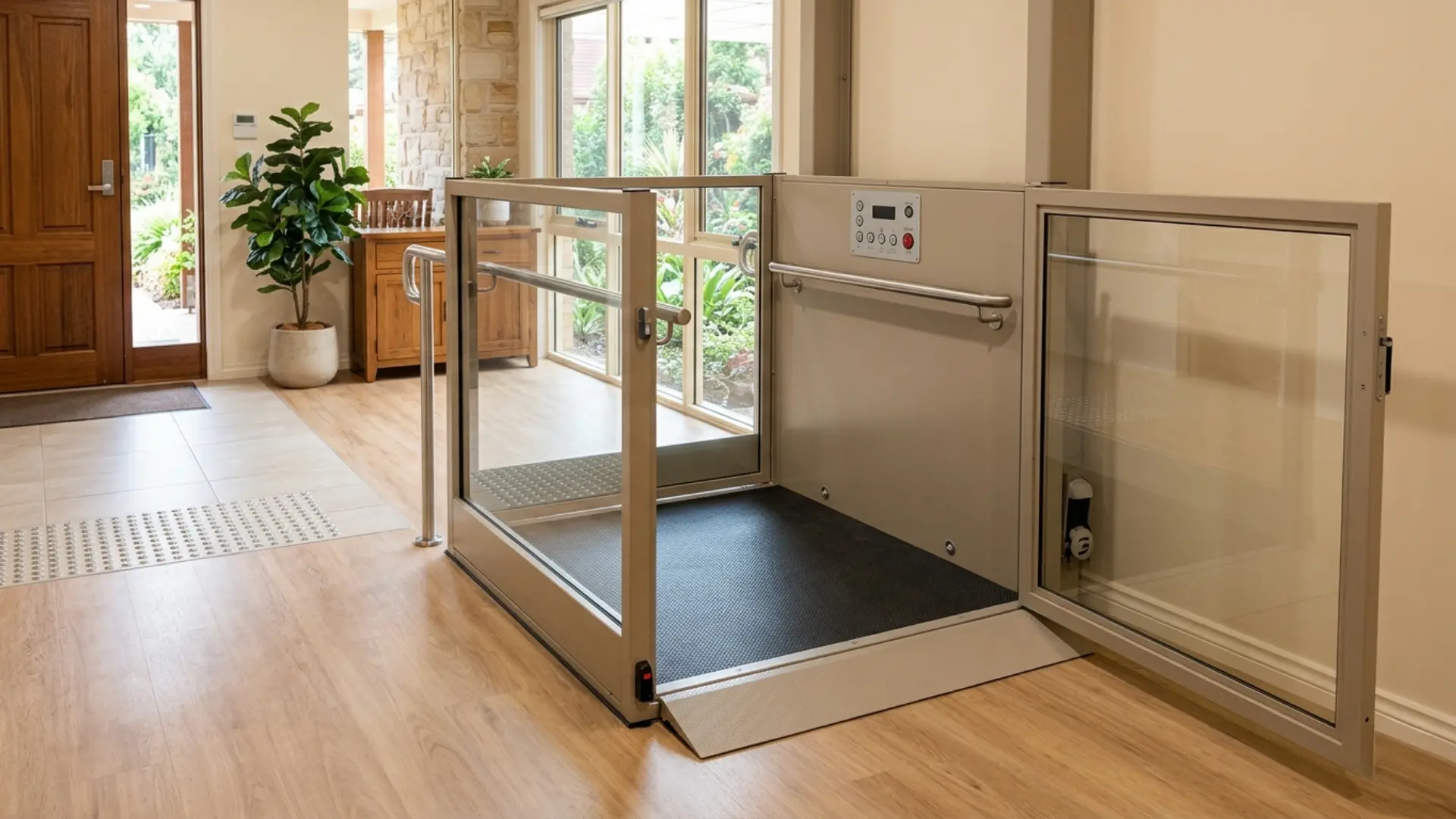
A wheelchair lift is a platform lift designed to carry a wheelchair user between floor levels. In Australia, they are used in two main contexts: residential accessibility (enabling a person with a disability to move between levels in a private home) and commercial or public building access (meeting DDA and Premises Standards obligations).
The cost difference between these two applications is significant. A residential open-platform wheelchair lift starts at around $22,000. A fully enclosed DDA-compliant unit for a commercial building can reach $55,000. Understanding which specification applies to your situation is the most important step before seeking quotes.
All figures on this page are AUD excluding GST. They reflect Australian supply and installation conditions as at March 2026 and are sourced from supplier-stated pricing and industry documentation. Building works — floor penetrations, structural modification, and electrical upgrades — are excluded and must be quoted separately.
The following cost ranges reflect installed prices for wheelchair lifts across common residential and commercial applications in Australia. All figures are AUD excluding GST and cover supply, delivery, and standard installation.
| Scenario | Cost range (AUD, ex GST) | Notes |
|---|---|---|
| Residential open-platform wheelchair lift (2 stops) | $22,000–$35,000 | Entry-level residential wheelchair platform lift. Open or scissor design suitable for low-traffic home use. Assumes minimal building works. Source: supplier-stated pricing, Australian residential lift suppliers. |
| Residential enclosed wheelchair lift (2 stops, cab) | $30,000–$45,000 | Fully enclosed cab with powered doors. Suitable for multi-storey home use and higher-frequency residential applications. Source: supplier-stated pricing, multiple Australian suppliers. |
| Commercial DDA-compliant wheelchair lift (2–3 stops) | $45,000–$55,000 | Enclosed platform lift meeting Premises Standards 2010 and AS 1428.1:2021 requirements. Includes accessible controls, tactile indicators, emergency systems, and compliant cab dimensions. Source: industry cost guide data. |
| Annual service contract | $500–$1,200 | Annual maintenance cost. AS/NZS 1735 requires regular inspection and maintenance for all platform lifts. Commercial installations may have higher service obligations. Source: supplier-stated service pricing. |
Residential ranges are sourced from supplier-stated pricing. The commercial DDA range reflects Premises Standards compliance requirements and is sourced from industry cost guide data. Building works are excluded from all figures. Regional variation applies — freight and installer availability in regional and remote areas can exceed the upper bound.
Last checked: 18 March 2026
Six factors determine where your wheelchair lift installation lands within the ranges above. Whether the lift is for residential or commercial DDA use is the single biggest variable.
Residential vs commercial DDA application
A residential wheelchair lift does not need to meet the Premises Standards 2010 or AS 1428.1:2021 compliance requirements that apply to commercial and public buildings. Residential units can use simpler open-platform designs with basic safety features. Commercial applications require certified enclosed cabs, compliant control heights, tactile indicators, and emergency systems — adding $10,000–$20,000 over a residential specification.
Open platform vs enclosed cab
Open or scissor-lift platforms are the entry-level option and are suitable for residential use where the travel height is limited and traffic is low. Enclosed cabs with powered doors provide better protection and are required for most commercial DDA applications. The step from an open platform to an enclosed cab typically adds $5,000–$15,000.
Travel height and number of stops
Standard residential wheelchair lifts typically travel up to 3 metres between levels. Commercial units can travel up to 5–6 metres. Each additional stop adds rail, landing doors, and installation time. A 3-stop installation costs materially more than a 2-stop unit of the same type.
Building works and structural modification
Retrofitting a wheelchair lift into an existing building typically requires floor penetrations, structural modification, and potentially ceiling work. In a new build, these provisions can be designed in from the start at lower cost. Retrofit building works commonly cost $5,000–$20,000+ depending on structure and materials, and are quoted separately by a licensed builder.
NDIS and funding eligibility
Residential wheelchair lifts may be eligible for NDIS funding under the Home Modifications or Assistive Technology categories, depending on the participant’s plan. An Assistive Technology Advisor or Occupational Therapist can assess eligibility and prepare the required documentation. NDIS funding does not affect the supply price but may affect how the project is scoped and invoiced.
Ongoing service and maintenance
Wheelchair lifts require regular servicing under AS/NZS 1735. Annual service contracts typically cost $500–$1,200 per year for residential units. Commercial installations with higher usage may cost more. Include service costs when comparing suppliers — some suppliers bundle the first year of service; others charge separately.
Wheelchair Lifts companies in Australia
Browse profiles, compare service areas, and check reviews.

Shotton Lifts
NDIS★ 5.0 (9 reviews)
Family-owned Australian lift manufacturer since 1977. 80+ staff. Design, engineer, manufacture, install and service from Dandenong South VIC. NDIS registered.
View profile →

LiftFit Australia
NDIS★ 5.0 (8 reviews)
Victoria-based NDIS registered lift provider, est. 2011. Partners with Cibes, Savaria, and Kalea. Residential, commercial, and platform lifts.
View profile →

Sunshine Coast Elevators
★ 5.0 (3 reviews)
Sunshine Coast QLD specialist in bespoke Italian-made residential elevators and disability access lifts. 38+ years industry experience.
View profile →

Platinum Elevators
NDIS★ 4.9 (134 reviews)
Keysborough VIC-based residential and commercial elevator specialist. 100% Italian-made products. NDIS registered provider (until Oct 2028).
View profile →
West Coast Elevators
NDIS★ 4.9 (96 reviews)
Perth-based home and commercial lift specialist serving Western Australia. NDIS registered provider.
View profile →

Direct Lifts Australia
NDIS★ 4.9
Queensland-based home and commercial lift supplier and installer. NDIS registered provider.
View profile →
LiftQuotes is a comparison platform. Companies shown are filtered by relevance to this page. Listing does not imply endorsement. LiftQuotes may receive a referral fee when you request quotes.
How we research these costs
Cost figures on this page were compiled from supplier-stated pricing from multiple Australian wheelchair lift suppliers (residential and commercial) and industry documentation covering DDA and Premises Standards compliance requirements. Residential ranges reflect open-platform and enclosed cab configurations sourced from publicly available supplier pricing. The commercial DDA range reflects compliance with the Premises Standards 2010 and AS 1428.1:2021, which add specification cost over a standard residential unit. Where ranges differed between sources, the broader range is reported. All figures exclude GST. Building works (floor penetrations, structural modification, electrical supply) are excluded and must be scoped separately. NDIS funding eligibility, where applicable, does not affect the supply price. This page does not constitute a quote.
Primary sources: Supplier-stated pricing from Australian wheelchair lift suppliers (residential and commercial); AS 1428.1:2021 Design for Access and Mobility; Disability (Access to Premises — Buildings) Standards 2010 (Premises Standards).
Last reviewed
18 March 2026
For a full overview of wheelchair lift types, platform size requirements, and NDIS funding pathways, see the wheelchair lifts guide. Ready to compare supplier pricing? Get free quotes from multiple Australian wheelchair lift suppliers.
Get quotes tailored to your project
Tell us about your home and receive personalised pricing from local installers.
What are you looking for today?
I need a lift installed
I have a lift that needs attention
A wheelchair lift is a platform lift designed to carry a wheelchair user between floor levels. In Australia, they are used in two main contexts: residential accessibility (enabling a person with a disability to move between levels in a private home) and commercial or public building access (meeting DDA and Premises Standards obligations).
The cost difference between these two applications is significant. A residential open-platform wheelchair lift starts at around $22,000. A fully enclosed DDA-compliant unit for a commercial building can reach $55,000. Understanding which specification applies to your situation is the most important step before seeking quotes.
All figures on this page are AUD excluding GST. They reflect Australian supply and installation conditions as at March 2026 and are sourced from supplier-stated pricing and industry documentation. Building works — floor penetrations, structural modification, and electrical upgrades — are excluded and must be quoted separately.
The following cost ranges reflect installed prices for wheelchair lifts across common residential and commercial applications in Australia. All figures are AUD excluding GST and cover supply, delivery, and standard installation.
| Scenario | Cost range (AUD, ex GST) | Notes |
|---|---|---|
| Residential open-platform wheelchair lift (2 stops) | $22,000–$35,000 | Entry-level residential wheelchair platform lift. Open or scissor design suitable for low-traffic home use. Assumes minimal building works. Source: supplier-stated pricing, Australian residential lift suppliers. |
| Residential enclosed wheelchair lift (2 stops, cab) | $30,000–$45,000 | Fully enclosed cab with powered doors. Suitable for multi-storey home use and higher-frequency residential applications. Source: supplier-stated pricing, multiple Australian suppliers. |
| Commercial DDA-compliant wheelchair lift (2–3 stops) | $45,000–$55,000 | Enclosed platform lift meeting Premises Standards 2010 and AS 1428.1:2021 requirements. Includes accessible controls, tactile indicators, emergency systems, and compliant cab dimensions. Source: industry cost guide data. |
| Annual service contract | $500–$1,200 | Annual maintenance cost. AS/NZS 1735 requires regular inspection and maintenance for all platform lifts. Commercial installations may have higher service obligations. Source: supplier-stated service pricing. |
Residential ranges are sourced from supplier-stated pricing. The commercial DDA range reflects Premises Standards compliance requirements and is sourced from industry cost guide data. Building works are excluded from all figures. Regional variation applies — freight and installer availability in regional and remote areas can exceed the upper bound.
Last checked: 18 March 2026
Six factors determine where your wheelchair lift installation lands within the ranges above. Whether the lift is for residential or commercial DDA use is the single biggest variable.
Residential vs commercial DDA application
A residential wheelchair lift does not need to meet the Premises Standards 2010 or AS 1428.1:2021 compliance requirements that apply to commercial and public buildings. Residential units can use simpler open-platform designs with basic safety features. Commercial applications require certified enclosed cabs, compliant control heights, tactile indicators, and emergency systems — adding $10,000–$20,000 over a residential specification.
Open platform vs enclosed cab
Open or scissor-lift platforms are the entry-level option and are suitable for residential use where the travel height is limited and traffic is low. Enclosed cabs with powered doors provide better protection and are required for most commercial DDA applications. The step from an open platform to an enclosed cab typically adds $5,000–$15,000.
Travel height and number of stops
Standard residential wheelchair lifts typically travel up to 3 metres between levels. Commercial units can travel up to 5–6 metres. Each additional stop adds rail, landing doors, and installation time. A 3-stop installation costs materially more than a 2-stop unit of the same type.
Building works and structural modification
Retrofitting a wheelchair lift into an existing building typically requires floor penetrations, structural modification, and potentially ceiling work. In a new build, these provisions can be designed in from the start at lower cost. Retrofit building works commonly cost $5,000–$20,000+ depending on structure and materials, and are quoted separately by a licensed builder.
NDIS and funding eligibility
Residential wheelchair lifts may be eligible for NDIS funding under the Home Modifications or Assistive Technology categories, depending on the participant’s plan. An Assistive Technology Advisor or Occupational Therapist can assess eligibility and prepare the required documentation. NDIS funding does not affect the supply price but may affect how the project is scoped and invoiced.
Ongoing service and maintenance
Wheelchair lifts require regular servicing under AS/NZS 1735. Annual service contracts typically cost $500–$1,200 per year for residential units. Commercial installations with higher usage may cost more. Include service costs when comparing suppliers — some suppliers bundle the first year of service; others charge separately.
Wheelchair Lifts companies in Australia
Browse profiles, compare service areas, and check reviews.
Shotton Lifts
NDIS★ 5.0 (9 reviews)
Family-owned Australian lift manufacturer since 1977. 80+ staff. Design, engineer, manufacture, install and service from Dandenong South VIC. NDIS registered.
View profile →
LiftFit Australia
NDIS★ 5.0 (8 reviews)
Victoria-based NDIS registered lift provider, est. 2011. Partners with Cibes, Savaria, and Kalea. Residential, commercial, and platform lifts.
View profile →
Sunshine Coast Elevators
★ 5.0 (3 reviews)
Sunshine Coast QLD specialist in bespoke Italian-made residential elevators and disability access lifts. 38+ years industry experience.
View profile →
Platinum Elevators
NDIS★ 4.9 (134 reviews)
Keysborough VIC-based residential and commercial elevator specialist. 100% Italian-made products. NDIS registered provider (until Oct 2028).
View profile →
West Coast Elevators
NDIS★ 4.9 (96 reviews)
Perth-based home and commercial lift specialist serving Western Australia. NDIS registered provider.
View profile →
Direct Lifts Australia
NDIS★ 4.9
Queensland-based home and commercial lift supplier and installer. NDIS registered provider.
View profile →
LiftQuotes is a comparison platform. Companies shown are filtered by relevance to this page. Listing does not imply endorsement. LiftQuotes may receive a referral fee when you request quotes.
How we research these costs
Cost figures on this page were compiled from supplier-stated pricing from multiple Australian wheelchair lift suppliers (residential and commercial) and industry documentation covering DDA and Premises Standards compliance requirements. Residential ranges reflect open-platform and enclosed cab configurations sourced from publicly available supplier pricing. The commercial DDA range reflects compliance with the Premises Standards 2010 and AS 1428.1:2021, which add specification cost over a standard residential unit. Where ranges differed between sources, the broader range is reported. All figures exclude GST. Building works (floor penetrations, structural modification, electrical supply) are excluded and must be scoped separately. NDIS funding eligibility, where applicable, does not affect the supply price. This page does not constitute a quote.
Primary sources: Supplier-stated pricing from Australian wheelchair lift suppliers (residential and commercial); AS 1428.1:2021 Design for Access and Mobility; Disability (Access to Premises — Buildings) Standards 2010 (Premises Standards).
Last reviewed
18 March 2026
For a full overview of wheelchair lift types, platform size requirements, and NDIS funding pathways, see the wheelchair lifts guide. Ready to compare supplier pricing? Get free quotes from multiple Australian wheelchair lift suppliers.
Get quotes tailored to your project
Tell us about your home and receive personalised pricing from local installers.
What are you looking for today?
I need a lift installed
I have a lift that needs attention
Common questions about wheelchair lift costs
Wheelchair lift costs in Australia range from around $22,000 for a residential open-platform unit to $55,000 for a fully enclosed DDA-compliant commercial model. Residential enclosed cabs typically cost $30,000–$45,000. All figures exclude GST and building works such as floor penetrations, structural modification, and electrical upgrades, which must be quoted separately by a licensed builder.
Related guides
Location
Commercial Lifts Melbourne: Costs, Compliance & Installers
Commercial lift costs, Victorian OHS compliance and the Melbourne installer market — indicative prices, WorkSafe Victoria rules and NCC requirements for VIC projects.
Location
Commercial Lifts Sydney: Costs, Compliance & Installers
Commercial lift costs, NSW compliance and the Sydney installer market — indicative prices, SafeWork NSW rules and NCC requirements for CBD and metro projects.
Guide
What Size Lift Do I Need for a Wheelchair? (Australia)
A home lift for a wheelchair needs roughly 1,100 x 1,400 mm inside and a 900 mm clear door. See minimum sizes for a wheelchair, a carer, and turning space.
Guide
Support at Home & Lift Funding: The 2026 Guide
Can Support at Home fund a home lift or stairlift? How aged care funding works, the OT assessment, means-tested contributions, and how it differs from the NDIS.
Ready to get wheelchair lift quotes?
Compare quotes from multiple Australian lift suppliers. Free, no-obligation, and takes less than two minutes.
Join 1,000+ Australians who've requested quotes through LiftQuotes
Get free quotes