How Often Do Lifts Need to Be Serviced in Australia?
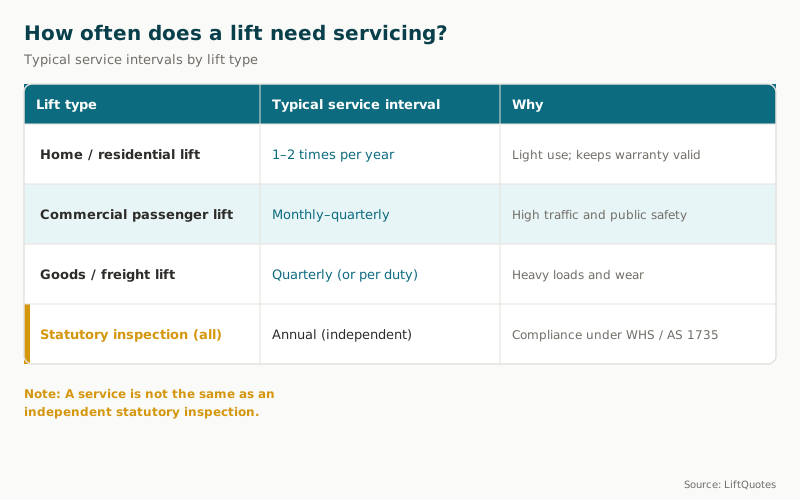
Home lifts are usually serviced once or twice a year and commercial lifts monthly to quarterly. On top of routine servicing, every lift needs a separate annual independent inspection.
Home lifts: once or twice a year
A residential lift under AS/NZS 1735.18:2002 does light duty. An annual or six-monthly service is usually enough to keep it reliable and keep the warranty valid.
Commercial lifts: monthly to quarterly
Higher traffic and public-safety duties shorten the interval. Busy lifts in hospitals, shopping centres, and apartment towers are often on monthly contracts.
Goods lifts: quarterly or per duty cycle
Heavy and repeated loads accelerate wear on ropes, guides, and doors, so freight lifts are commonly serviced quarterly or against their load cycle.
Every lift: an annual independent inspection
Separate from routine servicing, a statutory inspection by an independent competent person verifies the lift against its design and AS 1735 — typically once a year.
Most Australian lifts are serviced somewhere between once a year and once a month, depending on the lift type and how hard it works. A home lift used by a single household is typically serviced once or twice a year. A commercial passenger lift in a busy office or apartment building is usually serviced monthly to quarterly. Goods and freight lifts sit in between — often quarterly, or on a schedule tied to their duty cycle.
Servicing is not the same as inspection. Routine servicing is preventive maintenance carried out by your lift company: lubrication, adjustment, safety-device testing, and parts replacement. A statutory inspection is a separate, usually annual assessment carried out by an independent competent person. You need both, and they are budgeted separately.
Servicing is more than good practice. It keeps the manufacturer’s warranty valid and helps the building owner meet Work Health and Safety (WHS) duties — or, in Victoria, equivalent OHS duties. This guide sets out service frequency by lift type, how servicing differs from inspection, and what happens when a lift is left unserviced.
How often should each type of lift be serviced?
Service frequency comes down to two things: how heavily the lift is used, and what the manufacturer and the relevant standard require. A lightly used home lift and a lift carrying hundreds of passengers a day in an office tower are not on the same schedule.
- Home and residential lifts — typically serviced once or twice a year. A single-household lift covered by AS/NZS 1735.18:2002 does light duty, so an annual or six-monthly visit is usually enough to keep it running and keep the warranty valid.
- Commercial passenger lifts — usually serviced monthly to quarterly. Higher traffic, public safety obligations, and duty of care under Work Health and Safety law push the interval shorter. A busy lift in a hospital or shopping centre may be on a monthly contract.
- Goods and freight lifts — commonly quarterly, or on a duty-based schedule tied to load cycles. Heavy loads accelerate wear on ropes, guides, and doors.
Your lift company sets the exact interval in the lift maintenance contract, based on the manufacturer's schedule and how the lift is actually used.
Servicing versus statutory inspection — they are not the same
Routine servicing and statutory inspection are two different activities, and confusing them is the most common mistake building owners make.
Servicing is preventive maintenance carried out by your lift maintenance provider — lubrication, adjustment, testing of safety devices, and replacing worn parts before they fail. It happens on the interval set in your service contract.
A statutory inspection is a separate, independent assessment of the lift against its registered design and the relevant standard. It is usually carried out annually by a competent person who is independent of the day-to-day servicing. The scope and cost sit apart from your maintenance contract — see our guide to lift inspection cost for what to budget.
In short: a service keeps the lift healthy; an inspection verifies that it is compliant and safe. A well-run building needs both.
Is lift servicing a legal requirement?
For lifts in workplaces and shared buildings, the answer is effectively yes. Lifts are registrable plant under the Model Work Health and Safety (WHS) Regulations, and the person conducting a business or undertaking — usually the building owner or managing body — has a duty to keep plant safe and properly maintained. Letting servicing lapse breaches that duty.
Victoria is the exception. It did not adopt the model WHS laws and operates under the Occupational Health and Safety Act 2004 and OHS Regulations 2017 — but the practical obligation to maintain lifts is the same. Whichever state you are in, service intervals and maintenance records are how you demonstrate the lift has been kept safe.
The AS 1735 series of Australian Standards sets the framework for lift design, maintenance, and inspection. For what regular servicing costs and what a contract should include, see lift maintenance cost.
What happens when servicing is skipped
Neglected lifts fail in predictable ways. Worn ropes and sheaves, dry guide rails, drifting door timing, and degraded safety devices all develop gradually, then cause a breakdown at the worst moment. The immediate cost is downtime and emergency callout fees, which run far higher than a scheduled visit.
The longer-term costs are worse. An out-of-service lift in an apartment block or aged-care facility strands residents. A safety device that has not been tested can fail when it is needed most. If an incident occurs on a lift with no maintenance records, the building owner is exposed under WHS or OHS law. Missed servicing can also void the manufacturer's warranty, turning a covered repair into an out-of-pocket one.
For commercial buildings, uptime alone makes the business case — see commercial lifts for how service levels are specified.
How to set the right service interval
Start with the manufacturer's recommended schedule, then adjust for real-world use:
- Traffic — more passengers or heavier loads mean shorter intervals.
- Environment — coastal, dusty, or outdoor installations wear faster.
- Criticality — a hospital or single-lift building needs tighter servicing than a lift with a redundant twin.
- Age — older lifts and those nearing modernisation often need more frequent attention.
As of Q2 2026, most Australian maintenance contracts are structured as comprehensive (parts and labour included) or non-comprehensive (labour only). The interval — monthly, quarterly, six-monthly, or annual — is set in that contract.
Not sure whether your lift is on the right schedule, or paying too much for the wrong contract? Get free quotes from qualified Australian lift companies and compare service intervals, inclusions, and price.
Lift companies in Australia
Browse profiles, compare service areas, and check reviews.

Lift Shop
★ 5.0 (1551 reviews)
Australia's largest dedicated home lift specialist since 1996. 10,000+ installations. Exclusive Italian-crafted lifts with industry-leading 8-year warranty.
View profile →

Compact Home Lifts
NDIS★ 5.0 (465 reviews)
Melbourne branch of Compact Home Lifts. Compact residential lift specialist providing maintenance and repair services across Victoria.
View profile →

Next Level Elevators
★ 5.0 (454 reviews)
Award-winning provider of premium Italian-designed all-electric home elevators. Certified Eltec Partner. Showrooms in Melbourne, Sydney, and Brisbane.
View profile →

Shotton Lifts
NDIS★ 5.0 (9 reviews)
Family-owned Australian lift manufacturer since 1977. 80+ staff. Design, engineer, manufacture, install and service from Dandenong South VIC. NDIS registered.
View profile →

LiftFit Australia
NDIS★ 5.0 (8 reviews)
Victoria-based NDIS registered lift provider, est. 2011. Partners with Cibes, Savaria, and Kalea. Residential, commercial, and platform lifts.
View profile →

Easy Living Home Elevators
★ 5.0 (7 reviews)
Australia's #1 home elevator supplier since 1998. 100% Australian-owned. 11,000+ elevators in service across 6 states.
View profile →
LiftQuotes is a comparison platform. Companies shown are filtered by relevance to this page. Listing does not imply endorsement. LiftQuotes may receive a referral fee when you request quotes.
Put this into action
When you're ready to move forward, get free quotes from verified Australian lift installers.
What are you looking for today?
I need a lift installed
I have a lift that needs attention
Most Australian lifts are serviced somewhere between once a year and once a month, depending on the lift type and how hard it works. A home lift used by a single household is typically serviced once or twice a year. A commercial passenger lift in a busy office or apartment building is usually serviced monthly to quarterly. Goods and freight lifts sit in between — often quarterly, or on a schedule tied to their duty cycle.
Servicing is not the same as inspection. Routine servicing is preventive maintenance carried out by your lift company: lubrication, adjustment, safety-device testing, and parts replacement. A statutory inspection is a separate, usually annual assessment carried out by an independent competent person. You need both, and they are budgeted separately.
Servicing is more than good practice. It keeps the manufacturer’s warranty valid and helps the building owner meet Work Health and Safety (WHS) duties — or, in Victoria, equivalent OHS duties. This guide sets out service frequency by lift type, how servicing differs from inspection, and what happens when a lift is left unserviced.
How often should each type of lift be serviced?
Service frequency comes down to two things: how heavily the lift is used, and what the manufacturer and the relevant standard require. A lightly used home lift and a lift carrying hundreds of passengers a day in an office tower are not on the same schedule.
- Home and residential lifts — typically serviced once or twice a year. A single-household lift covered by AS/NZS 1735.18:2002 does light duty, so an annual or six-monthly visit is usually enough to keep it running and keep the warranty valid.
- Commercial passenger lifts — usually serviced monthly to quarterly. Higher traffic, public safety obligations, and duty of care under Work Health and Safety law push the interval shorter. A busy lift in a hospital or shopping centre may be on a monthly contract.
- Goods and freight lifts — commonly quarterly, or on a duty-based schedule tied to load cycles. Heavy loads accelerate wear on ropes, guides, and doors.
Your lift company sets the exact interval in the lift maintenance contract, based on the manufacturer's schedule and how the lift is actually used.
Servicing versus statutory inspection — they are not the same
Routine servicing and statutory inspection are two different activities, and confusing them is the most common mistake building owners make.
Servicing is preventive maintenance carried out by your lift maintenance provider — lubrication, adjustment, testing of safety devices, and replacing worn parts before they fail. It happens on the interval set in your service contract.
A statutory inspection is a separate, independent assessment of the lift against its registered design and the relevant standard. It is usually carried out annually by a competent person who is independent of the day-to-day servicing. The scope and cost sit apart from your maintenance contract — see our guide to lift inspection cost for what to budget.
In short: a service keeps the lift healthy; an inspection verifies that it is compliant and safe. A well-run building needs both.
Is lift servicing a legal requirement?
For lifts in workplaces and shared buildings, the answer is effectively yes. Lifts are registrable plant under the Model Work Health and Safety (WHS) Regulations, and the person conducting a business or undertaking — usually the building owner or managing body — has a duty to keep plant safe and properly maintained. Letting servicing lapse breaches that duty.
Victoria is the exception. It did not adopt the model WHS laws and operates under the Occupational Health and Safety Act 2004 and OHS Regulations 2017 — but the practical obligation to maintain lifts is the same. Whichever state you are in, service intervals and maintenance records are how you demonstrate the lift has been kept safe.
The AS 1735 series of Australian Standards sets the framework for lift design, maintenance, and inspection. For what regular servicing costs and what a contract should include, see lift maintenance cost.
What happens when servicing is skipped
Neglected lifts fail in predictable ways. Worn ropes and sheaves, dry guide rails, drifting door timing, and degraded safety devices all develop gradually, then cause a breakdown at the worst moment. The immediate cost is downtime and emergency callout fees, which run far higher than a scheduled visit.
The longer-term costs are worse. An out-of-service lift in an apartment block or aged-care facility strands residents. A safety device that has not been tested can fail when it is needed most. If an incident occurs on a lift with no maintenance records, the building owner is exposed under WHS or OHS law. Missed servicing can also void the manufacturer's warranty, turning a covered repair into an out-of-pocket one.
For commercial buildings, uptime alone makes the business case — see commercial lifts for how service levels are specified.
How to set the right service interval
Start with the manufacturer's recommended schedule, then adjust for real-world use:
- Traffic — more passengers or heavier loads mean shorter intervals.
- Environment — coastal, dusty, or outdoor installations wear faster.
- Criticality — a hospital or single-lift building needs tighter servicing than a lift with a redundant twin.
- Age — older lifts and those nearing modernisation often need more frequent attention.
As of Q2 2026, most Australian maintenance contracts are structured as comprehensive (parts and labour included) or non-comprehensive (labour only). The interval — monthly, quarterly, six-monthly, or annual — is set in that contract.
Not sure whether your lift is on the right schedule, or paying too much for the wrong contract? Get free quotes from qualified Australian lift companies and compare service intervals, inclusions, and price.
Lift companies in Australia
Browse profiles, compare service areas, and check reviews.
Lift Shop
★ 5.0 (1551 reviews)
Australia's largest dedicated home lift specialist since 1996. 10,000+ installations. Exclusive Italian-crafted lifts with industry-leading 8-year warranty.
View profile →
Compact Home Lifts
NDIS★ 5.0 (465 reviews)
Melbourne branch of Compact Home Lifts. Compact residential lift specialist providing maintenance and repair services across Victoria.
View profile →
Next Level Elevators
★ 5.0 (454 reviews)
Award-winning provider of premium Italian-designed all-electric home elevators. Certified Eltec Partner. Showrooms in Melbourne, Sydney, and Brisbane.
View profile →
Shotton Lifts
NDIS★ 5.0 (9 reviews)
Family-owned Australian lift manufacturer since 1977. 80+ staff. Design, engineer, manufacture, install and service from Dandenong South VIC. NDIS registered.
View profile →
LiftFit Australia
NDIS★ 5.0 (8 reviews)
Victoria-based NDIS registered lift provider, est. 2011. Partners with Cibes, Savaria, and Kalea. Residential, commercial, and platform lifts.
View profile →
Easy Living Home Elevators
★ 5.0 (7 reviews)
Australia's #1 home elevator supplier since 1998. 100% Australian-owned. 11,000+ elevators in service across 6 states.
View profile →
LiftQuotes is a comparison platform. Companies shown are filtered by relevance to this page. Listing does not imply endorsement. LiftQuotes may receive a referral fee when you request quotes.
Put this into action
When you're ready to move forward, get free quotes from verified Australian lift installers.
What are you looking for today?
I need a lift installed
I have a lift that needs attention
Common questions about lift service frequency
It depends on the lift type and how heavily it is used. As a rule of thumb: home lifts are serviced once or twice a year, commercial passenger lifts monthly to quarterly, and goods lifts quarterly or on a duty-based schedule. On top of routine servicing, every lift needs a separate annual independent inspection. The exact interval is set in your maintenance contract, based on the manufacturer’s schedule and real-world use.
Related guides
Guide
Our Editorial Methodology: How LiftQuotes Researches Content
How LiftQuotes researches, sources and reviews every lift guide and cost page: the standards we cite, our linked-source rule for cost data, and how often we update.
Guide
Lift Compliance Checklist for Facility Managers (Australia)
A facility manager's lift compliance checklist for Australia: plant registration, inspection, log books, 4G VoLTE emergency phones and DDA access duties.
Comparison
Stairlift vs Platform Lift: Which Access Solution Fits?
A stairlift carries a seated user along the stairs from about $3,000; a platform lift raises a wheelchair vertically from about $15,000. Compare cost, access and fit.
Location
Lift Companies in Melbourne: Compare Local Installers
Compare lift companies in Melbourne for home, platform and commercial lifts. WorkSafe Victoria compliance, local installer coverage and indicative VIC costs.
Compare lift service intervals and pricing
Whether you manage a single home lift or a building full of them, compare quotes from qualified Australian lift companies on service frequency, contract inclusions, and price.
Join 1,000+ Australians who've requested quotes through LiftQuotes
Get free quotes