Lift Modernisation in Australia
Lift modernisation spans three scope bands — from controller and drive upgrades at $80,000–$120,000 per car through to full replacement at $400,000+. Here is how to define the right scope, understand the costs, and plan the programme.
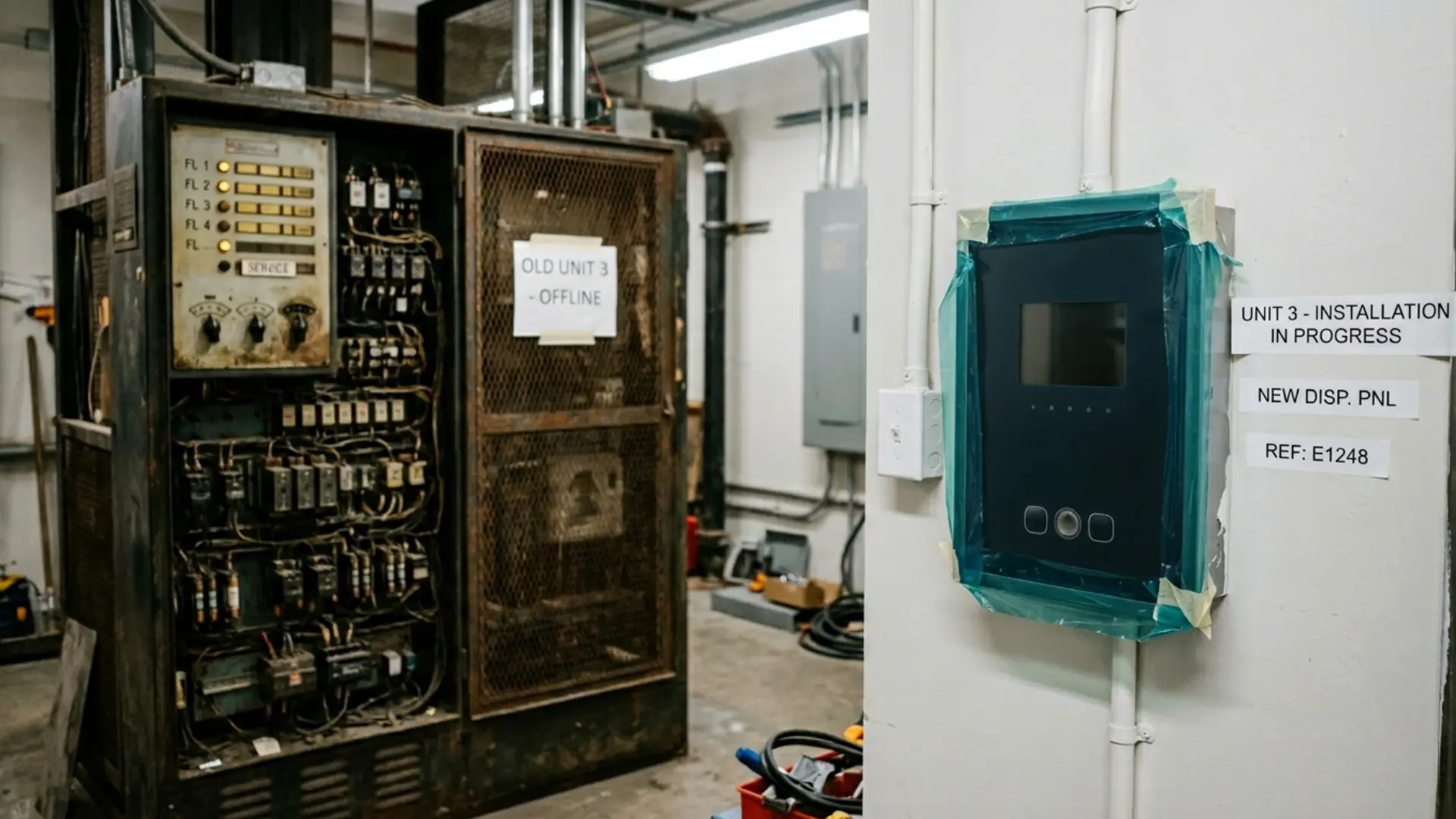
Lift modernisation covers planned upgrades to an existing lift installation — from targeted component replacement (controller, drive, and door systems) through to full equipment replacement in the existing shaft. Indicative cost ranges run from $80,000–$120,000 per car for a controller and drive scope, up to $220,000–$400,000 or more for full replacement in complex shafts (based on available market data, last checked March 2026). A multi-lift building portfolio modernisation can exceed $750,000 in total. Modernisation sits between ongoing repair — reactive and unplanned — and a full new installation. It is a planned, scoped capital expenditure.
Modernisation is triggered by a combination of factors, not a single threshold. Rising breakdown frequency, parts obsolescence, compliance obligations tied to building work, and the need to ensure 4G VoLTE emergency phone compliance on an ongoing basis have all prompted modernisation programmes in Australian commercial buildings. For strata committees and owners corporations facing 20–25 year lifecycle decisions, the question is typically: modernise now as a planned investment, or continue repairing until forced into a more compressed and expensive programme.
Three broad scope bands structure the decision: starter scope (controller, drive, and doors) addresses the components responsible for most failures; comprehensive scope adds car interior, landing equipment, and communications; full replacement addresses cases where all equipment in the shaft requires replacement. Each scope has different programme timelines, downtime implications, and cost profiles.
An independent lift consultant — engaged before going to market — can define the scope from a technical inspection, run a competitive tender against that fixed specification, and evaluate contractor responses on a like-for-like basis. Without independent scope definition, contractors will quote different scopes and direct comparison becomes impossible. LESA (Lift Engineering Society of Australia) and AAVT (Australian Association of Vertical Transport) can provide referrals to independent consultants.
Scope bands, programme planning and how to go to market
Triggers: when does modernisation become necessary?
Modernisation is most commonly triggered by one or more of the following:
- Rising breakdown frequency — call-out rates increasing as controllers, drives, and door systems approach end of service life (typically 15–25 years for commercial equipment)
- Parts obsolescence — the original controller or drive is no longer supported by the manufacturer and replacement parts are unavailable or sourced from diminishing aftermarket stock
- Compliance obligations — building works or a change of use triggers NCC requirements that necessitate an accessible lift upgrade under the Premises Standards 2010 or AS 1735.12:2020
- Emergency phone compliance — buildings requiring updated equipment to maintain active 4G VoLTE monitoring arrangements on an ongoing basis
- Insurer and lender requirements — some insurers and building financiers require evidence of lift condition and maintenance history as part of portfolio risk assessments
- Contract renewal leverage — a maintenance contract up for tender where the incumbent uses modernisation as a condition of a competitive service rate
The most dangerous trigger is accumulated deferred maintenance. Buildings that have extended repair life through non-comprehensive contracts and minimal capital investment can face a compressed and expensive forced modernisation rather than a planned one.
The three scope bands
Starter scope: controller, drive, and doors ($80,000–$120,000 per car)
This scope replaces the controller, motor drive unit, and door operating systems — the components responsible for most failures and most compliance risk. The car interior, landing fixtures, and shaft structure are retained. This is the most common entry point for a first-stage modernisation on a 15–25 year old commercial lift.
Comprehensive scope: starter scope plus interior and landing equipment ($150,000–$250,000 per car)
This scope adds the car interior (panels, floor, lighting, display), landing fixtures (buttons, indicators, landing doors where required), and communications and emergency phone equipment. The result is a functionally new lift in the existing shaft structure.
Full replacement: all equipment in the existing shaft ($220,000–$400,000+ per car)
This scope replaces everything in the shaft. It is used where the shaft structure is sound but the car, guide rails, roping, and all equipment require replacement — typically in lifts 30 or more years old, or where capacity or speed requirements have changed. Buildings with multiple lifts at this stage often face combined budgets exceeding $750,000 for a full portfolio programme.
All figures are indicative, based on available market data (last checked March 2026), and exclude GST, associated building works, and structural modifications.
Programme planning: phasing and downtime
A starter scope modernisation typically takes 4–12 weeks per car out of service, depending on parts lead times and site access. Comprehensive scope or full replacement takes 8–20 weeks per car.
For single-lift buildings, extended downtime requires a plan for occupants with mobility limitations before works begin. For multi-lift buildings, phased modernisation — one car at a time — maintains partial service throughout the programme but extends the overall timeline.
Parts lead times for specialist components such as controllers and drive units can extend programmes significantly, particularly where imported components are involved. Confirm parts availability and lead times with contractors before committing to a programme schedule and before communicating timelines to building occupants.
Compliance implications of a modernisation
Modernisation can trigger compliance obligations that a targeted repair does not. Under the NCC and the Disability (Access to Premises — Buildings) Standards 2010, building work on a lift may trigger accessible lift requirements — particularly in buildings subject to the Premises Standards where the work is the largest item in a broader building programme. AS 1735.12:2020 governs lift facilities for persons with disabilities in commercial contexts.
Before proceeding with a modernisation scope, confirm with your state building certifier or an access consultant whether the work triggers NCC or Premises Standards obligations. In WHS jurisdictions, significant equipment changes also require notification to or registration update with your state WHS regulator. Victoria operates under the OHS Regulations 2017 rather than the model WHS framework.
Getting the scope right: the case for independent definition
Without an independently defined scope, contractors will quote different scopes. The contractor with the lowest figure may have defined a narrower scope; the highest may have included items the building does not need. Post-award scope additions — discovered when the shaft is opened — are common when scope is not defined before tender.
An independent lift consultant defines the scope from a technical inspection of the existing installation, runs the tender against that fixed specification, and evaluates contractor responses on a like-for-like basis. The consultant fee is typically recovered through better contract terms, reduced post-award scope additions, and avoided disputes.
LESA (Lift Engineering Society of Australia) and AAVT (Australian Association of Vertical Transport) can provide referrals to independent lift consultants in Australia.
Related pages
For the repair-vs-modernisation decision framework and cost comparison, see lift repair. For maintenance contract considerations that affect modernisation timing, see lift maintenance. For commercial lift specifications and compliance context, see commercial lifts.
Lift Modernisation companies in Australia
Browse profiles, compare service areas, and check reviews.
Elevator Project Management
★ 5.0 (4 reviews)
Melbourne-based elevator project management, modernisation consulting, and maintenance advisory firm.
View profile →

EcoLift
★ 5.0 (3 reviews)
Family-owned Sydney lift company. European-parts-based installations for reliability and cost-efficient servicing.
View profile →
EMS Elevator Group
★ 5.0 (2 reviews)
Sydney-based bespoke elevator company specialising in installation, modernisation, and maintenance. 24/7 support.
View profile →

Grant Elevators
★ 4.8 (22 reviews)
Perth's premier luxury lift company with 50+ years experience and 3,000+ projects across 6 countries. Four generations of family ownership.
View profile →

Lift Services Sydney
★ 4.4 (7 reviews)
Independent Australian-owned Sydney lift company with 60+ years combined experience. Maintenance, new installations, and modernisation.
View profile →

Hamilton Elevators
★ 4.3
Sydney-based elevator company delivering personal, high-quality service for residential and commercial lift projects. AEA member.
View profile →
LiftQuotes is a comparison platform. Companies shown are filtered by relevance to this page. Listing does not imply endorsement. LiftQuotes may receive a referral fee when you request quotes.
Get quotes from local installers
Your home's layout and access needs will determine the right product. Get quotes to find out.
What are you looking for today?
I need a lift installed
I have a lift that needs attention
Lift modernisation covers planned upgrades to an existing lift installation — from targeted component replacement (controller, drive, and door systems) through to full equipment replacement in the existing shaft. Indicative cost ranges run from $80,000–$120,000 per car for a controller and drive scope, up to $220,000–$400,000 or more for full replacement in complex shafts (based on available market data, last checked March 2026). A multi-lift building portfolio modernisation can exceed $750,000 in total. Modernisation sits between ongoing repair — reactive and unplanned — and a full new installation. It is a planned, scoped capital expenditure.
Modernisation is triggered by a combination of factors, not a single threshold. Rising breakdown frequency, parts obsolescence, compliance obligations tied to building work, and the need to ensure 4G VoLTE emergency phone compliance on an ongoing basis have all prompted modernisation programmes in Australian commercial buildings. For strata committees and owners corporations facing 20–25 year lifecycle decisions, the question is typically: modernise now as a planned investment, or continue repairing until forced into a more compressed and expensive programme.
Three broad scope bands structure the decision: starter scope (controller, drive, and doors) addresses the components responsible for most failures; comprehensive scope adds car interior, landing equipment, and communications; full replacement addresses cases where all equipment in the shaft requires replacement. Each scope has different programme timelines, downtime implications, and cost profiles.
An independent lift consultant — engaged before going to market — can define the scope from a technical inspection, run a competitive tender against that fixed specification, and evaluate contractor responses on a like-for-like basis. Without independent scope definition, contractors will quote different scopes and direct comparison becomes impossible. LESA (Lift Engineering Society of Australia) and AAVT (Australian Association of Vertical Transport) can provide referrals to independent consultants.
Scope bands, programme planning and how to go to market
Triggers: when does modernisation become necessary?
Modernisation is most commonly triggered by one or more of the following:
- Rising breakdown frequency — call-out rates increasing as controllers, drives, and door systems approach end of service life (typically 15–25 years for commercial equipment)
- Parts obsolescence — the original controller or drive is no longer supported by the manufacturer and replacement parts are unavailable or sourced from diminishing aftermarket stock
- Compliance obligations — building works or a change of use triggers NCC requirements that necessitate an accessible lift upgrade under the Premises Standards 2010 or AS 1735.12:2020
- Emergency phone compliance — buildings requiring updated equipment to maintain active 4G VoLTE monitoring arrangements on an ongoing basis
- Insurer and lender requirements — some insurers and building financiers require evidence of lift condition and maintenance history as part of portfolio risk assessments
- Contract renewal leverage — a maintenance contract up for tender where the incumbent uses modernisation as a condition of a competitive service rate
The most dangerous trigger is accumulated deferred maintenance. Buildings that have extended repair life through non-comprehensive contracts and minimal capital investment can face a compressed and expensive forced modernisation rather than a planned one.
The three scope bands
Starter scope: controller, drive, and doors ($80,000–$120,000 per car)
This scope replaces the controller, motor drive unit, and door operating systems — the components responsible for most failures and most compliance risk. The car interior, landing fixtures, and shaft structure are retained. This is the most common entry point for a first-stage modernisation on a 15–25 year old commercial lift.
Comprehensive scope: starter scope plus interior and landing equipment ($150,000–$250,000 per car)
This scope adds the car interior (panels, floor, lighting, display), landing fixtures (buttons, indicators, landing doors where required), and communications and emergency phone equipment. The result is a functionally new lift in the existing shaft structure.
Full replacement: all equipment in the existing shaft ($220,000–$400,000+ per car)
This scope replaces everything in the shaft. It is used where the shaft structure is sound but the car, guide rails, roping, and all equipment require replacement — typically in lifts 30 or more years old, or where capacity or speed requirements have changed. Buildings with multiple lifts at this stage often face combined budgets exceeding $750,000 for a full portfolio programme.
All figures are indicative, based on available market data (last checked March 2026), and exclude GST, associated building works, and structural modifications.
Programme planning: phasing and downtime
A starter scope modernisation typically takes 4–12 weeks per car out of service, depending on parts lead times and site access. Comprehensive scope or full replacement takes 8–20 weeks per car.
For single-lift buildings, extended downtime requires a plan for occupants with mobility limitations before works begin. For multi-lift buildings, phased modernisation — one car at a time — maintains partial service throughout the programme but extends the overall timeline.
Parts lead times for specialist components such as controllers and drive units can extend programmes significantly, particularly where imported components are involved. Confirm parts availability and lead times with contractors before committing to a programme schedule and before communicating timelines to building occupants.
Compliance implications of a modernisation
Modernisation can trigger compliance obligations that a targeted repair does not. Under the NCC and the Disability (Access to Premises — Buildings) Standards 2010, building work on a lift may trigger accessible lift requirements — particularly in buildings subject to the Premises Standards where the work is the largest item in a broader building programme. AS 1735.12:2020 governs lift facilities for persons with disabilities in commercial contexts.
Before proceeding with a modernisation scope, confirm with your state building certifier or an access consultant whether the work triggers NCC or Premises Standards obligations. In WHS jurisdictions, significant equipment changes also require notification to or registration update with your state WHS regulator. Victoria operates under the OHS Regulations 2017 rather than the model WHS framework.
Getting the scope right: the case for independent definition
Without an independently defined scope, contractors will quote different scopes. The contractor with the lowest figure may have defined a narrower scope; the highest may have included items the building does not need. Post-award scope additions — discovered when the shaft is opened — are common when scope is not defined before tender.
An independent lift consultant defines the scope from a technical inspection of the existing installation, runs the tender against that fixed specification, and evaluates contractor responses on a like-for-like basis. The consultant fee is typically recovered through better contract terms, reduced post-award scope additions, and avoided disputes.
LESA (Lift Engineering Society of Australia) and AAVT (Australian Association of Vertical Transport) can provide referrals to independent lift consultants in Australia.
Related pages
For the repair-vs-modernisation decision framework and cost comparison, see lift repair. For maintenance contract considerations that affect modernisation timing, see lift maintenance. For commercial lift specifications and compliance context, see commercial lifts.
Lift Modernisation companies in Australia
Browse profiles, compare service areas, and check reviews.
Elevator Project Management
★ 5.0 (4 reviews)
Melbourne-based elevator project management, modernisation consulting, and maintenance advisory firm.
View profile →
EcoLift
★ 5.0 (3 reviews)
Family-owned Sydney lift company. European-parts-based installations for reliability and cost-efficient servicing.
View profile →
EMS Elevator Group
★ 5.0 (2 reviews)
Sydney-based bespoke elevator company specialising in installation, modernisation, and maintenance. 24/7 support.
View profile →
Grant Elevators
★ 4.8 (22 reviews)
Perth's premier luxury lift company with 50+ years experience and 3,000+ projects across 6 countries. Four generations of family ownership.
View profile →
Lift Services Sydney
★ 4.4 (7 reviews)
Independent Australian-owned Sydney lift company with 60+ years combined experience. Maintenance, new installations, and modernisation.
View profile →
Hamilton Elevators
★ 4.3
Sydney-based elevator company delivering personal, high-quality service for residential and commercial lift projects. AEA member.
View profile →
LiftQuotes is a comparison platform. Companies shown are filtered by relevance to this page. Listing does not imply endorsement. LiftQuotes may receive a referral fee when you request quotes.
Get quotes from local installers
Your home's layout and access needs will determine the right product. Get quotes to find out.
What are you looking for today?
I need a lift installed
I have a lift that needs attention
Triggers, scope bands and programme considerations
What triggers a lift modernisation
Rising call-out frequency, parts obsolescence (controller or drive no longer supported by the manufacturer), compliance obligations arising from building works, insurer or lender requirements, and ongoing emergency phone compliance are all common triggers. The most costly scenario is accumulated deferred maintenance — buildings that have extended repair life through minimal capital investment face a compressed and less planned modernisation when components fail completely.
The three scope bands
Starter scope — controller, drive, and doors — runs $80,000–$120,000 per car and addresses the components responsible for most failures. Comprehensive scope adds car interior, landing fixtures, and communications: $150,000–$250,000 per car. Full replacement of all equipment in the existing shaft runs $220,000–$400,000 or more per car. All figures are indicative (last checked March 2026); actual costs depend on lift size, speed class, stops, shaft conditions, and site access.
Programme planning and downtime
A starter scope modernisation typically takes 4–12 weeks per car out of service. Comprehensive or full replacement takes 8–20 weeks. For single-lift buildings, downtime requires a plan for occupants with mobility limitations before works begin. For multi-lift buildings, phased modernisation — one car at a time — maintains partial service throughout the programme but extends the total timeline. Parts lead times for specialist components can extend programmes — confirm availability before scheduling.
Compliance implications
Modernisation can trigger compliance obligations that targeted repair does not. Under the NCC and the Disability (Access to Premises — Buildings) Standards 2010, building work on a lift may trigger accessible lift requirements under AS 1735.12:2020. Confirm with your state building certifier or an access consultant whether the modernisation scope triggers NCC or Premises Standards obligations before proceeding — particularly where the modernisation is part of a broader building programme.
Related guides
Location
Commercial Lifts Melbourne: Costs, Compliance & Installers
Commercial lift costs, Victorian OHS compliance and the Melbourne installer market — indicative prices, WorkSafe Victoria rules and NCC requirements for VIC projects.
Location
Commercial Lifts Sydney: Costs, Compliance & Installers
Commercial lift costs, NSW compliance and the Sydney installer market — indicative prices, SafeWork NSW rules and NCC requirements for CBD and metro projects.
Guide
What Size Lift Do I Need for a Wheelchair? (Australia)
A home lift for a wheelchair needs roughly 1,100 x 1,400 mm inside and a 900 mm clear door. See minimum sizes for a wheelchair, a carer, and turning space.
Guide
Support at Home & Lift Funding: The 2026 Guide
Can Support at Home fund a home lift or stairlift? How aged care funding works, the OT assessment, means-tested contributions, and how it differs from the NDIS.
Get lift modernisation quotes for your building
Modernisation costs vary significantly based on scope, lift age, shaft conditions, and the number of stops. Getting independent quotes — ideally after an independent scope definition — gives you a like-for-like basis for comparison.
Join 1,000+ Australians who've requested quotes through LiftQuotes
Get modernisation quotes