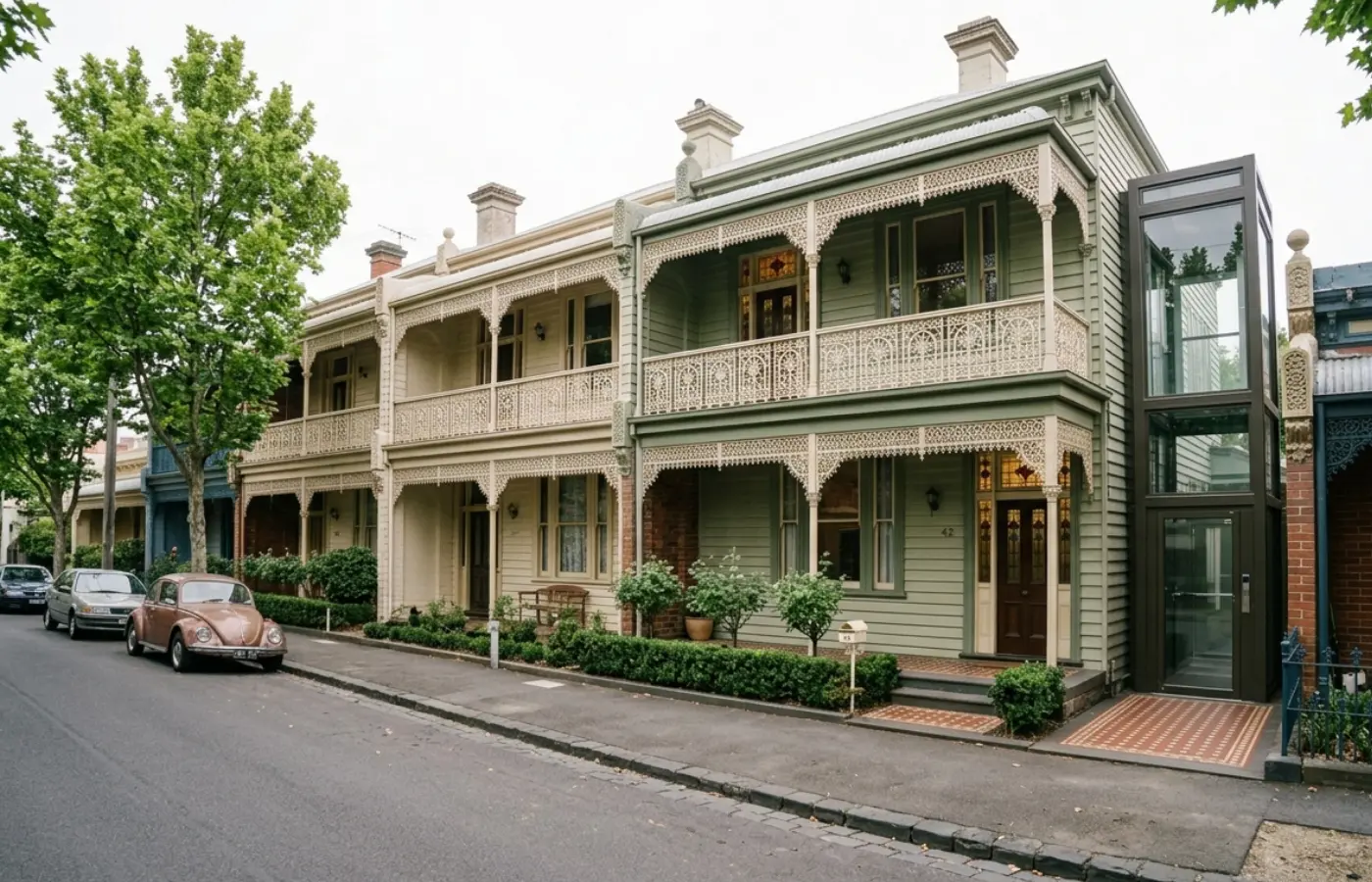
Home Lifts Melbourne: Installation, Costs, and Local Suppliers
Victoria uses OHS legislation — not WHS — which affects how home lifts are registered and maintained. Here is what applies for Melbourne home lift installations.
Melbourne home lift projects divide clearly into two groups: inner-city Victorian terrace retrofits and double-storey suburban new builds or renovations. Both groups face the same regulatory pathway, but the structural and cost picture differs significantly.
Melbourne inner suburbs — Fitzroy, Collingwood, Richmond, Carlton, Brunswick, and Northcote — contain dense rows of Victorian and Edwardian terrace houses. These properties share many of the same constraints as Sydney terraces: narrow floor plans, period construction walls, steep staircases, and frequent heritage overlay conditions. Compact hydraulic or pneumatic through-floor lifts are typically the most practical options.
Outer suburban new builds in the Hills District east, Berwick, Point Cook, Doncaster, and Glen Waverley tend to be double-storey project homes with adequate ceiling height and more flexibility on shaft placement. Standard cable traction or hydraulic installations are straightforward in this housing type.
A critical distinction for Melbourne: Victoria operates under the Occupational Health and Safety Act 2004 and OHS Regulations 2017 — not the harmonised WHS framework used in other states. Plant registration for home lifts goes through WorkSafe Victoria, not a WHS regulator. See our home lifts overview and home lift cost guide for product and cost context.
Melbourne, Victoria
Victoria did not adopt the harmonised Work Health and Safety (WHS) laws. It operates under the Occupational Health and Safety Act 2004 (Vic) and OHS Regulations 2017 — a distinct framework from all other mainland states. For home lift owners, the practical implication is that plant registration goes through WorkSafe Victoria, not a WHS regulator.
Home lifts are registrable plant under the OHS Regulations 2017. Both the design registration and the item registration must be lodged with WorkSafe Victoria before the lift is used. Your lift supplier will typically manage this as part of the installation handover process.
For strata and apartment buildings in Melbourne, the owners corporation (governed by the Owners Corporations Act 2006 (Vic)) is responsible for the repair and maintenance of common property, including any shared lift. If you are installing a lift within your own lot, confirm with the owners corporation whether a special resolution or by-law is required before work begins.
Melbourne inner suburbs have a high density of heritage overlays under the Melbourne Planning Scheme. Properties in areas such as Fitzroy, Collingwood, Carlton, Richmond, and Brunswick may require a heritage impact assessment as part of the planning permit application for structural modifications.
Local compliance at a glance
- Regulator
- WorkSafe Victoria
- Framework
- OHS Act 2004
- Building approval
- Building permit (registered surveyor)
- Plant registration
- Required before first use
Melbourne costs are broadly in line with national ranges. Inner-suburb heritage overlay properties may incur additional permit and assessment costs.
Victorian terraces — inner Melbourne retrofits
The inner Melbourne terrace belt runs through Fitzroy, Collingwood, Richmond, Carlton, Northcote, and Brunswick. These properties share structural constraints with Sydney terraces — narrow floor plans, period construction walls, cast iron lacework facades — but Melbourne terraces are often slightly wider and may have rear extensions that create more shaft placement options. Compact hydraulic and pneumatic through-floor lifts are the most practical product categories for this housing type.
Heritage overlay conditions are common across inner Melbourne. Under the Melbourne Planning Scheme, properties in heritage overlay zones may require a planning permit and heritage impact assessment before structural modifications can proceed. Confirm the overlay status of your property at MAPVIEW (the Victorian government planning map) before commissioning a structural assessment.
Owners corporation obligations
Melbourne has a high proportion of apartment and townhouse complexes governed by owners corporations under the Owners Corporations Act 2006 (Vic). The owners corporation is responsible for the repair and maintenance of common property, including any shared lift infrastructure. If you are installing a home lift within your own strata lot, check whether the installation requires a special resolution or by-law approval from the owners corporation. Your strata manager will advise.
Building permit requirements in Victoria
All home lift installations in Victoria require a building permit from a registered building surveyor before work begins. Victoria does not have an equivalent to the NSW Complying Development Certificate (CDC) pathway — structural modifications require a full building permit regardless of scale. The registered building surveyor must inspect and certify the completed installation before the lift is put into service.
WorkSafe Victoria plant registration
Victoria uses the OHS framework — not WHS. Home lifts are registrable plant under the OHS Regulations 2017. Both the design registration and item registration must be lodged with WorkSafe Victoria before the lift is used. Your supplier will typically manage this.
Verify current requirements at WorkSafe Victoria: https://www.worksafe.vic.gov.au/plant-and-equipment-design-registration-or-alteration
Coverage area
This page covers home lift installations across greater Melbourne — including the Inner North, Inner East, Inner West, South East, outer growth corridors (Berwick, Craigieburn, Werribee, Point Cook), and the Mornington Peninsula. Suburb-level pages will link back to this page as the Melbourne metro hub.
For national cost context, see our home lift cost guide. For product options, see our home lifts overview. Ready to compare Melbourne suppliers? Get free quotes through LiftQuotes.
Lift companies in Melbourne
Browse profiles, compare service areas, and check reviews.

Shotton Lifts
NDIS★ 5.0 (9 reviews)
Family-owned Australian lift manufacturer since 1977. 80+ staff. Design, engineer, manufacture, install and service from Dandenong South VIC. NDIS registered.
View profile →

LiftFit Australia
NDIS★ 5.0 (8 reviews)
Victoria-based NDIS registered lift provider, est. 2011. Partners with Cibes, Savaria, and Kalea. Residential, commercial, and platform lifts.
View profile →

Easy Living Home Elevators
★ 5.0 (7 reviews)
Australia's #1 home elevator supplier since 1998. 100% Australian-owned. 11,000+ elevators in service across 6 states.
View profile →

E-Lift
★ 5.0
Melbourne-based owner-operated home and commercial lift specialist. Italian-designed hydraulic lifts. Personalised service from purchase to maintenance.
View profile →

Platinum Elevators
NDIS★ 4.9 (134 reviews)
Keysborough VIC-based residential and commercial elevator specialist. 100% Italian-made products. NDIS registered provider (until Oct 2028).
View profile →

Direct Lifts Australia
NDIS★ 4.9
Queensland-based home and commercial lift supplier and installer. NDIS registered provider.
View profile →
LiftQuotes is a comparison platform. Companies shown are filtered by relevance to this page. Listing does not imply endorsement. LiftQuotes may receive a referral fee when you request quotes.
Compare lift installers in Melbourne
Get free, no-obligation quotes from lift companies serving Melbourne and surrounding areas.
What are you looking for today?
I need a lift installed
I have a lift that needs attention
Melbourne, Victoria
Victoria did not adopt the harmonised Work Health and Safety (WHS) laws. It operates under the Occupational Health and Safety Act 2004 (Vic) and OHS Regulations 2017 — a distinct framework from all other mainland states. For home lift owners, the practical implication is that plant registration goes through WorkSafe Victoria, not a WHS regulator.
Home lifts are registrable plant under the OHS Regulations 2017. Both the design registration and the item registration must be lodged with WorkSafe Victoria before the lift is used. Your lift supplier will typically manage this as part of the installation handover process.
For strata and apartment buildings in Melbourne, the owners corporation (governed by the Owners Corporations Act 2006 (Vic)) is responsible for the repair and maintenance of common property, including any shared lift. If you are installing a lift within your own lot, confirm with the owners corporation whether a special resolution or by-law is required before work begins.
Melbourne inner suburbs have a high density of heritage overlays under the Melbourne Planning Scheme. Properties in areas such as Fitzroy, Collingwood, Carlton, Richmond, and Brunswick may require a heritage impact assessment as part of the planning permit application for structural modifications.
Local compliance at a glance
- Regulator
- WorkSafe Victoria
- Framework
- OHS Act 2004
- Building approval
- Building permit (registered surveyor)
- Plant registration
- Required before first use
Melbourne costs are broadly in line with national ranges. Inner-suburb heritage overlay properties may incur additional permit and assessment costs.
Victorian terraces — inner Melbourne retrofits
The inner Melbourne terrace belt runs through Fitzroy, Collingwood, Richmond, Carlton, Northcote, and Brunswick. These properties share structural constraints with Sydney terraces — narrow floor plans, period construction walls, cast iron lacework facades — but Melbourne terraces are often slightly wider and may have rear extensions that create more shaft placement options. Compact hydraulic and pneumatic through-floor lifts are the most practical product categories for this housing type.
Heritage overlay conditions are common across inner Melbourne. Under the Melbourne Planning Scheme, properties in heritage overlay zones may require a planning permit and heritage impact assessment before structural modifications can proceed. Confirm the overlay status of your property at MAPVIEW (the Victorian government planning map) before commissioning a structural assessment.
Owners corporation obligations
Melbourne has a high proportion of apartment and townhouse complexes governed by owners corporations under the Owners Corporations Act 2006 (Vic). The owners corporation is responsible for the repair and maintenance of common property, including any shared lift infrastructure. If you are installing a home lift within your own strata lot, check whether the installation requires a special resolution or by-law approval from the owners corporation. Your strata manager will advise.
Building permit requirements in Victoria
All home lift installations in Victoria require a building permit from a registered building surveyor before work begins. Victoria does not have an equivalent to the NSW Complying Development Certificate (CDC) pathway — structural modifications require a full building permit regardless of scale. The registered building surveyor must inspect and certify the completed installation before the lift is put into service.
WorkSafe Victoria plant registration
Victoria uses the OHS framework — not WHS. Home lifts are registrable plant under the OHS Regulations 2017. Both the design registration and item registration must be lodged with WorkSafe Victoria before the lift is used. Your supplier will typically manage this.
Verify current requirements at WorkSafe Victoria: https://www.worksafe.vic.gov.au/plant-and-equipment-design-registration-or-alteration
Coverage area
This page covers home lift installations across greater Melbourne — including the Inner North, Inner East, Inner West, South East, outer growth corridors (Berwick, Craigieburn, Werribee, Point Cook), and the Mornington Peninsula. Suburb-level pages will link back to this page as the Melbourne metro hub.
For national cost context, see our home lift cost guide. For product options, see our home lifts overview. Ready to compare Melbourne suppliers? Get free quotes through LiftQuotes.
Lift companies in Melbourne
Browse profiles, compare service areas, and check reviews.
Shotton Lifts
NDIS★ 5.0 (9 reviews)
Family-owned Australian lift manufacturer since 1977. 80+ staff. Design, engineer, manufacture, install and service from Dandenong South VIC. NDIS registered.
View profile →
LiftFit Australia
NDIS★ 5.0 (8 reviews)
Victoria-based NDIS registered lift provider, est. 2011. Partners with Cibes, Savaria, and Kalea. Residential, commercial, and platform lifts.
View profile →
Easy Living Home Elevators
★ 5.0 (7 reviews)
Australia's #1 home elevator supplier since 1998. 100% Australian-owned. 11,000+ elevators in service across 6 states.
View profile →
E-Lift
★ 5.0
Melbourne-based owner-operated home and commercial lift specialist. Italian-designed hydraulic lifts. Personalised service from purchase to maintenance.
View profile →
Platinum Elevators
NDIS★ 4.9 (134 reviews)
Keysborough VIC-based residential and commercial elevator specialist. 100% Italian-made products. NDIS registered provider (until Oct 2028).
View profile →
Direct Lifts Australia
NDIS★ 4.9
Queensland-based home and commercial lift supplier and installer. NDIS registered provider.
View profile →
LiftQuotes is a comparison platform. Companies shown are filtered by relevance to this page. Listing does not imply endorsement. LiftQuotes may receive a referral fee when you request quotes.
Compare lift installers in Melbourne
Get free, no-obligation quotes from lift companies serving Melbourne and surrounding areas.
What are you looking for today?
I need a lift installed
I have a lift that needs attention
You might also need
Location
Commercial Lifts Melbourne: Costs, Compliance & Installers
Commercial lift costs, Victorian OHS compliance and the Melbourne installer market — indicative prices, WorkSafe Victoria rules and NCC requirements for VIC projects.
Location
Commercial Lifts Sydney: Costs, Compliance & Installers
Commercial lift costs, NSW compliance and the Sydney installer market — indicative prices, SafeWork NSW rules and NCC requirements for CBD and metro projects.
Guide
What Size Lift Do I Need for a Wheelchair? (Australia)
A home lift for a wheelchair needs roughly 1,100 x 1,400 mm inside and a 900 mm clear door. See minimum sizes for a wheelchair, a carer, and turning space.
Guide
Support at Home & Lift Funding: The 2026 Guide
Can Support at Home fund a home lift or stairlift? How aged care funding works, the OT assessment, means-tested contributions, and how it differs from the NDIS.
Get quotes from Melbourne home lift suppliers
Tell us about your Melbourne home. Local lift suppliers will assess your site and provide competing quotes. Free, no obligation.
Join 1,000+ Australians who've requested quotes through LiftQuotes
Get free Melbourne quotes