How to Specify a Commercial Lift
A plain-English guide for developers and builders at the specification and DA stage — how many lifts, what capacity and speed, MRL versus machine-room, and the NCC inputs that shape the spec.
Specifying a commercial lift means fixing six things before a supplier can price the job: how many lifts, each car's rated capacity, the travel speed, the drive type and machine configuration, the door arrangement, and the accessibility and fire requirements the National Construction Code imposes. The number of lifts comes from traffic analysis — building population and peak demand against a target waiting interval — not from a rule of thumb.
This guide is written for developers and builders at the specification and DA stage. It walks through each decision in plain English, sets out the compliance inputs that constrain the spec, and lists exactly what a lift company needs to give you an accurate quote. For a large or traffic-heavy building, bring in a lift consultant for detailed traffic modelling before the design is locked.
How to specify a commercial lift
Specifying a commercial lift comes down to six decisions: how many lifts the building needs, the rated capacity of each car, the travel speed, the drive type and machine configuration (MRL or machine-room), the door arrangement, and the accessibility and fire inputs the National Construction Code imposes. Settle those at the specification and DA stage and a lift company can price the job accurately; leave them vague and every quote you get back will be pricing a different building.
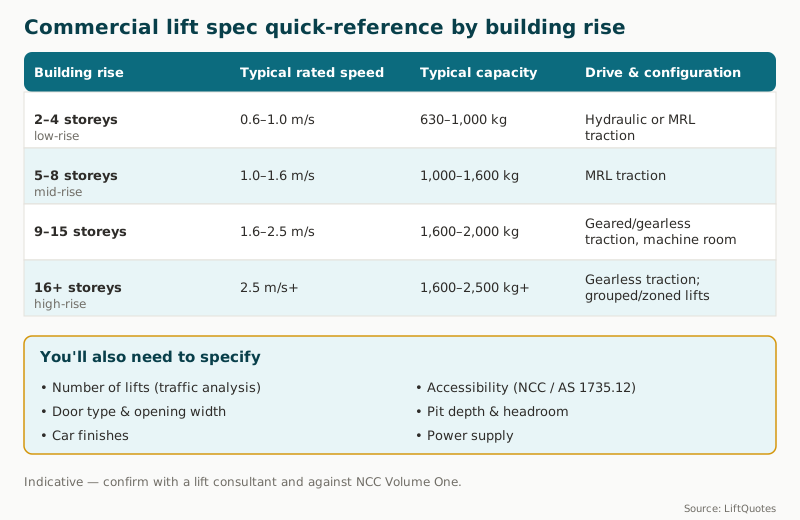
The quick-reference below maps typical speed, capacity and drive configuration to building rise, and lists the other items your specification has to cover.
How many lifts does the building need?
The number of lifts is the first and most consequential decision, and it is driven by traffic analysis, not floor count. Traffic analysis estimates the building population, the peak demand (usually the morning up-peak in an office, or a two-way peak in residential), the handling capacity of a proposed lift, and the average waiting interval that results. The target waiting interval is the number that matters: around 25–30 seconds is considered good for a premium office, 30–40 seconds is acceptable for standard commercial, and residential buildings tolerate longer.
A rough starting point for a standard commercial building is one lift per 3–4 floors or per 50–60 occupants, but treat that only as a sanity check. Population density, the mix of uses, and whether the building has basement or rooftop levels all shift the answer. For anything above a few storeys, or any building with concentrated peak demand, a lift consultant's traffic study is worth the fee — under-provisioning is expensive to fix once the shafts are poured.
Capacity and speed: matching the lift to the rise
Rated capacity is quoted in kilograms and in persons (roughly 75 kg per person). Common commercial cars run 630 kg (8 persons), 1,000 kg (13 persons), 1,600 kg (21 persons) and up. Bigger cars move more people per trip and lift the handling capacity, but they cost more and need a larger shaft — so capacity is a traffic decision, not a case of bigger being better. If the building has to carry stretchers or beds — an aged-care or medical setting — capacity and car dimensions are set by that requirement; see our guide to hospital lift requirements for stretcher-capable specifications.
Speed is matched to the rise. A 2–4 storey building is well served by 0.6–1.0 m/s; a mid-rise of 5–8 storeys wants 1.0–1.6 m/s; and taller buildings need 1.6–2.5 m/s and beyond so the lift can clear the shaft quickly enough to keep the waiting interval down. Over-specifying speed on a low building wastes money; under-specifying it on a tall one wrecks the traffic performance.
MRL or machine-room? Drive type and configuration
The drive and machine configuration follow from the rise. For low-rise buildings, a hydraulic lift or a machine-room-less (MRL) traction lift both work — hydraulics are simple and cheaper but slower and less efficient, while MRL traction removes the separate machine room and suits most modern low- to mid-rise projects. An MRL commercial lift houses the gearless machine within the shaft, which frees the floor space a traditional machine room would occupy — a real planning advantage.
For mid- to high-rise, gearless traction — with a machine room or as an MRL, depending on the building — is the norm, and the tallest buildings use grouped or zoned banks of gearless lifts controlled together. Drive type is where a lift consultant earns their fee on a complex building, but the plain-English version is straightforward: hydraulic for a short, light-duty rise; MRL traction for most mid-rise; gearless traction, often grouped, as the building gets tall.
The compliance inputs that constrain the spec
A commercial lift is not specified in a vacuum — the NCC and the referenced Australian Standards set hard constraints. At least one accessible lift is required in most new commercial buildings, and it must meet AS 1735.12:2020 (lifts for persons with disabilities) and the access provisions of the Premises Standards 2010: minimum car dimensions, a 900 mm clear door opening, control heights, tactile and Braille buttons, and audible floor announcements. Our guide to NCC lift requirements sets out when a building must provide a lift and to what standard, and lift standards in Australia explains what each part of the AS 1735 series governs.
Fire mode, emergency power, and — in taller buildings — a firefighting or evacuation lift are further NCC-driven inputs. These are not extras bolted on late: they change the car, the controller and the shaft, so they belong in the specification from the first draft. Confirm the exact requirements for your building class with your building surveyor and against NCC Volume One. LiftQuotes does not provide compliance advice — verify requirements with a qualified building certifier or lift consultant.
What a lift company needs to quote
To price a commercial lift, a lift company needs the physical and electrical parameters of the shaft, not just the storey count. Have this ready before you go to tender:
- Architectural drawings showing the shaft, lobby and each landing
- Number of storeys and stops, and the total travel in metres
- Rated capacity and speed you are targeting
- Pit depth and overhead headroom available
- Door type and clear opening width
- Power supply available at the machine location
- Accessibility and fire requirements from your certifier
With those, a supplier can quote equipment, installation and a realistic lead time; without them, expect a wide budget range and a caveat on every line. For indicative figures while you scope the budget, our commercial lift cost guide breaks down ranges by building height as of Q3 2026.
Get the specification right at DA and tender stage and the rest of the project runs smoother — the lift stops being a programme risk and becomes a line item. Get free quotes from Australian lift companies who can specify and price a commercial lift for your building.
Lift companies in Australia
Browse profiles, compare service areas, and check reviews.

Lift Shop
★ 5.0 (1551 reviews)
Australia's largest dedicated home lift specialist since 1996. 10,000+ installations. Exclusive Italian-crafted lifts with industry-leading 8-year warranty.
View profile →

Compact Home Lifts
NDIS★ 5.0 (465 reviews)
Melbourne branch of Compact Home Lifts. Compact residential lift specialist providing maintenance and repair services across Victoria.
View profile →

Next Level Elevators
★ 5.0 (454 reviews)
Award-winning provider of premium Italian-designed all-electric home elevators. Certified Eltec Partner. Showrooms in Melbourne, Sydney, and Brisbane.
View profile →

Shotton Lifts
NDIS★ 5.0 (9 reviews)
Family-owned Australian lift manufacturer since 1977. 80+ staff. Design, engineer, manufacture, install and service from Dandenong South VIC. NDIS registered.
View profile →

LiftFit Australia
NDIS★ 5.0 (8 reviews)
Victoria-based NDIS registered lift provider, est. 2011. Partners with Cibes, Savaria, and Kalea. Residential, commercial, and platform lifts.
View profile →

Easy Living Home Elevators
★ 5.0 (7 reviews)
Australia's #1 home elevator supplier since 1998. 100% Australian-owned. 11,000+ elevators in service across 6 states.
View profile →
LiftQuotes is a comparison platform. Companies shown are filtered by relevance to this page. Listing does not imply endorsement. LiftQuotes may receive a referral fee when you request quotes.
Put this into action
When you're ready to move forward, get free quotes from verified Australian lift installers.
What are you looking for today?
I need a lift installed
I have a lift that needs attention
How to specify a commercial lift
Specifying a commercial lift comes down to six decisions: how many lifts the building needs, the rated capacity of each car, the travel speed, the drive type and machine configuration (MRL or machine-room), the door arrangement, and the accessibility and fire inputs the National Construction Code imposes. Settle those at the specification and DA stage and a lift company can price the job accurately; leave them vague and every quote you get back will be pricing a different building.
The quick-reference below maps typical speed, capacity and drive configuration to building rise, and lists the other items your specification has to cover.
How many lifts does the building need?
The number of lifts is the first and most consequential decision, and it is driven by traffic analysis, not floor count. Traffic analysis estimates the building population, the peak demand (usually the morning up-peak in an office, or a two-way peak in residential), the handling capacity of a proposed lift, and the average waiting interval that results. The target waiting interval is the number that matters: around 25–30 seconds is considered good for a premium office, 30–40 seconds is acceptable for standard commercial, and residential buildings tolerate longer.
A rough starting point for a standard commercial building is one lift per 3–4 floors or per 50–60 occupants, but treat that only as a sanity check. Population density, the mix of uses, and whether the building has basement or rooftop levels all shift the answer. For anything above a few storeys, or any building with concentrated peak demand, a lift consultant's traffic study is worth the fee — under-provisioning is expensive to fix once the shafts are poured.
Capacity and speed: matching the lift to the rise
Rated capacity is quoted in kilograms and in persons (roughly 75 kg per person). Common commercial cars run 630 kg (8 persons), 1,000 kg (13 persons), 1,600 kg (21 persons) and up. Bigger cars move more people per trip and lift the handling capacity, but they cost more and need a larger shaft — so capacity is a traffic decision, not a case of bigger being better. If the building has to carry stretchers or beds — an aged-care or medical setting — capacity and car dimensions are set by that requirement; see our guide to hospital lift requirements for stretcher-capable specifications.
Speed is matched to the rise. A 2–4 storey building is well served by 0.6–1.0 m/s; a mid-rise of 5–8 storeys wants 1.0–1.6 m/s; and taller buildings need 1.6–2.5 m/s and beyond so the lift can clear the shaft quickly enough to keep the waiting interval down. Over-specifying speed on a low building wastes money; under-specifying it on a tall one wrecks the traffic performance.
MRL or machine-room? Drive type and configuration
The drive and machine configuration follow from the rise. For low-rise buildings, a hydraulic lift or a machine-room-less (MRL) traction lift both work — hydraulics are simple and cheaper but slower and less efficient, while MRL traction removes the separate machine room and suits most modern low- to mid-rise projects. An MRL commercial lift houses the gearless machine within the shaft, which frees the floor space a traditional machine room would occupy — a real planning advantage.
For mid- to high-rise, gearless traction — with a machine room or as an MRL, depending on the building — is the norm, and the tallest buildings use grouped or zoned banks of gearless lifts controlled together. Drive type is where a lift consultant earns their fee on a complex building, but the plain-English version is straightforward: hydraulic for a short, light-duty rise; MRL traction for most mid-rise; gearless traction, often grouped, as the building gets tall.
The compliance inputs that constrain the spec
A commercial lift is not specified in a vacuum — the NCC and the referenced Australian Standards set hard constraints. At least one accessible lift is required in most new commercial buildings, and it must meet AS 1735.12:2020 (lifts for persons with disabilities) and the access provisions of the Premises Standards 2010: minimum car dimensions, a 900 mm clear door opening, control heights, tactile and Braille buttons, and audible floor announcements. Our guide to NCC lift requirements sets out when a building must provide a lift and to what standard, and lift standards in Australia explains what each part of the AS 1735 series governs.
Fire mode, emergency power, and — in taller buildings — a firefighting or evacuation lift are further NCC-driven inputs. These are not extras bolted on late: they change the car, the controller and the shaft, so they belong in the specification from the first draft. Confirm the exact requirements for your building class with your building surveyor and against NCC Volume One. LiftQuotes does not provide compliance advice — verify requirements with a qualified building certifier or lift consultant.
What a lift company needs to quote
To price a commercial lift, a lift company needs the physical and electrical parameters of the shaft, not just the storey count. Have this ready before you go to tender:
- Architectural drawings showing the shaft, lobby and each landing
- Number of storeys and stops, and the total travel in metres
- Rated capacity and speed you are targeting
- Pit depth and overhead headroom available
- Door type and clear opening width
- Power supply available at the machine location
- Accessibility and fire requirements from your certifier
With those, a supplier can quote equipment, installation and a realistic lead time; without them, expect a wide budget range and a caveat on every line. For indicative figures while you scope the budget, our commercial lift cost guide breaks down ranges by building height as of Q3 2026.
Get the specification right at DA and tender stage and the rest of the project runs smoother — the lift stops being a programme risk and becomes a line item. Get free quotes from Australian lift companies who can specify and price a commercial lift for your building.
Lift companies in Australia
Browse profiles, compare service areas, and check reviews.
Lift Shop
★ 5.0 (1551 reviews)
Australia's largest dedicated home lift specialist since 1996. 10,000+ installations. Exclusive Italian-crafted lifts with industry-leading 8-year warranty.
View profile →
Compact Home Lifts
NDIS★ 5.0 (465 reviews)
Melbourne branch of Compact Home Lifts. Compact residential lift specialist providing maintenance and repair services across Victoria.
View profile →
Next Level Elevators
★ 5.0 (454 reviews)
Award-winning provider of premium Italian-designed all-electric home elevators. Certified Eltec Partner. Showrooms in Melbourne, Sydney, and Brisbane.
View profile →
Shotton Lifts
NDIS★ 5.0 (9 reviews)
Family-owned Australian lift manufacturer since 1977. 80+ staff. Design, engineer, manufacture, install and service from Dandenong South VIC. NDIS registered.
View profile →
LiftFit Australia
NDIS★ 5.0 (8 reviews)
Victoria-based NDIS registered lift provider, est. 2011. Partners with Cibes, Savaria, and Kalea. Residential, commercial, and platform lifts.
View profile →
Easy Living Home Elevators
★ 5.0 (7 reviews)
Australia's #1 home elevator supplier since 1998. 100% Australian-owned. 11,000+ elevators in service across 6 states.
View profile →
LiftQuotes is a comparison platform. Companies shown are filtered by relevance to this page. Listing does not imply endorsement. LiftQuotes may receive a referral fee when you request quotes.
Put this into action
When you're ready to move forward, get free quotes from verified Australian lift installers.
What are you looking for today?
I need a lift installed
I have a lift that needs attention
Number of lifts is a traffic decision
It comes from traffic analysis — building population and peak demand measured against a target waiting interval — not from a floor-count rule of thumb. Get it wrong and it is expensive to fix once the shafts are poured.
Capacity and speed follow the rise
Bigger, faster cars improve handling capacity but cost more and need larger shafts. Match capacity to the traffic and speed to the number of storeys, rather than over-specifying either.
MRL or machine-room
Hydraulic or MRL traction suits low-rise; gearless traction, often grouped or zoned, is the norm as a building gets tall. The drive type follows the rise.
The NCC sets hard limits
At least one accessible lift to AS 1735.12, plus fire mode and emergency power in taller buildings. Specify these from the first draft — they change the car, controller and shaft.
Common questions about specifying a commercial lift
Work through six decisions in order: how many lifts the building needs (from traffic analysis), the rated capacity of each car, the travel speed matched to the rise, the drive type and machine configuration (MRL or machine-room), the door type and opening, and the accessibility and fire requirements the National Construction Code imposes. Settle these at the specification and DA stage so a lift company can price the job accurately, and engage a lift consultant for detailed traffic modelling on a larger building.
Related guides
Guide
Our Editorial Methodology: How LiftQuotes Researches Content
How LiftQuotes researches, sources and reviews every lift guide and cost page: the standards we cite, our linked-source rule for cost data, and how often we update.
Guide
Lift Compliance Checklist for Facility Managers (Australia)
A facility manager's lift compliance checklist for Australia: plant registration, inspection, log books, 4G VoLTE emergency phones and DDA access duties.
Comparison
Stairlift vs Platform Lift: Which Access Solution Fits?
A stairlift carries a seated user along the stairs from about $3,000; a platform lift raises a wheelchair vertically from about $15,000. Compare cost, access and fit.
Location
Lift Companies in Melbourne: Compare Local Installers
Compare lift companies in Melbourne for home, platform and commercial lifts. WorkSafe Victoria compliance, local installer coverage and indicative VIC costs.
Specifying a lift for a new commercial building?
Tell us the building — storeys, use and rough programme — and we will connect you with Australian lift companies who can specify, price and install a commercial lift. Free, with no obligation.
Join 1,000+ Australians who've requested quotes through LiftQuotes
Get free quotes