
Commercial Lift Installation Timeline
From placing the order to handover, a commercial lift runs on a programme of its own. Here is the full sequence — procurement, manufacturing, builder's works, installation, commissioning and registration — with indicative durations for each stage.
From order to handover, a standard commercial lift takes roughly four to nine months — and the clock is driven by manufacturing lead time, not the few weeks of on-site installation. A lift is built to order, so the date you place the order matters more than the date the installers arrive.
This guide maps the full sequence against a construction programme: procurement and shop drawings, manufacturing, the builder's structural works, installation, commissioning, plant registration and handover. It sets out indicative durations for each stage, shows where the builder's scope ends and the lift company's begins, and names the three things that cause most delays. Order the lift early and the long manufacturing lead time runs in parallel with the build instead of extending it.
How long does it take to install a commercial lift?
From placing the order to handover, plan on roughly four to nine months for a standard commercial passenger lift — and longer for a tall building, a bespoke imported unit, or a project where builder's works run late. The single biggest variable is manufacturing lead time, not the on-site installation. A lift is made to order, and for a European or premium unit the factory lead time alone can run eight to twenty weeks or more before anything reaches site.
That is why the order date, not the installation date, drives the programme. Get the lift ordered early — ideally as soon as the shaft design is fixed — and the manufacturing clock runs in parallel with the builder's structural works instead of after them.
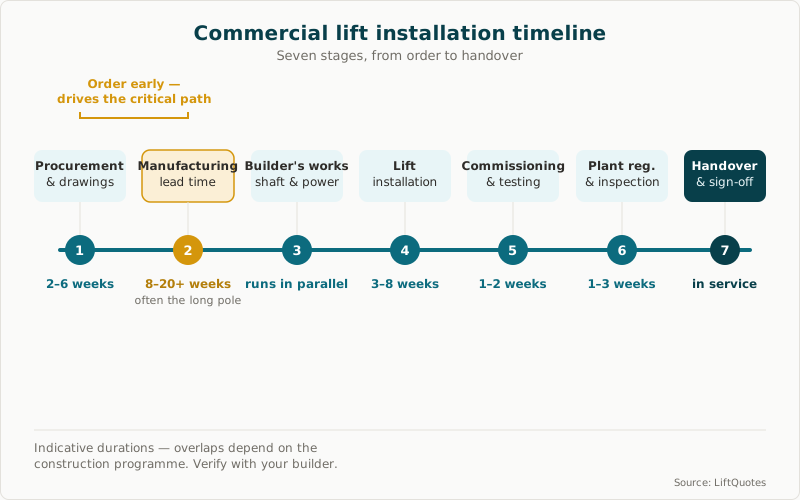
The stages, one by one
1. Procurement and shop drawings (2–6 weeks). Once you award the contract, the lift company produces shop drawings — the exact shaft, pit, overhead and power requirements for the chosen unit. These have to be approved before manufacturing starts and before the builder finalises the shaft. Late shop-drawing approval is a common and avoidable delay.
2. Manufacturing and lead time (8–20+ weeks). The lift is built to the approved specification. This is usually the long pole in the programme, especially for imported units. Ordering early is the one decision that most reduces total project time.
3. Builder's works (runs in parallel). The builder constructs the shaft, forms the pit, provides the machine room or overhead space, and brings the power supply to the machine location. This is the builder's scope, not the lift company's — the split is set out below. It should run alongside manufacturing so both finish together.
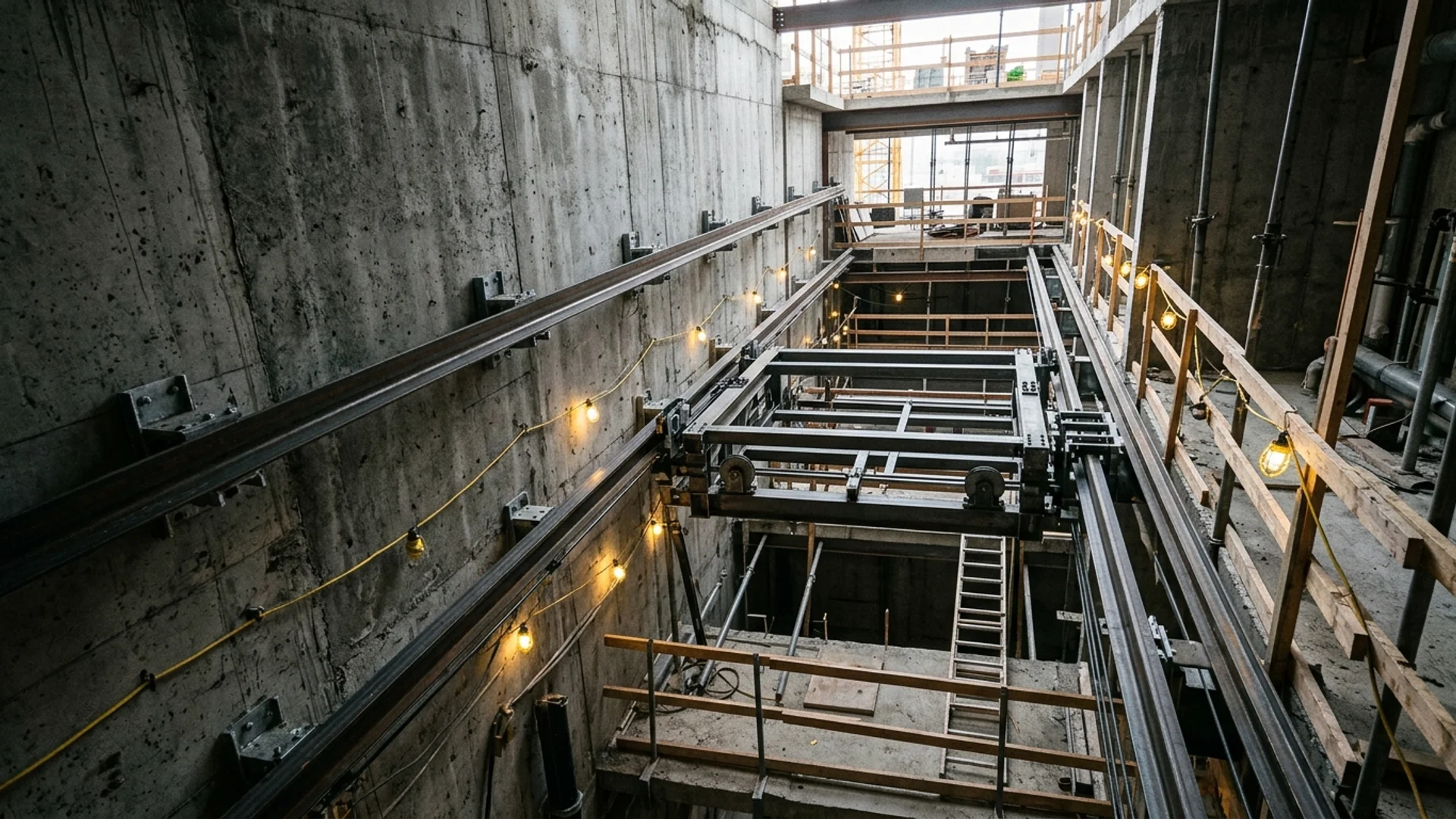
4. Lift installation (3–8 weeks). With the shaft ready and the equipment delivered, the lift company installs the guide rails, car, doors, drive and controller. Duration scales with the number of stops and the rise.
5. Commissioning and testing (1–2 weeks). The installed lift is adjusted, load-tested and safety-tested. Nothing is signed off until commissioning is complete.
6. Plant registration and statutory inspection (1–3 weeks). Under Schedule 5 of the Model WHS Regulations, lifts are registrable plant — both the design and each installed unit require registration with the state regulator (SafeWork NSW, Workplace Health and Safety Queensland, and the equivalents in other states). Victoria is the exception: it registers plant under its own OHS Regulations 2017 through WorkSafe Victoria, not the model WHS laws. Allow time for the inspection and the paperwork before anyone rides the lift.
7. Handover. Documentation, keys, the maintenance logbook and the first service contract change hands, and the lift goes into service.
Who is responsible — builder or lift company?
The clearest way to avoid programme blowouts is to fix the scope split early. The builder is responsible for the builder's works: the shaft, the pit, waterproofing, the machine room or overhead space, and a power supply of the correct rating terminated at the machine location. The lift company is responsible for the equipment: guide rails, car, doors, drive, controller, installation, commissioning and registration.
Delays almost always come from one of three things: the lift ordered too late, builder's works not finished when the installers arrive, or power not connected at handover. Each is a coordination failure, not a manufacturing one. A short programme meeting that pins the order date, the shaft-complete date and the power-on date removes most of the risk.
For where the lift sits in the wider build, our commercial lift hub covers the category, and our guide to how to specify a commercial lift sets out the decisions — number of lifts, capacity, speed and drive type — that need to be locked before procurement even starts.
What this means for your programme
Sequence the lift as an early procurement item, not a late fit-out one. As a working rule: fix the specification and shaft design at design development, place the lift order the moment shop drawings are approved, and hold the shaft-complete and power-on dates as programme milestones the same way you would a structural pour. The residential version of this sequencing is covered in our home lift installation guide, and the compliance inputs that shape the shaft are in NCC lift requirements.
For the budget side of the same decision, commercial lift cost breaks down indicative ranges by building height as of Q3 2026. LiftQuotes does not provide compliance advice — confirm plant registration and inspection requirements with your state regulator and building surveyor.
Getting the lift onto the programme early is what turns it from a schedule risk into a routine line item. Get free quotes from Australian lift companies who can give you a firm lead time for your building.
Lift companies in Australia
Browse profiles, compare service areas, and check reviews.

Lift Shop
★ 5.0 (1551 reviews)
Australia's largest dedicated home lift specialist since 1996. 10,000+ installations. Exclusive Italian-crafted lifts with industry-leading 8-year warranty.
View profile →

Compact Home Lifts
NDIS★ 5.0 (465 reviews)
Melbourne branch of Compact Home Lifts. Compact residential lift specialist providing maintenance and repair services across Victoria.
View profile →

Next Level Elevators
★ 5.0 (454 reviews)
Award-winning provider of premium Italian-designed all-electric home elevators. Certified Eltec Partner. Showrooms in Melbourne, Sydney, and Brisbane.
View profile →

Shotton Lifts
NDIS★ 5.0 (9 reviews)
Family-owned Australian lift manufacturer since 1977. 80+ staff. Design, engineer, manufacture, install and service from Dandenong South VIC. NDIS registered.
View profile →

LiftFit Australia
NDIS★ 5.0 (8 reviews)
Victoria-based NDIS registered lift provider, est. 2011. Partners with Cibes, Savaria, and Kalea. Residential, commercial, and platform lifts.
View profile →

Easy Living Home Elevators
★ 5.0 (7 reviews)
Australia's #1 home elevator supplier since 1998. 100% Australian-owned. 11,000+ elevators in service across 6 states.
View profile →
LiftQuotes is a comparison platform. Companies shown are filtered by relevance to this page. Listing does not imply endorsement. LiftQuotes may receive a referral fee when you request quotes.
Put this into action
When you're ready to move forward, get free quotes from verified Australian lift installers.
What are you looking for today?
I need a lift installed
I have a lift that needs attention
From order to handover, a standard commercial lift takes roughly four to nine months — and the clock is driven by manufacturing lead time, not the few weeks of on-site installation. A lift is built to order, so the date you place the order matters more than the date the installers arrive.
This guide maps the full sequence against a construction programme: procurement and shop drawings, manufacturing, the builder's structural works, installation, commissioning, plant registration and handover. It sets out indicative durations for each stage, shows where the builder's scope ends and the lift company's begins, and names the three things that cause most delays. Order the lift early and the long manufacturing lead time runs in parallel with the build instead of extending it.
How long does it take to install a commercial lift?
From placing the order to handover, plan on roughly four to nine months for a standard commercial passenger lift — and longer for a tall building, a bespoke imported unit, or a project where builder's works run late. The single biggest variable is manufacturing lead time, not the on-site installation. A lift is made to order, and for a European or premium unit the factory lead time alone can run eight to twenty weeks or more before anything reaches site.
That is why the order date, not the installation date, drives the programme. Get the lift ordered early — ideally as soon as the shaft design is fixed — and the manufacturing clock runs in parallel with the builder's structural works instead of after them.
The stages, one by one
1. Procurement and shop drawings (2–6 weeks). Once you award the contract, the lift company produces shop drawings — the exact shaft, pit, overhead and power requirements for the chosen unit. These have to be approved before manufacturing starts and before the builder finalises the shaft. Late shop-drawing approval is a common and avoidable delay.
2. Manufacturing and lead time (8–20+ weeks). The lift is built to the approved specification. This is usually the long pole in the programme, especially for imported units. Ordering early is the one decision that most reduces total project time.
3. Builder's works (runs in parallel). The builder constructs the shaft, forms the pit, provides the machine room or overhead space, and brings the power supply to the machine location. This is the builder's scope, not the lift company's — the split is set out below. It should run alongside manufacturing so both finish together.
4. Lift installation (3–8 weeks). With the shaft ready and the equipment delivered, the lift company installs the guide rails, car, doors, drive and controller. Duration scales with the number of stops and the rise.
5. Commissioning and testing (1–2 weeks). The installed lift is adjusted, load-tested and safety-tested. Nothing is signed off until commissioning is complete.
6. Plant registration and statutory inspection (1–3 weeks). Under Schedule 5 of the Model WHS Regulations, lifts are registrable plant — both the design and each installed unit require registration with the state regulator (SafeWork NSW, Workplace Health and Safety Queensland, and the equivalents in other states). Victoria is the exception: it registers plant under its own OHS Regulations 2017 through WorkSafe Victoria, not the model WHS laws. Allow time for the inspection and the paperwork before anyone rides the lift.
7. Handover. Documentation, keys, the maintenance logbook and the first service contract change hands, and the lift goes into service.
Who is responsible — builder or lift company?
The clearest way to avoid programme blowouts is to fix the scope split early. The builder is responsible for the builder's works: the shaft, the pit, waterproofing, the machine room or overhead space, and a power supply of the correct rating terminated at the machine location. The lift company is responsible for the equipment: guide rails, car, doors, drive, controller, installation, commissioning and registration.
Delays almost always come from one of three things: the lift ordered too late, builder's works not finished when the installers arrive, or power not connected at handover. Each is a coordination failure, not a manufacturing one. A short programme meeting that pins the order date, the shaft-complete date and the power-on date removes most of the risk.
For where the lift sits in the wider build, our commercial lift hub covers the category, and our guide to how to specify a commercial lift sets out the decisions — number of lifts, capacity, speed and drive type — that need to be locked before procurement even starts.
What this means for your programme
Sequence the lift as an early procurement item, not a late fit-out one. As a working rule: fix the specification and shaft design at design development, place the lift order the moment shop drawings are approved, and hold the shaft-complete and power-on dates as programme milestones the same way you would a structural pour. The residential version of this sequencing is covered in our home lift installation guide, and the compliance inputs that shape the shaft are in NCC lift requirements.
For the budget side of the same decision, commercial lift cost breaks down indicative ranges by building height as of Q3 2026. LiftQuotes does not provide compliance advice — confirm plant registration and inspection requirements with your state regulator and building surveyor.
Getting the lift onto the programme early is what turns it from a schedule risk into a routine line item. Get free quotes from Australian lift companies who can give you a firm lead time for your building.
Lift companies in Australia
Browse profiles, compare service areas, and check reviews.
Lift Shop
★ 5.0 (1551 reviews)
Australia's largest dedicated home lift specialist since 1996. 10,000+ installations. Exclusive Italian-crafted lifts with industry-leading 8-year warranty.
View profile →
Compact Home Lifts
NDIS★ 5.0 (465 reviews)
Melbourne branch of Compact Home Lifts. Compact residential lift specialist providing maintenance and repair services across Victoria.
View profile →
Next Level Elevators
★ 5.0 (454 reviews)
Award-winning provider of premium Italian-designed all-electric home elevators. Certified Eltec Partner. Showrooms in Melbourne, Sydney, and Brisbane.
View profile →
Shotton Lifts
NDIS★ 5.0 (9 reviews)
Family-owned Australian lift manufacturer since 1977. 80+ staff. Design, engineer, manufacture, install and service from Dandenong South VIC. NDIS registered.
View profile →
LiftFit Australia
NDIS★ 5.0 (8 reviews)
Victoria-based NDIS registered lift provider, est. 2011. Partners with Cibes, Savaria, and Kalea. Residential, commercial, and platform lifts.
View profile →
Easy Living Home Elevators
★ 5.0 (7 reviews)
Australia's #1 home elevator supplier since 1998. 100% Australian-owned. 11,000+ elevators in service across 6 states.
View profile →
LiftQuotes is a comparison platform. Companies shown are filtered by relevance to this page. Listing does not imply endorsement. LiftQuotes may receive a referral fee when you request quotes.
Put this into action
When you're ready to move forward, get free quotes from verified Australian lift installers.
What are you looking for today?
I need a lift installed
I have a lift that needs attention
The order date drives the programme
Manufacturing lead time — often eight to twenty weeks or more — is the long pole, not the on-site installation. Placing the order early is the single decision that most reduces total project time.
Builder's works run in parallel
The shaft, pit, machine space and power supply are the builder's scope and should be built while the lift is being manufactured, so both finish together rather than one waiting on the other.
Most delays are coordination, not manufacturing
Late orders, unfinished builder's works and power not connected at handover cause most blowouts. Pin the order, shaft-complete and power-on dates as programme milestones.
Lifts are registrable plant
Under Schedule 5 of the Model WHS Regulations each installed lift needs registration and statutory inspection before it goes into service. Victoria registers plant under its own OHS Regulations through WorkSafe Victoria.
Common questions about commercial lift installation timelines
From placing the order to handover, plan on roughly four to nine months for a standard commercial passenger lift, and longer for a tall building, a bespoke imported unit, or a project where builder's works run late. The dominant variable is manufacturing lead time, not the three to eight weeks of on-site installation. Because the lift is built to order, the date you place the order matters more than the date the installers arrive on site.
Related guides
Guide
Our Editorial Methodology: How LiftQuotes Researches Content
How LiftQuotes researches, sources and reviews every lift guide and cost page: the standards we cite, our linked-source rule for cost data, and how often we update.
Guide
Lift Compliance Checklist for Facility Managers (Australia)
A facility manager's lift compliance checklist for Australia: plant registration, inspection, log books, 4G VoLTE emergency phones and DDA access duties.
Comparison
Stairlift vs Platform Lift: Which Access Solution Fits?
A stairlift carries a seated user along the stairs from about $3,000; a platform lift raises a wheelchair vertically from about $15,000. Compare cost, access and fit.
Location
Lift Companies in Melbourne: Compare Local Installers
Compare lift companies in Melbourne for home, platform and commercial lifts. WorkSafe Victoria compliance, local installer coverage and indicative VIC costs.
Planning a lift into your construction programme?
Tell us the building — storeys, use and rough programme dates — and we will connect you with Australian lift companies who can give you a firm lead time for your project. Free, with no obligation.
Join 1,000+ Australians who've requested quotes through LiftQuotes
Get free quotes