Residential vs Commercial Lifts
The difference is duty. A residential lift is built to AS/NZS 1735.18 for light use in a single home; a commercial lift is engineered for continuous public traffic, higher capacity and the accessibility rules that apply to public buildings. That gap decides which lift is even allowed where.
The core difference between a residential and a commercial lift is duty — how hard the lift is built to work. A residential lift, certified to AS/NZS 1735.18 for private residences, is designed for light use in a single household: a handful of trips a day, modest capacity, low speed. A commercial lift is engineered for continuous public traffic, higher capacity and speed, and the accessibility obligations that apply to public buildings.
That difference is not a marketing tier. It is written into the standards each lift is certified against, and it decides where each lift is allowed to operate. A lift certified for a private residence generally cannot be installed in an office, shop or apartment common area — and a full commercial lift is usually overbuilt and overpriced for a family home. This page sets out the trade-off row by row so you can match the lift to the building with confidence.
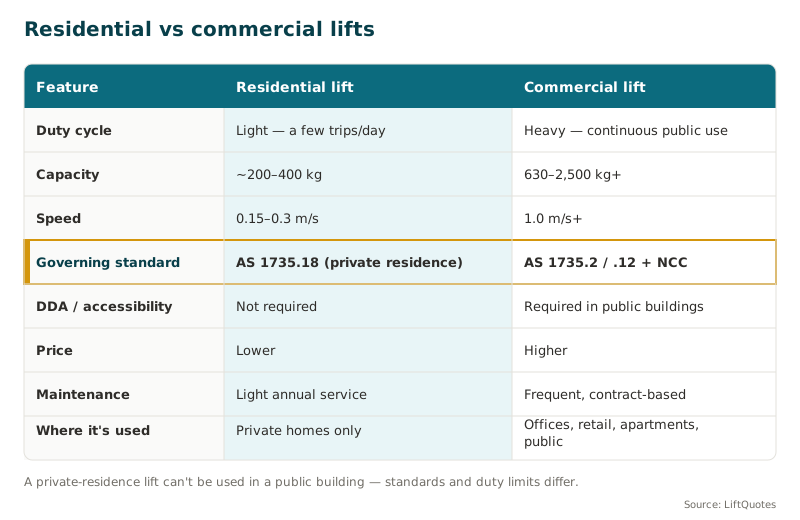
Residential and commercial lifts compared across the factors that decide which one your building needs. The governing-standard row is the one that determines where each lift may lawfully be used.
Swipe to compare →
| Factor | Residential lift | Commercial lift |
|---|---|---|
| Duty cycle | Light — a few trips a day | Heavy — continuous public use |
| Capacity | ~200–400 kg | 630–2,500 kg+ |
| Speed | 0.15–0.3 m/s | 1.0 m/s and higher |
| Governing standard | AS/NZS 1735.18 (private residence) | AS 1735.2 / .12 + the NCC |
| DDA / accessibility | Not required | Required in public buildings |
| Price | Lower | Higher |
| Maintenance | Light annual service | Frequent, contract-based |
| Where it is used | Private homes only | Offices, retail, apartments, public |
Figures are indicative as of Q2 2026 and describe typical products in each class. Actual capacity, speed and compliance depend on the specific model and building — confirm against the manufacturer specification, the relevant AS 1735 part, and the NCC for your building class.
Lift companies in Australia
Browse profiles, compare service areas, and check reviews.

Lift Shop
★ 5.0 (1551 reviews)
Australia's largest dedicated home lift specialist since 1996. 10,000+ installations. Exclusive Italian-crafted lifts with industry-leading 8-year warranty.
View profile →

Compact Home Lifts
NDIS★ 5.0 (465 reviews)
Melbourne branch of Compact Home Lifts. Compact residential lift specialist providing maintenance and repair services across Victoria.
View profile →

Next Level Elevators
★ 5.0 (454 reviews)
Award-winning provider of premium Italian-designed all-electric home elevators. Certified Eltec Partner. Showrooms in Melbourne, Sydney, and Brisbane.
View profile →

Shotton Lifts
NDIS★ 5.0 (9 reviews)
Family-owned Australian lift manufacturer since 1977. 80+ staff. Design, engineer, manufacture, install and service from Dandenong South VIC. NDIS registered.
View profile →

LiftFit Australia
NDIS★ 5.0 (8 reviews)
Victoria-based NDIS registered lift provider, est. 2011. Partners with Cibes, Savaria, and Kalea. Residential, commercial, and platform lifts.
View profile →

Easy Living Home Elevators
★ 5.0 (7 reviews)
Australia's #1 home elevator supplier since 1998. 100% Australian-owned. 11,000+ elevators in service across 6 states.
View profile →
LiftQuotes is a comparison platform. Companies shown are filtered by relevance to this page. Listing does not imply endorsement. LiftQuotes may receive a referral fee when you request quotes.
What separates a residential lift from a commercial one
Both move people between floors on guide rails, and both can look similar from the inside. The difference is what they are built and certified to withstand. A residential lift is a private-residence lift under AS/NZS 1735.18 — light duty, low speed, modest capacity, one household. A commercial lift is built for public duty: continuous calls, heavier cars, faster travel, and the wear that comes from strangers using it all day.
Duty cycle is the honest way to describe it. A home lift might make a dozen trips on a busy day. A lift in a small office or an apartment building can make several hundred. The components — motor, ropes or belts, door gear, controller — are sized for that difference from the outset, which is why you cannot simply move one lift into the other setting.
Standards: the reason you can't swap one for the other
This is the row that matters most. Residential and commercial lifts are certified against different Australian Standards, and those standards define where each may be used.
A private-residence lift is built to AS/NZS 1735.18:2002, which covers automatically controlled, low-speed passenger lifts inside a private home. It is not a public-building standard. A commercial passenger lift is built to AS 1735.2, with AS 1735.12 governing accessibility, sits under the National Construction Code, and must meet the disability access provisions that apply to public premises. Our guide to lift standards in Australia sets out the full AS 1735 series and where each part applies, and NCC lift requirements covers when a commercial building must provide an accessible lift at all.
The practical consequence is firm: a lift certified for a private residence generally cannot lawfully be used in an office, shop, medical suite or the common area of an apartment block. It has not been assessed for public duty or accessibility, and a building certifier will not sign it off.
Capacity, speed and duty cycle
A residential lift typically carries 200–400 kg — enough for two or three people, or a wheelchair user and a carer — and travels at around 0.15–0.3 m/s. That is deliberate. Slow, quiet and compact suits a home.
A commercial lift starts where the residential range ends. Capacities run from 630 kg to 2,500 kg and beyond, and speeds of 1.0 m/s and higher are normal so the lift can clear waiting traffic. Those numbers reflect a different job: moving many people, prams, trolleys and deliveries, reliably, for decades.
Cost, and why commercial lifts run higher
A residential lift is the more affordable of the two, because it is smaller, slower and lighter in duty. A commercial lift costs more for concrete reasons — heavier engineering, larger machines, fire and accessibility compliance, and the testing and certification a public installation demands. For indicative figures by building height and type, see our commercial lift cost breakdown.
If you are weighing a lift for a house, the residential category — see home lifts — is almost always the right and cheaper starting point. Specifying a commercial lift for a family home means paying for public-duty capability the household will never use.
Maintenance and lifespan
Both lift types need regular servicing, but the intensity differs. A residential lift usually runs on a light annual service. A commercial lift needs a structured maintenance contract, more frequent visits, and often 24/7 breakdown cover — because downtime affects a whole building of people and, in some settings, compliance.
Lifespan follows duty and upkeep. A well-maintained commercial lift is built to run for 20–25 years before major modernisation, under far heavier use than a home lift ever sees. A residential lift, used lightly, can last comparably with much less intervention. Neither category simply lasts longer in the abstract — the commercial lift is engineered to survive a much harder working life.
Can you put a commercial lift in a home — or a home lift in a business?
You can install a commercial lift in a large private home, and some architectural or multi-generational projects do exactly that for the extra capacity and speed. It is legal and it works. It is just expensive, and usually unnecessary.
The reverse is the real trap. A private-residence lift cannot be dropped into a shop, office or apartment common area, because it is not certified for public duty or accessibility. A genuinely private lift inside a single-tenancy small business is a grey area — confirm the classification with your state regulator and a certifier before you rely on it, because the rule turns on public access, not on the building's label.
For most buyers the decision is straightforward: a home takes a residential lift, a public or shared building takes a commercial one, and the standards make the call for you. If your project sits on the line — a home business, a mixed-use conversion, a large multi-generational house — get the duty class confirmed early. Get free quotes from lift companies who can specify both and tell you which class your building actually requires.
Still deciding? Get quotes for both options
Installers will assess your site and recommend the right specification.
What are you looking for today?
I need a lift installed
I have a lift that needs attention
The core difference between a residential and a commercial lift is duty — how hard the lift is built to work. A residential lift, certified to AS/NZS 1735.18 for private residences, is designed for light use in a single household: a handful of trips a day, modest capacity, low speed. A commercial lift is engineered for continuous public traffic, higher capacity and speed, and the accessibility obligations that apply to public buildings.
That difference is not a marketing tier. It is written into the standards each lift is certified against, and it decides where each lift is allowed to operate. A lift certified for a private residence generally cannot be installed in an office, shop or apartment common area — and a full commercial lift is usually overbuilt and overpriced for a family home. This page sets out the trade-off row by row so you can match the lift to the building with confidence.
Residential and commercial lifts compared across the factors that decide which one your building needs. The governing-standard row is the one that determines where each lift may lawfully be used.
Swipe to compare →
| Factor | Residential lift | Commercial lift |
|---|---|---|
| Duty cycle | Light — a few trips a day | Heavy — continuous public use |
| Capacity | ~200–400 kg | 630–2,500 kg+ |
| Speed | 0.15–0.3 m/s | 1.0 m/s and higher |
| Governing standard | AS/NZS 1735.18 (private residence) | AS 1735.2 / .12 + the NCC |
| DDA / accessibility | Not required | Required in public buildings |
| Price | Lower | Higher |
| Maintenance | Light annual service | Frequent, contract-based |
| Where it is used | Private homes only | Offices, retail, apartments, public |
Figures are indicative as of Q2 2026 and describe typical products in each class. Actual capacity, speed and compliance depend on the specific model and building — confirm against the manufacturer specification, the relevant AS 1735 part, and the NCC for your building class.
Lift companies in Australia
Browse profiles, compare service areas, and check reviews.
Lift Shop
★ 5.0 (1551 reviews)
Australia's largest dedicated home lift specialist since 1996. 10,000+ installations. Exclusive Italian-crafted lifts with industry-leading 8-year warranty.
View profile →
Compact Home Lifts
NDIS★ 5.0 (465 reviews)
Melbourne branch of Compact Home Lifts. Compact residential lift specialist providing maintenance and repair services across Victoria.
View profile →
Next Level Elevators
★ 5.0 (454 reviews)
Award-winning provider of premium Italian-designed all-electric home elevators. Certified Eltec Partner. Showrooms in Melbourne, Sydney, and Brisbane.
View profile →
Shotton Lifts
NDIS★ 5.0 (9 reviews)
Family-owned Australian lift manufacturer since 1977. 80+ staff. Design, engineer, manufacture, install and service from Dandenong South VIC. NDIS registered.
View profile →
LiftFit Australia
NDIS★ 5.0 (8 reviews)
Victoria-based NDIS registered lift provider, est. 2011. Partners with Cibes, Savaria, and Kalea. Residential, commercial, and platform lifts.
View profile →
Easy Living Home Elevators
★ 5.0 (7 reviews)
Australia's #1 home elevator supplier since 1998. 100% Australian-owned. 11,000+ elevators in service across 6 states.
View profile →
LiftQuotes is a comparison platform. Companies shown are filtered by relevance to this page. Listing does not imply endorsement. LiftQuotes may receive a referral fee when you request quotes.
What separates a residential lift from a commercial one
Both move people between floors on guide rails, and both can look similar from the inside. The difference is what they are built and certified to withstand. A residential lift is a private-residence lift under AS/NZS 1735.18 — light duty, low speed, modest capacity, one household. A commercial lift is built for public duty: continuous calls, heavier cars, faster travel, and the wear that comes from strangers using it all day.
Duty cycle is the honest way to describe it. A home lift might make a dozen trips on a busy day. A lift in a small office or an apartment building can make several hundred. The components — motor, ropes or belts, door gear, controller — are sized for that difference from the outset, which is why you cannot simply move one lift into the other setting.
Standards: the reason you can't swap one for the other
This is the row that matters most. Residential and commercial lifts are certified against different Australian Standards, and those standards define where each may be used.
A private-residence lift is built to AS/NZS 1735.18:2002, which covers automatically controlled, low-speed passenger lifts inside a private home. It is not a public-building standard. A commercial passenger lift is built to AS 1735.2, with AS 1735.12 governing accessibility, sits under the National Construction Code, and must meet the disability access provisions that apply to public premises. Our guide to lift standards in Australia sets out the full AS 1735 series and where each part applies, and NCC lift requirements covers when a commercial building must provide an accessible lift at all.
The practical consequence is firm: a lift certified for a private residence generally cannot lawfully be used in an office, shop, medical suite or the common area of an apartment block. It has not been assessed for public duty or accessibility, and a building certifier will not sign it off.
Capacity, speed and duty cycle
A residential lift typically carries 200–400 kg — enough for two or three people, or a wheelchair user and a carer — and travels at around 0.15–0.3 m/s. That is deliberate. Slow, quiet and compact suits a home.
A commercial lift starts where the residential range ends. Capacities run from 630 kg to 2,500 kg and beyond, and speeds of 1.0 m/s and higher are normal so the lift can clear waiting traffic. Those numbers reflect a different job: moving many people, prams, trolleys and deliveries, reliably, for decades.
Cost, and why commercial lifts run higher
A residential lift is the more affordable of the two, because it is smaller, slower and lighter in duty. A commercial lift costs more for concrete reasons — heavier engineering, larger machines, fire and accessibility compliance, and the testing and certification a public installation demands. For indicative figures by building height and type, see our commercial lift cost breakdown.
If you are weighing a lift for a house, the residential category — see home lifts — is almost always the right and cheaper starting point. Specifying a commercial lift for a family home means paying for public-duty capability the household will never use.
Maintenance and lifespan
Both lift types need regular servicing, but the intensity differs. A residential lift usually runs on a light annual service. A commercial lift needs a structured maintenance contract, more frequent visits, and often 24/7 breakdown cover — because downtime affects a whole building of people and, in some settings, compliance.
Lifespan follows duty and upkeep. A well-maintained commercial lift is built to run for 20–25 years before major modernisation, under far heavier use than a home lift ever sees. A residential lift, used lightly, can last comparably with much less intervention. Neither category simply lasts longer in the abstract — the commercial lift is engineered to survive a much harder working life.
Can you put a commercial lift in a home — or a home lift in a business?
You can install a commercial lift in a large private home, and some architectural or multi-generational projects do exactly that for the extra capacity and speed. It is legal and it works. It is just expensive, and usually unnecessary.
The reverse is the real trap. A private-residence lift cannot be dropped into a shop, office or apartment common area, because it is not certified for public duty or accessibility. A genuinely private lift inside a single-tenancy small business is a grey area — confirm the classification with your state regulator and a certifier before you rely on it, because the rule turns on public access, not on the building's label.
For most buyers the decision is straightforward: a home takes a residential lift, a public or shared building takes a commercial one, and the standards make the call for you. If your project sits on the line — a home business, a mixed-use conversion, a large multi-generational house — get the duty class confirmed early. Get free quotes from lift companies who can specify both and tell you which class your building actually requires.
Still deciding? Get quotes for both options
Installers will assess your site and recommend the right specification.
What are you looking for today?
I need a lift installed
I have a lift that needs attention
Duty is the real difference
A residential lift is built for light use in one home; a commercial lift is built for continuous public traffic. Every other difference follows from that.
The standard decides where it goes
Residential lifts are certified to AS/NZS 1735.18 for private homes; commercial lifts sit under AS 1735.2 / .12 and the NCC, with accessibility duties for public buildings.
A home lift can't serve the public
A private-residence lift is not assessed for public duty or accessibility, so it cannot lawfully be used in an office, shop or apartment common area.
Match the lift to the building
A home gets a residential lift; a shared or public building gets a commercial one. Only line-ball cases — home businesses, mixed-use — need a certifier's call.
Common Questions About Residential and Commercial Lifts
The difference is duty and certification. A residential lift is a private-residence lift built to AS/NZS 1735.18 for light use in a single household — modest capacity (around 200–400 kg), low speed (0.15–0.3 m/s) and a light annual service. A commercial lift is built for continuous public traffic: capacities of 630 kg and up, speeds of 1.0 m/s and higher, compliance with AS 1735.2 / .12 and the National Construction Code, and a structured maintenance contract. Because each is certified against a different standard, the classification also decides where the lift may lawfully be installed.
Related guides
Guide
Our Editorial Methodology: How LiftQuotes Researches Content
How LiftQuotes researches, sources and reviews every lift guide and cost page: the standards we cite, our linked-source rule for cost data, and how often we update.
Guide
Lift Compliance Checklist for Facility Managers (Australia)
A facility manager's lift compliance checklist for Australia: plant registration, inspection, log books, 4G VoLTE emergency phones and DDA access duties.
Comparison
Stairlift vs Platform Lift: Which Access Solution Fits?
A stairlift carries a seated user along the stairs from about $3,000; a platform lift raises a wheelchair vertically from about $15,000. Compare cost, access and fit.
Location
Lift Companies in Melbourne: Compare Local Installers
Compare lift companies in Melbourne for home, platform and commercial lifts. WorkSafe Victoria compliance, local installer coverage and indicative VIC costs.
Not sure which class of lift your building needs?
Tell us the building and how it will be used, and we will connect you with lift companies who can specify both residential and commercial options — free, with no obligation.
Join 1,000+ Australians who've requested quotes through LiftQuotes
Get free quotes