Lift Maintenance Log Requirements in Australia (What to Record)
A lift maintenance log records every service visit — date, technician, work done, faults, parts, and the next service due — and the building owner must hold it for the life of the lift.
A lift maintenance log — the lift log book — is the running record of everything done to a lift. Every service visit must capture the date and time, the technician’s name and licence or registration, a description of the work performed, any faults found and rectified, parts replaced, and the next service due date. Alongside those visit notes, the file holds the lift’s commissioning and registration certificates, its full inspection history, and any incident, breakdown, or modernisation records.
The record belongs to the building. It is held and controlled by the building owner or the managing body — not the maintenance contractor — and it must be kept for the service life of the lift. A paper log book or a secure digital record are both acceptable, provided the record is complete, tamper-resistant, and available on request.
For a lift in a workplace or shared building, this is a compliance obligation, not just good housekeeping. Lifts are registrable plant under Work Health and Safety (WHS) law, and the person conducting the business or undertaking must be able to show the lift has been maintained. Victoria is the exception — it operates under the Occupational Health and Safety Act 2004, regulated by WorkSafe Victoria — but the duty to keep records is the same. This guide sets out exactly what the log must contain, how long to keep it, and who asks to see it.
What must a lift maintenance log record?
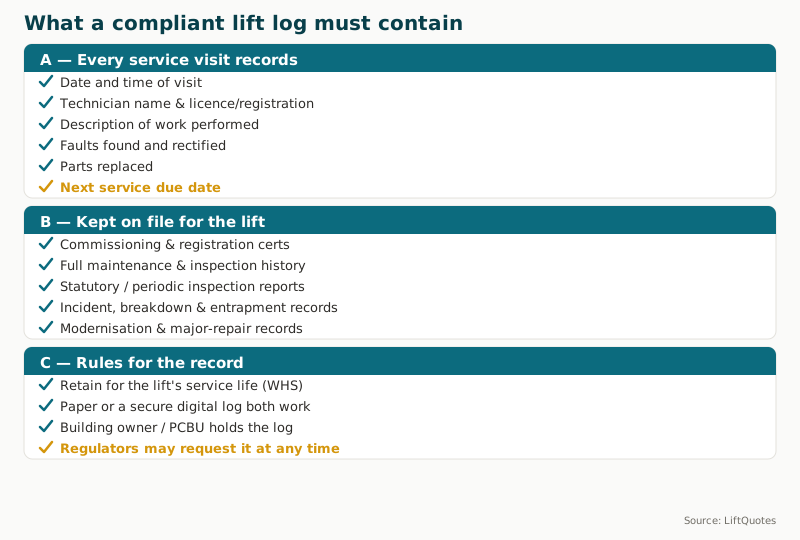
Every service visit must be written up while the technician is on site, and every entry needs to stand on its own. An auditor reading the log two years later should be able to see what was checked, what was wrong, and what was done about it. Six items are non-negotiable for each visit:
- Date and time of the visit — when the work happened, not when it was invoiced.
- Technician name and licence or registration — who did the work, and that they were competent to do it.
- Description of work performed — the servicing, adjustments, and safety-device tests carried out.
- Faults found and rectified — what was wrong, and whether it was fixed on the day or deferred.
- Parts replaced — components changed, so wear patterns and warranty claims can be traced.
- Next service due date — the interval set in your contract, so the schedule is visible and enforceable.
The interval and inclusions behind those entries are set in your lift maintenance contract, so the log and the contract should always agree. A visit that is not recorded did not happen as far as a regulator or insurer is concerned.
Which records are kept on file for the lift?
The visit notes are only part of the file. The log book also holds the documents that prove the lift is a known, compliant, registered machine:
- Commissioning and registration certificates — the lift’s original design and item registration, which tie back to the plant registration held with your state regulator. Our guide to lift plant registration explains which certificates apply in each state.
- Full maintenance and inspection history — every service report and statutory inspection, in date order.
- Statutory and periodic inspection reports — the independent competent-person assessments that sit apart from routine servicing.
- Incident, breakdown, and entrapment records — what failed, when, and how it was resolved.
- Modernisation and major-repair records — controller upgrades, drive replacements, and door works that change the lift’s configuration.
These records are framed by the AS 1735 series of Australian Standards, which governs lift design, maintenance, and inspection. Our overview of Australian lift standards sets out how the AS 1735 parts fit together and where to verify the current editions.
How long must lift maintenance records be kept?
Keep the records for the service life of the lift. A lift installed today may run for 25 to 30 years, and its log needs to cover that whole period — a five-year-old record is exactly what an incident investigation will ask for. WHS record-keeping duties for registrable plant expect maintenance and inspection records to be retained and available, and inspection reports in particular should be held for the life of the plant.
The practical failure point is a change of maintenance contractor. When a lift moves to a new provider, the historical log stays with the building — it is the owner’s record, not the outgoing contractor’s. Do not let it walk out the door with the old contract.
Who holds the log, and is a digital record acceptable?
The building owner or the person conducting the business or undertaking (PCBU) controls and holds the log. In a strata or owners corporation building that is the managing body; in a commercial building it is the owner or facility manager acting on their behalf. The maintenance contractor writes entries, but the record itself belongs to the building.
A secure digital log is acceptable — many providers now use app-based records that timestamp each visit — provided it is complete, tamper-resistant, and you can produce it on request without depending on the contractor’s goodwill. A paper log book is equally valid. What matters is completeness and access, not the medium.
Victoria operates under the Occupational Health and Safety Act 2004 and OHS Regulations 2017, regulated by WorkSafe Victoria, rather than the model WHS laws that apply elsewhere. The record-keeping expectation is the same, but the governing instrument differs — worth noting if you manage a national portfolio.
What auditors, insurers, and regulators ask for
The log earns its keep at audit, insurance, and incident time. An insurer assessing a building, a WHS or OHS regulator following up a complaint, or a lawyer after an entrapment will ask for the same thing: the maintenance history, the inspection reports, and the incident records. A complete log answers the question in minutes; a patchy one turns a routine request into a liability.
If your log is thin — missing visit notes, no inspection reports, records held only by a contractor — the fix is to rebuild the file and tighten the contract that feeds it. Our facility manager lift compliance checklist covers the full record set alongside registration and emergency-phone duties, and our lift repair guide explains how fault and rectification records should be logged.
Reviewing your maintenance arrangements or moving to a provider with better record-keeping? Get free quotes from qualified Australian lift companies and compare service reporting, contract inclusions, and price.
Lift companies in Australia
Browse profiles, compare service areas, and check reviews.

Lift Shop
★ 5.0 (1551 reviews)
Australia's largest dedicated home lift specialist since 1996. 10,000+ installations. Exclusive Italian-crafted lifts with industry-leading 8-year warranty.
View profile →

Compact Home Lifts
NDIS★ 5.0 (465 reviews)
Melbourne branch of Compact Home Lifts. Compact residential lift specialist providing maintenance and repair services across Victoria.
View profile →

Next Level Elevators
★ 5.0 (454 reviews)
Award-winning provider of premium Italian-designed all-electric home elevators. Certified Eltec Partner. Showrooms in Melbourne, Sydney, and Brisbane.
View profile →

Shotton Lifts
NDIS★ 5.0 (9 reviews)
Family-owned Australian lift manufacturer since 1977. 80+ staff. Design, engineer, manufacture, install and service from Dandenong South VIC. NDIS registered.
View profile →

LiftFit Australia
NDIS★ 5.0 (8 reviews)
Victoria-based NDIS registered lift provider, est. 2011. Partners with Cibes, Savaria, and Kalea. Residential, commercial, and platform lifts.
View profile →

Easy Living Home Elevators
★ 5.0 (7 reviews)
Australia's #1 home elevator supplier since 1998. 100% Australian-owned. 11,000+ elevators in service across 6 states.
View profile →
LiftQuotes is a comparison platform. Companies shown are filtered by relevance to this page. Listing does not imply endorsement. LiftQuotes may receive a referral fee when you request quotes.
Put this into action
When you're ready to move forward, get free quotes from verified Australian lift installers.
What are you looking for today?
I need a lift installed
I have a lift that needs attention
What must a lift maintenance log record?
Every service visit must be written up while the technician is on site, and every entry needs to stand on its own. An auditor reading the log two years later should be able to see what was checked, what was wrong, and what was done about it. Six items are non-negotiable for each visit:
- Date and time of the visit — when the work happened, not when it was invoiced.
- Technician name and licence or registration — who did the work, and that they were competent to do it.
- Description of work performed — the servicing, adjustments, and safety-device tests carried out.
- Faults found and rectified — what was wrong, and whether it was fixed on the day or deferred.
- Parts replaced — components changed, so wear patterns and warranty claims can be traced.
- Next service due date — the interval set in your contract, so the schedule is visible and enforceable.
The interval and inclusions behind those entries are set in your lift maintenance contract, so the log and the contract should always agree. A visit that is not recorded did not happen as far as a regulator or insurer is concerned.
Which records are kept on file for the lift?
The visit notes are only part of the file. The log book also holds the documents that prove the lift is a known, compliant, registered machine:
- Commissioning and registration certificates — the lift’s original design and item registration, which tie back to the plant registration held with your state regulator. Our guide to lift plant registration explains which certificates apply in each state.
- Full maintenance and inspection history — every service report and statutory inspection, in date order.
- Statutory and periodic inspection reports — the independent competent-person assessments that sit apart from routine servicing.
- Incident, breakdown, and entrapment records — what failed, when, and how it was resolved.
- Modernisation and major-repair records — controller upgrades, drive replacements, and door works that change the lift’s configuration.
These records are framed by the AS 1735 series of Australian Standards, which governs lift design, maintenance, and inspection. Our overview of Australian lift standards sets out how the AS 1735 parts fit together and where to verify the current editions.
How long must lift maintenance records be kept?
Keep the records for the service life of the lift. A lift installed today may run for 25 to 30 years, and its log needs to cover that whole period — a five-year-old record is exactly what an incident investigation will ask for. WHS record-keeping duties for registrable plant expect maintenance and inspection records to be retained and available, and inspection reports in particular should be held for the life of the plant.
The practical failure point is a change of maintenance contractor. When a lift moves to a new provider, the historical log stays with the building — it is the owner’s record, not the outgoing contractor’s. Do not let it walk out the door with the old contract.
Who holds the log, and is a digital record acceptable?
The building owner or the person conducting the business or undertaking (PCBU) controls and holds the log. In a strata or owners corporation building that is the managing body; in a commercial building it is the owner or facility manager acting on their behalf. The maintenance contractor writes entries, but the record itself belongs to the building.
A secure digital log is acceptable — many providers now use app-based records that timestamp each visit — provided it is complete, tamper-resistant, and you can produce it on request without depending on the contractor’s goodwill. A paper log book is equally valid. What matters is completeness and access, not the medium.
Victoria operates under the Occupational Health and Safety Act 2004 and OHS Regulations 2017, regulated by WorkSafe Victoria, rather than the model WHS laws that apply elsewhere. The record-keeping expectation is the same, but the governing instrument differs — worth noting if you manage a national portfolio.
What auditors, insurers, and regulators ask for
The log earns its keep at audit, insurance, and incident time. An insurer assessing a building, a WHS or OHS regulator following up a complaint, or a lawyer after an entrapment will ask for the same thing: the maintenance history, the inspection reports, and the incident records. A complete log answers the question in minutes; a patchy one turns a routine request into a liability.
If your log is thin — missing visit notes, no inspection reports, records held only by a contractor — the fix is to rebuild the file and tighten the contract that feeds it. Our facility manager lift compliance checklist covers the full record set alongside registration and emergency-phone duties, and our lift repair guide explains how fault and rectification records should be logged.
Reviewing your maintenance arrangements or moving to a provider with better record-keeping? Get free quotes from qualified Australian lift companies and compare service reporting, contract inclusions, and price.
Lift companies in Australia
Browse profiles, compare service areas, and check reviews.
Lift Shop
★ 5.0 (1551 reviews)
Australia's largest dedicated home lift specialist since 1996. 10,000+ installations. Exclusive Italian-crafted lifts with industry-leading 8-year warranty.
View profile →
Compact Home Lifts
NDIS★ 5.0 (465 reviews)
Melbourne branch of Compact Home Lifts. Compact residential lift specialist providing maintenance and repair services across Victoria.
View profile →
Next Level Elevators
★ 5.0 (454 reviews)
Award-winning provider of premium Italian-designed all-electric home elevators. Certified Eltec Partner. Showrooms in Melbourne, Sydney, and Brisbane.
View profile →
Shotton Lifts
NDIS★ 5.0 (9 reviews)
Family-owned Australian lift manufacturer since 1977. 80+ staff. Design, engineer, manufacture, install and service from Dandenong South VIC. NDIS registered.
View profile →
LiftFit Australia
NDIS★ 5.0 (8 reviews)
Victoria-based NDIS registered lift provider, est. 2011. Partners with Cibes, Savaria, and Kalea. Residential, commercial, and platform lifts.
View profile →
Easy Living Home Elevators
★ 5.0 (7 reviews)
Australia's #1 home elevator supplier since 1998. 100% Australian-owned. 11,000+ elevators in service across 6 states.
View profile →
LiftQuotes is a comparison platform. Companies shown are filtered by relevance to this page. Listing does not imply endorsement. LiftQuotes may receive a referral fee when you request quotes.
Put this into action
When you're ready to move forward, get free quotes from verified Australian lift installers.
What are you looking for today?
I need a lift installed
I have a lift that needs attention
Every visit: six things to capture
Each service visit must record the date and time, the technician’s name and licence, the work performed, faults found and rectified, parts replaced, and the next service due date.
On file: the lift’s full history
The log also holds commissioning and registration certificates, statutory inspection reports, and any incident, breakdown, entrapment, or modernisation records for the life of the lift.
Retention: the service life of the lift
Records are kept for the lift’s working life to meet WHS record-keeping duties. Do not discard old records when a contract changes hands.
Who holds it: the owner or PCBU
The building owner or managing body controls the log — not the contractor. Auditors, insurers, and regulators can request it at any time.
Common questions about lift maintenance records
A lift log book — also called the lift maintenance log — is the running record of everything done to a lift over its life. It holds a dated entry for each service visit, the lift’s commissioning and registration certificates, statutory inspection reports, and any incident, breakdown, or modernisation records. It belongs to the building owner or managing body, and it is the primary evidence that the lift has been maintained and kept safe.
Related guides
Guide
Our Editorial Methodology: How LiftQuotes Researches Content
How LiftQuotes researches, sources and reviews every lift guide and cost page: the standards we cite, our linked-source rule for cost data, and how often we update.
Guide
Lift Compliance Checklist for Facility Managers (Australia)
A facility manager's lift compliance checklist for Australia: plant registration, inspection, log books, 4G VoLTE emergency phones and DDA access duties.
Comparison
Stairlift vs Platform Lift: Which Access Solution Fits?
A stairlift carries a seated user along the stairs from about $3,000; a platform lift raises a wheelchair vertically from about $15,000. Compare cost, access and fit.
Location
Lift Companies in Melbourne: Compare Local Installers
Compare lift companies in Melbourne for home, platform and commercial lifts. WorkSafe Victoria compliance, local installer coverage and indicative VIC costs.
Compare lift maintenance and reporting
Compare verified installers and get free, no-obligation quotes tailored to your project.
Join 1,000+ Australians who've requested quotes through LiftQuotes
Get free quotes