Lift Compliance Checklist for Facility Managers (Australia)
A facility manager's recurring lift duties fall into five areas — plant registration, inspection and servicing, records, emergency communications, and access. Get all five current and you can answer any auditor on the spot.
A facility manager's core lift compliance duties in Australia fall into five areas: register the lift as plant where required, keep servicing and statutory inspections current, hold complete audit-ready records, maintain a working 4G VoLTE emergency phone, and meet the building's access duties. Get those five right and you can answer almost any auditor, insurer, or regulator without scrambling.
Lifts are registrable plant under Schedule 5 of the model Work Health and Safety (WHS) Regulations, so the person conducting the business or undertaking (PCBU) — usually the building owner or the manager acting for them — carries a legal duty to keep the lift safe and to prove it. Victoria is the exception: it operates under the Occupational Health and Safety Act 2004, regulated by WorkSafe Victoria, but the practical obligations are the same.
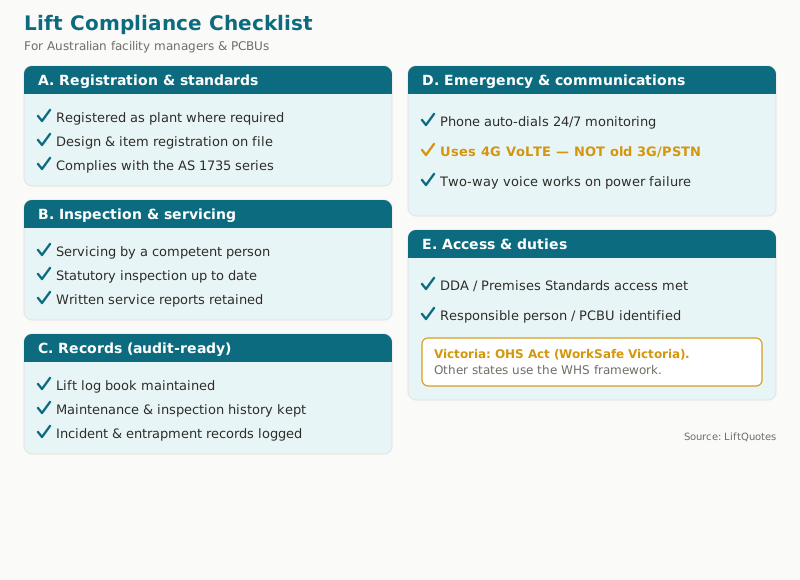
Use the checklist below as a standing reference. It groups every recurring duty so nothing quietly lapses between service visits, and it flags the two items facility managers most often get caught on: the 4G VoLTE emergency phone and the Victorian OHS distinction.
A facility manager's lift compliance duties at a glance
Compliance for a commercial or shared-building lift is not one obligation but several, running on different clocks. The checklist below groups them into five areas — registration and standards, inspection and servicing, records, emergency communications, and access and duties — so a facility manager can see the whole picture and spot what has lapsed.
The duties sit across the three layers of Australian lift obligation: building compliance (the National Construction Code and the AS 1735 series), disability access (the Premises Standards and AS 1735.12), and workplace safety (WHS or, in Victoria, OHS plant duties). Our overview of Australian lift standards sets out how those layers fit together. Get the five checklist areas current and you are meeting the recurring core of all three.
Plant registration: is your lift registrable plant?
Yes — in almost every case. Under Schedule 5 of the model WHS Regulations, lifts, escalators, and moving walkways are listed as registrable plant. That means two separate registrations exist: design registration for the lift type, and item (or plant) registration for the specific installed unit. Both should be held, and the registration numbers should sit in your lift file where an auditor can find them.
Registration is handled by the state regulator, and the process varies by jurisdiction. Our guide to lift plant registration breaks down what each state requires and links to the regulator portals. Victoria is again the exception — design and item registration are administered by WorkSafe Victoria under the OHS framework rather than the model WHS laws.
Inspection and servicing frequency
A commercial lift should be serviced on a regular preventive schedule by a competent person — commonly monthly to quarterly for a passenger lift in a busy building, set by the manufacturer's requirements and your maintenance contract. On top of routine servicing, a statutory or periodic inspection by an independent competent person confirms the safety systems still perform to standard.
Servicing frequency is a contract term, not a legal fixed number, so the interval must be defined in your lift maintenance agreement and matched to how hard the lift works. Keep a written service report after every visit — an undocumented service does not exist as far as an auditor is concerned. If a lift fails an inspection it should be taken out of service until the defect is rectified; our lift repair guide covers how fault and rectification records should be captured.
Records and the lift log book
The lift log book is your primary evidence of compliance. It must hold a dated entry for every service visit (date, technician and licence, work done, faults rectified, parts replaced, next service due), plus the commissioning and registration certificates, the full inspection history, and any incident, breakdown, or entrapment records.
Keep the records for the service life of the lift — 25 to 30 years is normal — and remember the record belongs to the building, not the contractor. When you change maintenance providers the historical log stays with you. A secure digital log is acceptable provided it is complete, tamper-resistant, and you can produce it on request.
Emergency phone and communications
Every lift must have an emergency phone that auto-dials a 24/7 monitoring service and supports two-way voice, and it must keep working during a power failure. Since the PSTN copper network and 3G were decommissioned, all lift emergency phones in Australia run on 4G VoLTE or a landline SIP service. This is now an ongoing compliance-maintenance item, not a one-off migration.
Verify that the monitoring arrangement is active and the connection is functioning as part of routine maintenance. Our guide to lift emergency phone compliance covers testing cadence and what a compliant monitoring setup looks like. A lift with a dead phone line is non-compliant even if everything else works.
Access duties and who is the responsible person
For buildings open to the public or to employees, the lift must meet the disability access provisions that applied when it was installed or last upgraded — principally the Disability (Access to Premises — Buildings) Standards 2010 and AS 1735.12:2020 for accessible lifts. Our guide to DDA lift compliance explains car dimensions, controls, and the new-versus-existing-building distinction.
Finally, name the responsible person. Under WHS law the PCBU — the building owner or the manager acting on their behalf — carries the duty for the lift as plant on the premises. In Victoria that duty sits under the OHS Act with WorkSafe Victoria as the regulator. Whoever holds the role should be identifiable in your records, because when something goes wrong the first question is always who was responsible.
LiftQuotes does not provide legal or compliance advice — verify current requirements with your state regulator or a qualified lift or access consultant. If you are reviewing maintenance arrangements or need a provider with stronger reporting and compliance support, get free quotes from qualified Australian lift companies and compare on response time, inclusions, and record-keeping.
Lift companies in Australia
Browse profiles, compare service areas, and check reviews.

Lift Shop
★ 5.0 (1551 reviews)
Australia's largest dedicated home lift specialist since 1996. 10,000+ installations. Exclusive Italian-crafted lifts with industry-leading 8-year warranty.
View profile →

Compact Home Lifts
NDIS★ 5.0 (465 reviews)
Melbourne branch of Compact Home Lifts. Compact residential lift specialist providing maintenance and repair services across Victoria.
View profile →

Next Level Elevators
★ 5.0 (454 reviews)
Award-winning provider of premium Italian-designed all-electric home elevators. Certified Eltec Partner. Showrooms in Melbourne, Sydney, and Brisbane.
View profile →

Shotton Lifts
NDIS★ 5.0 (9 reviews)
Family-owned Australian lift manufacturer since 1977. 80+ staff. Design, engineer, manufacture, install and service from Dandenong South VIC. NDIS registered.
View profile →

LiftFit Australia
NDIS★ 5.0 (8 reviews)
Victoria-based NDIS registered lift provider, est. 2011. Partners with Cibes, Savaria, and Kalea. Residential, commercial, and platform lifts.
View profile →

Easy Living Home Elevators
★ 5.0 (7 reviews)
Australia's #1 home elevator supplier since 1998. 100% Australian-owned. 11,000+ elevators in service across 6 states.
View profile →
LiftQuotes is a comparison platform. Companies shown are filtered by relevance to this page. Listing does not imply endorsement. LiftQuotes may receive a referral fee when you request quotes.
Put this into action
When you're ready to move forward, get free quotes from verified Australian lift installers.
What are you looking for today?
I need a lift installed
I have a lift that needs attention
A facility manager's core lift compliance duties in Australia fall into five areas: register the lift as plant where required, keep servicing and statutory inspections current, hold complete audit-ready records, maintain a working 4G VoLTE emergency phone, and meet the building's access duties. Get those five right and you can answer almost any auditor, insurer, or regulator without scrambling.
Lifts are registrable plant under Schedule 5 of the model Work Health and Safety (WHS) Regulations, so the person conducting the business or undertaking (PCBU) — usually the building owner or the manager acting for them — carries a legal duty to keep the lift safe and to prove it. Victoria is the exception: it operates under the Occupational Health and Safety Act 2004, regulated by WorkSafe Victoria, but the practical obligations are the same.
Use the checklist below as a standing reference. It groups every recurring duty so nothing quietly lapses between service visits, and it flags the two items facility managers most often get caught on: the 4G VoLTE emergency phone and the Victorian OHS distinction.
A facility manager's lift compliance duties at a glance
Compliance for a commercial or shared-building lift is not one obligation but several, running on different clocks. The checklist below groups them into five areas — registration and standards, inspection and servicing, records, emergency communications, and access and duties — so a facility manager can see the whole picture and spot what has lapsed.
The duties sit across the three layers of Australian lift obligation: building compliance (the National Construction Code and the AS 1735 series), disability access (the Premises Standards and AS 1735.12), and workplace safety (WHS or, in Victoria, OHS plant duties). Our overview of Australian lift standards sets out how those layers fit together. Get the five checklist areas current and you are meeting the recurring core of all three.
Plant registration: is your lift registrable plant?
Yes — in almost every case. Under Schedule 5 of the model WHS Regulations, lifts, escalators, and moving walkways are listed as registrable plant. That means two separate registrations exist: design registration for the lift type, and item (or plant) registration for the specific installed unit. Both should be held, and the registration numbers should sit in your lift file where an auditor can find them.
Registration is handled by the state regulator, and the process varies by jurisdiction. Our guide to lift plant registration breaks down what each state requires and links to the regulator portals. Victoria is again the exception — design and item registration are administered by WorkSafe Victoria under the OHS framework rather than the model WHS laws.
Inspection and servicing frequency
A commercial lift should be serviced on a regular preventive schedule by a competent person — commonly monthly to quarterly for a passenger lift in a busy building, set by the manufacturer's requirements and your maintenance contract. On top of routine servicing, a statutory or periodic inspection by an independent competent person confirms the safety systems still perform to standard.
Servicing frequency is a contract term, not a legal fixed number, so the interval must be defined in your lift maintenance agreement and matched to how hard the lift works. Keep a written service report after every visit — an undocumented service does not exist as far as an auditor is concerned. If a lift fails an inspection it should be taken out of service until the defect is rectified; our lift repair guide covers how fault and rectification records should be captured.
Records and the lift log book
The lift log book is your primary evidence of compliance. It must hold a dated entry for every service visit (date, technician and licence, work done, faults rectified, parts replaced, next service due), plus the commissioning and registration certificates, the full inspection history, and any incident, breakdown, or entrapment records.
Keep the records for the service life of the lift — 25 to 30 years is normal — and remember the record belongs to the building, not the contractor. When you change maintenance providers the historical log stays with you. A secure digital log is acceptable provided it is complete, tamper-resistant, and you can produce it on request.
Emergency phone and communications
Every lift must have an emergency phone that auto-dials a 24/7 monitoring service and supports two-way voice, and it must keep working during a power failure. Since the PSTN copper network and 3G were decommissioned, all lift emergency phones in Australia run on 4G VoLTE or a landline SIP service. This is now an ongoing compliance-maintenance item, not a one-off migration.
Verify that the monitoring arrangement is active and the connection is functioning as part of routine maintenance. Our guide to lift emergency phone compliance covers testing cadence and what a compliant monitoring setup looks like. A lift with a dead phone line is non-compliant even if everything else works.
Access duties and who is the responsible person
For buildings open to the public or to employees, the lift must meet the disability access provisions that applied when it was installed or last upgraded — principally the Disability (Access to Premises — Buildings) Standards 2010 and AS 1735.12:2020 for accessible lifts. Our guide to DDA lift compliance explains car dimensions, controls, and the new-versus-existing-building distinction.
Finally, name the responsible person. Under WHS law the PCBU — the building owner or the manager acting on their behalf — carries the duty for the lift as plant on the premises. In Victoria that duty sits under the OHS Act with WorkSafe Victoria as the regulator. Whoever holds the role should be identifiable in your records, because when something goes wrong the first question is always who was responsible.
LiftQuotes does not provide legal or compliance advice — verify current requirements with your state regulator or a qualified lift or access consultant. If you are reviewing maintenance arrangements or need a provider with stronger reporting and compliance support, get free quotes from qualified Australian lift companies and compare on response time, inclusions, and record-keeping.
Lift companies in Australia
Browse profiles, compare service areas, and check reviews.
Lift Shop
★ 5.0 (1551 reviews)
Australia's largest dedicated home lift specialist since 1996. 10,000+ installations. Exclusive Italian-crafted lifts with industry-leading 8-year warranty.
View profile →
Compact Home Lifts
NDIS★ 5.0 (465 reviews)
Melbourne branch of Compact Home Lifts. Compact residential lift specialist providing maintenance and repair services across Victoria.
View profile →
Next Level Elevators
★ 5.0 (454 reviews)
Award-winning provider of premium Italian-designed all-electric home elevators. Certified Eltec Partner. Showrooms in Melbourne, Sydney, and Brisbane.
View profile →
Shotton Lifts
NDIS★ 5.0 (9 reviews)
Family-owned Australian lift manufacturer since 1977. 80+ staff. Design, engineer, manufacture, install and service from Dandenong South VIC. NDIS registered.
View profile →
LiftFit Australia
NDIS★ 5.0 (8 reviews)
Victoria-based NDIS registered lift provider, est. 2011. Partners with Cibes, Savaria, and Kalea. Residential, commercial, and platform lifts.
View profile →
Easy Living Home Elevators
★ 5.0 (7 reviews)
Australia's #1 home elevator supplier since 1998. 100% Australian-owned. 11,000+ elevators in service across 6 states.
View profile →
LiftQuotes is a comparison platform. Companies shown are filtered by relevance to this page. Listing does not imply endorsement. LiftQuotes may receive a referral fee when you request quotes.
Put this into action
When you're ready to move forward, get free quotes from verified Australian lift installers.
What are you looking for today?
I need a lift installed
I have a lift that needs attention
Register the lift as plant
Lifts are registrable plant under Schedule 5 of the model WHS Regulations. Confirm both design and item registration are held and the numbers sit in your lift file.
Keep inspection and servicing current
Routine servicing by a competent person plus a statutory or periodic inspection, with a written report retained after every visit.
Hold audit-ready records
A complete lift log book, the full maintenance and inspection history, and incident or entrapment records — held by the owner for the life of the lift.
Verify emergency comms and access
A 4G VoLTE emergency phone that auto-dials 24/7 monitoring, plus DDA and Premises Standards access provisions and a named responsible person.
Common questions about lift compliance for facility managers
A facility manager's recurring lift obligations fall into five areas: register the lift as plant where required; keep routine servicing and statutory inspections current; maintain a complete, audit-ready log book; keep a working 4G VoLTE emergency phone connected to 24/7 monitoring; and meet the building's disability access duties. These sit across the three layers of Australian lift obligation — building compliance (NCC and the AS 1735 series), disability access (the Premises Standards and AS 1735.12), and workplace safety (WHS, or OHS in Victoria). The building owner or PCBU carries the legal duty.
Related guides
Guide
Our Editorial Methodology: How LiftQuotes Researches Content
How LiftQuotes researches, sources and reviews every lift guide and cost page: the standards we cite, our linked-source rule for cost data, and how often we update.
Guide
Lift Noise Levels Guide: Choosing a Quiet Home Lift (Australia)
A quiet home lift runs at roughly 40 to 70 dB depending on drive type. Compare indicative lift noise levels and learn how to specify the quietest option.
Comparison
Stairlift vs Platform Lift: Which Access Solution Fits?
A stairlift carries a seated user along the stairs from about $3,000; a platform lift raises a wheelchair vertically from about $15,000. Compare cost, access and fit.
Location
Lift Companies in Melbourne: Compare Local Installers
Compare lift companies in Melbourne for home, platform and commercial lifts. WorkSafe Victoria compliance, local installer coverage and indicative VIC costs.
Reviewing your lift maintenance and compliance?
Compare verified installers and get free, no-obligation quotes tailored to your project.
Join 1,000+ Australians who've requested quotes through LiftQuotes
Get free quotes