Through-Floor Lift vs Shaft Lift
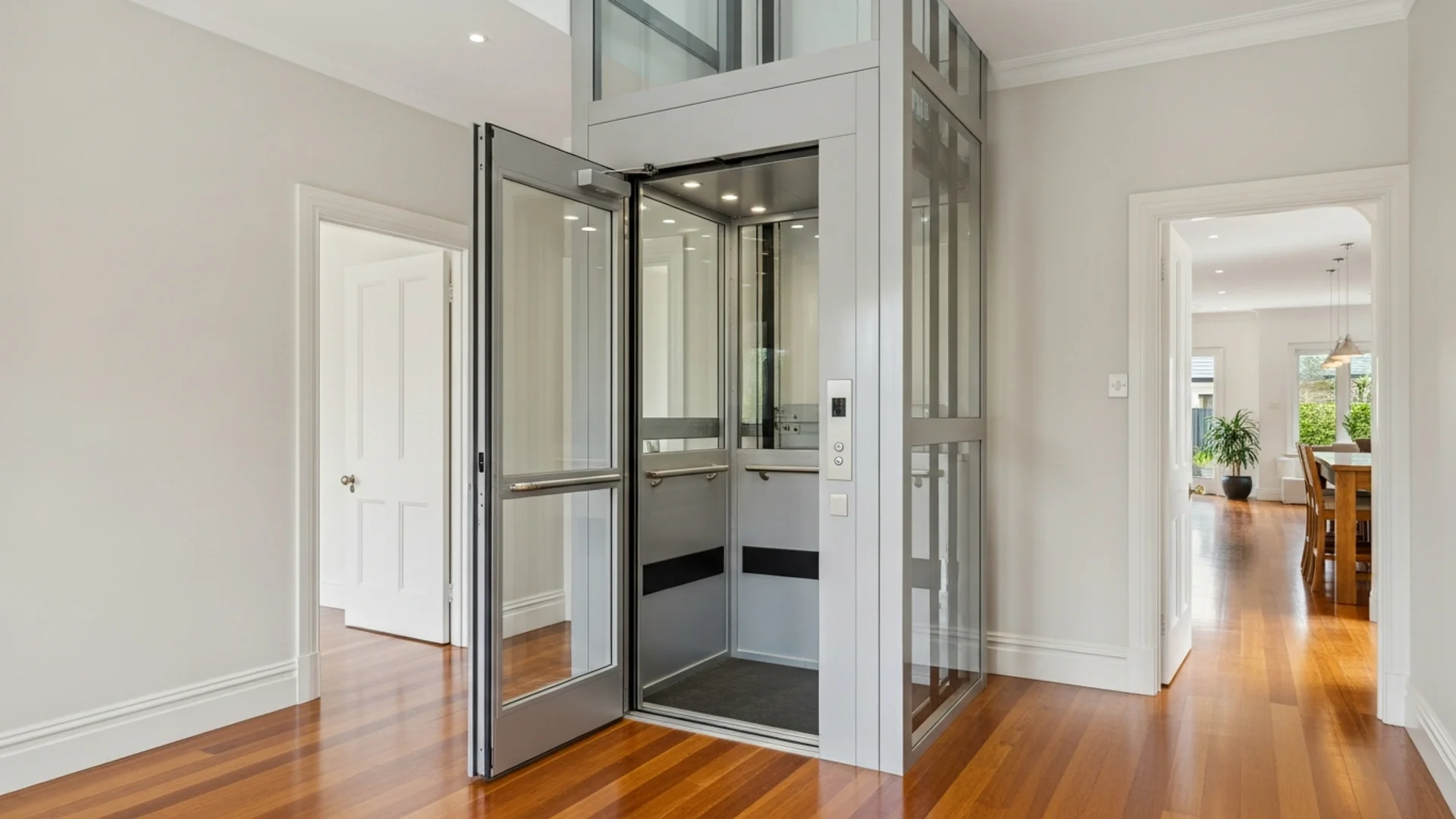
The difference comes down to the shaft. A through-floor lift passes through a neat opening in the ceiling and needs no separate hoistway, which makes it cheaper and easier to retrofit. A shaft lift runs in a fully enclosed structure that serves more levels and takes more finish — for more money.
The core difference between a through-floor lift and a shaft lift is whether you build a separate enclosure. A through-floor lift is self-contained: the car travels on its own guide rails and passes through a rectangular aperture cut in the floor above, which closes over when the car is not there. There is no masonry shaft to construct. A shaft lift runs inside a fully enclosed hoistway — a structural box built into or onto the home — which is what lets it serve more levels and carry a wider choice of car sizes and finishes.
That single decision drives almost everything else: cost, how much building work the install needs, how many floors you can reach, and how the finished lift looks. For most two-storey Australian homes — especially retrofits and accessibility projects — a through-floor lift is the lower-cost, less disruptive choice. A shaft lift earns its extra cost when you need to serve three or more levels, want a larger or higher-specification car, or are building the shaft into a new home from the start. This page sets out the trade-off row by row so you can match the lift to your home with confidence.
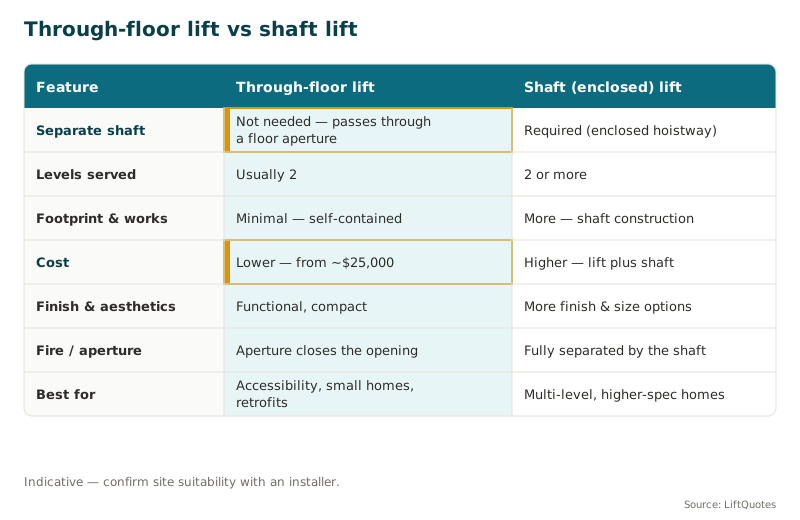
Through-floor and shaft lifts compared across the factors that actually decide the choice for a home. The shaft row at the top is the one everything else follows from.
Swipe to compare →
| Factor | Through-floor lift | Shaft (enclosed) lift |
|---|---|---|
| Best for | Accessibility, small homes, retrofits | Multi-level or higher-spec homes |
| Separate shaft | Not needed — passes through a floor aperture | Required — a fully enclosed hoistway |
| Levels served | Usually 2 | 2 or more |
| Footprint & building work | Minimal — self-contained unit | More — shaft construction on top of the lift |
| Typical cost | Lower — from around $25,000 installed | Higher — the lift plus the shaft build |
| Finish & aesthetics | Functional and compact | More finish, size and door options |
| Fire & aperture | A powered aperture closes off the opening | The floors are fully separated by the shaft |
Figures are indicative as of Q2 2026 and describe typical residential products in each class. The $25,000 starting figure is a supplier-stated, installed indicative for a compact 2-stop through-floor lift and excludes significant building works; confirm site suitability and a firm price with an installer for your home.
Lift companies in Australia
Browse profiles, compare service areas, and check reviews.

Lift Shop
★ 5.0 (1551 reviews)
Australia's largest dedicated home lift specialist since 1996. 10,000+ installations. Exclusive Italian-crafted lifts with industry-leading 8-year warranty.
View profile →

Compact Home Lifts
NDIS★ 5.0 (465 reviews)
Melbourne branch of Compact Home Lifts. Compact residential lift specialist providing maintenance and repair services across Victoria.
View profile →

Next Level Elevators
★ 5.0 (454 reviews)
Award-winning provider of premium Italian-designed all-electric home elevators. Certified Eltec Partner. Showrooms in Melbourne, Sydney, and Brisbane.
View profile →

Shotton Lifts
NDIS★ 5.0 (9 reviews)
Family-owned Australian lift manufacturer since 1977. 80+ staff. Design, engineer, manufacture, install and service from Dandenong South VIC. NDIS registered.
View profile →

LiftFit Australia
NDIS★ 5.0 (8 reviews)
Victoria-based NDIS registered lift provider, est. 2011. Partners with Cibes, Savaria, and Kalea. Residential, commercial, and platform lifts.
View profile →

Easy Living Home Elevators
★ 5.0 (7 reviews)
Australia's #1 home elevator supplier since 1998. 100% Australian-owned. 11,000+ elevators in service across 6 states.
View profile →
LiftQuotes is a comparison platform. Companies shown are filtered by relevance to this page. Listing does not imply endorsement. LiftQuotes may receive a referral fee when you request quotes.
What actually separates the two
Both lifts do the same job — carry one or two people, or a wheelchair user and a carer, between the floors of a house. What differs is the structure around the car. A through-floor lift is a sealed unit that carries its own guide rails and drive; when it rises, it passes through a motorised aperture in the ceiling that opens for the car and closes flush once it has gone up, so the hole in your floor is not left open. A shaft lift, by contrast, runs inside a purpose-built enclosed hoistway. That enclosure is the expensive, disruptive part — and it is also what unlocks more levels, bigger cars and better finishes.
The practical upshot is that a through-floor lift is usually the faster, cheaper retrofit, while a shaft lift is the more flexible — and more costly — long-term fit. If you are still deciding whether a home lift suits your house at all, start with our overview of home lifts in Australia, which covers the main lift types side by side.
Choose a through-floor lift if…
A through-floor lift is the right call for the majority of two-storey homes, and especially for accessibility retrofits. Choose it if you are connecting exactly two levels, want to avoid major structural work, and are fitting a lift into an existing home rather than a new build. Because it needs no separate shaft, it can often be installed in days rather than weeks, and it takes up very little floor area — the car simply sits in a corner of a downstairs room and rises through the ceiling above. That compact footprint is why through-floor units feature so heavily in our guide to small lifts for homes.
It is also the more affordable option, which matters when a lift is being funded privately or partly through a mobility program. The trade-off is that you are generally limited to two stops and to the manufacturer's standard car sizes and finishes.
Choose a shaft lift if…
A shaft lift makes sense when a through-floor unit cannot do what you need. Choose it if you have to serve three or more levels, want a larger car or a specific door configuration, or are building a new home where the shaft can be designed in from the start rather than retrofitted later. The enclosed hoistway also gives you a fully separated structure between floors, which can simplify fire and acoustic detailing in a larger or higher-specification home.
The cost of that flexibility is real. You are paying for the lift and for the shaft itself — the concrete, framing or masonry that forms the enclosure — which is often the single largest line in the quote. Our breakdown of lift shaft construction cost sets out what that structural work typically adds, and why it varies so much between a new build and a retrofit.
The cost gap, in context
The headline difference buyers feel is price. Compact through-floor lifts start at around $25,000 installed for a standard two-stop unit, based on supplier-stated indicative pricing as of Q2 2026 (hipages home lift cost guide; supplier starting prices) — though that figure assumes a straightforward install without significant building works. A shaft lift starts higher and climbs with the cost of the hoistway, so the all-in figure depends heavily on whether the shaft is being built into a new home or cut into an existing one.
Because the building works are where most of the variation — and most of the bill shock — lives, treat any starting price as a floor, not a quote. Our full guide to home lift cost breaks down the drivers, and for the enclosed option specifically, the lift shaft construction cost page covers the structural component that a through-floor lift avoids entirely.
Standards, safety and space
Both lift types, when installed in a private home, are built to the same Australian Standard — AS/NZS 1735.18:2002, which covers automatically controlled, low-speed passenger lifts in private residences. Neither is inherently safer than the other; both use enclosed cars, interlocks and controlled apertures or doors to prevent falls. A common worry with through-floor lifts is the open hole in the ceiling, but the aperture is motorised and closes off the opening whenever the car is on the lower floor, so there is no exposed gap in normal use.
Where they differ practically is space and structure. A through-floor lift needs a clear landing zone directly above the car and a floor structure that can take the load; a shaft lift needs room for the enclosure on both levels. If you are checking whether either will physically fit, our guide to home lift space requirements covers the minimum dimensions and the structural checks an installer will make.
The verdict
For most two-storey Australian homes — and for the majority of accessibility retrofits — a through-floor lift is the better starting point. It costs less, installs faster, takes minimal space, and meets the same residential standard as a shaft lift. Choose a shaft lift when you genuinely need what it adds: three or more levels, a larger or higher-specification car, or a shaft designed into a new build from day one.
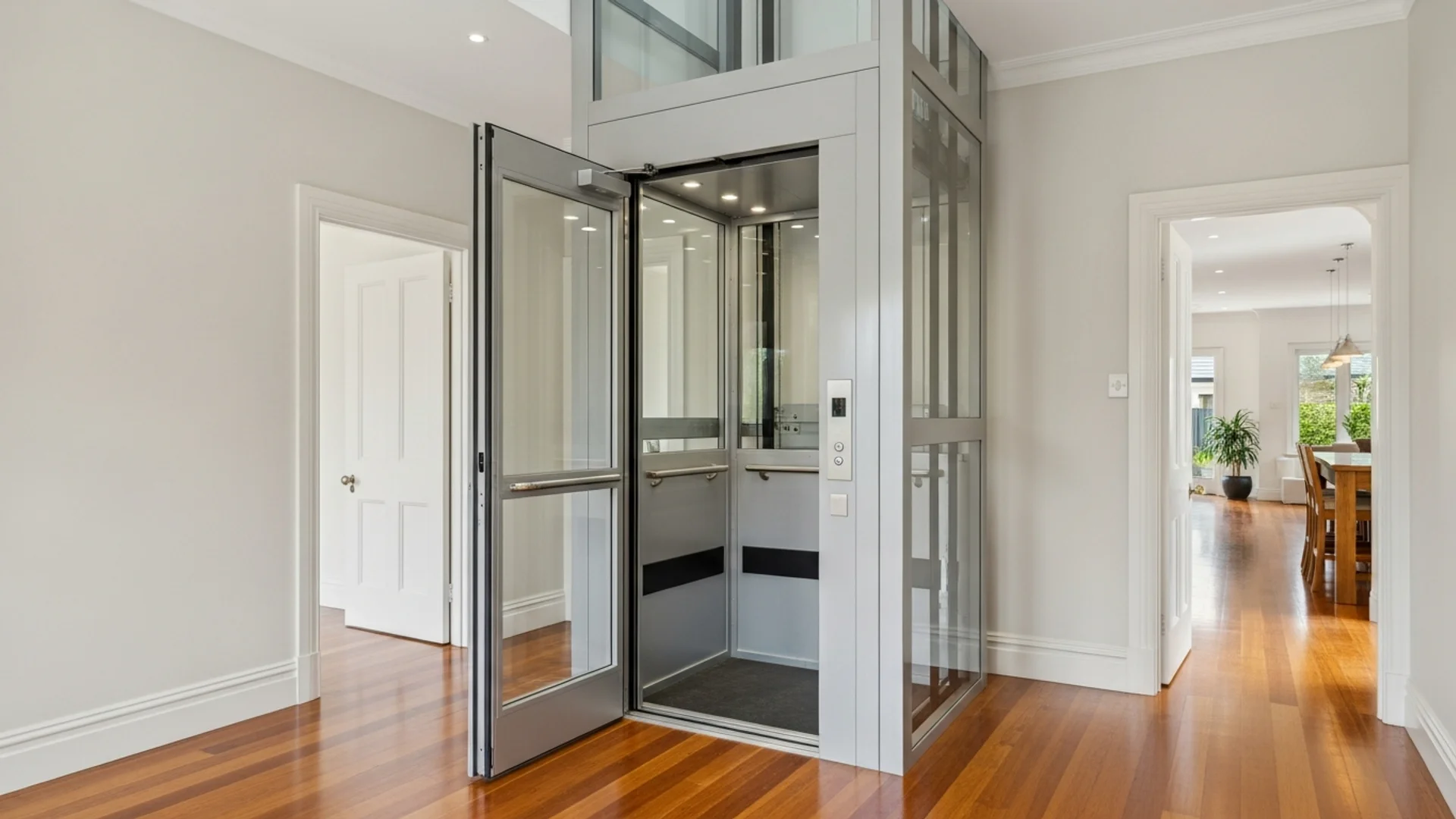
The honest way to settle it is against your own home, because the floor structure, the levels you need and the finish you want decide the price far more than the lift type alone. Get free quotes from lift companies who install both, and ask each to price the through-floor option and the shaft option so you can compare the all-in figures side by side.
Still deciding? Get quotes for both options
Installers will assess your site and recommend the right specification.
What are you looking for today?
I need a lift installed
I have a lift that needs attention
The core difference between a through-floor lift and a shaft lift is whether you build a separate enclosure. A through-floor lift is self-contained: the car travels on its own guide rails and passes through a rectangular aperture cut in the floor above, which closes over when the car is not there. There is no masonry shaft to construct. A shaft lift runs inside a fully enclosed hoistway — a structural box built into or onto the home — which is what lets it serve more levels and carry a wider choice of car sizes and finishes.
That single decision drives almost everything else: cost, how much building work the install needs, how many floors you can reach, and how the finished lift looks. For most two-storey Australian homes — especially retrofits and accessibility projects — a through-floor lift is the lower-cost, less disruptive choice. A shaft lift earns its extra cost when you need to serve three or more levels, want a larger or higher-specification car, or are building the shaft into a new home from the start. This page sets out the trade-off row by row so you can match the lift to your home with confidence.
Through-floor and shaft lifts compared across the factors that actually decide the choice for a home. The shaft row at the top is the one everything else follows from.
Swipe to compare →
| Factor | Through-floor lift | Shaft (enclosed) lift |
|---|---|---|
| Best for | Accessibility, small homes, retrofits | Multi-level or higher-spec homes |
| Separate shaft | Not needed — passes through a floor aperture | Required — a fully enclosed hoistway |
| Levels served | Usually 2 | 2 or more |
| Footprint & building work | Minimal — self-contained unit | More — shaft construction on top of the lift |
| Typical cost | Lower — from around $25,000 installed | Higher — the lift plus the shaft build |
| Finish & aesthetics | Functional and compact | More finish, size and door options |
| Fire & aperture | A powered aperture closes off the opening | The floors are fully separated by the shaft |
Figures are indicative as of Q2 2026 and describe typical residential products in each class. The $25,000 starting figure is a supplier-stated, installed indicative for a compact 2-stop through-floor lift and excludes significant building works; confirm site suitability and a firm price with an installer for your home.
Lift companies in Australia
Browse profiles, compare service areas, and check reviews.
Lift Shop
★ 5.0 (1551 reviews)
Australia's largest dedicated home lift specialist since 1996. 10,000+ installations. Exclusive Italian-crafted lifts with industry-leading 8-year warranty.
View profile →
Compact Home Lifts
NDIS★ 5.0 (465 reviews)
Melbourne branch of Compact Home Lifts. Compact residential lift specialist providing maintenance and repair services across Victoria.
View profile →
Next Level Elevators
★ 5.0 (454 reviews)
Award-winning provider of premium Italian-designed all-electric home elevators. Certified Eltec Partner. Showrooms in Melbourne, Sydney, and Brisbane.
View profile →
Shotton Lifts
NDIS★ 5.0 (9 reviews)
Family-owned Australian lift manufacturer since 1977. 80+ staff. Design, engineer, manufacture, install and service from Dandenong South VIC. NDIS registered.
View profile →
LiftFit Australia
NDIS★ 5.0 (8 reviews)
Victoria-based NDIS registered lift provider, est. 2011. Partners with Cibes, Savaria, and Kalea. Residential, commercial, and platform lifts.
View profile →
Easy Living Home Elevators
★ 5.0 (7 reviews)
Australia's #1 home elevator supplier since 1998. 100% Australian-owned. 11,000+ elevators in service across 6 states.
View profile →
LiftQuotes is a comparison platform. Companies shown are filtered by relevance to this page. Listing does not imply endorsement. LiftQuotes may receive a referral fee when you request quotes.
What actually separates the two
Both lifts do the same job — carry one or two people, or a wheelchair user and a carer, between the floors of a house. What differs is the structure around the car. A through-floor lift is a sealed unit that carries its own guide rails and drive; when it rises, it passes through a motorised aperture in the ceiling that opens for the car and closes flush once it has gone up, so the hole in your floor is not left open. A shaft lift, by contrast, runs inside a purpose-built enclosed hoistway. That enclosure is the expensive, disruptive part — and it is also what unlocks more levels, bigger cars and better finishes.
The practical upshot is that a through-floor lift is usually the faster, cheaper retrofit, while a shaft lift is the more flexible — and more costly — long-term fit. If you are still deciding whether a home lift suits your house at all, start with our overview of home lifts in Australia, which covers the main lift types side by side.
Choose a through-floor lift if…
A through-floor lift is the right call for the majority of two-storey homes, and especially for accessibility retrofits. Choose it if you are connecting exactly two levels, want to avoid major structural work, and are fitting a lift into an existing home rather than a new build. Because it needs no separate shaft, it can often be installed in days rather than weeks, and it takes up very little floor area — the car simply sits in a corner of a downstairs room and rises through the ceiling above. That compact footprint is why through-floor units feature so heavily in our guide to small lifts for homes.
It is also the more affordable option, which matters when a lift is being funded privately or partly through a mobility program. The trade-off is that you are generally limited to two stops and to the manufacturer's standard car sizes and finishes.
Choose a shaft lift if…
A shaft lift makes sense when a through-floor unit cannot do what you need. Choose it if you have to serve three or more levels, want a larger car or a specific door configuration, or are building a new home where the shaft can be designed in from the start rather than retrofitted later. The enclosed hoistway also gives you a fully separated structure between floors, which can simplify fire and acoustic detailing in a larger or higher-specification home.
The cost of that flexibility is real. You are paying for the lift and for the shaft itself — the concrete, framing or masonry that forms the enclosure — which is often the single largest line in the quote. Our breakdown of lift shaft construction cost sets out what that structural work typically adds, and why it varies so much between a new build and a retrofit.
The cost gap, in context
The headline difference buyers feel is price. Compact through-floor lifts start at around $25,000 installed for a standard two-stop unit, based on supplier-stated indicative pricing as of Q2 2026 (hipages home lift cost guide; supplier starting prices) — though that figure assumes a straightforward install without significant building works. A shaft lift starts higher and climbs with the cost of the hoistway, so the all-in figure depends heavily on whether the shaft is being built into a new home or cut into an existing one.
Because the building works are where most of the variation — and most of the bill shock — lives, treat any starting price as a floor, not a quote. Our full guide to home lift cost breaks down the drivers, and for the enclosed option specifically, the lift shaft construction cost page covers the structural component that a through-floor lift avoids entirely.
Standards, safety and space
Both lift types, when installed in a private home, are built to the same Australian Standard — AS/NZS 1735.18:2002, which covers automatically controlled, low-speed passenger lifts in private residences. Neither is inherently safer than the other; both use enclosed cars, interlocks and controlled apertures or doors to prevent falls. A common worry with through-floor lifts is the open hole in the ceiling, but the aperture is motorised and closes off the opening whenever the car is on the lower floor, so there is no exposed gap in normal use.
Where they differ practically is space and structure. A through-floor lift needs a clear landing zone directly above the car and a floor structure that can take the load; a shaft lift needs room for the enclosure on both levels. If you are checking whether either will physically fit, our guide to home lift space requirements covers the minimum dimensions and the structural checks an installer will make.
The verdict
For most two-storey Australian homes — and for the majority of accessibility retrofits — a through-floor lift is the better starting point. It costs less, installs faster, takes minimal space, and meets the same residential standard as a shaft lift. Choose a shaft lift when you genuinely need what it adds: three or more levels, a larger or higher-specification car, or a shaft designed into a new build from day one.
The honest way to settle it is against your own home, because the floor structure, the levels you need and the finish you want decide the price far more than the lift type alone. Get free quotes from lift companies who install both, and ask each to price the through-floor option and the shaft option so you can compare the all-in figures side by side.
Still deciding? Get quotes for both options
Installers will assess your site and recommend the right specification.
What are you looking for today?
I need a lift installed
I have a lift that needs attention
The shaft is the whole decision
A through-floor lift needs no separate hoistway — it passes through a floor aperture. A shaft lift runs in an enclosed structure. Cost, works and levels all follow from that.
Through-floor wins on cost and retrofit
Lower price, minimal footprint and a fast install make the through-floor lift the default for two-storey homes and accessibility retrofits.
Shaft lift buys flexibility
Choose the enclosed option when you need three or more levels, a larger or higher-spec car, or a shaft designed into a new build.
Same safety standard either way
In a private home both are built to AS/NZS 1735.18:2002, and a through-floor aperture closes off the opening whenever the car is down.
Common Questions About Through-Floor and Shaft Lifts
A through-floor lift is a self-contained home lift that carries its own guide rails and drive and travels through a rectangular aperture cut in the floor above, rather than running inside a separate enclosed shaft. When the car rises, the aperture opens for it and closes flush once the car has passed, so there is no open hole in the upper floor in normal use. Because it needs no masonry hoistway, a through-floor lift takes up very little space, installs quickly, and is one of the most affordable ways to connect two levels of a home — which is why it is so common in accessibility retrofits.
Related guides
Guide
Our Editorial Methodology: How LiftQuotes Researches Content
How LiftQuotes researches, sources and reviews every lift guide and cost page: the standards we cite, our linked-source rule for cost data, and how often we update.
Guide
Lift Compliance Checklist for Facility Managers (Australia)
A facility manager's lift compliance checklist for Australia: plant registration, inspection, log books, 4G VoLTE emergency phones and DDA access duties.
Comparison
Stairlift vs Platform Lift: Which Access Solution Fits?
A stairlift carries a seated user along the stairs from about $3,000; a platform lift raises a wheelchair vertically from about $15,000. Compare cost, access and fit.
Location
Lift Companies in Melbourne: Compare Local Installers
Compare lift companies in Melbourne for home, platform and commercial lifts. WorkSafe Victoria compliance, local installer coverage and indicative VIC costs.
Not sure which lift your home can take?
Tell us your home and the levels you need to connect, and we will match you with lift companies who install both through-floor and shaft lifts — free, with no obligation.
Join 1,000+ Australians who've requested quotes through LiftQuotes
Get free quotes