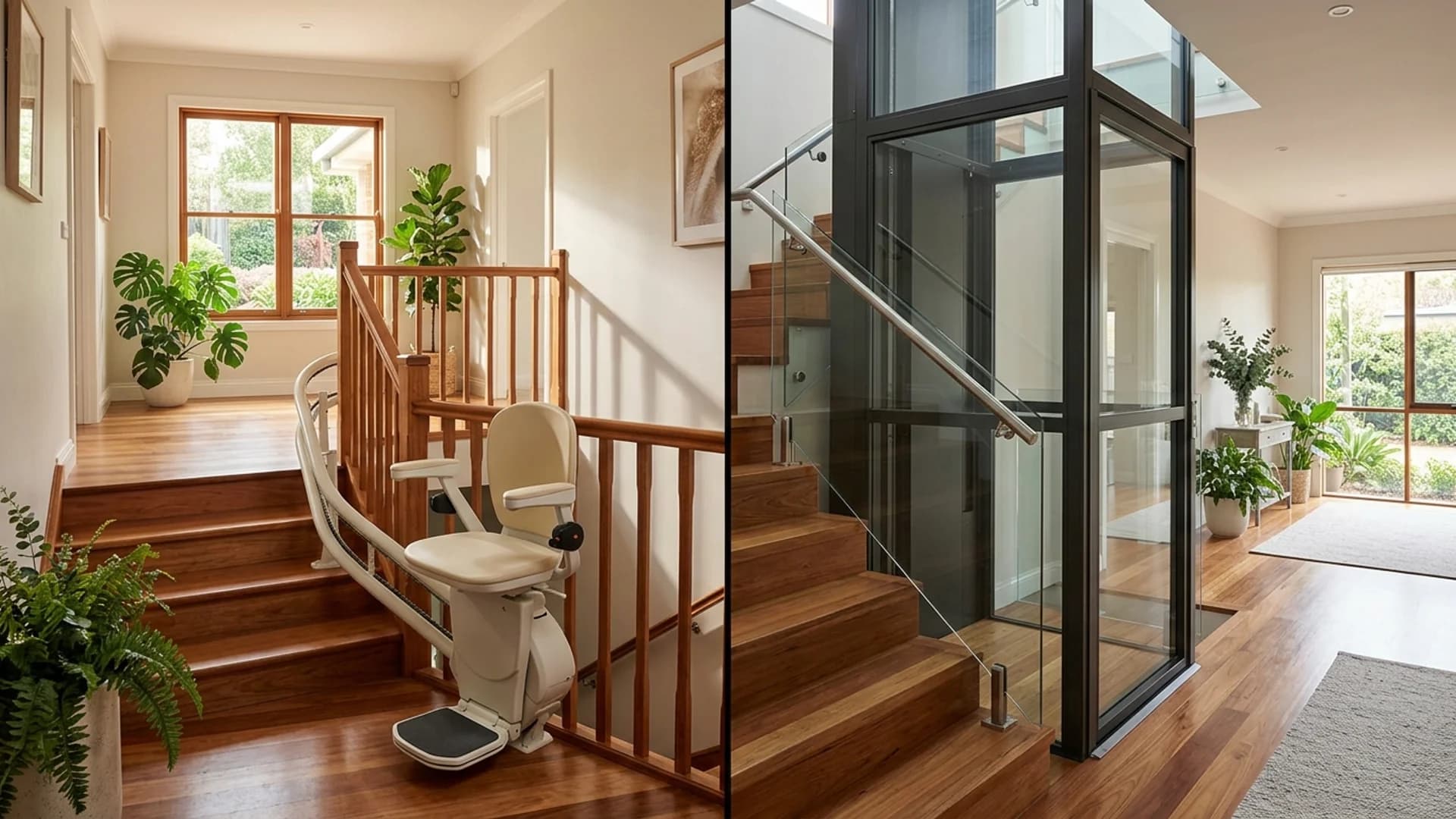
Stairlift vs Platform Lift
The difference is how you travel. A stairlift carries a seated user along the line of the staircase, so it is cheaper and fits in a day but cannot take a wheelchair. A platform lift raises a standing user or a wheelchair vertically, which costs more and needs floor space but solves access a stairlift cannot.
The wheelchair question decides it
A stairlift carries only a seated user; a platform lift carries a wheelchair. If the user travels in a wheelchair, a platform lift is almost always the answer.
Stairlift wins on cost and speed
From around $3,000 for a straight rail, fitted in about a day with no building work — the low-cost fix that keeps the stairs usable for everyone else.
Platform lift buys capability
At roughly $15,000–$45,000 installed it carries a wheelchair to AS 1735.14, needs a base and floor space, and comes with funding pathways attached.
Funding can change the maths
NDIS home modifications, Support at Home and aged-care schemes can fund a platform lift after an OT assessment — start the assessment early.
The core difference between a stairlift and a platform lift is what they move and how. A stairlift is a powered seat that runs on a rail fixed to your existing staircase — the user sits, and the chair follows the stairs up and down. A platform lift is a small vertical lift: a flat platform, often enclosed, that rises straight up between levels and is large enough to carry a person standing or a wheelchair user and their chair.
That single distinction decides almost everything else. A stairlift is the lower-cost, faster, less disruptive option — it fits to the stairs in about a day, needs no building work, and starts from a few thousand dollars. But it only carries a seated user, so it does not suit someone who uses a wheelchair full time. A platform lift costs several times more and needs a level base and floor space, but it carries a wheelchair, meets the accessibility standard AS 1735.14, and can be funded through disability and aged-care programs.
For most people the choice comes down to one question: does the user need to travel in a wheelchair? If yes, a platform lift is almost always the answer. If the user can transfer to a seat and the priority is a low-cost, quick fix that keeps the stairs usable for everyone else, a stairlift usually wins. This page sets out the trade-off row by row so you can match the right access solution to the person who will use it.
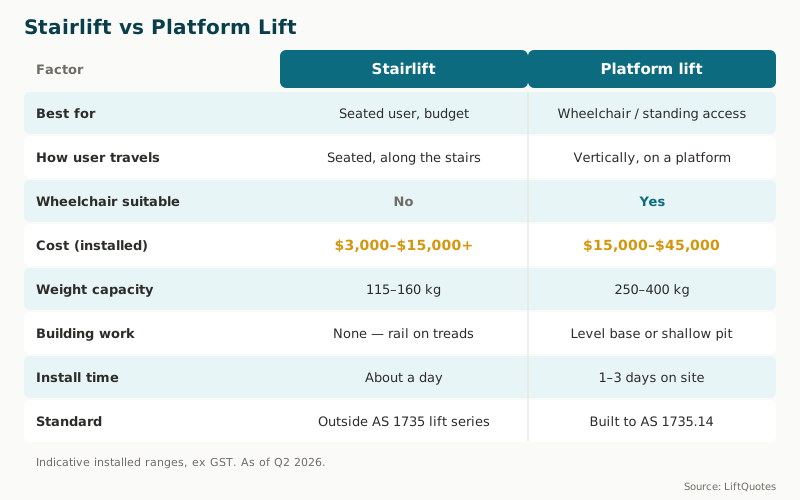
Stairlift and platform lift compared across the factors that actually decide the choice. The wheelchair row is the one most people follow first.
Swipe to compare →
| Factor | Stairlift | Platform lift |
|---|---|---|
| Best for | A seated user on a budget, keeping the stairs | A wheelchair user or standing access between levels |
| How the user travels | Seated, along the line of the staircase | Standing or in a wheelchair, straight up |
| Wheelchair suitable | No — the user must transfer to the seat | Yes — platform sized for a wheelchair and user |
| Typical cost (installed) | $3,000–$15,000+ | $15,000–$45,000 |
| Weight capacity | 115–160 kg | Around 250–400 kg |
| Building work | None — rail fixes to the stair treads | A level base or shallow pit; some floor space |
| Install time | Usually about a day | 1–3 days on site once the base is ready |
| Standard / compliance | Rail-mounted seat, outside the AS 1735 lift series | Built and commissioned to AS 1735.14 |
Figures are indicative as of Q2 2026, ex GST, and describe typical residential products in each class. Stairlift ranges span straight rails at the low end to curved, custom-manufactured rails at the high end; platform lift ranges are installed prices that vary with the base, electrical supply and whether the lift is enclosed or outdoor. Confirm a firm price and site suitability with an installer.
Lift companies in Australia
Browse profiles, compare service areas, and check reviews.

Lift Shop
★ 5.0 (1551 reviews)
Australia's largest dedicated home lift specialist since 1996. 10,000+ installations. Exclusive Italian-crafted lifts with industry-leading 8-year warranty.
View profile →

Compact Home Lifts
NDIS★ 5.0 (465 reviews)
Melbourne branch of Compact Home Lifts. Compact residential lift specialist providing maintenance and repair services across Victoria.
View profile →

Next Level Elevators
★ 5.0 (454 reviews)
Award-winning provider of premium Italian-designed all-electric home elevators. Certified Eltec Partner. Showrooms in Melbourne, Sydney, and Brisbane.
View profile →

Shotton Lifts
NDIS★ 5.0 (9 reviews)
Family-owned Australian lift manufacturer since 1977. 80+ staff. Design, engineer, manufacture, install and service from Dandenong South VIC. NDIS registered.
View profile →

LiftFit Australia
NDIS★ 5.0 (8 reviews)
Victoria-based NDIS registered lift provider, est. 2011. Partners with Cibes, Savaria, and Kalea. Residential, commercial, and platform lifts.
View profile →

Easy Living Home Elevators
★ 5.0 (7 reviews)
Australia's #1 home elevator supplier since 1998. 100% Australian-owned. 11,000+ elevators in service across 6 states.
View profile →
LiftQuotes is a comparison platform. Companies shown are filtered by relevance to this page. Listing does not imply endorsement. LiftQuotes may receive a referral fee when you request quotes.
What actually separates the two
Both solve the same problem — getting a person safely between the levels of a home — but they solve it in opposite ways. A stairlift works with the staircase: a rail is fixed to the treads, and a motorised seat travels along it, following straight or curved stairs. The stairs stay fully usable for everyone else, because the folded chair sits to one side. A platform lift ignores the staircase entirely and travels vertically, like a very short home lift, on its own guide mast or inside a compact enclosure. That is what lets it carry a wheelchair — the thing a stairlift cannot do.
The practical upshot is that a stairlift is the quick, affordable retrofit for a seated user, while a platform lift is the more capable — and more expensive — solution for wheelchair access. If you are weighing a lift against a lift rather than a lift against a chair, our platform lifts overview and the home lift vs stairlift comparison cover the neighbouring choices.
Choose a stairlift if…
A stairlift is the right call when the user can safely sit and transfer to a seat, and the priority is a low-cost fix that does not touch the building. Choose it if you are connecting the levels of a standard staircase, want the stairs to stay usable for the rest of the household, and need the solution installed quickly — most straight-stair installs are done in a single day. It is by far the cheaper option: a straight rail starts from a few thousand dollars, though a curved staircase needs a custom-manufactured rail that costs considerably more. Our stairlift cost in Australia guide breaks down straight, curved, reconditioned and rental pricing.
The trade-off is real, though. A stairlift only carries a seated user within a modest weight limit, it does not suit anyone who cannot transfer out of a wheelchair, and it does nothing for luggage, prams or a second person travelling together. It is a personal mobility device, not general vertical access.
Choose a platform lift if…
A platform lift is the answer when a stairlift cannot do the job — most often because the user travels in a wheelchair. Choose it if you need to carry a wheelchair and its user, want a solution that a second person or a walking frame can share, or need to meet accessibility requirements for the dwelling. A platform lift raises the user vertically on a platform sized for a wheelchair, typically carries around 250–400 kg, and is built and commissioned to AS 1735.14 — the Australian Standard for low-rise platforms for limited-mobility applications. If wheelchair access is the whole point, our wheelchair lifts hub and the wheelchair lift cost guide cover platform sizing and the compliance points that matter.
That capability costs more and asks more of the site. A platform lift needs a level, load-rated base or a shallow pit and a clear footprint on both levels, and the installed price runs several times a stairlift. The platform lift installation cost page sets out the site works — base, electrical supply, rigging and commissioning — that sit on top of the unit price.
The cost gap, in context
The difference buyers feel first is price. A stairlift starts from around $3,000 for a straight rail and rises past $15,000 for a curved, custom rail (hipages home lift and access cost guide; supplier-stated pricing, last checked Q2 2026). A platform lift is an installed cost of roughly $15,000 to $45,000 as of Q2 2026, because you are paying for the lift, a base or pit, a dedicated electrical supply and commissioning — not just a rail on the stairs.
So the honest framing is not simply that one is cheaper. A stairlift is cheaper for what it does — carry one seated person. A platform lift costs more because it does more — carry a wheelchair, to a standard, with funding pathways attached. Treat both figures as planning ranges rather than quotes, since a curved staircase or a difficult base is exactly where the numbers move.
Funding: NDIS and aged care
Funding can change the maths for both. If the user is an NDIS participant with home modifications in their plan, a platform lift and its installation can be funded following an occupational therapist assessment — the pathway from OT assessment to NDIA approval is set out in our NDIS funded lifts guide. Older Australians may access support through the Support at Home program and My Aged Care, and states run home-modification schemes. Stairlifts can also attract funding or a subsidy in some circumstances, but because a platform lift is usually the clinically recommended option for a wheelchair user, it is more often the funded solution. Funding almost always requires an OT recommendation and an itemised quote, so start the assessment early — it usually sets the timeline.
Safety, space and who else uses the stairs
Both devices are safe when installed and maintained correctly, but they affect the household differently. A stairlift leaves the staircase in place, so anyone able to use the stairs still can — the chair folds against the wall between trips. A platform lift takes a permanent footprint on both levels and needs a clear travel path, which is a bigger commitment of space but delivers access that does not depend on the user being able to sit or climb at all. A platform lift is commissioned against AS 1735.14 and carries interlocks, controlled edges and emergency lowering; a stairlift relies on its seatbelt, obstruction sensors and rail limits. If you are unsure which suits the house, our platform lifts guide and stairlift cost in Australia page cover the space and site checks for each.
The verdict
For a seated user who can transfer safely and wants a low-cost, quick, non-structural fix, a stairlift is the better starting point — especially on a straight staircase where it is cheapest. For a wheelchair user, or where the access has to meet AS 1735.14 and may be funded, a platform lift is almost always the right answer, and the extra cost buys capability a stairlift simply does not have.
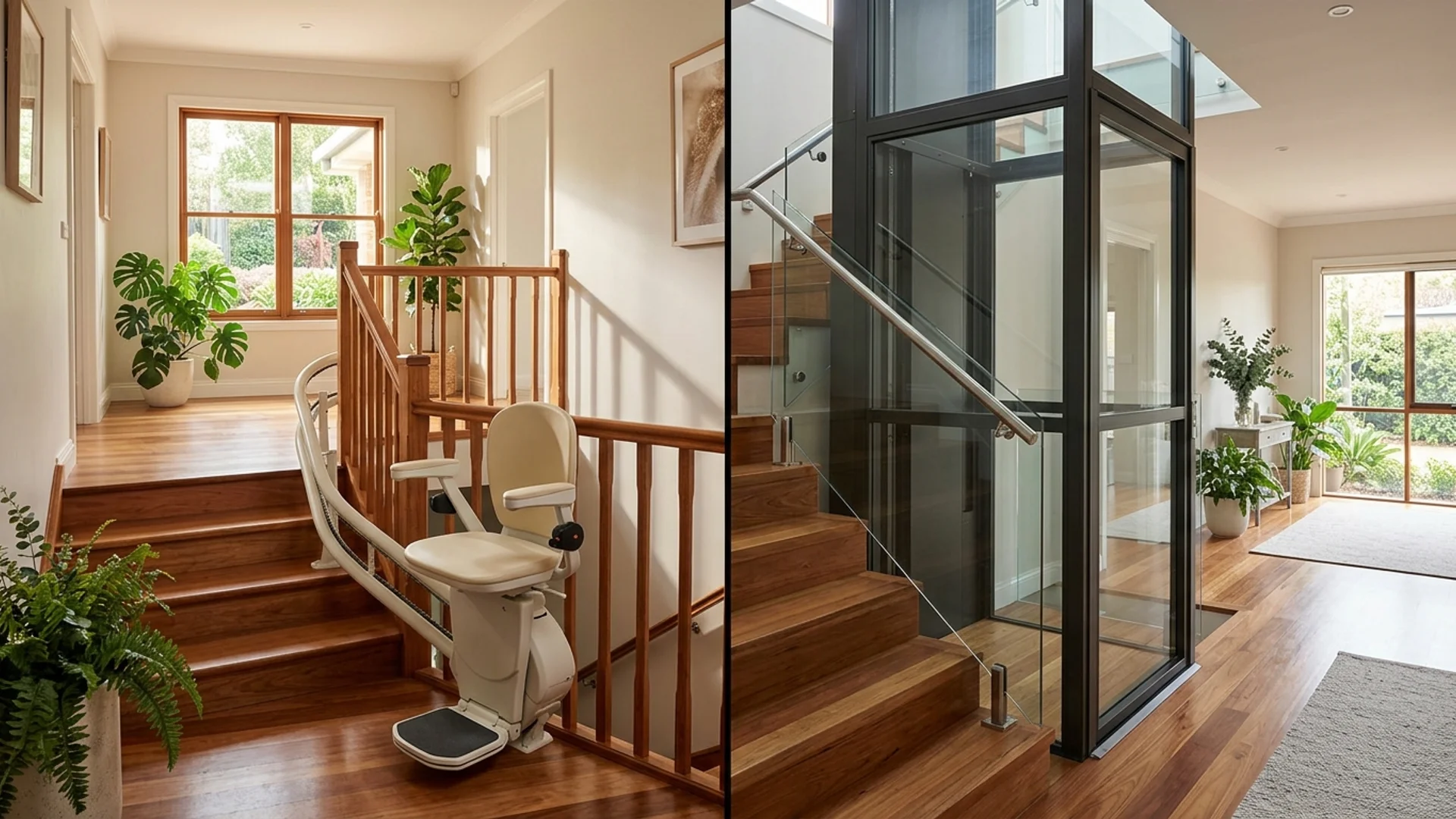
The reliable way to settle it is against the person and the house, because the user's mobility, the shape of the staircase and the space you have decide the fit far more than the price alone. Get free quotes from lift and access companies who supply both, and ask each to price the stairlift option and the platform lift option so you can compare the all-in figures side by side.
Still deciding? Get quotes for both options
Installers will assess your site and recommend the right specification.
What are you looking for today?
I need a lift installed
I have a lift that needs attention
The core difference between a stairlift and a platform lift is what they move and how. A stairlift is a powered seat that runs on a rail fixed to your existing staircase — the user sits, and the chair follows the stairs up and down. A platform lift is a small vertical lift: a flat platform, often enclosed, that rises straight up between levels and is large enough to carry a person standing or a wheelchair user and their chair.
That single distinction decides almost everything else. A stairlift is the lower-cost, faster, less disruptive option — it fits to the stairs in about a day, needs no building work, and starts from a few thousand dollars. But it only carries a seated user, so it does not suit someone who uses a wheelchair full time. A platform lift costs several times more and needs a level base and floor space, but it carries a wheelchair, meets the accessibility standard AS 1735.14, and can be funded through disability and aged-care programs.
For most people the choice comes down to one question: does the user need to travel in a wheelchair? If yes, a platform lift is almost always the answer. If the user can transfer to a seat and the priority is a low-cost, quick fix that keeps the stairs usable for everyone else, a stairlift usually wins. This page sets out the trade-off row by row so you can match the right access solution to the person who will use it.
Stairlift and platform lift compared across the factors that actually decide the choice. The wheelchair row is the one most people follow first.
Swipe to compare →
| Factor | Stairlift | Platform lift |
|---|---|---|
| Best for | A seated user on a budget, keeping the stairs | A wheelchair user or standing access between levels |
| How the user travels | Seated, along the line of the staircase | Standing or in a wheelchair, straight up |
| Wheelchair suitable | No — the user must transfer to the seat | Yes — platform sized for a wheelchair and user |
| Typical cost (installed) | $3,000–$15,000+ | $15,000–$45,000 |
| Weight capacity | 115–160 kg | Around 250–400 kg |
| Building work | None — rail fixes to the stair treads | A level base or shallow pit; some floor space |
| Install time | Usually about a day | 1–3 days on site once the base is ready |
| Standard / compliance | Rail-mounted seat, outside the AS 1735 lift series | Built and commissioned to AS 1735.14 |
Figures are indicative as of Q2 2026, ex GST, and describe typical residential products in each class. Stairlift ranges span straight rails at the low end to curved, custom-manufactured rails at the high end; platform lift ranges are installed prices that vary with the base, electrical supply and whether the lift is enclosed or outdoor. Confirm a firm price and site suitability with an installer.
Lift companies in Australia
Browse profiles, compare service areas, and check reviews.
Lift Shop
★ 5.0 (1551 reviews)
Australia's largest dedicated home lift specialist since 1996. 10,000+ installations. Exclusive Italian-crafted lifts with industry-leading 8-year warranty.
View profile →
Compact Home Lifts
NDIS★ 5.0 (465 reviews)
Melbourne branch of Compact Home Lifts. Compact residential lift specialist providing maintenance and repair services across Victoria.
View profile →
Next Level Elevators
★ 5.0 (454 reviews)
Award-winning provider of premium Italian-designed all-electric home elevators. Certified Eltec Partner. Showrooms in Melbourne, Sydney, and Brisbane.
View profile →
Shotton Lifts
NDIS★ 5.0 (9 reviews)
Family-owned Australian lift manufacturer since 1977. 80+ staff. Design, engineer, manufacture, install and service from Dandenong South VIC. NDIS registered.
View profile →
LiftFit Australia
NDIS★ 5.0 (8 reviews)
Victoria-based NDIS registered lift provider, est. 2011. Partners with Cibes, Savaria, and Kalea. Residential, commercial, and platform lifts.
View profile →
Easy Living Home Elevators
★ 5.0 (7 reviews)
Australia's #1 home elevator supplier since 1998. 100% Australian-owned. 11,000+ elevators in service across 6 states.
View profile →
LiftQuotes is a comparison platform. Companies shown are filtered by relevance to this page. Listing does not imply endorsement. LiftQuotes may receive a referral fee when you request quotes.
What actually separates the two
Both solve the same problem — getting a person safely between the levels of a home — but they solve it in opposite ways. A stairlift works with the staircase: a rail is fixed to the treads, and a motorised seat travels along it, following straight or curved stairs. The stairs stay fully usable for everyone else, because the folded chair sits to one side. A platform lift ignores the staircase entirely and travels vertically, like a very short home lift, on its own guide mast or inside a compact enclosure. That is what lets it carry a wheelchair — the thing a stairlift cannot do.
The practical upshot is that a stairlift is the quick, affordable retrofit for a seated user, while a platform lift is the more capable — and more expensive — solution for wheelchair access. If you are weighing a lift against a lift rather than a lift against a chair, our platform lifts overview and the home lift vs stairlift comparison cover the neighbouring choices.
Choose a stairlift if…
A stairlift is the right call when the user can safely sit and transfer to a seat, and the priority is a low-cost fix that does not touch the building. Choose it if you are connecting the levels of a standard staircase, want the stairs to stay usable for the rest of the household, and need the solution installed quickly — most straight-stair installs are done in a single day. It is by far the cheaper option: a straight rail starts from a few thousand dollars, though a curved staircase needs a custom-manufactured rail that costs considerably more. Our stairlift cost in Australia guide breaks down straight, curved, reconditioned and rental pricing.
The trade-off is real, though. A stairlift only carries a seated user within a modest weight limit, it does not suit anyone who cannot transfer out of a wheelchair, and it does nothing for luggage, prams or a second person travelling together. It is a personal mobility device, not general vertical access.
Choose a platform lift if…
A platform lift is the answer when a stairlift cannot do the job — most often because the user travels in a wheelchair. Choose it if you need to carry a wheelchair and its user, want a solution that a second person or a walking frame can share, or need to meet accessibility requirements for the dwelling. A platform lift raises the user vertically on a platform sized for a wheelchair, typically carries around 250–400 kg, and is built and commissioned to AS 1735.14 — the Australian Standard for low-rise platforms for limited-mobility applications. If wheelchair access is the whole point, our wheelchair lifts hub and the wheelchair lift cost guide cover platform sizing and the compliance points that matter.
That capability costs more and asks more of the site. A platform lift needs a level, load-rated base or a shallow pit and a clear footprint on both levels, and the installed price runs several times a stairlift. The platform lift installation cost page sets out the site works — base, electrical supply, rigging and commissioning — that sit on top of the unit price.
The cost gap, in context
The difference buyers feel first is price. A stairlift starts from around $3,000 for a straight rail and rises past $15,000 for a curved, custom rail (hipages home lift and access cost guide; supplier-stated pricing, last checked Q2 2026). A platform lift is an installed cost of roughly $15,000 to $45,000 as of Q2 2026, because you are paying for the lift, a base or pit, a dedicated electrical supply and commissioning — not just a rail on the stairs.
So the honest framing is not simply that one is cheaper. A stairlift is cheaper for what it does — carry one seated person. A platform lift costs more because it does more — carry a wheelchair, to a standard, with funding pathways attached. Treat both figures as planning ranges rather than quotes, since a curved staircase or a difficult base is exactly where the numbers move.
Funding: NDIS and aged care
Funding can change the maths for both. If the user is an NDIS participant with home modifications in their plan, a platform lift and its installation can be funded following an occupational therapist assessment — the pathway from OT assessment to NDIA approval is set out in our NDIS funded lifts guide. Older Australians may access support through the Support at Home program and My Aged Care, and states run home-modification schemes. Stairlifts can also attract funding or a subsidy in some circumstances, but because a platform lift is usually the clinically recommended option for a wheelchair user, it is more often the funded solution. Funding almost always requires an OT recommendation and an itemised quote, so start the assessment early — it usually sets the timeline.
Safety, space and who else uses the stairs
Both devices are safe when installed and maintained correctly, but they affect the household differently. A stairlift leaves the staircase in place, so anyone able to use the stairs still can — the chair folds against the wall between trips. A platform lift takes a permanent footprint on both levels and needs a clear travel path, which is a bigger commitment of space but delivers access that does not depend on the user being able to sit or climb at all. A platform lift is commissioned against AS 1735.14 and carries interlocks, controlled edges and emergency lowering; a stairlift relies on its seatbelt, obstruction sensors and rail limits. If you are unsure which suits the house, our platform lifts guide and stairlift cost in Australia page cover the space and site checks for each.
The verdict
For a seated user who can transfer safely and wants a low-cost, quick, non-structural fix, a stairlift is the better starting point — especially on a straight staircase where it is cheapest. For a wheelchair user, or where the access has to meet AS 1735.14 and may be funded, a platform lift is almost always the right answer, and the extra cost buys capability a stairlift simply does not have.
The reliable way to settle it is against the person and the house, because the user's mobility, the shape of the staircase and the space you have decide the fit far more than the price alone. Get free quotes from lift and access companies who supply both, and ask each to price the stairlift option and the platform lift option so you can compare the all-in figures side by side.
Still deciding? Get quotes for both options
Installers will assess your site and recommend the right specification.
What are you looking for today?
I need a lift installed
I have a lift that needs attention
Common Questions About Stairlifts and Platform Lifts
A stairlift is a powered seat on a rail fixed to your existing staircase — the user sits, and the chair follows the stairs up and down. A platform lift is a small vertical lift: a flat platform, often enclosed, that rises straight up between levels and is big enough for a person standing or a wheelchair user and their chair. The key difference is that a stairlift carries only a seated user and keeps the stairs usable for everyone else, while a platform lift carries a wheelchair and travels vertically. That is why a stairlift is cheaper and quicker to fit, and a platform lift is the choice when someone needs to travel in a wheelchair.
Related guides
Guide
Our Editorial Methodology: How LiftQuotes Researches Content
How LiftQuotes researches, sources and reviews every lift guide and cost page: the standards we cite, our linked-source rule for cost data, and how often we update.
Guide
Lift Compliance Checklist for Facility Managers (Australia)
A facility manager's lift compliance checklist for Australia: plant registration, inspection, log books, 4G VoLTE emergency phones and DDA access duties.
Location
Lift Companies in Melbourne: Compare Local Installers
Compare lift companies in Melbourne for home, platform and commercial lifts. WorkSafe Victoria compliance, local installer coverage and indicative VIC costs.
Comparison
Stairlift: Buy vs Rent — Which Makes Sense in Australia?
Should you buy or rent a stairlift in Australia? Buying suits permanent needs and curved stairs; renting suits short-term recovery. Compare cost, funding and fit.
Not sure which access solution suits the user?
Tell us who will use the lift and the levels you need to connect, and we will match you with companies who supply both stairlifts and platform lifts — free, with no obligation.
Join 1,000+ Australians who've requested quotes through LiftQuotes
Get free quotes