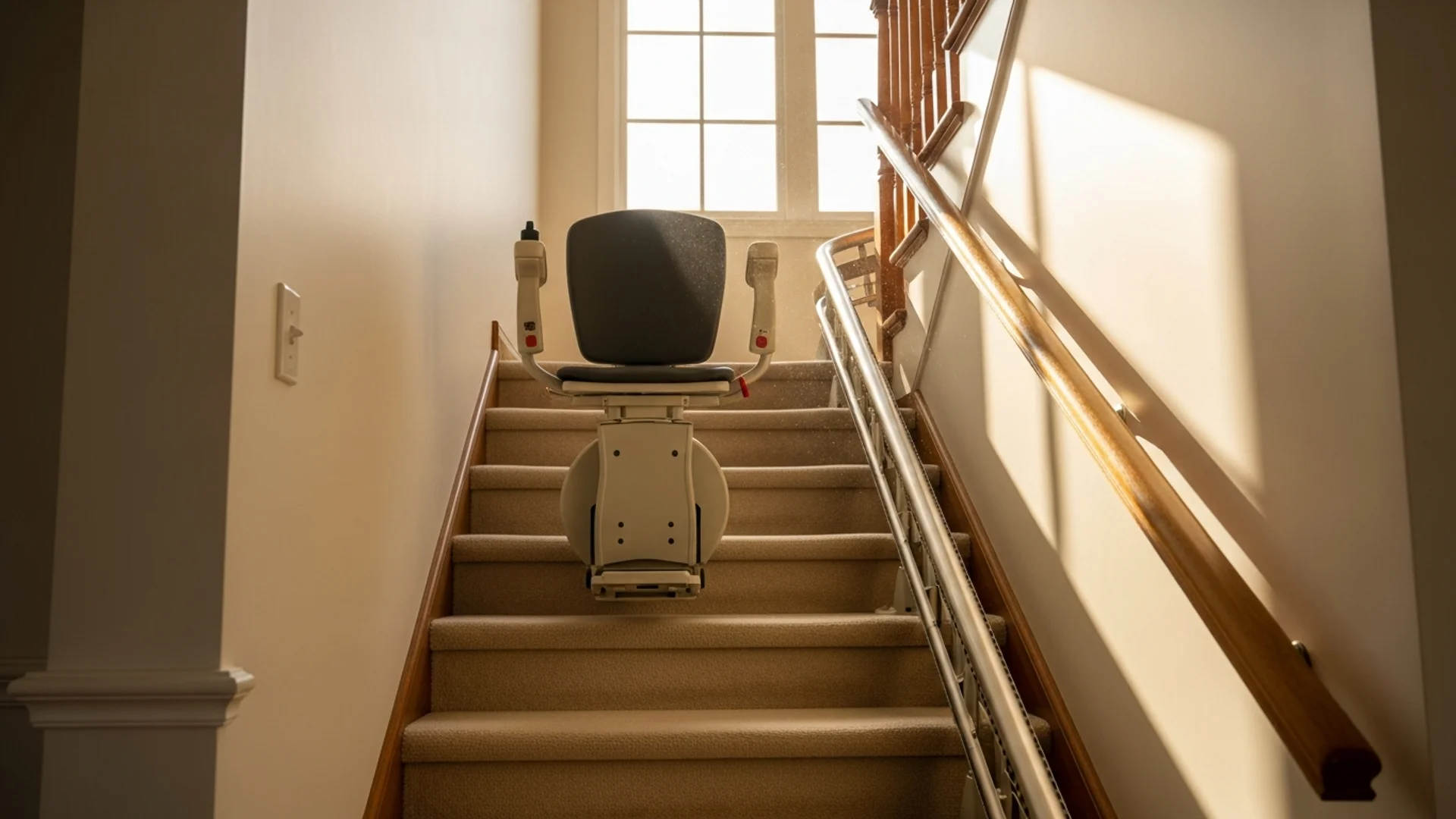
Stairlift: Buy vs Rent
Buying a stairlift makes sense when the need is permanent; renting makes sense when it is temporary. How long you will actually use the lift decides this more reliably than price does — here is how to tell which side of the line you sit on.
The choice between buying and renting a stairlift comes down to one thing: how long you need it. Buy when the mobility change is permanent or the staircase is curved. Rent when the need is short-term — a post-surgery recovery, palliative care at home, or a trial before you commit to a bigger decision.
Price follows from that. A straight stairlift bought outright runs roughly $3,500 to $8,000 installed; a curved rail, custom-made to your staircase, runs $9,000 to $20,000 or more. Renting a straight unit typically costs a modest installation fee plus around $150 to $300 a month, with removal included at the end (indicative Australian pricing, ex GST, last checked August 2026).
Renting is cheaper on day one and more expensive by the second year. Buying is the reverse. The rest of this page matches each option to a real situation and to the funding that might cover it, so the decision fits your circumstances rather than a supplier's preferred model.
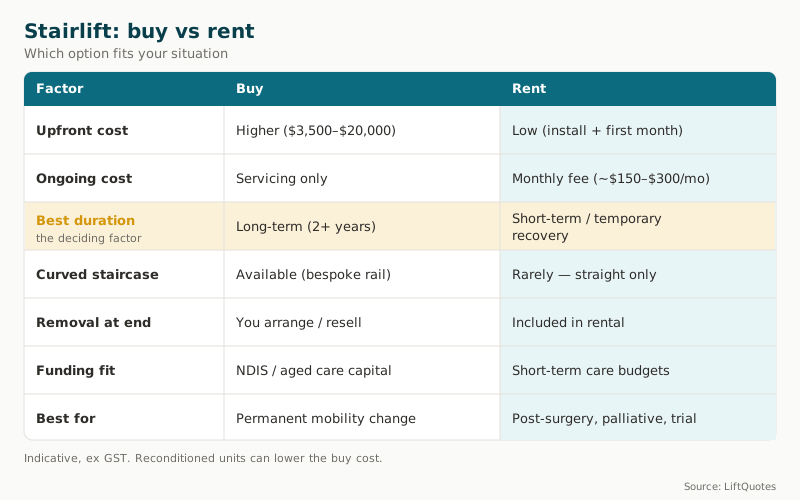
Buying and renting compared across the factors that actually decide it. The row that matters most is duration — match the commitment to how long you expect to use the lift.
Swipe to compare →
| Factor | Buy | Rent |
|---|---|---|
| Upfront cost | Higher — $3,500–$20,000 installed | Low — install fee plus first month |
| Ongoing cost | Servicing only ($200–$500/yr) | Monthly fee (~$150–$300/mo) |
| Best duration | Long-term — 2+ years of use | Short-term or temporary recovery |
| Curved staircase | Available — bespoke curved rail | Rarely — straight rails only |
| Removal at end | You arrange it, or resell the unit | Included in the rental agreement |
| Funding fit | NDIS / aged-care capital funding | Short-term or interim care budgets |
| Best for | A permanent mobility change | Post-surgery, palliative or a trial |
Indicative figures, ex GST, per staircase, last checked August 2026. Reconditioned units can lower the buy cost. Curved rentals are uncommon because curved rails are custom-manufactured to each staircase. Confirm current pricing with a site survey.
Lift companies in Australia
Browse profiles, compare service areas, and check reviews.

Lift Shop
★ 5.0 (1551 reviews)
Australia's largest dedicated home lift specialist since 1996. 10,000+ installations. Exclusive Italian-crafted lifts with industry-leading 8-year warranty.
View profile →

Compact Home Lifts
NDIS★ 5.0 (465 reviews)
Melbourne branch of Compact Home Lifts. Compact residential lift specialist providing maintenance and repair services across Victoria.
View profile →

Next Level Elevators
★ 5.0 (454 reviews)
Award-winning provider of premium Italian-designed all-electric home elevators. Certified Eltec Partner. Showrooms in Melbourne, Sydney, and Brisbane.
View profile →

Shotton Lifts
NDIS★ 5.0 (9 reviews)
Family-owned Australian lift manufacturer since 1977. 80+ staff. Design, engineer, manufacture, install and service from Dandenong South VIC. NDIS registered.
View profile →

LiftFit Australia
NDIS★ 5.0 (8 reviews)
Victoria-based NDIS registered lift provider, est. 2011. Partners with Cibes, Savaria, and Kalea. Residential, commercial, and platform lifts.
View profile →

Easy Living Home Elevators
★ 5.0 (7 reviews)
Australia's #1 home elevator supplier since 1998. 100% Australian-owned. 11,000+ elevators in service across 6 states.
View profile →
LiftQuotes is a comparison platform. Companies shown are filtered by relevance to this page. Listing does not imply endorsement. LiftQuotes may receive a referral fee when you request quotes.
Buy or rent: the fast answer
Rent if you expect to use the stairlift for less than about a year and your staircase is straight. Buy if you expect to use it for two years or more, or if your staircase is curved. The middle ground — roughly one to two years — is where funding and cash flow tip the balance, and where it is worth pricing both.
Choose to rent when: you are recovering from surgery or a fall, you are arranging palliative care at home, an occupational therapist has suggested a stairlift as an interim measure, or you simply want to trial one before committing. Renting removes the risk of buying equipment you may only need for a season.
Choose to buy when: the mobility change is permanent or progressive, your staircase is curved (rentals almost never cover curved rails), you want the lowest cost over the full life of the equipment, or you are drawing on capital funding through the NDIS or aged care that is designed for a permanent home modification.
What renting a stairlift actually costs
A stairlift rental has two parts: an upfront installation and delivery fee, then a recurring monthly charge. As of August 2026, the monthly fee for a straight stairlift sits in the region of $150 to $300, and most suppliers set a minimum rental term — often around three months — with removal and refurbishment folded into the agreement. When you no longer need the lift, the supplier collects it and makes good the staircase.
That structure is built for temporary need. If a family member is coming home after a hip replacement and will be back to using the stairs in a few months, paying a few hundred dollars a month and handing the unit back is far more sensible than buying. For a fuller picture of what the equipment itself costs to own, our guide to stairlift cost in Australia breaks down straight, curved, reconditioned and outdoor pricing.
The catch is duration. Rent for long enough and the monthly payments quietly overtake the cost of simply buying a straight unit outright — usually somewhere around the two-year mark, depending on the fee. Past that point you are paying to avoid an upfront cost you would have recovered anyway.
What buying costs — and where it pays off
Buying a straight stairlift costs roughly $3,500 to $8,000 installed; a curved rail, because it is manufactured to the exact geometry of your staircase, costs $9,000 to $20,000 or more (indicative, ex GST, last checked August 2026). Our stairlift installation cost guide separates the fitting from the price of the unit and covers what a site survey typically adds.
Ownership pays off in two situations. The first is long-term use: over more than about two years, the purchase price is lower than the accumulated rent. The second is a curved staircase — curved rails are bespoke and effectively cannot be rented, so purchase is the only realistic path.
Reconditioned stairlifts narrow the gap further. A refurbished straight unit can cost $2,000 to $4,000 installed, bringing ownership within reach of budgets that would otherwise default to renting. Reconditioned stock is straight-rail almost without exception, since curved rails are cut for one staircase and rarely transfer to another.
Curved staircases change the decision
If your staircase turns a corner, has a half-landing, or spirals, the buy-versus-rent question mostly answers itself. Curved rails are cut and welded to the precise line of your stairs, so they cannot be pulled off a shelf, fitted quickly, and returned — which is why rental fleets are built almost entirely from straight units.
That makes purchase the practical choice for curved stairs, and it makes the timeline matter. A curved rail is quoted from a physical site survey and manufactured to order, so allow several weeks between order and installation. If the need is urgent and the staircase is curved, a temporary straight rental on a single flight — or a different access solution altogether — may bridge the gap while the curved unit is built.
Funding: NDIS, aged care and short-term budgets
How your stairlift is funded often steers the buy-versus-rent decision as much as the price does. Capital funding — the kind that pays for a permanent home modification — is generally structured around ownership. If you are funding through the NDIS, a stairlift is treated as a home modification that follows an occupational therapist assessment and NDIA approval; our guide to NDIS-funded lifts sets out that pathway step by step. Older Australians may access support through My Aged Care and the Support at Home program, again typically toward a purchased, permanent solution.
Renting fits a different kind of budget. Short-term care packages, interim recovery funding, and hospital-discharge arrangements are designed to cover a temporary need without committing to a capital asset. If your funding is short-term by nature, renting aligns with it; if your funding is a one-off capital allocation, buying usually makes better use of it. LiftQuotes does not provide funding or financial advice — confirm what your specific plan or package covers with your planner, OT, or My Aged Care before you commit.
When a stairlift isn't the answer
A stairlift carries one person up a staircase. It does not carry a wheelchair, and its seated capacity is limited. If the need is a permanent wheelchair requirement, multi-storey access, or something you expect to grow into over the next decade, a home lift may be the better long-term spend even though it costs more upfront. Our comparison of a home lift versus a stairlift weighs capacity, wheelchair suitability, resale impact and running cost side by side.
For most people the decision is simpler than the options make it look. Match the commitment to the need: rent for the temporary, buy for the permanent, and let the staircase and your funding settle the close calls. When you are ready to price it properly, get free quotes from stairlift suppliers who offer both — and ask each of them to quote the buy and the rent side by side so you can compare like for like.
Still deciding? Get quotes for both options
Installers will assess your site and recommend the right specification.
What are you looking for today?
I need a lift installed
I have a lift that needs attention
The choice between buying and renting a stairlift comes down to one thing: how long you need it. Buy when the mobility change is permanent or the staircase is curved. Rent when the need is short-term — a post-surgery recovery, palliative care at home, or a trial before you commit to a bigger decision.
Price follows from that. A straight stairlift bought outright runs roughly $3,500 to $8,000 installed; a curved rail, custom-made to your staircase, runs $9,000 to $20,000 or more. Renting a straight unit typically costs a modest installation fee plus around $150 to $300 a month, with removal included at the end (indicative Australian pricing, ex GST, last checked August 2026).
Renting is cheaper on day one and more expensive by the second year. Buying is the reverse. The rest of this page matches each option to a real situation and to the funding that might cover it, so the decision fits your circumstances rather than a supplier's preferred model.
Buying and renting compared across the factors that actually decide it. The row that matters most is duration — match the commitment to how long you expect to use the lift.
Swipe to compare →
| Factor | Buy | Rent |
|---|---|---|
| Upfront cost | Higher — $3,500–$20,000 installed | Low — install fee plus first month |
| Ongoing cost | Servicing only ($200–$500/yr) | Monthly fee (~$150–$300/mo) |
| Best duration | Long-term — 2+ years of use | Short-term or temporary recovery |
| Curved staircase | Available — bespoke curved rail | Rarely — straight rails only |
| Removal at end | You arrange it, or resell the unit | Included in the rental agreement |
| Funding fit | NDIS / aged-care capital funding | Short-term or interim care budgets |
| Best for | A permanent mobility change | Post-surgery, palliative or a trial |
Indicative figures, ex GST, per staircase, last checked August 2026. Reconditioned units can lower the buy cost. Curved rentals are uncommon because curved rails are custom-manufactured to each staircase. Confirm current pricing with a site survey.
Lift companies in Australia
Browse profiles, compare service areas, and check reviews.
Lift Shop
★ 5.0 (1551 reviews)
Australia's largest dedicated home lift specialist since 1996. 10,000+ installations. Exclusive Italian-crafted lifts with industry-leading 8-year warranty.
View profile →
Compact Home Lifts
NDIS★ 5.0 (465 reviews)
Melbourne branch of Compact Home Lifts. Compact residential lift specialist providing maintenance and repair services across Victoria.
View profile →
Next Level Elevators
★ 5.0 (454 reviews)
Award-winning provider of premium Italian-designed all-electric home elevators. Certified Eltec Partner. Showrooms in Melbourne, Sydney, and Brisbane.
View profile →
Shotton Lifts
NDIS★ 5.0 (9 reviews)
Family-owned Australian lift manufacturer since 1977. 80+ staff. Design, engineer, manufacture, install and service from Dandenong South VIC. NDIS registered.
View profile →
LiftFit Australia
NDIS★ 5.0 (8 reviews)
Victoria-based NDIS registered lift provider, est. 2011. Partners with Cibes, Savaria, and Kalea. Residential, commercial, and platform lifts.
View profile →
Easy Living Home Elevators
★ 5.0 (7 reviews)
Australia's #1 home elevator supplier since 1998. 100% Australian-owned. 11,000+ elevators in service across 6 states.
View profile →
LiftQuotes is a comparison platform. Companies shown are filtered by relevance to this page. Listing does not imply endorsement. LiftQuotes may receive a referral fee when you request quotes.
Buy or rent: the fast answer
Rent if you expect to use the stairlift for less than about a year and your staircase is straight. Buy if you expect to use it for two years or more, or if your staircase is curved. The middle ground — roughly one to two years — is where funding and cash flow tip the balance, and where it is worth pricing both.
Choose to rent when: you are recovering from surgery or a fall, you are arranging palliative care at home, an occupational therapist has suggested a stairlift as an interim measure, or you simply want to trial one before committing. Renting removes the risk of buying equipment you may only need for a season.
Choose to buy when: the mobility change is permanent or progressive, your staircase is curved (rentals almost never cover curved rails), you want the lowest cost over the full life of the equipment, or you are drawing on capital funding through the NDIS or aged care that is designed for a permanent home modification.
What renting a stairlift actually costs
A stairlift rental has two parts: an upfront installation and delivery fee, then a recurring monthly charge. As of August 2026, the monthly fee for a straight stairlift sits in the region of $150 to $300, and most suppliers set a minimum rental term — often around three months — with removal and refurbishment folded into the agreement. When you no longer need the lift, the supplier collects it and makes good the staircase.
That structure is built for temporary need. If a family member is coming home after a hip replacement and will be back to using the stairs in a few months, paying a few hundred dollars a month and handing the unit back is far more sensible than buying. For a fuller picture of what the equipment itself costs to own, our guide to stairlift cost in Australia breaks down straight, curved, reconditioned and outdoor pricing.
The catch is duration. Rent for long enough and the monthly payments quietly overtake the cost of simply buying a straight unit outright — usually somewhere around the two-year mark, depending on the fee. Past that point you are paying to avoid an upfront cost you would have recovered anyway.
What buying costs — and where it pays off
Buying a straight stairlift costs roughly $3,500 to $8,000 installed; a curved rail, because it is manufactured to the exact geometry of your staircase, costs $9,000 to $20,000 or more (indicative, ex GST, last checked August 2026). Our stairlift installation cost guide separates the fitting from the price of the unit and covers what a site survey typically adds.
Ownership pays off in two situations. The first is long-term use: over more than about two years, the purchase price is lower than the accumulated rent. The second is a curved staircase — curved rails are bespoke and effectively cannot be rented, so purchase is the only realistic path.
Reconditioned stairlifts narrow the gap further. A refurbished straight unit can cost $2,000 to $4,000 installed, bringing ownership within reach of budgets that would otherwise default to renting. Reconditioned stock is straight-rail almost without exception, since curved rails are cut for one staircase and rarely transfer to another.
Curved staircases change the decision
If your staircase turns a corner, has a half-landing, or spirals, the buy-versus-rent question mostly answers itself. Curved rails are cut and welded to the precise line of your stairs, so they cannot be pulled off a shelf, fitted quickly, and returned — which is why rental fleets are built almost entirely from straight units.
That makes purchase the practical choice for curved stairs, and it makes the timeline matter. A curved rail is quoted from a physical site survey and manufactured to order, so allow several weeks between order and installation. If the need is urgent and the staircase is curved, a temporary straight rental on a single flight — or a different access solution altogether — may bridge the gap while the curved unit is built.
Funding: NDIS, aged care and short-term budgets
How your stairlift is funded often steers the buy-versus-rent decision as much as the price does. Capital funding — the kind that pays for a permanent home modification — is generally structured around ownership. If you are funding through the NDIS, a stairlift is treated as a home modification that follows an occupational therapist assessment and NDIA approval; our guide to NDIS-funded lifts sets out that pathway step by step. Older Australians may access support through My Aged Care and the Support at Home program, again typically toward a purchased, permanent solution.
Renting fits a different kind of budget. Short-term care packages, interim recovery funding, and hospital-discharge arrangements are designed to cover a temporary need without committing to a capital asset. If your funding is short-term by nature, renting aligns with it; if your funding is a one-off capital allocation, buying usually makes better use of it. LiftQuotes does not provide funding or financial advice — confirm what your specific plan or package covers with your planner, OT, or My Aged Care before you commit.
When a stairlift isn't the answer
A stairlift carries one person up a staircase. It does not carry a wheelchair, and its seated capacity is limited. If the need is a permanent wheelchair requirement, multi-storey access, or something you expect to grow into over the next decade, a home lift may be the better long-term spend even though it costs more upfront. Our comparison of a home lift versus a stairlift weighs capacity, wheelchair suitability, resale impact and running cost side by side.
For most people the decision is simpler than the options make it look. Match the commitment to the need: rent for the temporary, buy for the permanent, and let the staircase and your funding settle the close calls. When you are ready to price it properly, get free quotes from stairlift suppliers who offer both — and ask each of them to quote the buy and the rent side by side so you can compare like for like.
Still deciding? Get quotes for both options
Installers will assess your site and recommend the right specification.
What are you looking for today?
I need a lift installed
I have a lift that needs attention
Duration decides it
Rent for a short-term or temporary need; buy for two years or more of use. Around the two-year mark, accumulated rent overtakes the purchase price of a straight unit.
Curved stairs mean buying
Curved rails are made to your exact staircase and cannot realistically be rented. If your stairs turn, purchase is effectively the only path.
Renting suits recovery
Post-surgery, palliative care, or a trial before committing all fit renting — a low upfront fee, a monthly charge, and removal included when you are done.
Funding steers the choice
Capital funding through the NDIS or aged care generally suits a purchase; short-term or interim care budgets suit a rental. Match the equipment to the funding.
Common Questions About Buying and Renting a Stairlift
It depends on how long you need it. Buy if you expect to use the stairlift for two years or more, or if your staircase is curved — curved rails are custom-made and effectively cannot be rented. Rent if the need is short-term, such as recovery from surgery or palliative care at home. As a rule of thumb, rental payments overtake the cost of buying a straight unit outright at around the two-year mark, so long-term needs are cheaper to buy.
Related guides
Guide
Our Editorial Methodology: How LiftQuotes Researches Content
How LiftQuotes researches, sources and reviews every lift guide and cost page: the standards we cite, our linked-source rule for cost data, and how often we update.
Guide
Lift Compliance Checklist for Facility Managers (Australia)
A facility manager's lift compliance checklist for Australia: plant registration, inspection, log books, 4G VoLTE emergency phones and DDA access duties.
Comparison
Stairlift vs Platform Lift: Which Access Solution Fits?
A stairlift carries a seated user along the stairs from about $3,000; a platform lift raises a wheelchair vertically from about $15,000. Compare cost, access and fit.
Location
Lift Companies in Melbourne: Compare Local Installers
Compare lift companies in Melbourne for home, platform and commercial lifts. WorkSafe Victoria compliance, local installer coverage and indicative VIC costs.
Not sure whether to buy or rent?
Tell us your staircase, timeframe and funding, and we will connect you with stairlift suppliers who offer both buy and rent — so you can compare the two side by side, free and with no obligation.
Join 1,000+ Australians who've requested quotes through LiftQuotes
Get free quotes