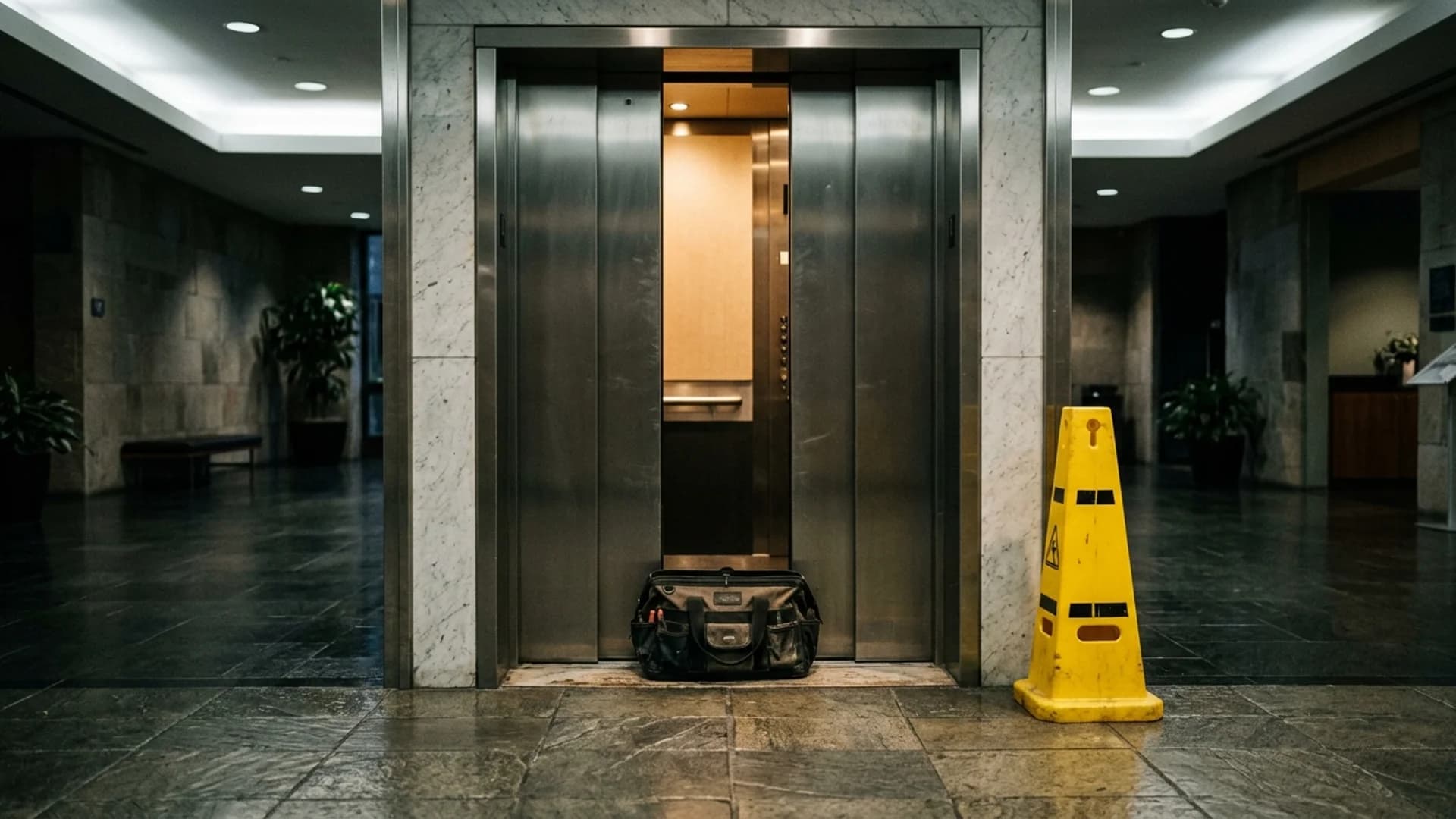
Lift Breakdown Response: What to Do When a Lift Fails
One calm, correct playbook for building and facility managers — check for entrapment, get the right help on the phone, secure the lift, and log it. Never force the doors.
When a lift breaks down, work through a fixed sequence: check whether anyone is trapped, get the right help on the phone, secure the lift out of service, and log the incident. If someone is inside, one rule overrides everything else — only a competent lift technician or emergency services may release them. Never force the doors.
This guide gives building and facility managers a single response playbook. It covers the immediate actions, the entrapment protocol, how to isolate and sign a failed lift, what to record in the lift log, and the maintenance habits that stop most breakdowns before they start.
What to do when a lift breaks down
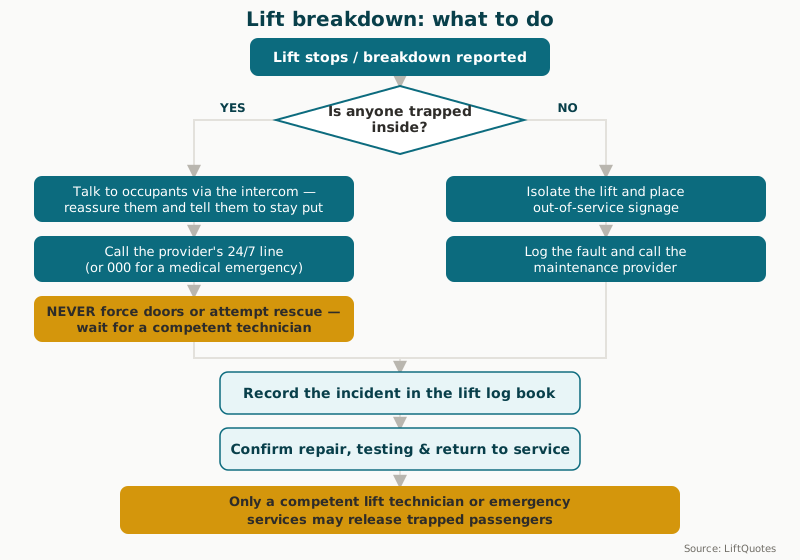
Run the same five steps every time, in order: establish whether anyone is trapped inside; call your lift maintenance provider's 24-hour line (or 000 if there is a medical emergency); reassure any occupants and tell them to stay put; isolate the lift and place out-of-service signage; and record the incident in the lift log. The order matters. Checking for a trapped passenger comes before the paperwork, and securing the lift comes before you leave the scene.
The flowchart below sets out the two paths — someone trapped, or an empty lift out of service — and where they converge.
If someone is trapped: the entrapment protocol
Entrapment feels like an emergency to the person inside, but a stalled lift is one of the safest places to be — the car cannot fall, and there is ample air. Your job is to keep the occupant calm and get a competent technician to them, not to get them out yourself.
Speak to them through the car intercom or lift emergency phone as soon as you can. Tell them help is on the way, that the lift is safe, and that they must stay inside and clear of the doors. Then call the maintenance provider's 24/7 line and report an entrapment — most contracts carry a priority response time for exactly this. Call 000 if the person is unwell, distressed, or medically vulnerable.
Do not try to prise the doors open, and never wind the lift by hand. That is a task for a trained technician following the correct procedure. A partially opened door can expose the gap between the car and the shaft, and an unbalanced car can move without warning. Only a competent lift technician or emergency services may release trapped passengers.
Securing and isolating the lift
Once anyone inside is safe, or the car is confirmed empty, treat the lift as a hazard until it is proven fit. Isolate it so it cannot be called — most lifts have a lock-off or service switch a technician will use, but as a first step keep people away from the doors.
Place clear out-of-service signage at every landing, not just the ground floor. A sign only in the lobby leaves someone on level 6 pressing a dead call button — or worse, stepping toward a door that should never open. Under your work health and safety duties, a known hazard on common-property plant must be controlled until it is fixed, and signage plus isolation is how you control it in the meantime.
Logging the incident and returning to service
Record every breakdown in the lift log book: the date and time, the fault reported, who you contacted, the response time, and what was done. The log is your audit trail under WHS obligations and the best early-warning system you have — three door faults in a month is a pattern, not bad luck.
Do not return the lift to service on your own judgement. A technician must diagnose the fault, complete the repair, test the lift, and formally hand it back before the signage comes down. If parts are on back-order, keep it isolated — a lift that runs intermittently between faults is more dangerous than one plainly out of service. Recurring faults are the prompt to weigh lift repair against modernisation, especially where spare parts for an ageing controller are getting hard to source.
Why lifts break down — and how to prevent it
Most breakdowns trace to a short list of causes: door systems (by far the most common — misaligned sensors, worn rollers, debris in the tracks), controller and electrical faults, levelling and sensor errors, and drive or hydraulic problems. Doors cycle more than any other component, so door faults account for the largest share of call-outs.
Routine servicing is what keeps these off your desk. A planned lift maintenance contract catches worn door gear and drifting sensors before they strand a passenger, and it keeps the emergency phone and monitoring line compliant at the same time. Comprehensive contracts fold call-outs and parts into one fee; the lift maintenance cost guide shows where the ranges sit as of Q3 2026, so you can judge whether a quote reflects the cover your building actually needs.
A breakdown is rarely the real problem — an unmaintained lift is. Get the response right on the day, then close the loop with a maintenance regime that stops the next one. Get free quotes from vetted Australian lift maintenance and repair companies serving your building.
Lift companies in Australia
Browse profiles, compare service areas, and check reviews.

Lift Shop
★ 5.0 (1551 reviews)
Australia's largest dedicated home lift specialist since 1996. 10,000+ installations. Exclusive Italian-crafted lifts with industry-leading 8-year warranty.
View profile →

Compact Home Lifts
NDIS★ 5.0 (465 reviews)
Melbourne branch of Compact Home Lifts. Compact residential lift specialist providing maintenance and repair services across Victoria.
View profile →

Next Level Elevators
★ 5.0 (454 reviews)
Award-winning provider of premium Italian-designed all-electric home elevators. Certified Eltec Partner. Showrooms in Melbourne, Sydney, and Brisbane.
View profile →

Shotton Lifts
NDIS★ 5.0 (9 reviews)
Family-owned Australian lift manufacturer since 1977. 80+ staff. Design, engineer, manufacture, install and service from Dandenong South VIC. NDIS registered.
View profile →

LiftFit Australia
NDIS★ 5.0 (8 reviews)
Victoria-based NDIS registered lift provider, est. 2011. Partners with Cibes, Savaria, and Kalea. Residential, commercial, and platform lifts.
View profile →

Easy Living Home Elevators
★ 5.0 (7 reviews)
Australia's #1 home elevator supplier since 1998. 100% Australian-owned. 11,000+ elevators in service across 6 states.
View profile →
LiftQuotes is a comparison platform. Companies shown are filtered by relevance to this page. Listing does not imply endorsement. LiftQuotes may receive a referral fee when you request quotes.
Put this into action
When you're ready to move forward, get free quotes from verified Australian lift installers.
What are you looking for today?
I need a lift installed
I have a lift that needs attention
What to do when a lift breaks down
Run the same five steps every time, in order: establish whether anyone is trapped inside; call your lift maintenance provider's 24-hour line (or 000 if there is a medical emergency); reassure any occupants and tell them to stay put; isolate the lift and place out-of-service signage; and record the incident in the lift log. The order matters. Checking for a trapped passenger comes before the paperwork, and securing the lift comes before you leave the scene.
The flowchart below sets out the two paths — someone trapped, or an empty lift out of service — and where they converge.
If someone is trapped: the entrapment protocol
Entrapment feels like an emergency to the person inside, but a stalled lift is one of the safest places to be — the car cannot fall, and there is ample air. Your job is to keep the occupant calm and get a competent technician to them, not to get them out yourself.
Speak to them through the car intercom or lift emergency phone as soon as you can. Tell them help is on the way, that the lift is safe, and that they must stay inside and clear of the doors. Then call the maintenance provider's 24/7 line and report an entrapment — most contracts carry a priority response time for exactly this. Call 000 if the person is unwell, distressed, or medically vulnerable.
Do not try to prise the doors open, and never wind the lift by hand. That is a task for a trained technician following the correct procedure. A partially opened door can expose the gap between the car and the shaft, and an unbalanced car can move without warning. Only a competent lift technician or emergency services may release trapped passengers.
Securing and isolating the lift
Once anyone inside is safe, or the car is confirmed empty, treat the lift as a hazard until it is proven fit. Isolate it so it cannot be called — most lifts have a lock-off or service switch a technician will use, but as a first step keep people away from the doors.
Place clear out-of-service signage at every landing, not just the ground floor. A sign only in the lobby leaves someone on level 6 pressing a dead call button — or worse, stepping toward a door that should never open. Under your work health and safety duties, a known hazard on common-property plant must be controlled until it is fixed, and signage plus isolation is how you control it in the meantime.
Logging the incident and returning to service
Record every breakdown in the lift log book: the date and time, the fault reported, who you contacted, the response time, and what was done. The log is your audit trail under WHS obligations and the best early-warning system you have — three door faults in a month is a pattern, not bad luck.
Do not return the lift to service on your own judgement. A technician must diagnose the fault, complete the repair, test the lift, and formally hand it back before the signage comes down. If parts are on back-order, keep it isolated — a lift that runs intermittently between faults is more dangerous than one plainly out of service. Recurring faults are the prompt to weigh lift repair against modernisation, especially where spare parts for an ageing controller are getting hard to source.
Why lifts break down — and how to prevent it
Most breakdowns trace to a short list of causes: door systems (by far the most common — misaligned sensors, worn rollers, debris in the tracks), controller and electrical faults, levelling and sensor errors, and drive or hydraulic problems. Doors cycle more than any other component, so door faults account for the largest share of call-outs.
Routine servicing is what keeps these off your desk. A planned lift maintenance contract catches worn door gear and drifting sensors before they strand a passenger, and it keeps the emergency phone and monitoring line compliant at the same time. Comprehensive contracts fold call-outs and parts into one fee; the lift maintenance cost guide shows where the ranges sit as of Q3 2026, so you can judge whether a quote reflects the cover your building actually needs.
A breakdown is rarely the real problem — an unmaintained lift is. Get the response right on the day, then close the loop with a maintenance regime that stops the next one. Get free quotes from vetted Australian lift maintenance and repair companies serving your building.
Lift companies in Australia
Browse profiles, compare service areas, and check reviews.
Lift Shop
★ 5.0 (1551 reviews)
Australia's largest dedicated home lift specialist since 1996. 10,000+ installations. Exclusive Italian-crafted lifts with industry-leading 8-year warranty.
View profile →
Compact Home Lifts
NDIS★ 5.0 (465 reviews)
Melbourne branch of Compact Home Lifts. Compact residential lift specialist providing maintenance and repair services across Victoria.
View profile →
Next Level Elevators
★ 5.0 (454 reviews)
Award-winning provider of premium Italian-designed all-electric home elevators. Certified Eltec Partner. Showrooms in Melbourne, Sydney, and Brisbane.
View profile →
Shotton Lifts
NDIS★ 5.0 (9 reviews)
Family-owned Australian lift manufacturer since 1977. 80+ staff. Design, engineer, manufacture, install and service from Dandenong South VIC. NDIS registered.
View profile →
LiftFit Australia
NDIS★ 5.0 (8 reviews)
Victoria-based NDIS registered lift provider, est. 2011. Partners with Cibes, Savaria, and Kalea. Residential, commercial, and platform lifts.
View profile →
Easy Living Home Elevators
★ 5.0 (7 reviews)
Australia's #1 home elevator supplier since 1998. 100% Australian-owned. 11,000+ elevators in service across 6 states.
View profile →
LiftQuotes is a comparison platform. Companies shown are filtered by relevance to this page. Listing does not imply endorsement. LiftQuotes may receive a referral fee when you request quotes.
Put this into action
When you're ready to move forward, get free quotes from verified Australian lift installers.
What are you looking for today?
I need a lift installed
I have a lift that needs attention
Check for entrapment first
Before anything else, find out whether a passenger is inside. A trapped person turns a maintenance call into a welfare situation that needs immediate contact and reassurance.
Never attempt a manual rescue
Forcing doors or winding a lift by hand can move the car or injure occupants. Only a competent lift technician — or emergency services in a medical emergency — may release trapped passengers.
Secure and sign the lift
A faulted lift left accessible is a hazard. Isolate it, place clear out-of-service signage at every landing, and keep people out until a technician has tested it and returned it to service.
Log every incident
Record the fault, the time, who you called and the outcome in the lift log book. The log is your WHS audit trail and the data that reveals a lift heading for modernisation.
Common questions about lift breakdowns and entrapments
Work through a fixed sequence. First, check whether anyone is trapped inside. Call your lift maintenance provider's 24-hour line (or 000 if there is a medical emergency). Reassure any occupants and tell them to stay put. Isolate the lift and place out-of-service signage at every landing. Then record the incident in the lift log book. Do not attempt to move the lift or open the doors yourself — that is a task for a competent technician.
Related guides
Guide
Our Editorial Methodology: How LiftQuotes Researches Content
How LiftQuotes researches, sources and reviews every lift guide and cost page: the standards we cite, our linked-source rule for cost data, and how often we update.
Guide
Lift Compliance Checklist for Facility Managers (Australia)
A facility manager's lift compliance checklist for Australia: plant registration, inspection, log books, 4G VoLTE emergency phones and DDA access duties.
Comparison
Stairlift vs Platform Lift: Which Access Solution Fits?
A stairlift carries a seated user along the stairs from about $3,000; a platform lift raises a wheelchair vertically from about $15,000. Compare cost, access and fit.
Location
Lift Companies in Melbourne: Compare Local Installers
Compare lift companies in Melbourne for home, platform and commercial lifts. WorkSafe Victoria compliance, local installer coverage and indicative VIC costs.
Need a faster, more reliable lift service?
Get free, no-obligation quotes from vetted Australian lift maintenance and repair companies with 24/7 breakdown cover.
Join 1,000+ Australians who've requested quotes through LiftQuotes
Get free quotes