Indoor vs Outdoor Home Lifts
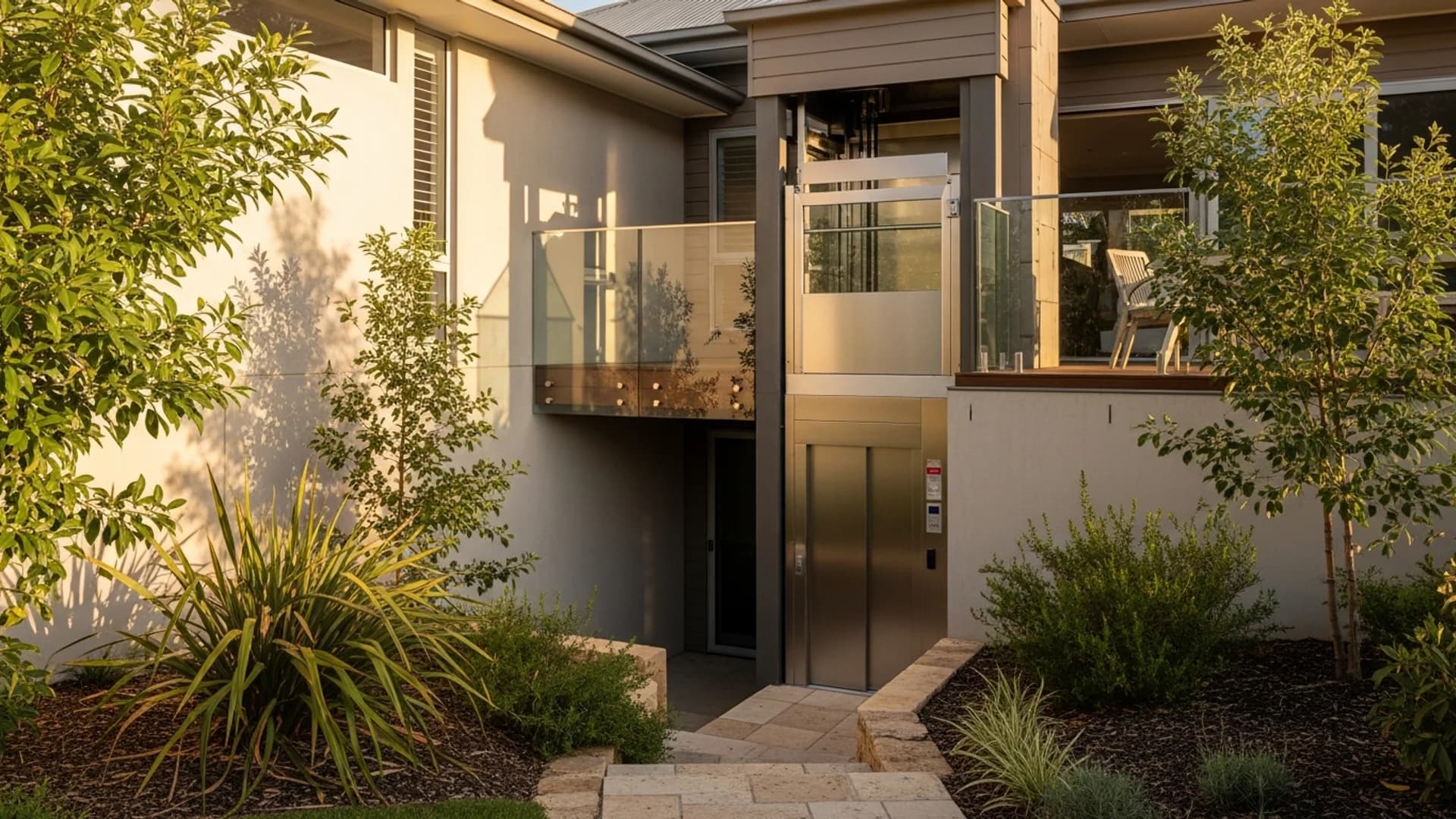
An indoor lift lives inside the home, protected from the weather and finished to match your interior. An outdoor lift mounts against an external wall or deck, freeing up internal floor space but needing weatherproofing, a footing and — near the coast — proper corrosion protection. Where you put the lift is the first real decision.
The core difference between an indoor and an outdoor home lift is not the lift itself — it is where it goes, and what that location demands. An indoor lift sits inside the house. It is shielded from rain, salt and sun, it draws on the interior finishes you already have, and it usually needs only minor building works. An outdoor lift is mounted on an external wall or against a deck. It carries a weather-sealed, IP-rated car, it almost always needs a concrete footing, and near the coast it needs corrosion protection that an indoor lift never will.
The trade-off is space. An indoor lift takes floor area from inside the home — a corner of a room, a section of a hallway, or a stacked footprint through the floor. An outdoor lift leaves your interior untouched, which is why it is often the answer for a space-tight or heritage home where there is simply no good internal position for a shaft. This page compares the two across location, weatherproofing, internal space, footings, corrosion, finishes, approval and cost, so you can decide where your lift belongs before you start collecting quotes.
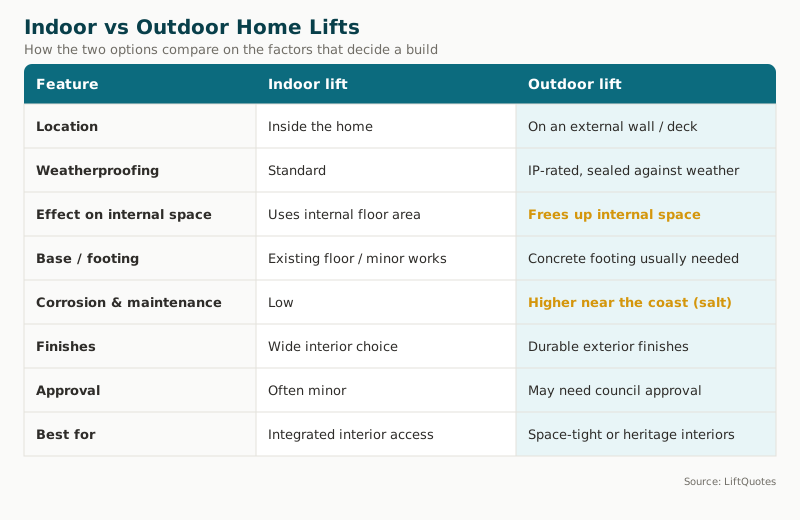
Indoor and outdoor home lifts compared across the factors that actually decide the build. The two rows most buyers under-estimate are internal space — where an outdoor lift wins by freeing interior floor area — and coastal corrosion, where an outdoor lift needs ongoing care an indoor lift avoids.
Swipe to compare →
| Factor | Indoor lift | Outdoor lift |
|---|---|---|
| Best for | Integrated interior access | Space-tight or heritage interiors |
| Location | Inside the home | On an external wall or deck |
| Weatherproofing | Standard | IP-rated, sealed against weather |
| Effect on internal space | Uses internal floor area | Frees up internal space |
| Base / footing | Existing floor or minor works | Concrete footing usually needed |
| Corrosion & maintenance | Low | Higher near the coast (salt air) |
| Finishes | Wide interior choice | Durable exterior finishes |
| Approval | Often minor | May need council approval |
Indicative positioning as of Q2 2026, based on LiftQuotes research and supplier-stated ranges for standard residential installations. Weatherproofing, footings and finishes vary by model and site — confirm the IP rating, the base requirement and any council approval with your lift supplier and, where needed, a building certifier.
The real question: where does the lift go?
Most buyers start by choosing a lift type and only later work out where to put it. Reverse that. Deciding whether the lift lives inside the home or against an external wall shapes everything that follows — the weatherproofing, the base, the finishes, the approval and a fair slice of the cost. An indoor lift is the default for most homes: it is protected, it integrates with your interior, and the building works are usually contained. An outdoor lift becomes the better answer when there is no comfortable place inside for a shaft, or when you would rather not lose any internal floor area at all.
Both are genuine home lifts and both sit under the same residential lift standard, AS/NZS 1735.18:2002 — the Australian standard for automatically controlled passenger lifts in private residences. The choice is not about safety or capability; it is about location and what your site allows. If you are still weighing the broader options, our home lifts hub covers every residential lift type, and the home lift space requirements guide sets out exactly how much room each configuration needs.
Indoor lifts: protected, integrated, simpler
An indoor lift is installed inside the envelope of the house, so it never has to fight the weather. That single fact simplifies almost everything. The car uses standard finishes rather than weather-sealed ones, it typically sits on an existing floor or needs only minor structural work, and it draws on the interior joinery and colours you already have. Corrosion is a non-issue, maintenance is lighter, and the lift becomes part of the home rather than an addition bolted to the outside.
The cost of that simplicity is floor space. An indoor lift has to take its footprint from somewhere — a corner of a living area, a repurposed cupboard, a section of hallway, or a stacked position running through the floor. In a home with room to spare that is a fair trade. In a compact or heritage interior, where every square metre is already working, it can be the deciding constraint — and the point where an outdoor lift starts to look attractive. For platform-style access inside the home, our platform lifts guide covers the low-rise options that suit shallow pits and tight internal runs.
Outdoor lifts: freeing internal space at a price
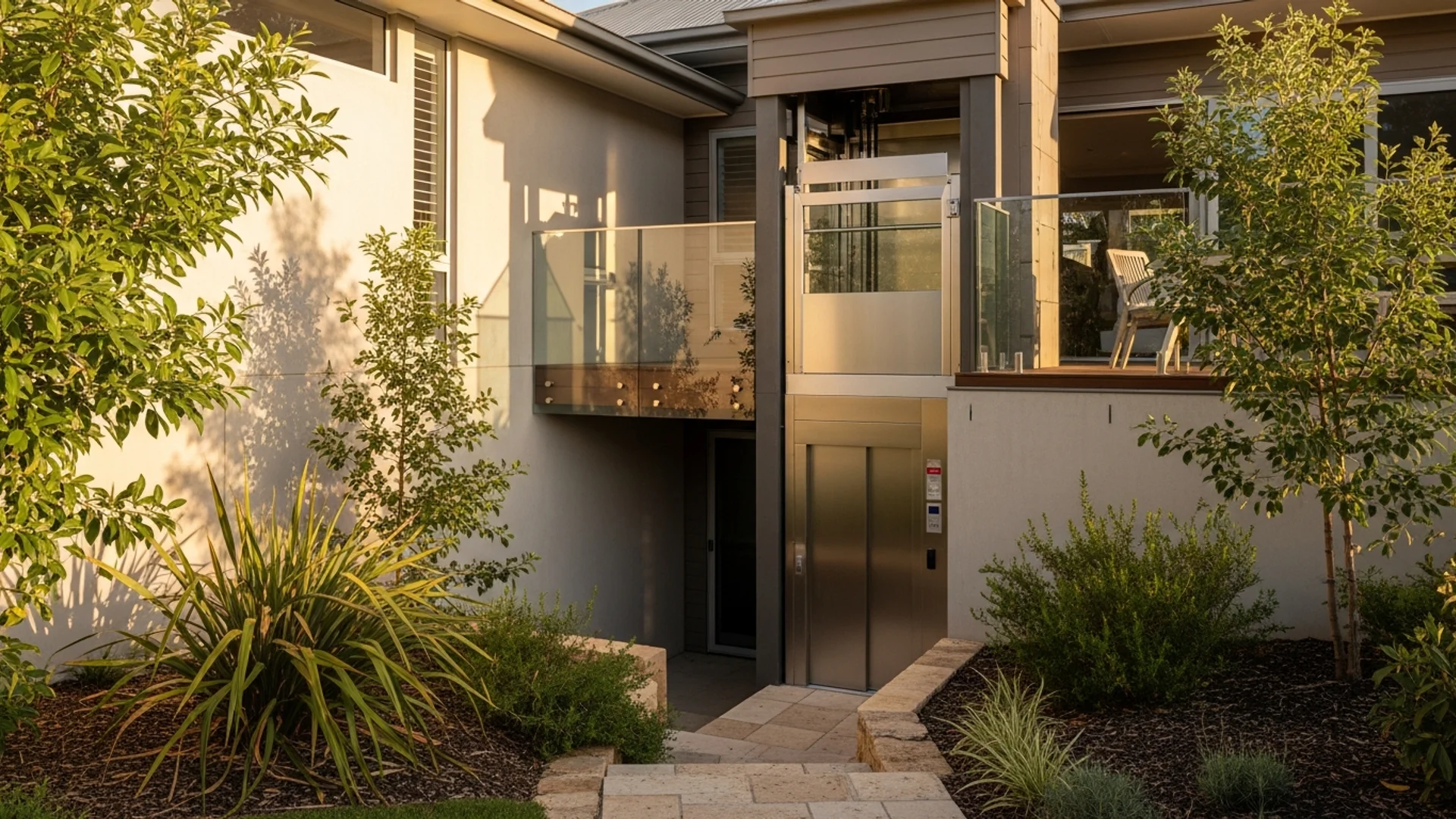
An outdoor lift mounts against an external wall or beside a deck, linking levels from the outside of the home. Its headline advantage is that it frees up internal space entirely — your interior floor plan stays exactly as it is, which is why an external lift is so often the answer for a space-tight or heritage home. It can also connect awkward split levels, garden terraces and elevated decks that no internal shaft could reach neatly. Our dedicated outdoor lifts Australia guide goes deeper on the external options, weatherproofing grades and siting.
That freed space comes at a price in build complexity. An outdoor lift needs a weather-sealed, IP-rated car and enclosure to keep rain and dust out of the mechanism. It almost always needs a concrete footing to sit on, which is a genuine piece of groundwork rather than a minor floor fix. And because it changes the external appearance of the home and often sits near a boundary, it is more likely to need council approval than an internal lift tucked inside the walls. None of this makes an outdoor lift a poor choice — it makes it a choice with a different set of works behind it.
Weatherproofing, corrosion and the coastal factor
Weatherproofing is where the two types diverge most. An indoor lift needs none beyond the standard build. An outdoor lift is specified with an IP (Ingress Protection) rating — a sealing standard that keeps water and dust out of the electrics and running gear — and the enclosure, doors and controls are all chosen to shed weather. Ask any outdoor supplier for the exact IP rating of the car and controller, and how the mechanism is protected, before you commit.
Corrosion is the factor coastal buyers most often overlook. Salt-laden air attacks unprotected metal, so an outdoor lift within a few kilometres of the surf needs marine-grade or specially coated components and a more attentive maintenance routine to stay reliable. This is a real ongoing cost and it is entirely specific to outdoor installations near the coast — an indoor lift in the same suburb never faces it. If your home is coastal and you are leaning outdoor, treat corrosion protection and a maintenance plan as part of the specification, not an afterthought.
Cost: what actually changes
The lift mechanism itself is broadly comparable between an indoor and an outdoor installation of the same type and travel. What moves the number is everything around it. As of Q2 2026, an outdoor lift typically carries added cost for the weather-sealed car and enclosure, the concrete footing, corrosion protection where the site is coastal, and — where it is triggered — a council approval process. An indoor lift usually avoids the footing and the weatherproofing premium but has to absorb any internal building works needed to open up the space, which in a tight or heritage interior can be significant in its own right.
There is no honest single figure for either, because the site drives the total more than the lift does. For the full picture on residential pricing and the factors that push it up or down, see our home lift cost guide, which breaks down the ranges with sources and dates. The practical takeaway: price the whole job — lift, base, weatherproofing and approval — not just the car, and get comparable quotes for both an indoor and an outdoor position if your home could take either.
Approval and standards
Both indoor and outdoor home lifts are covered by AS/NZS 1735.18:2002, the residential lift standard, and platform-style external lifts may also fall under AS 1735.14 for low-rise limited-mobility platforms. On the safety side the two are equivalent — the standard does not care whether the lift is inside or out. Where they differ is planning. An indoor lift contained within the existing walls often needs only minor approval, if any. An outdoor lift changes the external appearance of the home, may sit close to a boundary, and can therefore trigger a development application (DA) with your local council.
Approval requirements vary by state and council, so LiftQuotes does not provide planning advice — confirm what your project needs with your local council or a building certifier before you commit to an external position. A good outdoor lift supplier will have been through the process many times and can tell you early whether a DA is likely for your site.
Which should you choose?
Choose an indoor lift if you have a workable internal position and want the simplest, most protected, most integrated result — which is most homes with room to spare. Choose an outdoor lift if your interior is tight or heritage-constrained and internal floor space is precious, or if the levels you need to connect are outside the home. If your site is coastal, weight the decision toward whether you are willing to fund and maintain corrosion protection for an external unit — and if you are not, an indoor lift removes that burden entirely.
For most homeowners with a suitable internal spot, an indoor lift is the straightforward choice. The outdoor option earns its place when space, heritage constraints or the geometry of the site make an internal shaft impractical — and in those homes it is often the only sensible answer. Get free quotes for both positions where your home could take either, and ask each supplier to price the footing, the weatherproofing and any council approval, not just the lift.
Lift companies in Australia
Browse profiles, compare service areas, and check reviews.

Lift Shop
★ 5.0 (1551 reviews)
Australia's largest dedicated home lift specialist since 1996. 10,000+ installations. Exclusive Italian-crafted lifts with industry-leading 8-year warranty.
View profile →

Compact Home Lifts
NDIS★ 5.0 (465 reviews)
Melbourne branch of Compact Home Lifts. Compact residential lift specialist providing maintenance and repair services across Victoria.
View profile →

Next Level Elevators
★ 5.0 (454 reviews)
Award-winning provider of premium Italian-designed all-electric home elevators. Certified Eltec Partner. Showrooms in Melbourne, Sydney, and Brisbane.
View profile →

Shotton Lifts
NDIS★ 5.0 (9 reviews)
Family-owned Australian lift manufacturer since 1977. 80+ staff. Design, engineer, manufacture, install and service from Dandenong South VIC. NDIS registered.
View profile →

LiftFit Australia
NDIS★ 5.0 (8 reviews)
Victoria-based NDIS registered lift provider, est. 2011. Partners with Cibes, Savaria, and Kalea. Residential, commercial, and platform lifts.
View profile →

Easy Living Home Elevators
★ 5.0 (7 reviews)
Australia's #1 home elevator supplier since 1998. 100% Australian-owned. 11,000+ elevators in service across 6 states.
View profile →
LiftQuotes is a comparison platform. Companies shown are filtered by relevance to this page. Listing does not imply endorsement. LiftQuotes may receive a referral fee when you request quotes.
Still deciding? Get quotes for both options
Installers will assess your site and recommend the right specification.
What are you looking for today?
I need a lift installed
I have a lift that needs attention
Indoor and outdoor home lifts compared across the factors that actually decide the build. The two rows most buyers under-estimate are internal space — where an outdoor lift wins by freeing interior floor area — and coastal corrosion, where an outdoor lift needs ongoing care an indoor lift avoids.
Swipe to compare →
| Factor | Indoor lift | Outdoor lift |
|---|---|---|
| Best for | Integrated interior access | Space-tight or heritage interiors |
| Location | Inside the home | On an external wall or deck |
| Weatherproofing | Standard | IP-rated, sealed against weather |
| Effect on internal space | Uses internal floor area | Frees up internal space |
| Base / footing | Existing floor or minor works | Concrete footing usually needed |
| Corrosion & maintenance | Low | Higher near the coast (salt air) |
| Finishes | Wide interior choice | Durable exterior finishes |
| Approval | Often minor | May need council approval |
Indicative positioning as of Q2 2026, based on LiftQuotes research and supplier-stated ranges for standard residential installations. Weatherproofing, footings and finishes vary by model and site — confirm the IP rating, the base requirement and any council approval with your lift supplier and, where needed, a building certifier.
The real question: where does the lift go?
Most buyers start by choosing a lift type and only later work out where to put it. Reverse that. Deciding whether the lift lives inside the home or against an external wall shapes everything that follows — the weatherproofing, the base, the finishes, the approval and a fair slice of the cost. An indoor lift is the default for most homes: it is protected, it integrates with your interior, and the building works are usually contained. An outdoor lift becomes the better answer when there is no comfortable place inside for a shaft, or when you would rather not lose any internal floor area at all.
Both are genuine home lifts and both sit under the same residential lift standard, AS/NZS 1735.18:2002 — the Australian standard for automatically controlled passenger lifts in private residences. The choice is not about safety or capability; it is about location and what your site allows. If you are still weighing the broader options, our home lifts hub covers every residential lift type, and the home lift space requirements guide sets out exactly how much room each configuration needs.
Indoor lifts: protected, integrated, simpler
An indoor lift is installed inside the envelope of the house, so it never has to fight the weather. That single fact simplifies almost everything. The car uses standard finishes rather than weather-sealed ones, it typically sits on an existing floor or needs only minor structural work, and it draws on the interior joinery and colours you already have. Corrosion is a non-issue, maintenance is lighter, and the lift becomes part of the home rather than an addition bolted to the outside.
The cost of that simplicity is floor space. An indoor lift has to take its footprint from somewhere — a corner of a living area, a repurposed cupboard, a section of hallway, or a stacked position running through the floor. In a home with room to spare that is a fair trade. In a compact or heritage interior, where every square metre is already working, it can be the deciding constraint — and the point where an outdoor lift starts to look attractive. For platform-style access inside the home, our platform lifts guide covers the low-rise options that suit shallow pits and tight internal runs.
Outdoor lifts: freeing internal space at a price
An outdoor lift mounts against an external wall or beside a deck, linking levels from the outside of the home. Its headline advantage is that it frees up internal space entirely — your interior floor plan stays exactly as it is, which is why an external lift is so often the answer for a space-tight or heritage home. It can also connect awkward split levels, garden terraces and elevated decks that no internal shaft could reach neatly. Our dedicated outdoor lifts Australia guide goes deeper on the external options, weatherproofing grades and siting.
That freed space comes at a price in build complexity. An outdoor lift needs a weather-sealed, IP-rated car and enclosure to keep rain and dust out of the mechanism. It almost always needs a concrete footing to sit on, which is a genuine piece of groundwork rather than a minor floor fix. And because it changes the external appearance of the home and often sits near a boundary, it is more likely to need council approval than an internal lift tucked inside the walls. None of this makes an outdoor lift a poor choice — it makes it a choice with a different set of works behind it.
Weatherproofing, corrosion and the coastal factor
Weatherproofing is where the two types diverge most. An indoor lift needs none beyond the standard build. An outdoor lift is specified with an IP (Ingress Protection) rating — a sealing standard that keeps water and dust out of the electrics and running gear — and the enclosure, doors and controls are all chosen to shed weather. Ask any outdoor supplier for the exact IP rating of the car and controller, and how the mechanism is protected, before you commit.
Corrosion is the factor coastal buyers most often overlook. Salt-laden air attacks unprotected metal, so an outdoor lift within a few kilometres of the surf needs marine-grade or specially coated components and a more attentive maintenance routine to stay reliable. This is a real ongoing cost and it is entirely specific to outdoor installations near the coast — an indoor lift in the same suburb never faces it. If your home is coastal and you are leaning outdoor, treat corrosion protection and a maintenance plan as part of the specification, not an afterthought.
Cost: what actually changes
The lift mechanism itself is broadly comparable between an indoor and an outdoor installation of the same type and travel. What moves the number is everything around it. As of Q2 2026, an outdoor lift typically carries added cost for the weather-sealed car and enclosure, the concrete footing, corrosion protection where the site is coastal, and — where it is triggered — a council approval process. An indoor lift usually avoids the footing and the weatherproofing premium but has to absorb any internal building works needed to open up the space, which in a tight or heritage interior can be significant in its own right.
There is no honest single figure for either, because the site drives the total more than the lift does. For the full picture on residential pricing and the factors that push it up or down, see our home lift cost guide, which breaks down the ranges with sources and dates. The practical takeaway: price the whole job — lift, base, weatherproofing and approval — not just the car, and get comparable quotes for both an indoor and an outdoor position if your home could take either.
Approval and standards
Both indoor and outdoor home lifts are covered by AS/NZS 1735.18:2002, the residential lift standard, and platform-style external lifts may also fall under AS 1735.14 for low-rise limited-mobility platforms. On the safety side the two are equivalent — the standard does not care whether the lift is inside or out. Where they differ is planning. An indoor lift contained within the existing walls often needs only minor approval, if any. An outdoor lift changes the external appearance of the home, may sit close to a boundary, and can therefore trigger a development application (DA) with your local council.
Approval requirements vary by state and council, so LiftQuotes does not provide planning advice — confirm what your project needs with your local council or a building certifier before you commit to an external position. A good outdoor lift supplier will have been through the process many times and can tell you early whether a DA is likely for your site.
Which should you choose?
Choose an indoor lift if you have a workable internal position and want the simplest, most protected, most integrated result — which is most homes with room to spare. Choose an outdoor lift if your interior is tight or heritage-constrained and internal floor space is precious, or if the levels you need to connect are outside the home. If your site is coastal, weight the decision toward whether you are willing to fund and maintain corrosion protection for an external unit — and if you are not, an indoor lift removes that burden entirely.
For most homeowners with a suitable internal spot, an indoor lift is the straightforward choice. The outdoor option earns its place when space, heritage constraints or the geometry of the site make an internal shaft impractical — and in those homes it is often the only sensible answer. Get free quotes for both positions where your home could take either, and ask each supplier to price the footing, the weatherproofing and any council approval, not just the lift.
Lift companies in Australia
Browse profiles, compare service areas, and check reviews.
Lift Shop
★ 5.0 (1551 reviews)
Australia's largest dedicated home lift specialist since 1996. 10,000+ installations. Exclusive Italian-crafted lifts with industry-leading 8-year warranty.
View profile →
Compact Home Lifts
NDIS★ 5.0 (465 reviews)
Melbourne branch of Compact Home Lifts. Compact residential lift specialist providing maintenance and repair services across Victoria.
View profile →
Next Level Elevators
★ 5.0 (454 reviews)
Award-winning provider of premium Italian-designed all-electric home elevators. Certified Eltec Partner. Showrooms in Melbourne, Sydney, and Brisbane.
View profile →
Shotton Lifts
NDIS★ 5.0 (9 reviews)
Family-owned Australian lift manufacturer since 1977. 80+ staff. Design, engineer, manufacture, install and service from Dandenong South VIC. NDIS registered.
View profile →
LiftFit Australia
NDIS★ 5.0 (8 reviews)
Victoria-based NDIS registered lift provider, est. 2011. Partners with Cibes, Savaria, and Kalea. Residential, commercial, and platform lifts.
View profile →
Easy Living Home Elevators
★ 5.0 (7 reviews)
Australia's #1 home elevator supplier since 1998. 100% Australian-owned. 11,000+ elevators in service across 6 states.
View profile →
LiftQuotes is a comparison platform. Companies shown are filtered by relevance to this page. Listing does not imply endorsement. LiftQuotes may receive a referral fee when you request quotes.
Still deciding? Get quotes for both options
Installers will assess your site and recommend the right specification.
What are you looking for today?
I need a lift installed
I have a lift that needs attention
Location drives the whole build
Indoor or outdoor is the first real decision. It sets the weatherproofing, the footing, the finishes, the approval and much of the cost — choose the position before the lift.
Outdoor frees internal space
An external lift leaves your interior floor plan untouched, which is why it suits space-tight and heritage homes. An indoor lift takes its footprint from a room, hallway or floor.
The coast changes everything outdoors
An outdoor lift near the surf needs marine-grade corrosion protection and more attentive maintenance. An indoor lift in the same suburb never faces salt air.
Price the whole job, not the car
The lift mechanism is broadly comparable; footings, weatherproofing and approval move the number. Get comparable quotes for both positions if your home could take either.
Common Questions About Indoor and Outdoor Home Lifts
An outdoor home lift is a residential lift mounted against an external wall or beside a deck, rather than inside the house. It carries a weather-sealed, IP-rated car and enclosure so rain, dust and salt air cannot reach the mechanism, and it usually sits on a concrete footing. Its main advantage is that it frees up internal floor space entirely, which makes it a common choice for space-tight or heritage homes and for connecting garden levels, terraces and elevated decks that no internal shaft could reach neatly.
Related guides
Guide
Our Editorial Methodology: How LiftQuotes Researches Content
How LiftQuotes researches, sources and reviews every lift guide and cost page: the standards we cite, our linked-source rule for cost data, and how often we update.
Guide
Lift Compliance Checklist for Facility Managers (Australia)
A facility manager's lift compliance checklist for Australia: plant registration, inspection, log books, 4G VoLTE emergency phones and DDA access duties.
Comparison
Stairlift vs Platform Lift: Which Access Solution Fits?
A stairlift carries a seated user along the stairs from about $3,000; a platform lift raises a wheelchair vertically from about $15,000. Compare cost, access and fit.
Location
Lift Companies in Melbourne: Compare Local Installers
Compare lift companies in Melbourne for home, platform and commercial lifts. WorkSafe Victoria compliance, local installer coverage and indicative VIC costs.
Deciding where your lift should go?
Tell us about your home and whether you are weighing an indoor or outdoor position, and we will connect you with suppliers who can price the footing, weatherproofing and approval for your site. Free, with no obligation.
Join 1,000+ Australians who've requested quotes through LiftQuotes
Get free quotes