How Long Does a Home Lift Last?
Most home lifts last 15 to 25 years or more. How long yours lasts comes down to servicing, build quality, use and environment — and a mid-life modernisation can add years.
A home lift in Australia typically lasts 15 to 25 years, and often longer when it is serviced well and modernised once along the way. There is no single expiry date. Lifespan is the result of four things: how often the lift is used, how well it is maintained, the quality of the equipment, and the environment it operates in.
Two identical lifts can age very differently. A lightly used lift in a dry inland home, serviced twice a year, can run reliably past the 25-year mark. The same model in a busy coastal household with patchy servicing might need major work at 12 to 15 years. Salt air, humidity, dust and heavy daily use all shorten the interval between repairs.
The reassuring part for owners is that a home lift is not a throwaway appliance. The shaft, structure and guide rails usually outlast the moving parts by decades. When the drive, controller or car interior wears out, modernising those components — rather than replacing the whole lift — can extend its working life well beyond 25 years.
How long does a home lift last?
A home lift in Australia typically lasts 15 to 25 years or more. Reaching the upper end of that range depends on regular servicing and, usually, one mid-life modernisation. A home lift is engineered for a long service life — the shaft, structure and rails are built to outlast the moving parts, which is why upgrading worn components is often smarter than replacing the whole lift.
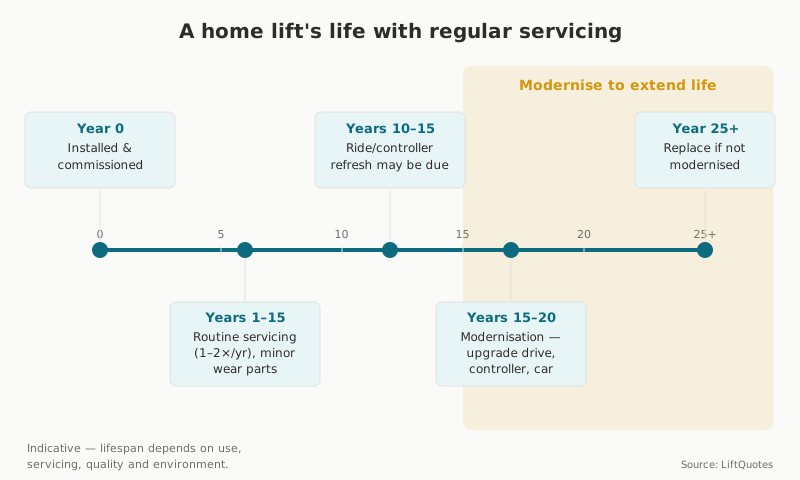
The answer is a range, not a promise, because four things move it up or down: usage, servicing quality, build quality and the environment the lift lives in. The timeline below shows how a typical home lift ages when it is looked after.
What determines a home lift’s lifespan
Four factors decide whether a lift reaches 15 years or sails past 25.
- Usage. A lift making a handful of trips a day ages far more slowly than one running constantly in a multi-generational household. More cycles mean more wear on the drive, ropes or hydraulics, doors and guide shoes.
- Servicing quality. This is the factor most within your control. A lift on a regular lift maintenance contract — serviced once or twice a year — has worn parts replaced before they fail and small faults corrected before they cascade. A neglected lift wears out years sooner.
- Build quality. A well-engineered lift from an established manufacturer, with readily available spare parts, is easier and cheaper to keep running for decades than a budget unit whose parts become obsolete.
- Environment. Coastal salt air, tropical humidity and dust are hard on electronics and metalwork. A lift in Cairns or a beachside Sydney home generally needs more attention than one in a dry inland suburb.
What wears out — and when
Different parts of a home lift have different working lives. Knowing the pattern helps you budget and spot when a lift is approaching a major service milestone.
- Wear items (1–15 years): door mechanisms, guide shoes and rollers, seals, lubricants, batteries for the emergency lowering and phone, and light fittings. These are routine replacements handled during servicing.
- Mid-life items (10–15 years): the controller and ride-quality components can start to date. Electronics age, and comfort or reliability may fall even when nothing has failed outright.
- Major components (15–25 years): the drive system — hydraulic power pack, traction motor or screw-drive assembly — and the car interior are the big-ticket items that eventually reach end of life.
Running costs also creep up as a lift ages and repairs become more frequent. Our guide to home lift running costs breaks down what to expect year to year across a lift’s life.
When to modernise, and when to replace
By around 15 to 20 years, many home lifts reach a decision point: keep repairing, modernise, or replace. Because the shaft and structure usually remain sound, lift modernisation — upgrading the drive, controller, car and doors while reusing the existing shaft — is often the most cost-effective way to add another 10 to 15 years of life.
As of Q2 2026, a controls or drive upgrade is an indicative $15,000–$30,000, while a full modernisation covering the drive, controller, car and doors runs an indicative $40,000–$80,000 (ex GST); see our lift modernisation guide for the scope options behind those ranges. Full replacement — removing the old lift and installing a new one — sits higher again, closer to the cost of a new install.
Replacement usually makes sense only when the shaft or structure is no longer suitable, spare parts are genuinely unavailable, or the cumulative repair bill starts to rival a new lift. For most well-maintained home lifts, modernisation reaches end of life later and costs less.
How to extend the life of your home lift
A few habits make the difference between a lift that struggles at 15 years and one that runs comfortably past 25:
- Keep it on a regular service contract. Do not skip visits to save money — deferred servicing is the fastest route to premature wear.
- Fix small faults early. A noisy door or a slight levelling error is cheap to correct now and expensive to ignore.
- Protect it from the environment. Manage humidity and salt exposure, and specify corrosion-resistant finishes if you are near the coast.
- Plan for modernisation. Treat a mid-life upgrade as expected, not a failure — budgeting for it early avoids an emergency replacement later.
If you are weighing up a new lift, a modernisation, or just want to compare service contracts, it pays to see real numbers first — our home lift cost guide covers what a new install involves. When you are ready, get free quotes from qualified Australian lift companies and compare on price, inclusions and long-term support.
Lift companies in Australia
Browse profiles, compare service areas, and check reviews.

Lift Shop
★ 5.0 (1551 reviews)
Australia's largest dedicated home lift specialist since 1996. 10,000+ installations. Exclusive Italian-crafted lifts with industry-leading 8-year warranty.
View profile →

Compact Home Lifts
NDIS★ 5.0 (465 reviews)
Melbourne branch of Compact Home Lifts. Compact residential lift specialist providing maintenance and repair services across Victoria.
View profile →

Next Level Elevators
★ 5.0 (454 reviews)
Award-winning provider of premium Italian-designed all-electric home elevators. Certified Eltec Partner. Showrooms in Melbourne, Sydney, and Brisbane.
View profile →

Shotton Lifts
NDIS★ 5.0 (9 reviews)
Family-owned Australian lift manufacturer since 1977. 80+ staff. Design, engineer, manufacture, install and service from Dandenong South VIC. NDIS registered.
View profile →

LiftFit Australia
NDIS★ 5.0 (8 reviews)
Victoria-based NDIS registered lift provider, est. 2011. Partners with Cibes, Savaria, and Kalea. Residential, commercial, and platform lifts.
View profile →

Easy Living Home Elevators
★ 5.0 (7 reviews)
Australia's #1 home elevator supplier since 1998. 100% Australian-owned. 11,000+ elevators in service across 6 states.
View profile →
LiftQuotes is a comparison platform. Companies shown are filtered by relevance to this page. Listing does not imply endorsement. LiftQuotes may receive a referral fee when you request quotes.
Put this into action
When you're ready to move forward, get free quotes from verified Australian lift installers.
What are you looking for today?
I need a lift installed
I have a lift that needs attention
A home lift in Australia typically lasts 15 to 25 years, and often longer when it is serviced well and modernised once along the way. There is no single expiry date. Lifespan is the result of four things: how often the lift is used, how well it is maintained, the quality of the equipment, and the environment it operates in.
Two identical lifts can age very differently. A lightly used lift in a dry inland home, serviced twice a year, can run reliably past the 25-year mark. The same model in a busy coastal household with patchy servicing might need major work at 12 to 15 years. Salt air, humidity, dust and heavy daily use all shorten the interval between repairs.
The reassuring part for owners is that a home lift is not a throwaway appliance. The shaft, structure and guide rails usually outlast the moving parts by decades. When the drive, controller or car interior wears out, modernising those components — rather than replacing the whole lift — can extend its working life well beyond 25 years.
How long does a home lift last?
A home lift in Australia typically lasts 15 to 25 years or more. Reaching the upper end of that range depends on regular servicing and, usually, one mid-life modernisation. A home lift is engineered for a long service life — the shaft, structure and rails are built to outlast the moving parts, which is why upgrading worn components is often smarter than replacing the whole lift.
The answer is a range, not a promise, because four things move it up or down: usage, servicing quality, build quality and the environment the lift lives in. The timeline below shows how a typical home lift ages when it is looked after.
What determines a home lift’s lifespan
Four factors decide whether a lift reaches 15 years or sails past 25.
- Usage. A lift making a handful of trips a day ages far more slowly than one running constantly in a multi-generational household. More cycles mean more wear on the drive, ropes or hydraulics, doors and guide shoes.
- Servicing quality. This is the factor most within your control. A lift on a regular lift maintenance contract — serviced once or twice a year — has worn parts replaced before they fail and small faults corrected before they cascade. A neglected lift wears out years sooner.
- Build quality. A well-engineered lift from an established manufacturer, with readily available spare parts, is easier and cheaper to keep running for decades than a budget unit whose parts become obsolete.
- Environment. Coastal salt air, tropical humidity and dust are hard on electronics and metalwork. A lift in Cairns or a beachside Sydney home generally needs more attention than one in a dry inland suburb.
What wears out — and when
Different parts of a home lift have different working lives. Knowing the pattern helps you budget and spot when a lift is approaching a major service milestone.
- Wear items (1–15 years): door mechanisms, guide shoes and rollers, seals, lubricants, batteries for the emergency lowering and phone, and light fittings. These are routine replacements handled during servicing.
- Mid-life items (10–15 years): the controller and ride-quality components can start to date. Electronics age, and comfort or reliability may fall even when nothing has failed outright.
- Major components (15–25 years): the drive system — hydraulic power pack, traction motor or screw-drive assembly — and the car interior are the big-ticket items that eventually reach end of life.
Running costs also creep up as a lift ages and repairs become more frequent. Our guide to home lift running costs breaks down what to expect year to year across a lift’s life.
When to modernise, and when to replace
By around 15 to 20 years, many home lifts reach a decision point: keep repairing, modernise, or replace. Because the shaft and structure usually remain sound, lift modernisation — upgrading the drive, controller, car and doors while reusing the existing shaft — is often the most cost-effective way to add another 10 to 15 years of life.
As of Q2 2026, a controls or drive upgrade is an indicative $15,000–$30,000, while a full modernisation covering the drive, controller, car and doors runs an indicative $40,000–$80,000 (ex GST); see our lift modernisation guide for the scope options behind those ranges. Full replacement — removing the old lift and installing a new one — sits higher again, closer to the cost of a new install.
Replacement usually makes sense only when the shaft or structure is no longer suitable, spare parts are genuinely unavailable, or the cumulative repair bill starts to rival a new lift. For most well-maintained home lifts, modernisation reaches end of life later and costs less.
How to extend the life of your home lift
A few habits make the difference between a lift that struggles at 15 years and one that runs comfortably past 25:
- Keep it on a regular service contract. Do not skip visits to save money — deferred servicing is the fastest route to premature wear.
- Fix small faults early. A noisy door or a slight levelling error is cheap to correct now and expensive to ignore.
- Protect it from the environment. Manage humidity and salt exposure, and specify corrosion-resistant finishes if you are near the coast.
- Plan for modernisation. Treat a mid-life upgrade as expected, not a failure — budgeting for it early avoids an emergency replacement later.
If you are weighing up a new lift, a modernisation, or just want to compare service contracts, it pays to see real numbers first — our home lift cost guide covers what a new install involves. When you are ready, get free quotes from qualified Australian lift companies and compare on price, inclusions and long-term support.
Lift companies in Australia
Browse profiles, compare service areas, and check reviews.
Lift Shop
★ 5.0 (1551 reviews)
Australia's largest dedicated home lift specialist since 1996. 10,000+ installations. Exclusive Italian-crafted lifts with industry-leading 8-year warranty.
View profile →
Compact Home Lifts
NDIS★ 5.0 (465 reviews)
Melbourne branch of Compact Home Lifts. Compact residential lift specialist providing maintenance and repair services across Victoria.
View profile →
Next Level Elevators
★ 5.0 (454 reviews)
Award-winning provider of premium Italian-designed all-electric home elevators. Certified Eltec Partner. Showrooms in Melbourne, Sydney, and Brisbane.
View profile →
Shotton Lifts
NDIS★ 5.0 (9 reviews)
Family-owned Australian lift manufacturer since 1977. 80+ staff. Design, engineer, manufacture, install and service from Dandenong South VIC. NDIS registered.
View profile →
LiftFit Australia
NDIS★ 5.0 (8 reviews)
Victoria-based NDIS registered lift provider, est. 2011. Partners with Cibes, Savaria, and Kalea. Residential, commercial, and platform lifts.
View profile →
Easy Living Home Elevators
★ 5.0 (7 reviews)
Australia's #1 home elevator supplier since 1998. 100% Australian-owned. 11,000+ elevators in service across 6 states.
View profile →
LiftQuotes is a comparison platform. Companies shown are filtered by relevance to this page. Listing does not imply endorsement. LiftQuotes may receive a referral fee when you request quotes.
Put this into action
When you're ready to move forward, get free quotes from verified Australian lift installers.
What are you looking for today?
I need a lift installed
I have a lift that needs attention
Typical lifespan: 15–25+ years
A well-installed, well-serviced residential lift commonly lasts 15 to 25 years or more before it needs full replacement.
Servicing is the biggest lever
Regular servicing — once or twice a year for a home lift — catches wear early and is the single biggest factor in how long the lift lasts.
Modernisation extends life
Around the 15–20 year mark, upgrading the drive, controller and car can add many years without rebuilding the shaft.
Environment matters
Coastal salt, humidity and heavy daily use accelerate wear. Inland, lightly used lifts age more slowly.
Common questions about home lift lifespan
A home lift in Australia typically lasts 15 to 25 years or more. There is no fixed expiry date — lifespan depends on how heavily the lift is used, how well it is serviced, the build quality of the equipment, and the environment it operates in. A lightly used, well-serviced lift can run reliably past 25 years, while a heavily used or neglected one may need major work at 12 to 15 years. A mid-life modernisation can extend a lift’s working life well beyond its original expectancy.
Related guides
Guide
Our Editorial Methodology: How LiftQuotes Researches Content
How LiftQuotes researches, sources and reviews every lift guide and cost page: the standards we cite, our linked-source rule for cost data, and how often we update.
Guide
Lift Compliance Checklist for Facility Managers (Australia)
A facility manager's lift compliance checklist for Australia: plant registration, inspection, log books, 4G VoLTE emergency phones and DDA access duties.
Comparison
Stairlift vs Platform Lift: Which Access Solution Fits?
A stairlift carries a seated user along the stairs from about $3,000; a platform lift raises a wheelchair vertically from about $15,000. Compare cost, access and fit.
Location
Lift Companies in Melbourne: Compare Local Installers
Compare lift companies in Melbourne for home, platform and commercial lifts. WorkSafe Victoria compliance, local installer coverage and indicative VIC costs.
Compare lift servicing, modernisation and new lift quotes
Whether you are keeping an ageing lift running, planning a modernisation, or costing a replacement, compare quotes from qualified Australian lift companies on price, inclusions and long-term support.
Join 1,000+ Australians who've requested quotes through LiftQuotes
Get free quotes