Home Lift Cost Calculator
There is no single price for a home lift — but you can estimate your own in minutes. Build up your figure from five parts: the lift, your stops, the building works, electrical and compliance, and finishes.
There is no single calculator number
A home lift costs $20,000–$70,000 installed for a typical 2-stop lift (ex GST, Q3 2026). The spread is real because the lift type and your building works — the two biggest lines — are set by your house, not a slider.
Build it up from five parts
Lift equipment, building works, number of stops, electrical and compliance, then finishes. Pick the range that matches your plans for each and add them together for a planning figure to confirm with a quote.
Building works cause the surprises
Cutting an opening, forming a pit and framing a shaft adds $8,000–$25,000 and is invisible in a brochure price. Retrofits sit at the top of that range until a site assessment says otherwise.
Budget the ongoing costs too
A residential lift needs servicing once or twice a year — roughly $300–$800 annually plus power. Factor it in up front so the running cost is a decision, not a surprise.
A home lift in Australia typically costs between $20,000 and $70,000 installed for a standard 2-stop lift, ex GST, as of Q3 2026. That range is wide because a compact through-floor lift dropped into a new build has very different cost drivers to a full hydraulic lift retrofitted into an existing home — so a fixed calculator number would mislead you more than it helps.
What does work is a build-up: start with the lift, add your number of stops, add the building works your home needs, then layer on electrical, compliance and finishes. This guide walks through each part with real ranges so you can assemble an estimate for your own situation, then check it against actual quotes. Every figure below is indicative, ex GST, and last checked in Q3 2026.
How to estimate your home lift cost
There is no reliable one-number home lift cost calculator, because the two things that move the price most — which lift you choose and how much building work your home needs — are decided by your house, not by a slider. The honest way to get a number you can plan around is to build it up from five parts. Do that and a typical 2-stop installation lands between $20,000 and $70,000 installed, ex GST, as of Q3 2026; the worksheet below shows where that spread comes from.
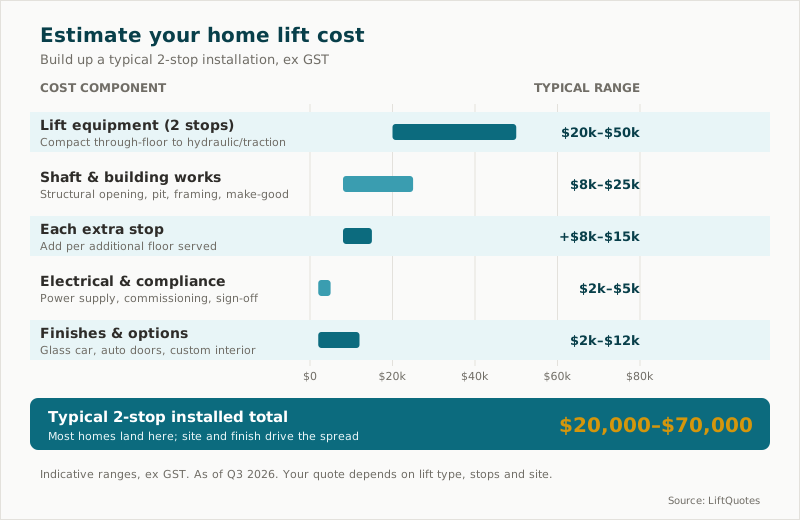
Work down the five components, pick the range that matches your plans, and add them together. Treat the total as a planning figure to confirm with a site quote — not a fixed price.
1. Start with the lift itself
The lift equipment is the largest single line, and it is set by the type you choose. A compact self-supporting through-floor lift — the kind covered in our guide to small lifts for homes — starts around $20,000–$30,000 for a 2-stop unit. A mid-range hydraulic or traction home lift with a proper shaft runs $30,000–$50,000, and a premium lift with a glass car and larger capacity climbs from there. This is the figure to anchor your estimate on; our full home lift cost breakdown compares the types side by side.
Pick one number for the equipment before you add anything else. Everything that follows is a variable layered on top of it.
2. Add your building works
Building works are where most buyer shock comes from, because they are invisible in a brochure price. Cutting a structural opening between floors, forming a pit, framing a shaft and making good the surrounding rooms typically adds $8,000–$25,000. A self-supporting lift in an open-plan new build sits at the low end; a shaft threaded through a heritage home with load-bearing walls and a concrete pit sits at the top. Our guide to lift shaft construction cost breaks this line down further, and home lift space requirements shows the dimensions that decide how much structural work you actually need.
If you are retrofitting rather than building new, assume the upper half of this range until a site assessment tells you otherwise.
3. Count your stops
The base figures above assume a 2-stop lift — ground floor to first floor. Each additional stop adds roughly $8,000–$15,000, covering the extra landing door, guide rails, wiring and shaft height. A three-storey home served top to bottom is therefore materially dearer than the same lift over two levels, so count your stops early: it is one of the few inputs that scales the price in a predictable, near-linear way.
4. Electrical, compliance and finishes
Two smaller lines round out the equipment side. Electrical supply, commissioning and compliance sign-off usually add $2,000–$5,000 — a home lift is registrable plant in some contexts and must be commissioned to AS/NZS 1735.18:2002, the Australian Standard for passenger lifts in private residences. Finishes and options — a glass or mirrored car, automatic doors, a custom interior, a second entrance — add anywhere from $2,000 to $12,000 depending on how far you push the specification.
These lines are genuinely optional in size. A pared-back lift keeps both near their floor; a showpiece installation is where they climb.
5. Don't forget the ongoing costs
Your estimate is not finished at handover. A residential lift needs servicing once or twice a year, and budgeting for it up front avoids a surprise later. Expect $300–$800 a year for a basic maintenance visit, plus power and the occasional part — our guide to home lift running costs sets out the full annual picture. Factor an ongoing line into your decision the same way you would for a car: the purchase is the big number, but the running cost decides how comfortable you are living with it.
Put your estimate together
Add your five components and you have a planning figure. Three worked examples, all ex GST and current as of Q3 2026:
- Entry-level, 2-stop, new build: compact lift ($22,000) + light building works ($9,000) + electrical ($3,000) + minimal finishes ($2,000) ≈ $36,000.
- Mid-range, 2-stop, retrofit: hydraulic lift ($40,000) + shaft and pit ($18,000) + electrical ($4,000) + finishes ($6,000) ≈ $68,000.
- Premium, 3-stop, retrofit: glass traction lift ($55,000) + extra stop ($12,000) + building works ($24,000) + electrical ($5,000) + finishes ($10,000) ≈ $106,000.
Those examples show why a single calculator number is a trap: the same three-word search — "home lift cost" — covers a $36,000 job and a $106,000 job. Your house decides which one you are.
These ranges are drawn from LiftQuotes' research into Australian supplier pricing and consumer cost-guide data, cross-checked against the AS/NZS 1735.18:2002 requirements a residential lift must meet, and last reviewed in Q3 2026. The only way to turn your estimate into a real number is a site assessment, so once you have a figure you are comfortable with, plan the job with our home lift installation guide and get free quotes from Australian installers who can price your specific home.
Lift companies in Australia
Browse profiles, compare service areas, and check reviews.

Lift Shop
★ 5.0 (1551 reviews)
Australia's largest dedicated home lift specialist since 1996. 10,000+ installations. Exclusive Italian-crafted lifts with industry-leading 8-year warranty.
View profile →

Compact Home Lifts
NDIS★ 5.0 (465 reviews)
Melbourne branch of Compact Home Lifts. Compact residential lift specialist providing maintenance and repair services across Victoria.
View profile →

Next Level Elevators
★ 5.0 (454 reviews)
Award-winning provider of premium Italian-designed all-electric home elevators. Certified Eltec Partner. Showrooms in Melbourne, Sydney, and Brisbane.
View profile →

Shotton Lifts
NDIS★ 5.0 (9 reviews)
Family-owned Australian lift manufacturer since 1977. 80+ staff. Design, engineer, manufacture, install and service from Dandenong South VIC. NDIS registered.
View profile →

LiftFit Australia
NDIS★ 5.0 (8 reviews)
Victoria-based NDIS registered lift provider, est. 2011. Partners with Cibes, Savaria, and Kalea. Residential, commercial, and platform lifts.
View profile →

Easy Living Home Elevators
★ 5.0 (7 reviews)
Australia's #1 home elevator supplier since 1998. 100% Australian-owned. 11,000+ elevators in service across 6 states.
View profile →
LiftQuotes is a comparison platform. Companies shown are filtered by relevance to this page. Listing does not imply endorsement. LiftQuotes may receive a referral fee when you request quotes.
Put this into action
When you're ready to move forward, get free quotes from verified Australian lift installers.
What are you looking for today?
I need a lift installed
I have a lift that needs attention
A home lift in Australia typically costs between $20,000 and $70,000 installed for a standard 2-stop lift, ex GST, as of Q3 2026. That range is wide because a compact through-floor lift dropped into a new build has very different cost drivers to a full hydraulic lift retrofitted into an existing home — so a fixed calculator number would mislead you more than it helps.
What does work is a build-up: start with the lift, add your number of stops, add the building works your home needs, then layer on electrical, compliance and finishes. This guide walks through each part with real ranges so you can assemble an estimate for your own situation, then check it against actual quotes. Every figure below is indicative, ex GST, and last checked in Q3 2026.
How to estimate your home lift cost
There is no reliable one-number home lift cost calculator, because the two things that move the price most — which lift you choose and how much building work your home needs — are decided by your house, not by a slider. The honest way to get a number you can plan around is to build it up from five parts. Do that and a typical 2-stop installation lands between $20,000 and $70,000 installed, ex GST, as of Q3 2026; the worksheet below shows where that spread comes from.
Work down the five components, pick the range that matches your plans, and add them together. Treat the total as a planning figure to confirm with a site quote — not a fixed price.
1. Start with the lift itself
The lift equipment is the largest single line, and it is set by the type you choose. A compact self-supporting through-floor lift — the kind covered in our guide to small lifts for homes — starts around $20,000–$30,000 for a 2-stop unit. A mid-range hydraulic or traction home lift with a proper shaft runs $30,000–$50,000, and a premium lift with a glass car and larger capacity climbs from there. This is the figure to anchor your estimate on; our full home lift cost breakdown compares the types side by side.
Pick one number for the equipment before you add anything else. Everything that follows is a variable layered on top of it.
2. Add your building works
Building works are where most buyer shock comes from, because they are invisible in a brochure price. Cutting a structural opening between floors, forming a pit, framing a shaft and making good the surrounding rooms typically adds $8,000–$25,000. A self-supporting lift in an open-plan new build sits at the low end; a shaft threaded through a heritage home with load-bearing walls and a concrete pit sits at the top. Our guide to lift shaft construction cost breaks this line down further, and home lift space requirements shows the dimensions that decide how much structural work you actually need.
If you are retrofitting rather than building new, assume the upper half of this range until a site assessment tells you otherwise.
3. Count your stops
The base figures above assume a 2-stop lift — ground floor to first floor. Each additional stop adds roughly $8,000–$15,000, covering the extra landing door, guide rails, wiring and shaft height. A three-storey home served top to bottom is therefore materially dearer than the same lift over two levels, so count your stops early: it is one of the few inputs that scales the price in a predictable, near-linear way.
4. Electrical, compliance and finishes
Two smaller lines round out the equipment side. Electrical supply, commissioning and compliance sign-off usually add $2,000–$5,000 — a home lift is registrable plant in some contexts and must be commissioned to AS/NZS 1735.18:2002, the Australian Standard for passenger lifts in private residences. Finishes and options — a glass or mirrored car, automatic doors, a custom interior, a second entrance — add anywhere from $2,000 to $12,000 depending on how far you push the specification.
These lines are genuinely optional in size. A pared-back lift keeps both near their floor; a showpiece installation is where they climb.
5. Don't forget the ongoing costs
Your estimate is not finished at handover. A residential lift needs servicing once or twice a year, and budgeting for it up front avoids a surprise later. Expect $300–$800 a year for a basic maintenance visit, plus power and the occasional part — our guide to home lift running costs sets out the full annual picture. Factor an ongoing line into your decision the same way you would for a car: the purchase is the big number, but the running cost decides how comfortable you are living with it.
Put your estimate together
Add your five components and you have a planning figure. Three worked examples, all ex GST and current as of Q3 2026:
- Entry-level, 2-stop, new build: compact lift ($22,000) + light building works ($9,000) + electrical ($3,000) + minimal finishes ($2,000) ≈ $36,000.
- Mid-range, 2-stop, retrofit: hydraulic lift ($40,000) + shaft and pit ($18,000) + electrical ($4,000) + finishes ($6,000) ≈ $68,000.
- Premium, 3-stop, retrofit: glass traction lift ($55,000) + extra stop ($12,000) + building works ($24,000) + electrical ($5,000) + finishes ($10,000) ≈ $106,000.
Those examples show why a single calculator number is a trap: the same three-word search — "home lift cost" — covers a $36,000 job and a $106,000 job. Your house decides which one you are.
These ranges are drawn from LiftQuotes' research into Australian supplier pricing and consumer cost-guide data, cross-checked against the AS/NZS 1735.18:2002 requirements a residential lift must meet, and last reviewed in Q3 2026. The only way to turn your estimate into a real number is a site assessment, so once you have a figure you are comfortable with, plan the job with our home lift installation guide and get free quotes from Australian installers who can price your specific home.
Lift companies in Australia
Browse profiles, compare service areas, and check reviews.
Lift Shop
★ 5.0 (1551 reviews)
Australia's largest dedicated home lift specialist since 1996. 10,000+ installations. Exclusive Italian-crafted lifts with industry-leading 8-year warranty.
View profile →
Compact Home Lifts
NDIS★ 5.0 (465 reviews)
Melbourne branch of Compact Home Lifts. Compact residential lift specialist providing maintenance and repair services across Victoria.
View profile →
Next Level Elevators
★ 5.0 (454 reviews)
Award-winning provider of premium Italian-designed all-electric home elevators. Certified Eltec Partner. Showrooms in Melbourne, Sydney, and Brisbane.
View profile →
Shotton Lifts
NDIS★ 5.0 (9 reviews)
Family-owned Australian lift manufacturer since 1977. 80+ staff. Design, engineer, manufacture, install and service from Dandenong South VIC. NDIS registered.
View profile →
LiftFit Australia
NDIS★ 5.0 (8 reviews)
Victoria-based NDIS registered lift provider, est. 2011. Partners with Cibes, Savaria, and Kalea. Residential, commercial, and platform lifts.
View profile →
Easy Living Home Elevators
★ 5.0 (7 reviews)
Australia's #1 home elevator supplier since 1998. 100% Australian-owned. 11,000+ elevators in service across 6 states.
View profile →
LiftQuotes is a comparison platform. Companies shown are filtered by relevance to this page. Listing does not imply endorsement. LiftQuotes may receive a referral fee when you request quotes.
Put this into action
When you're ready to move forward, get free quotes from verified Australian lift installers.
What are you looking for today?
I need a lift installed
I have a lift that needs attention
Common questions about home lift costs
Not as a single number, and any tool that gives you one is guessing. The two biggest lines on a home lift — the lift type you choose and the building works your home needs — are set by your house, not by an online slider. The dependable approach is to build up your own estimate from five parts: lift equipment, number of stops, building works, electrical and compliance, and finishes. Add your ranges together for a planning figure, then confirm it with a site quote.
Related guides
Guide
Our Editorial Methodology: How LiftQuotes Researches Content
How LiftQuotes researches, sources and reviews every lift guide and cost page: the standards we cite, our linked-source rule for cost data, and how often we update.
Guide
Lift Compliance Checklist for Facility Managers (Australia)
A facility manager's lift compliance checklist for Australia: plant registration, inspection, log books, 4G VoLTE emergency phones and DDA access duties.
Comparison
Stairlift vs Platform Lift: Which Access Solution Fits?
A stairlift carries a seated user along the stairs from about $3,000; a platform lift raises a wheelchair vertically from about $15,000. Compare cost, access and fit.
Location
Lift Companies in Melbourne: Compare Local Installers
Compare lift companies in Melbourne for home, platform and commercial lifts. WorkSafe Victoria compliance, local installer coverage and indicative VIC costs.
Turn your estimate into a real quote
Tell us your home — how many floors, new build or retrofit, and roughly where — and we will connect you with Australian lift installers who can price your specific job. Free, with no obligation.
Join 1,000+ Australians who've requested quotes through LiftQuotes
Get free quotes