How to Compare Lift Maintenance Providers
An impartial framework for weighing OEM against independent providers on the criteria that actually decide value — scope, response time, parts access and track record.
Compare on seven criteria, not price
Contract scope, response-time SLA, parts access, coverage and after-hours cover, references, reporting quality and price transparency decide value — the lowest quote rarely wins once these are priced in.
OEM or independent is the first call
Manufacturers hold full own-brand parts and software access; independents compete on price and local response. New or proprietary lifts favour the OEM, mixed or ageing fleets often favour a capable independent.
Match contract scope before comparing price
Never score a comprehensive quote against a non-comprehensive one as if they were like-for-like. Establish what parts and call-outs each fee includes first, then compare.
Score, then document the decision
Rate each provider out of 5 on the criteria that matter most for your building, total the scores, and keep the sheet. The highest total — not the lowest price — is your answer, and your audit trail.
Choosing a lift maintenance provider is a procurement decision, not a coin toss. The headline price on a quote tells you almost nothing until you know what scope it covers, how fast the provider responds, and whether they can get parts for your lift.
This guide gives facility managers and owners corporations a neutral scorecard: the seven criteria that separate a good provider from a cheap one, how to weigh an OEM against an independent contractor, and a simple scoring approach that turns three quotes into a defensible decision.
How do you compare lift maintenance providers?
Compare providers on seven criteria, not on headline price: contract scope (comprehensive or non-comprehensive), response-time SLA, spare-parts access for your lift's brand and age, technician coverage and after-hours cover, references and track record, reporting quality, and price transparency. Score each provider against those criteria for your specific building, then weigh the total — the cheapest quote rarely wins once parts access and response time are priced in.
This is an evaluation framework, not a tender process. If you also need to run the procurement — writing the brief, shortlisting, and awarding — the strata lift maintenance guide sets out the owners-corporation process. This page covers how to judge one provider against another once you have their proposals in front of you.
OEM or independent: which suits your lift?
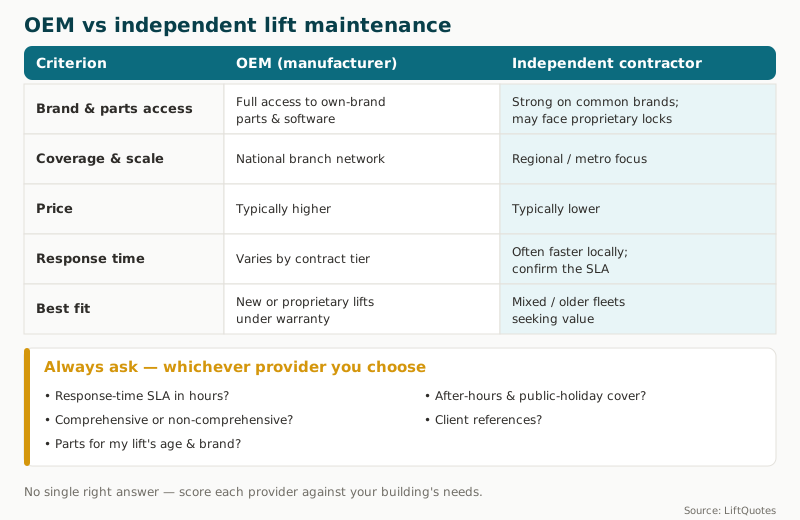
The first real decision is whether to appoint the original equipment manufacturer (OEM) — Schindler, KONE, Otis, TK Elevator — or an independent maintenance contractor.
OEMs hold full access to their own-brand parts, proprietary software, and controller diagnostics. For a lift still under warranty, or one running proprietary controls that lock out third parties, the manufacturer is often the path of least resistance. The trade-off is price and flexibility: OEM contracts typically cost more and tie you to a single supplier.
Independent contractors compete on price and local responsiveness. A good independent servicing a mixed or ageing fleet can match an OEM on quality and beat it on call-out time — provided they can source parts for your lift's brand and age. The risk is proprietary lockouts: some manufacturers restrict access to controller software, which can leave an independent unable to complete certain repairs. Confirm parts and software access before you sign.
Neither is universally better. New or proprietary lifts under warranty usually favour the OEM. Mixed or older fleets seeking value usually favour a capable independent. The lift companies compared guide breaks down where each type of provider is strongest.
The criteria that actually matter
Contract scope. Establish whether each quote is comprehensive (parts, labour, and call-outs included in one fee) or non-comprehensive (scheduled visits only, with parts and repairs billed separately). A cheap non-comprehensive quote can cost more over a year once call-outs and parts are added. Never compare a comprehensive quote against a non-comprehensive one as if they were like-for-like.
Response-time SLA. Ask for the guaranteed response time in hours, in writing — not a vague claim to be prompt or to prioritise your building. For a residential building, an entrapment response within 30 to 60 minutes and a breakdown attendance within 4 to 24 hours are reasonable benchmarks. The number matters less than whether it is contractually guaranteed and what happens if it is missed.
Spare-parts access. A provider who cannot get parts for your lift's brand and age is the single biggest hidden risk. Ask directly: can you source parts for this make and model, and what is the typical lead time? Obsolete parts extend downtime and can turn a routine lift maintenance contract into an early modernisation decision.
Coverage and after-hours cover. Confirm the provider covers your location with their own technicians, not subcontractors, and that after-hours and public-holiday call-outs are included — or priced clearly. A metro-only contractor servicing a regional site through third parties is a slower, less accountable arrangement.
References and track record. Ask for references from comparable buildings — same lift type, same age, same use. A provider already maintaining ten similar strata lifts in your area is a safer bet than one taking on your brand for the first time.
Reporting quality. Every visit should produce a written service report. Good reporting is your audit trail for WHS compliance and your early warning of recurring faults. Ask to see a sample report before you commit.
Price transparency. A transparent quote itemises scheduled servicing, call-out rates, and excluded items. Treat a quote that looks cheap with suspicion until you know whether it quietly excludes parts, emergency call-outs, or statutory inspection support.
A simple scoring approach
Do not just gather three quotes and pick the lowest. Score each provider out of 5 on the seven criteria above, then total the result. Weight the criteria that matter most for your building — for a high-traffic residential tower, response-time SLA and parts access should carry more weight than headline price.
As of Q3 2026, indicative comprehensive maintenance runs $2,500 to $6,000 per lift per year, while non-comprehensive contracts are lower in base cost but exposed to call-out and parts charges. Use the lift maintenance cost guide to sense-check whether a quote sits inside the market range before scoring it on price. A quote far below the range usually signals a narrow scope, not a bargain.
The provider with the highest total — not the lowest price — is your answer. Scoring turns a subjective call into a defensible one you can put to a committee or a building owner.
From shortlist to decision
Evaluating providers is one half of the job; running the process is the other. Once you have scored your shortlist, the procurement steps — writing the tender brief, requesting like-for-like quotes, and managing the handover of keys, log book, and service records — follow a separate playbook. For strata schemes, the strata lift maintenance guide sets out those owners-corporation duties in full.
Whatever you decide, document why. A short scoring sheet showing how each provider rated on scope, response time, parts access, and references is the record that protects you if the appointment is ever questioned. Get free quotes from maintenance providers serving your building and score them against the criteria above.
Lift companies in Australia
Browse profiles, compare service areas, and check reviews.

Lift Shop
★ 5.0 (1551 reviews)
Australia's largest dedicated home lift specialist since 1996. 10,000+ installations. Exclusive Italian-crafted lifts with industry-leading 8-year warranty.
View profile →

Compact Home Lifts
NDIS★ 5.0 (465 reviews)
Melbourne branch of Compact Home Lifts. Compact residential lift specialist providing maintenance and repair services across Victoria.
View profile →

Next Level Elevators
★ 5.0 (454 reviews)
Award-winning provider of premium Italian-designed all-electric home elevators. Certified Eltec Partner. Showrooms in Melbourne, Sydney, and Brisbane.
View profile →

Shotton Lifts
NDIS★ 5.0 (9 reviews)
Family-owned Australian lift manufacturer since 1977. 80+ staff. Design, engineer, manufacture, install and service from Dandenong South VIC. NDIS registered.
View profile →

LiftFit Australia
NDIS★ 5.0 (8 reviews)
Victoria-based NDIS registered lift provider, est. 2011. Partners with Cibes, Savaria, and Kalea. Residential, commercial, and platform lifts.
View profile →

Easy Living Home Elevators
★ 5.0 (7 reviews)
Australia's #1 home elevator supplier since 1998. 100% Australian-owned. 11,000+ elevators in service across 6 states.
View profile →
LiftQuotes is a comparison platform. Companies shown are filtered by relevance to this page. Listing does not imply endorsement. LiftQuotes may receive a referral fee when you request quotes.
Put this into action
When you're ready to move forward, get free quotes from verified Australian lift installers.
What are you looking for today?
I need a lift installed
I have a lift that needs attention
Choosing a lift maintenance provider is a procurement decision, not a coin toss. The headline price on a quote tells you almost nothing until you know what scope it covers, how fast the provider responds, and whether they can get parts for your lift.
This guide gives facility managers and owners corporations a neutral scorecard: the seven criteria that separate a good provider from a cheap one, how to weigh an OEM against an independent contractor, and a simple scoring approach that turns three quotes into a defensible decision.
How do you compare lift maintenance providers?
Compare providers on seven criteria, not on headline price: contract scope (comprehensive or non-comprehensive), response-time SLA, spare-parts access for your lift's brand and age, technician coverage and after-hours cover, references and track record, reporting quality, and price transparency. Score each provider against those criteria for your specific building, then weigh the total — the cheapest quote rarely wins once parts access and response time are priced in.
This is an evaluation framework, not a tender process. If you also need to run the procurement — writing the brief, shortlisting, and awarding — the strata lift maintenance guide sets out the owners-corporation process. This page covers how to judge one provider against another once you have their proposals in front of you.
OEM or independent: which suits your lift?
The first real decision is whether to appoint the original equipment manufacturer (OEM) — Schindler, KONE, Otis, TK Elevator — or an independent maintenance contractor.
OEMs hold full access to their own-brand parts, proprietary software, and controller diagnostics. For a lift still under warranty, or one running proprietary controls that lock out third parties, the manufacturer is often the path of least resistance. The trade-off is price and flexibility: OEM contracts typically cost more and tie you to a single supplier.
Independent contractors compete on price and local responsiveness. A good independent servicing a mixed or ageing fleet can match an OEM on quality and beat it on call-out time — provided they can source parts for your lift's brand and age. The risk is proprietary lockouts: some manufacturers restrict access to controller software, which can leave an independent unable to complete certain repairs. Confirm parts and software access before you sign.
Neither is universally better. New or proprietary lifts under warranty usually favour the OEM. Mixed or older fleets seeking value usually favour a capable independent. The lift companies compared guide breaks down where each type of provider is strongest.
The criteria that actually matter
Contract scope. Establish whether each quote is comprehensive (parts, labour, and call-outs included in one fee) or non-comprehensive (scheduled visits only, with parts and repairs billed separately). A cheap non-comprehensive quote can cost more over a year once call-outs and parts are added. Never compare a comprehensive quote against a non-comprehensive one as if they were like-for-like.
Response-time SLA. Ask for the guaranteed response time in hours, in writing — not a vague claim to be prompt or to prioritise your building. For a residential building, an entrapment response within 30 to 60 minutes and a breakdown attendance within 4 to 24 hours are reasonable benchmarks. The number matters less than whether it is contractually guaranteed and what happens if it is missed.
Spare-parts access. A provider who cannot get parts for your lift's brand and age is the single biggest hidden risk. Ask directly: can you source parts for this make and model, and what is the typical lead time? Obsolete parts extend downtime and can turn a routine lift maintenance contract into an early modernisation decision.
Coverage and after-hours cover. Confirm the provider covers your location with their own technicians, not subcontractors, and that after-hours and public-holiday call-outs are included — or priced clearly. A metro-only contractor servicing a regional site through third parties is a slower, less accountable arrangement.
References and track record. Ask for references from comparable buildings — same lift type, same age, same use. A provider already maintaining ten similar strata lifts in your area is a safer bet than one taking on your brand for the first time.
Reporting quality. Every visit should produce a written service report. Good reporting is your audit trail for WHS compliance and your early warning of recurring faults. Ask to see a sample report before you commit.
Price transparency. A transparent quote itemises scheduled servicing, call-out rates, and excluded items. Treat a quote that looks cheap with suspicion until you know whether it quietly excludes parts, emergency call-outs, or statutory inspection support.
A simple scoring approach
Do not just gather three quotes and pick the lowest. Score each provider out of 5 on the seven criteria above, then total the result. Weight the criteria that matter most for your building — for a high-traffic residential tower, response-time SLA and parts access should carry more weight than headline price.
As of Q3 2026, indicative comprehensive maintenance runs $2,500 to $6,000 per lift per year, while non-comprehensive contracts are lower in base cost but exposed to call-out and parts charges. Use the lift maintenance cost guide to sense-check whether a quote sits inside the market range before scoring it on price. A quote far below the range usually signals a narrow scope, not a bargain.
The provider with the highest total — not the lowest price — is your answer. Scoring turns a subjective call into a defensible one you can put to a committee or a building owner.
From shortlist to decision
Evaluating providers is one half of the job; running the process is the other. Once you have scored your shortlist, the procurement steps — writing the tender brief, requesting like-for-like quotes, and managing the handover of keys, log book, and service records — follow a separate playbook. For strata schemes, the strata lift maintenance guide sets out those owners-corporation duties in full.
Whatever you decide, document why. A short scoring sheet showing how each provider rated on scope, response time, parts access, and references is the record that protects you if the appointment is ever questioned. Get free quotes from maintenance providers serving your building and score them against the criteria above.
Lift companies in Australia
Browse profiles, compare service areas, and check reviews.
Lift Shop
★ 5.0 (1551 reviews)
Australia's largest dedicated home lift specialist since 1996. 10,000+ installations. Exclusive Italian-crafted lifts with industry-leading 8-year warranty.
View profile →
Compact Home Lifts
NDIS★ 5.0 (465 reviews)
Melbourne branch of Compact Home Lifts. Compact residential lift specialist providing maintenance and repair services across Victoria.
View profile →
Next Level Elevators
★ 5.0 (454 reviews)
Award-winning provider of premium Italian-designed all-electric home elevators. Certified Eltec Partner. Showrooms in Melbourne, Sydney, and Brisbane.
View profile →
Shotton Lifts
NDIS★ 5.0 (9 reviews)
Family-owned Australian lift manufacturer since 1977. 80+ staff. Design, engineer, manufacture, install and service from Dandenong South VIC. NDIS registered.
View profile →
LiftFit Australia
NDIS★ 5.0 (8 reviews)
Victoria-based NDIS registered lift provider, est. 2011. Partners with Cibes, Savaria, and Kalea. Residential, commercial, and platform lifts.
View profile →
Easy Living Home Elevators
★ 5.0 (7 reviews)
Australia's #1 home elevator supplier since 1998. 100% Australian-owned. 11,000+ elevators in service across 6 states.
View profile →
LiftQuotes is a comparison platform. Companies shown are filtered by relevance to this page. Listing does not imply endorsement. LiftQuotes may receive a referral fee when you request quotes.
Put this into action
When you're ready to move forward, get free quotes from verified Australian lift installers.
What are you looking for today?
I need a lift installed
I have a lift that needs attention
Common questions about comparing lift maintenance providers
Compare providers on seven criteria rather than headline price: contract scope (comprehensive or non-comprehensive), response-time SLA, spare-parts access for your lift's brand and age, technician coverage and after-hours cover, references from comparable buildings, reporting quality, and price transparency. Score each provider against those criteria for your specific building and appoint the highest total, not the cheapest quote.
Related guides
Guide
Our Editorial Methodology: How LiftQuotes Researches Content
How LiftQuotes researches, sources and reviews every lift guide and cost page: the standards we cite, our linked-source rule for cost data, and how often we update.
Guide
Lift Compliance Checklist for Facility Managers (Australia)
A facility manager's lift compliance checklist for Australia: plant registration, inspection, log books, 4G VoLTE emergency phones and DDA access duties.
Comparison
Stairlift vs Platform Lift: Which Access Solution Fits?
A stairlift carries a seated user along the stairs from about $3,000; a platform lift raises a wheelchair vertically from about $15,000. Compare cost, access and fit.
Location
Lift Companies in Melbourne: Compare Local Installers
Compare lift companies in Melbourne for home, platform and commercial lifts. WorkSafe Victoria compliance, local installer coverage and indicative VIC costs.
Ready to compare lift maintenance providers?
Get free, no-obligation quotes from vetted Australian lift maintenance companies and score them against the criteria that matter.
Join 1,000+ Australians who've requested quotes through LiftQuotes
Get free quotes