Platform Lift vs Stair Lift: Which Is Right for You?
Both help people move between floors at home — but they serve different users, have different costs, and carry different structural requirements. Here is how to choose.
Platform lifts and stair lifts are both common home modification solutions in Australia, but they solve the problem in fundamentally different ways — and they suit different users.
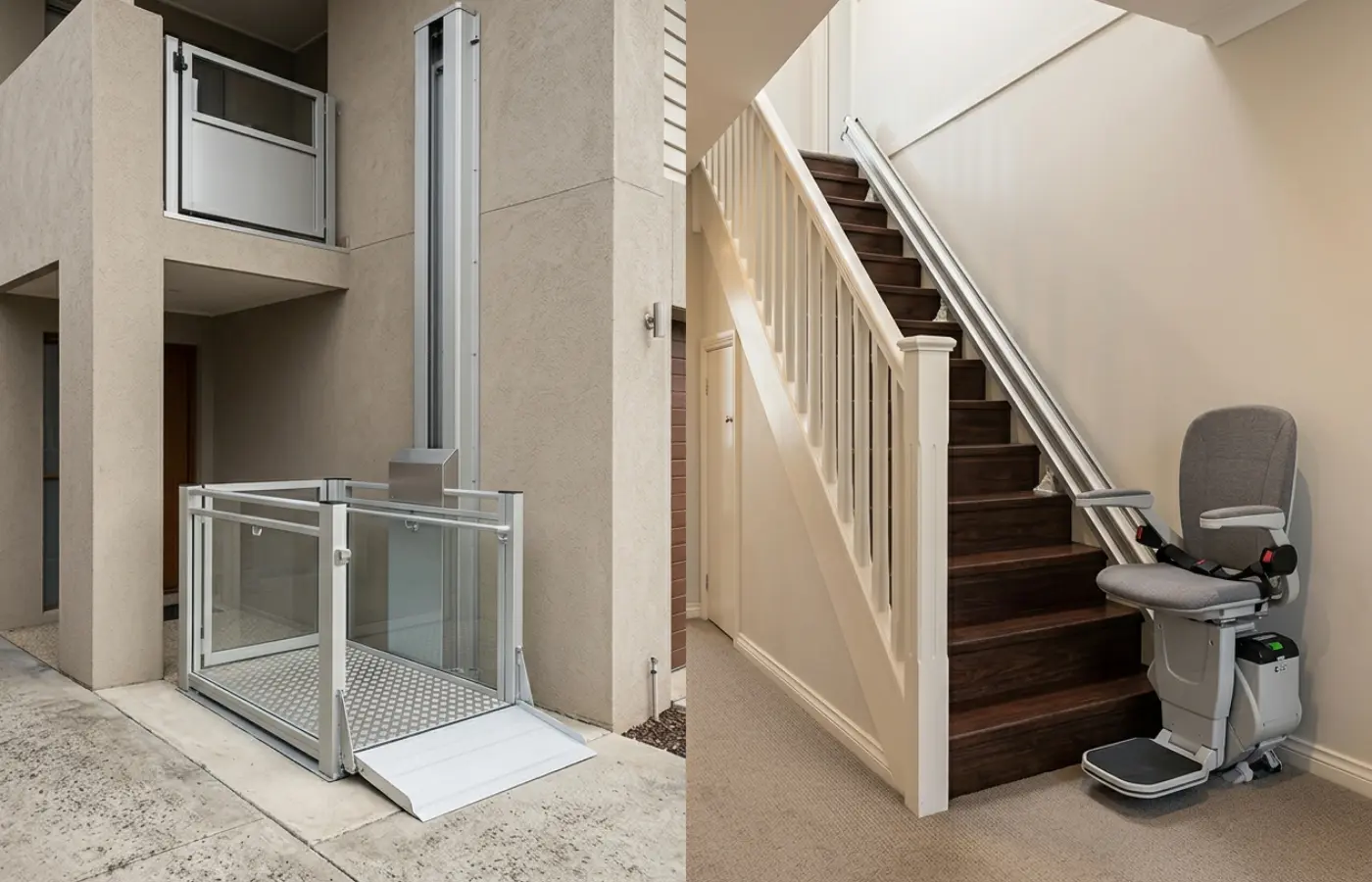
A stair lift attaches a rail to the existing staircase and carries a seated user up and down. It requires minimal structural work, costs significantly less than a platform lift, and can be installed in most homes. The critical limitation: a stair lift cannot accommodate a wheelchair. The user must be able to transfer to a seated position unaided.
A platform lift is a vertical lift that carries a platform — large enough for a wheelchair and a carer — between floor levels. It meets the access requirements in AS 1735.14, qualifies for NDIS and aged care home modification funding, and provides genuine, consistent access for wheelchair users. The trade-off is cost and space: a platform lift requires a floor opening or dedicated space and costs $22,000–$50,000 installed.
For more information on platform lifts as a category, see our platform lifts overview.
The table below compares platform lifts and stair lifts across six factors that determine which product is appropriate for a given home and user. These are decision factors — use them to identify the right category before getting quotes.
Swipe to compare →
| Factor | Platform lift | Stair lift |
|---|---|---|
| Wheelchair access | Yes — designed for wheelchair users and carers | No — requires the user to transfer to a seated position |
| Structural impact | Moderate — requires a floor opening or dedicated space; some structural work typical | Low — rail mounted to existing staircase; minimal modification to the home |
| Typical installed cost (AUD, ex GST) | $22,000–$50,000 | $4,000–$15,000 (straight stair); $8,000–$25,000+ (curved stair) |
| Maximum rise | Typically 2–3 floors vertical travel | Entire length of staircase — any rise |
| NDIS / aged care funding eligibility | Often eligible as an AT or home modification under NDIS and aged care programs | May be eligible for ambulatory users; confirm with your OT or plan manager |
| Relevant standard | AS 1735.14 (lift platforms for persons with disabilities) | Not covered by AS 1735 series — refer to NCC and supplier compliance documentation |
Cost ranges are indicative ex-GST and vary by brand, configuration, and staircase type. An occupational therapist assessment is typically required before a home modification can be funded. Always confirm eligibility with your plan manager or aged care provider before proceeding.
Lift companies in Australia
Browse profiles, compare service areas, and check reviews.

Lift Shop
★ 5.0 (1551 reviews)
Australia's largest dedicated home lift specialist since 1996. 10,000+ installations. Exclusive Italian-crafted lifts with industry-leading 8-year warranty.
View profile →

Compact Home Lifts
NDIS★ 5.0 (465 reviews)
Melbourne branch of Compact Home Lifts. Compact residential lift specialist providing maintenance and repair services across Victoria.
View profile →

Next Level Elevators
★ 5.0 (454 reviews)
Award-winning provider of premium Italian-designed all-electric home elevators. Certified Eltec Partner. Showrooms in Melbourne, Sydney, and Brisbane.
View profile →

Shotton Lifts
NDIS★ 5.0 (9 reviews)
Family-owned Australian lift manufacturer since 1977. 80+ staff. Design, engineer, manufacture, install and service from Dandenong South VIC. NDIS registered.
View profile →

LiftFit Australia
NDIS★ 5.0 (8 reviews)
Victoria-based NDIS registered lift provider, est. 2011. Partners with Cibes, Savaria, and Kalea. Residential, commercial, and platform lifts.
View profile →

Easy Living Home Elevators
★ 5.0 (7 reviews)
Australia's #1 home elevator supplier since 1998. 100% Australian-owned. 11,000+ elevators in service across 6 states.
View profile →
LiftQuotes is a comparison platform. Companies shown are filtered by relevance to this page. Listing does not imply endorsement. LiftQuotes may receive a referral fee when you request quotes.
Choose a platform lift if
- You or a family member uses a wheelchair and needs full, independent access between floors
- The access solution must also accommodate carers with equipment
- You are planning a long-term home modification that may qualify for NDIS or aged care funding
- The product must meet AS 1735.14 — which some funding programs require
- You want a solution that serves any future user of the home, including guests who use a wheelchair
For platform lift options and cost guidance, see our platform lifts overview and platform lift cost guide.
Choose a stair lift if
- The primary user is ambulatory or can transfer to a seated position unaided
- Budget is a priority — a stair lift costs significantly less than a platform lift
- You want minimal structural impact on the home
- The staircase is straight (curved staircase models are more expensive but available)
- The solution is medium-term — stair lifts can be removed or sold when no longer needed
Our recommendation
For wheelchair users or anyone planning a long-term home modification, a platform lift is the appropriate solution. It provides genuine access that is consistent regardless of the user's mobility, and it meets the compliance requirements that most NDIS and aged care funding programs reference.
For ambulatory users who need assistance on stairs and are not using a wheelchair, a stair lift is practical and significantly more cost-effective.
If you are unsure which category applies, consult an occupational therapist before purchasing. An OT assessment is required for most funded home modifications in any case — and the OT recommendation will carry weight with your plan manager or aged care provider. When you are ready to compare quotes, submit a brief through LiftQuotes.
Still deciding? Get quotes for both options
Installers will assess your site and recommend the right specification.
What are you looking for today?
I need a lift installed
I have a lift that needs attention
Platform lifts and stair lifts are both common home modification solutions in Australia, but they solve the problem in fundamentally different ways — and they suit different users.
A stair lift attaches a rail to the existing staircase and carries a seated user up and down. It requires minimal structural work, costs significantly less than a platform lift, and can be installed in most homes. The critical limitation: a stair lift cannot accommodate a wheelchair. The user must be able to transfer to a seated position unaided.
A platform lift is a vertical lift that carries a platform — large enough for a wheelchair and a carer — between floor levels. It meets the access requirements in AS 1735.14, qualifies for NDIS and aged care home modification funding, and provides genuine, consistent access for wheelchair users. The trade-off is cost and space: a platform lift requires a floor opening or dedicated space and costs $22,000–$50,000 installed.
For more information on platform lifts as a category, see our platform lifts overview.
The table below compares platform lifts and stair lifts across six factors that determine which product is appropriate for a given home and user. These are decision factors — use them to identify the right category before getting quotes.
Swipe to compare →
| Factor | Platform lift | Stair lift |
|---|---|---|
| Wheelchair access | Yes — designed for wheelchair users and carers | No — requires the user to transfer to a seated position |
| Structural impact | Moderate — requires a floor opening or dedicated space; some structural work typical | Low — rail mounted to existing staircase; minimal modification to the home |
| Typical installed cost (AUD, ex GST) | $22,000–$50,000 | $4,000–$15,000 (straight stair); $8,000–$25,000+ (curved stair) |
| Maximum rise | Typically 2–3 floors vertical travel | Entire length of staircase — any rise |
| NDIS / aged care funding eligibility | Often eligible as an AT or home modification under NDIS and aged care programs | May be eligible for ambulatory users; confirm with your OT or plan manager |
| Relevant standard | AS 1735.14 (lift platforms for persons with disabilities) | Not covered by AS 1735 series — refer to NCC and supplier compliance documentation |
Cost ranges are indicative ex-GST and vary by brand, configuration, and staircase type. An occupational therapist assessment is typically required before a home modification can be funded. Always confirm eligibility with your plan manager or aged care provider before proceeding.
Lift companies in Australia
Browse profiles, compare service areas, and check reviews.
Lift Shop
★ 5.0 (1551 reviews)
Australia's largest dedicated home lift specialist since 1996. 10,000+ installations. Exclusive Italian-crafted lifts with industry-leading 8-year warranty.
View profile →
Compact Home Lifts
NDIS★ 5.0 (465 reviews)
Melbourne branch of Compact Home Lifts. Compact residential lift specialist providing maintenance and repair services across Victoria.
View profile →
Next Level Elevators
★ 5.0 (454 reviews)
Award-winning provider of premium Italian-designed all-electric home elevators. Certified Eltec Partner. Showrooms in Melbourne, Sydney, and Brisbane.
View profile →
Shotton Lifts
NDIS★ 5.0 (9 reviews)
Family-owned Australian lift manufacturer since 1977. 80+ staff. Design, engineer, manufacture, install and service from Dandenong South VIC. NDIS registered.
View profile →
LiftFit Australia
NDIS★ 5.0 (8 reviews)
Victoria-based NDIS registered lift provider, est. 2011. Partners with Cibes, Savaria, and Kalea. Residential, commercial, and platform lifts.
View profile →
Easy Living Home Elevators
★ 5.0 (7 reviews)
Australia's #1 home elevator supplier since 1998. 100% Australian-owned. 11,000+ elevators in service across 6 states.
View profile →
LiftQuotes is a comparison platform. Companies shown are filtered by relevance to this page. Listing does not imply endorsement. LiftQuotes may receive a referral fee when you request quotes.
Choose a platform lift if
- You or a family member uses a wheelchair and needs full, independent access between floors
- The access solution must also accommodate carers with equipment
- You are planning a long-term home modification that may qualify for NDIS or aged care funding
- The product must meet AS 1735.14 — which some funding programs require
- You want a solution that serves any future user of the home, including guests who use a wheelchair
For platform lift options and cost guidance, see our platform lifts overview and platform lift cost guide.
Choose a stair lift if
- The primary user is ambulatory or can transfer to a seated position unaided
- Budget is a priority — a stair lift costs significantly less than a platform lift
- You want minimal structural impact on the home
- The staircase is straight (curved staircase models are more expensive but available)
- The solution is medium-term — stair lifts can be removed or sold when no longer needed
Our recommendation
For wheelchair users or anyone planning a long-term home modification, a platform lift is the appropriate solution. It provides genuine access that is consistent regardless of the user's mobility, and it meets the compliance requirements that most NDIS and aged care funding programs reference.
For ambulatory users who need assistance on stairs and are not using a wheelchair, a stair lift is practical and significantly more cost-effective.
If you are unsure which category applies, consult an occupational therapist before purchasing. An OT assessment is required for most funded home modifications in any case — and the OT recommendation will carry weight with your plan manager or aged care provider. When you are ready to compare quotes, submit a brief through LiftQuotes.
Still deciding? Get quotes for both options
Installers will assess your site and recommend the right specification.
What are you looking for today?
I need a lift installed
I have a lift that needs attention
Related guides
Guide
Our Editorial Methodology: How LiftQuotes Researches Content
How LiftQuotes researches, sources and reviews every lift guide and cost page: the standards we cite, our linked-source rule for cost data, and how often we update.
Guide
Lift Compliance Checklist for Facility Managers (Australia)
A facility manager's lift compliance checklist for Australia: plant registration, inspection, log books, 4G VoLTE emergency phones and DDA access duties.
Comparison
Stairlift vs Platform Lift: Which Access Solution Fits?
A stairlift carries a seated user along the stairs from about $3,000; a platform lift raises a wheelchair vertically from about $15,000. Compare cost, access and fit.
Location
Lift Companies in Melbourne: Compare Local Installers
Compare lift companies in Melbourne for home, platform and commercial lifts. WorkSafe Victoria compliance, local installer coverage and indicative VIC costs.
Get quotes for platform lifts
Tell us about your home and access needs. Lift suppliers will assess your site and send competing quotes. Free, no obligation.
Join 1,000+ Australians who've requested quotes through LiftQuotes
Get free quotes