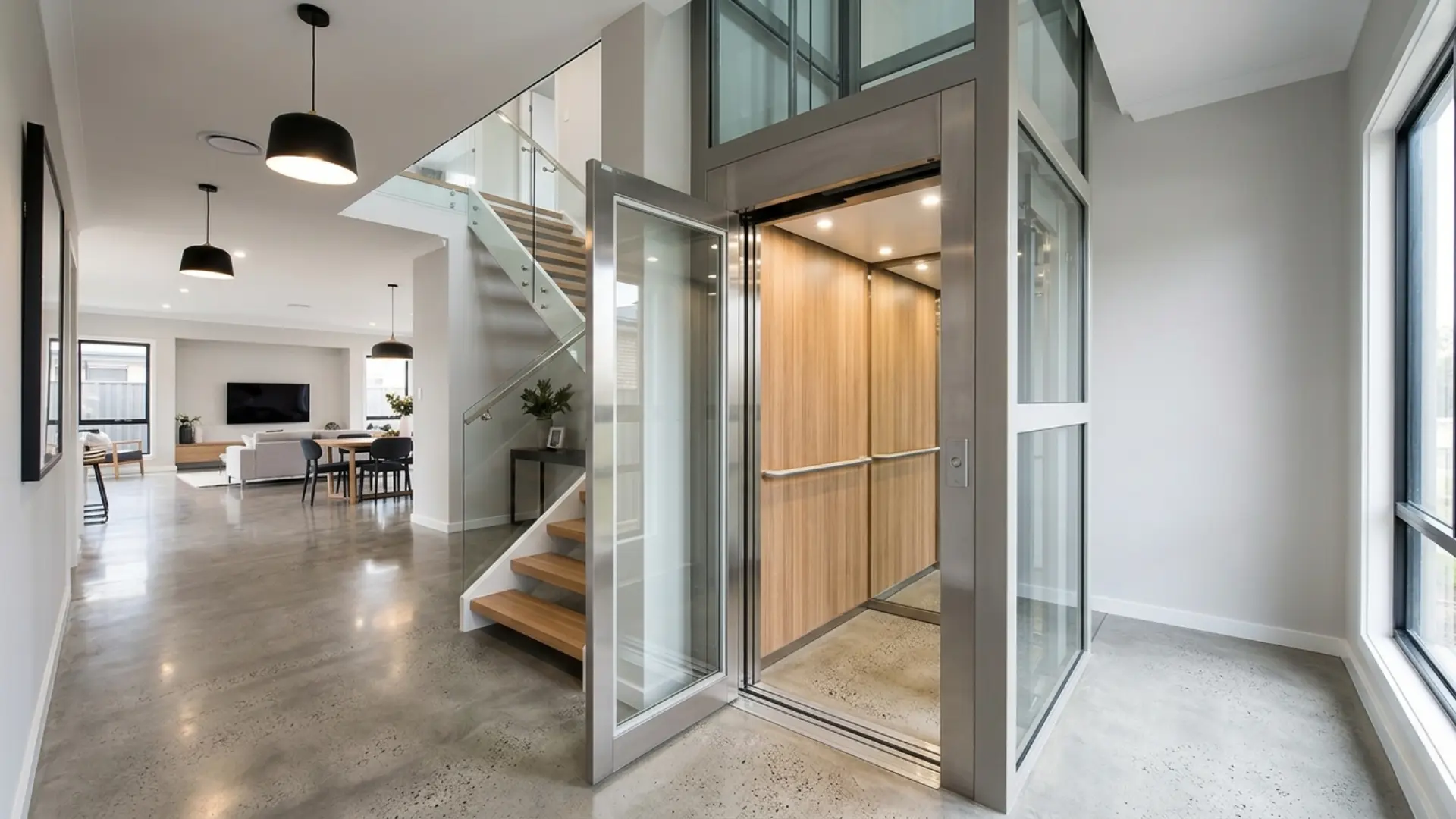
How Much Space Does a Home Lift Need?
Most home lifts require a shaft footprint of 1.2–1.8 m², a pit of 100–300 mm, and overhead clearance of 2.5–3.5 m. The exact figures depend on the drive system and the model.
Space is one of the most common practical barriers to installing a home lift. Most residential properties have enough room for at least one drive type — but the amount of space required varies significantly between cable traction, hydraulic, and pneumatic systems.
The three dimensions that matter are: shaft footprint (floor area occupied by the lift structure), pit depth (how far below the lowest landing floor the structure extends), and overhead clearance (the space above the top landing needed for the lift mechanism).
This guide gives indicative figures for each drive type and explains what can be done when space is genuinely constrained. For product and cost context, see our home lifts overview and home lift cost guide.
Space requirements by drive type
Cable traction lifts
- Shaft footprint: 1.2–1.6 m² (internal hoistway dimensions — the cab itself is smaller)
- Pit depth: 150–300 mm below the lowest landing floor
- Overhead clearance: 3.0–3.5 m above the top landing floor
- Machine room: Traditional traction systems require an overhead or adjacent machine room of approximately 2–4 m². MRL (machine-room-less) configurations eliminate this requirement.
Cable traction lifts suit homes with adequate ceiling height above the top landing. The shaft is typically constructed from timber framing or lightweight steel.
Hydraulic lifts
- Shaft footprint: 1.2–1.8 m²
- Pit depth: 100–150 mm (shallower than traction, which suits homes on slabs)
- Overhead clearance: 2.5–3.0 m above the top landing floor
- Machine room: A pump room of approximately 0.5–1.0 m² is required, typically adjacent to the shaft at the lowest landing level
Hydraulic lifts are well-suited to slab-on-ground homes where digging a deeper pit is impractical. The shallower pit is a significant advantage for ground-floor installations.
Pneumatic (vacuum) lifts
- Shaft footprint: 1.0–1.5 m² (the tube is self-supporting — no constructed shaft required)
- Pit depth: None — pneumatic lifts do not require a pit
- Overhead clearance: 2.4–2.8 m above the top landing floor
- Machine room: None required
Pneumatic lifts have the smallest space footprint of the three types and no pit requirement, making them the most practical option for retrofitting into existing homes with limited space. The cab diameter is smaller — typically 900–1050 mm — which may not be wide enough for a wheelchair.
What to measure before getting quotes
Before a supplier visits, measure the following:
- Floor-to-floor height — the vertical distance between each floor level the lift will serve
- Ceiling height at the top landing — the clearance available above the highest floor the lift reaches
- Available footprint — the floor area at each level where the lift could be positioned
- Sub-floor depth — if you are on a suspended floor, the space below the lowest landing that a pit could occupy
Bring these figures to your first supplier conversation. A site visit will confirm feasibility — no supplier should commit to a product recommendation without visiting the property.
For more on home lift types and what they cost, see our home lifts overview and home lift cost guide. Ready to compare suppliers? Get quotes through LiftQuotes.
Lift companies in Australia
Browse profiles, compare service areas, and check reviews.

Lift Shop
★ 5.0 (1551 reviews)
Australia's largest dedicated home lift specialist since 1996. 10,000+ installations. Exclusive Italian-crafted lifts with industry-leading 8-year warranty.
View profile →

Compact Home Lifts
NDIS★ 5.0 (465 reviews)
Melbourne branch of Compact Home Lifts. Compact residential lift specialist providing maintenance and repair services across Victoria.
View profile →

Next Level Elevators
★ 5.0 (454 reviews)
Award-winning provider of premium Italian-designed all-electric home elevators. Certified Eltec Partner. Showrooms in Melbourne, Sydney, and Brisbane.
View profile →

Shotton Lifts
NDIS★ 5.0 (9 reviews)
Family-owned Australian lift manufacturer since 1977. 80+ staff. Design, engineer, manufacture, install and service from Dandenong South VIC. NDIS registered.
View profile →

LiftFit Australia
NDIS★ 5.0 (8 reviews)
Victoria-based NDIS registered lift provider, est. 2011. Partners with Cibes, Savaria, and Kalea. Residential, commercial, and platform lifts.
View profile →

Easy Living Home Elevators
★ 5.0 (7 reviews)
Australia's #1 home elevator supplier since 1998. 100% Australian-owned. 11,000+ elevators in service across 6 states.
View profile →
LiftQuotes is a comparison platform. Companies shown are filtered by relevance to this page. Listing does not imply endorsement. LiftQuotes may receive a referral fee when you request quotes.
Put this into action
When you're ready to move forward, get free quotes from verified Australian lift installers.
What are you looking for today?
I need a lift installed
I have a lift that needs attention
Space requirements by drive type
Cable traction lifts
- Shaft footprint: 1.2–1.6 m² (internal hoistway dimensions — the cab itself is smaller)
- Pit depth: 150–300 mm below the lowest landing floor
- Overhead clearance: 3.0–3.5 m above the top landing floor
- Machine room: Traditional traction systems require an overhead or adjacent machine room of approximately 2–4 m². MRL (machine-room-less) configurations eliminate this requirement.
Cable traction lifts suit homes with adequate ceiling height above the top landing. The shaft is typically constructed from timber framing or lightweight steel.
Hydraulic lifts
- Shaft footprint: 1.2–1.8 m²
- Pit depth: 100–150 mm (shallower than traction, which suits homes on slabs)
- Overhead clearance: 2.5–3.0 m above the top landing floor
- Machine room: A pump room of approximately 0.5–1.0 m² is required, typically adjacent to the shaft at the lowest landing level
Hydraulic lifts are well-suited to slab-on-ground homes where digging a deeper pit is impractical. The shallower pit is a significant advantage for ground-floor installations.
Pneumatic (vacuum) lifts
- Shaft footprint: 1.0–1.5 m² (the tube is self-supporting — no constructed shaft required)
- Pit depth: None — pneumatic lifts do not require a pit
- Overhead clearance: 2.4–2.8 m above the top landing floor
- Machine room: None required
Pneumatic lifts have the smallest space footprint of the three types and no pit requirement, making them the most practical option for retrofitting into existing homes with limited space. The cab diameter is smaller — typically 900–1050 mm — which may not be wide enough for a wheelchair.
What to measure before getting quotes
Before a supplier visits, measure the following:
- Floor-to-floor height — the vertical distance between each floor level the lift will serve
- Ceiling height at the top landing — the clearance available above the highest floor the lift reaches
- Available footprint — the floor area at each level where the lift could be positioned
- Sub-floor depth — if you are on a suspended floor, the space below the lowest landing that a pit could occupy
Bring these figures to your first supplier conversation. A site visit will confirm feasibility — no supplier should commit to a product recommendation without visiting the property.
For more on home lift types and what they cost, see our home lifts overview and home lift cost guide. Ready to compare suppliers? Get quotes through LiftQuotes.
Lift companies in Australia
Browse profiles, compare service areas, and check reviews.
Lift Shop
★ 5.0 (1551 reviews)
Australia's largest dedicated home lift specialist since 1996. 10,000+ installations. Exclusive Italian-crafted lifts with industry-leading 8-year warranty.
View profile →
Compact Home Lifts
NDIS★ 5.0 (465 reviews)
Melbourne branch of Compact Home Lifts. Compact residential lift specialist providing maintenance and repair services across Victoria.
View profile →
Next Level Elevators
★ 5.0 (454 reviews)
Award-winning provider of premium Italian-designed all-electric home elevators. Certified Eltec Partner. Showrooms in Melbourne, Sydney, and Brisbane.
View profile →
Shotton Lifts
NDIS★ 5.0 (9 reviews)
Family-owned Australian lift manufacturer since 1977. 80+ staff. Design, engineer, manufacture, install and service from Dandenong South VIC. NDIS registered.
View profile →
LiftFit Australia
NDIS★ 5.0 (8 reviews)
Victoria-based NDIS registered lift provider, est. 2011. Partners with Cibes, Savaria, and Kalea. Residential, commercial, and platform lifts.
View profile →
Easy Living Home Elevators
★ 5.0 (7 reviews)
Australia's #1 home elevator supplier since 1998. 100% Australian-owned. 11,000+ elevators in service across 6 states.
View profile →
LiftQuotes is a comparison platform. Companies shown are filtered by relevance to this page. Listing does not imply endorsement. LiftQuotes may receive a referral fee when you request quotes.
Put this into action
When you're ready to move forward, get free quotes from verified Australian lift installers.
What are you looking for today?
I need a lift installed
I have a lift that needs attention
Related guides
Location
Commercial Lifts Melbourne: Costs, Compliance & Installers
Commercial lift costs, Victorian OHS compliance and the Melbourne installer market — indicative prices, WorkSafe Victoria rules and NCC requirements for VIC projects.
Location
Commercial Lifts Sydney: Costs, Compliance & Installers
Commercial lift costs, NSW compliance and the Sydney installer market — indicative prices, SafeWork NSW rules and NCC requirements for CBD and metro projects.
Guide
What Size Lift Do I Need for a Wheelchair? (Australia)
A home lift for a wheelchair needs roughly 1,100 x 1,400 mm inside and a 900 mm clear door. See minimum sizes for a wheelchair, a carer, and turning space.
Guide
Support at Home & Lift Funding: The 2026 Guide
Can Support at Home fund a home lift or stairlift? How aged care funding works, the OT assessment, means-tested contributions, and how it differs from the NDIS.
Get a site assessment and quotes
Lift suppliers will visit your home, measure the available space, and recommend the right product. Free, no obligation.
Join 1,000+ Australians who've requested quotes through LiftQuotes
Get free quotes